


 |
市场调查报告书
商品编码
1907274
北美智慧製造市场:市场占有率分析、产业趋势与统计、成长预测(2026-2031)North America Smart Manufacturing - Market Share Analysis, Industry Trends & Statistics, Growth Forecasts (2026 - 2031) |
||||||

※ 本网页内容可能与最新版本有所差异。详细情况请与我们联繫。
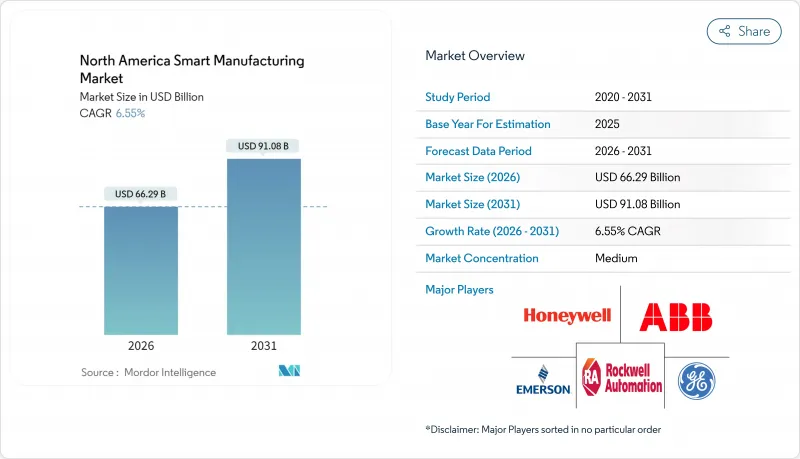
2025年北美智慧製造市场价值为622.1亿美元,预计从2026年的662.9亿美元成长到2031年的910.8亿美元,在预测期(2026-2031年)内复合年增长率为6.55%。
这一成长势头得益于创纪录的联邦奖励、强劲的私营部门资本形成,以及人工智慧 (AI)、5G 和网实整合系统 (CPS) 在离散製造和流程製造业的紧密整合。超过 93% 的製造商计划在 2024 年启动新的 AI倡议,这表明预测性、自最佳化生产环境正从试点阶段迈向大规模部署。半导体产业的復苏、汽车电气化强制令以及不断扩大的电池供应链都在支撑市场需求,而製药和生命科学企业也在加速设备升级,以满足严格的合规要求。北美智慧製造市场也受到劳动力市场动态变化的影响,熟练工人的流动和网路保险成本的飙升限制了中小企业采用智慧製造技术的步伐。
北美智慧製造市场趋势与洞察
美国离散製造业中人工智慧驱动的边缘分析应用激增
人工智慧演算法现已嵌入机器层面,实现预测性维护,将非计划停机时间减少高达 60%,并将设备寿命延长 20%。清洁能源与智慧製造创新研究院正透过其人才培养计画扩大这些工具的使用范围,协助弥合资料科学技能缺口。製造商发现,对于汽车和航太等对延迟高度敏感的应用而言,现场资料处理至关重要,因为毫秒级的反应速度直接影响产品品质。
加拿大工厂快速采用5G工业IoT网络
专用5G网路消除了传统连接瓶颈。美国一家钢铁厂在实施5G区域网路解决方案后,营运中断减少了70倍,每年节省了200万美元。製造业已占全球已公布的专用5G部署的46%。加拿大无线通讯协会预测,到2025年,5G可望减少加拿大国内1,220万吨二氧化碳排放。
营运技术(OT)和网路安全保险保费的持续上涨阻碍了数位转型。
到2024年,65%的製造商将成为勒索软体的受害者,拥有连网资产的公司的保险费上涨了30%以上。许多工厂仍缺乏持续的OT监控,加剧了感知风险与实际风险状况之间的差距。
细分市场分析
到2025年,可程式逻辑控制器(PLC)的收入份额将达到21.60%,为数千家工厂的控制系统提供动力。同时,随着製造商优先考虑安全的人机协作,北美协作机器人市场规模预计将以8.46%的复合年增长率成长。 OTTO Motors的自主移动机器人等案例研究表明,其投资回收期仅为11个月,在未发生任何安全事故的情况下,工作单元面积减少了15%。
混合边缘到云端架构正在整合PLC和AI推理引擎。罗克韦尔自动化和英伟达正在共同开发一种参考设计,使操作人员能够将生成式AI应用于品质检测流程。机器视觉结合了神经网路以确保零缺陷,而产品生命週期管理工具中的数位双胞胎技术则有助于在实际执行之前对流程调整进行虚拟测试。
到2025年,控制硬体支出将占总支出的54.30%,而软体和服务支出将在2031年之前以9.86%的复合年增长率超过控制硬体。製造商正积极采用订阅模式,将分析、网路安全和持续优化等服务捆绑在一起,以加快价值实现。通讯基础设施,特别是专用5G和时间敏感型以太网,将支援此转型,并促进工业IoT的可扩展性。
先进的视觉感测器代表了这一转变。康耐视的 In-Sight L38 3D 系统将人工智慧与双模成像相结合,透过最大限度地减少训练资料需求来加速技术应用。从SCARA机器人到自主移动机器人,各种机器人组件套件提供了更大的柔软性,而 MES 4.0 框架整合了 IT 和 OT 资料湖,在汽车试点项目中,库存减少了 30%,人均收入提高了 75%。
北美智慧製造市场份额报告按技术(PLC、SCADA等)、组件(控制设备、通讯基础设施等)、终端用户产业(汽车、石油天然气等)、部署模式(本地部署、云端部署等)和国家(美国、加拿大)进行细分。市场规模和预测均以美元计价。
其他福利:
- Excel格式的市场预测(ME)表
- 3个月的分析师支持
目录
第一章 引言
- 研究假设和市场定义
- 调查范围
第二章调查方法
第三章执行摘要
第四章 市场情势
- 价值/供应链分析
- 监理与科技趋势(北美)
- 投资分析(资本流动、併购、创业融资)
- 宏观经济事件(新冠疫情、贸易政策、劳动力短缺)的影响
- 市场驱动因素
- 美国离散製造业中人工智慧驱动的边缘分析应用激增
- 加拿大工厂快速采用5G工业IoT网络
- 回流激励措施(CHIPS 和科学法案、IRA)推动了数位化优先工厂的发展。
- 永续性的迫切需求推动了现有设施的智慧型能源管理维修。
- 在汽车丛集中引入网实整合系统以实现零缺陷生产
- 中小製造商对模组化、低程式码MES的需求日益增长,订单。
- 市场限制
- 营运技术保险和网路安全保险保费持续上涨限制了数位转型
- 传统PLC安装基础中存在的多厂商互通性差距
- 二级汽车零件製造商因通膨因素延后资本支出
- 北美熟练工人的离职率超过了技能提升工人的供应量。
- 波特五力分析
- 供应商的议价能力
- 买方的议价能力
- 新进入者的威胁
- 替代品的威胁
- 竞争强度
第五章 市场规模与成长预测
- 透过技术
- 监控与数据采集(SCADA)
- 分散式控制系统(DCS)
- 人机介面(HMI)
- 製造执行系统(MES)
- 产品生命週期管理(PLM)
- 企业资源规划(ERP)
- 机器人技术与协作机器人
- 机器视觉和品质检测
- 边缘和云端分析平台
- 按组件
- 控制设备(PLC、DCS、PAC)
- 通讯基础设施(5G、工业乙太网)
- 感测器和致动器
- 机器视觉系统
- 机器人(关节型机器人、SCARA机器人、自主移动机器人)
- 软体和服务(MES、数位双胞胎、SaaS)
- 按最终用户行业划分
- 车
- 航太/国防
- 石油和天然气(上游、中游、下游)
- 化工/石油化工
- 製药和生命科学
- 食品/饮料
- 金属和采矿
- 电子和半导体
- 纸浆和造纸
- 其他(纤维、塑胶)
- 透过部署模式
- 本地部署
- 云(SaaS)
- 杂交种
- 按国家/地区
- 美国
- 加拿大
- 墨西哥
第六章 竞争情势
- 策略性倡议(合作关係、生产回流、与环境、社会及公司治理相关的融资)
- 市占率分析
- 公司简介
- ABB Ltd.
- Emerson Electric Co.
- FANUC Corp.
- General Electric Co.
- Honeywell International Inc.
- Mitsubishi Electric Corp.
- Robert Bosch GmbH(Bosch Rexroth)
- Rockwell Automation Inc.
- Schneider Electric SE
- Siemens AG
- Texas Instruments Inc.
- Yokogawa Electric Corp.
- Omron Corp.
- PTC Inc.
- IBM Corp.
- Cisco Systems Inc.
- SAP SE
- Dassault Systemes SE
- Cognex Corp.
- Keyence Corp.
- Stratasys Ltd.
第七章 市场机会与未来展望
The North America smart manufacturing market was valued at USD 62.21 billion in 2025 and estimated to grow from USD 66.29 billion in 2026 to reach USD 91.08 billion by 2031, at a CAGR of 6.55% during the forecast period (2026-2031).
Momentum stems from record federal incentives, strong private-sector capital formation and the tight coupling of artificial intelligence, 5G and cyber-physical systems across discrete and process industries. More than 93% of manufacturers launched new AI initiatives in 2024, a signal that predictive, self-optimizing production environments are moving from pilots to scaled rollouts. Semiconductor reshoring, automotive electrification mandates and battery supply-chain buildouts anchor demand, while pharmaceutical and life-sciences facilities accelerate upgrades to meet stringent compliance requirements. The North America smart manufacturing market is also shaped by shifting workforce dynamics, with skilled-trades attrition and cyber-insurance cost spikes tempering adoption velocity among small and mid-sized enterprises.
North America Smart Manufacturing Market Trends and Insights
Surging Adoption of AI-Enabled Edge Analytics in U.S. Discrete Manufacturing
AI algorithms are now embedded at the machine layer, enabling predictive maintenance that cuts unplanned downtime by up to 60% and extends asset lifespans by 20%. The Clean Energy Smart Manufacturing Innovation Institute broadens access to these tools through workforce programs, helping close data-science skill gaps. Manufacturers view on-site data processing as essential for latency-sensitive applications in automotive and aerospace where millisecond-level responses govern quality.
Rapid Proliferation of 5G-Powered Industrial IoT Networks across Canadian Plants
Private 5G networks eliminate historical connectivity bottlenecks; one U.S. steel facility recorded a 70-fold reduction in operational disruptions and annual savings of USD 2 million after adopting a 5G LAN solution. Manufacturing already accounts for 46% of announced private 5G deployments worldwide. The Canadian Wireless Telecommunications Association forecasts that 5G could cut national emissions by 12.2 MtCO2e by 2025.
Persistent OT Cyber-Insurance Premium Hikes Limiting Digital Conversions
Ransomware incidents affected 65% of manufacturers in 2024, pushing premiums up more than 30% for firms introducing connected assets. Many plants still lack continuous OT monitoring, widening the gap between perceived and actual risk profiles.
Other drivers and restraints analyzed in the detailed report include:
- Reshoring Incentives Fueling Digital-First Factories
- Sustainability Mandates Driving Smart Energy-Management Retrofits
- North American Skilled-Trades Attrition Outpacing Upskilling Pipelines
For complete list of drivers and restraints, kindly check the Table Of Contents.
Segment Analysis
Programmable Logic Controllers held 21.60% revenue in 2025, anchoring the control layer across thousands of plants. The North America smart manufacturing market size for collaborative robotics, however, is projected to rise at an 8.46% CAGR as manufacturers prioritize safe human-robot collaboration. Deployments such as OTTO Motors' Autonomous Mobile Robots deliver 11-month paybacks and shrink work-cell footprints 15% without safety incidents.
Hybrid edge-to-cloud architectures increasingly unite PLCs with AI inference engines. Rockwell Automation and NVIDIA are co-developing reference designs that let operators apply generative AI for quality inspection flows. Machine vision now embeds neural networks for zero-defect assurance, while digital twins inside Product Lifecycle Management tools help test process tweaks virtually before physical execution.
Control hardware accounted for 54.30% of 2025 spending, yet software and services are forecast to outpace at a 9.86% CAGR through 2031. Manufacturers increasingly embrace subscription models that bundle analytics, cybersecurity and continuous optimization, reducing time-to-value. Communication infrastructure-especially private 5G and Time-Sensitive Networking Ethernet-underpins this pivot and supports Industrial IoT scalability.
Advanced vision sensors spotlight the transition. Cognex's In-Sight L38 3D system combines AI with dual-mode imaging to accelerate deployment by minimizing training data requirements. Robotics component kits, spanning SCARA to Autonomous Mobile Robots, further elevate flexibility, while MES 4.0 frameworks integrate IT and OT data lakes to slash inventory 30% and lift revenue per employee 75% in automotive trials.
North America Smart Manufacturing Market Share Report is Segmented by Technology (PLC, SCADA and More), Component (Control Devices, Communication Infrastructure, and More), End-User Industry (Automotive, Oil and Gas and More), Deployment Mode (On-Premise, Cloud and More), and Country (United States, Canada). The Market Size and Forecasts are Provided in Terms of Value (USD).
List of Companies Covered in this Report:
- ABB Ltd.
- Emerson Electric Co.
- FANUC Corp.
- General Electric Co.
- Honeywell International Inc.
- Mitsubishi Electric Corp.
- Robert Bosch GmbH (Bosch Rexroth)
- Rockwell Automation Inc.
- Schneider Electric SE
- Siemens AG
- Texas Instruments Inc.
- Yokogawa Electric Corp.
- Omron Corp.
- PTC Inc.
- IBM Corp.
- Cisco Systems Inc.
- SAP SE
- Dassault Systemes SE
- Cognex Corp.
- Keyence Corp.
- Stratasys Ltd.
Additional Benefits:
- The market estimate (ME) sheet in Excel format
- 3 months of analyst support
TABLE OF CONTENTS
1 INTRODUCTION
- 1.1 Study Assumptions and Market Definition
- 1.2 Scope of the Study
2 RESEARCH METHODOLOGY
3 EXECUTIVE SUMMARY
4 MARKET LANDSCAPE
- 4.1 Value / Supply-Chain Analysis
- 4.2 Regulatory and Technological Outlook (North America)
- 4.3 Investment Analysis (capital flows, MandA, venture funding)
- 4.4 Impact of Macroeconomic Events (COVID-19, Trade-Policy, Labor Shortage)
- 4.5 Market Drivers
- 4.5.1 Surging Adoption of AI-enabled Edge Analytics in U.S. Discrete Manufacturing
- 4.5.2 Rapid Proliferation of 5G-powered Industrial IoT Networks across Canadian Plants
- 4.5.3 Reshoring Incentives (CHIPS and Science Act, IRA) Fueling Digital-First Factories
- 4.5.4 Sustainability Mandates Driving Smart Energy-Management Retrofits in Brown-field Sites
- 4.5.5 Adoption of Cyber-Physical Systems for Zero-Defect Production in Automotive Clusters
- 4.5.6 Growing Demand for Modular, Low-Code MES among SME Job-Shops
- 4.6 Market Restraints
- 4.6.1 Persistent OT Cyber-Insurance Premium Hikes Limiting Digital Conversions
- 4.6.2 Multi-vendor Interoperability Gaps in Legacy PLC Install-base
- 4.6.3 Inflation-driven CAPEX Deferrals in Tier-2 Automotive Suppliers
- 4.6.4 North American Skilled-Trades Attrition Outpacing Upskilling Pipelines
- 4.7 Porter's Five Forces Analysis
- 4.7.1 Bargaining Power of Suppliers
- 4.7.2 Bargaining Power of Buyers
- 4.7.3 Threat of New Entrants
- 4.7.4 Threat of Substitutes
- 4.7.5 Intensity of Rivalry
5 MARKET SIZE AND GROWTH FORECASTS (VALUE)
- 5.1 By Techonology
- 5.1.1 Supervisory Control and Data Acquisition (SCADA)
- 5.1.2 Distributed Control System (DCS)
- 5.1.3 Human-Machine Interface (HMI)
- 5.1.4 Manufacturing Execution System (MES)
- 5.1.5 Product Lifecycle Management (PLM)
- 5.1.6 Enterprise Resource Planning (ERP)
- 5.1.7 Robotics and Collaborative Robots
- 5.1.8 Machine Vision and Quality Inspection
- 5.1.9 Edge and Cloud Analytics Platforms
- 5.2 By Component
- 5.2.1 Control Devices (PLC, DCS, PAC)
- 5.2.2 Communication Infrastructure (5G, Industrial Ethernet)
- 5.2.3 Sensors and Actuators
- 5.2.4 Machine Vision Systems
- 5.2.5 Robotics (Articulated, SCARA, AMR)
- 5.2.6 Software and Services (MES, Digital Twin, SaaS)
- 5.3 By End-User Industry
- 5.3.1 Automotive
- 5.3.2 Aerospace and Defense
- 5.3.3 Oil and Gas (Upstream, Midstream, Downstream)
- 5.3.4 Chemicals and Petrochemicals
- 5.3.5 Pharmaceuticals and Life-Sciences
- 5.3.6 Food and Beverage
- 5.3.7 Metals and Mining
- 5.3.8 Electronics and Semiconductors
- 5.3.9 Pulp and Paper
- 5.3.10 Others (Textiles, Plastics)
- 5.4 By Deployment Mode
- 5.4.1 On-premise
- 5.4.2 Cloud (SaaS)
- 5.4.3 Hybrid
- 5.5 By Country
- 5.5.1 United States
- 5.5.2 Canada
- 5.5.3 Mexico
6 COMPETITIVE LANDSCAPE
- 6.1 Strategic Moves (Partnerships, Reshoring, ESG-linked Financing)
- 6.2 Market Share Analysis
- 6.3 Company Profiles {(includes Global level Overview, Market level overview, Core Segments, Financials as available, Strategic Information, Market Rank/Share for key companies, Products and Services, and Recent Developments)}
- 6.3.1 ABB Ltd.
- 6.3.2 Emerson Electric Co.
- 6.3.3 FANUC Corp.
- 6.3.4 General Electric Co.
- 6.3.5 Honeywell International Inc.
- 6.3.6 Mitsubishi Electric Corp.
- 6.3.7 Robert Bosch GmbH (Bosch Rexroth)
- 6.3.8 Rockwell Automation Inc.
- 6.3.9 Schneider Electric SE
- 6.3.10 Siemens AG
- 6.3.11 Texas Instruments Inc.
- 6.3.12 Yokogawa Electric Corp.
- 6.3.13 Omron Corp.
- 6.3.14 PTC Inc.
- 6.3.15 IBM Corp.
- 6.3.16 Cisco Systems Inc.
- 6.3.17 SAP SE
- 6.3.18 Dassault Systemes SE
- 6.3.19 Cognex Corp.
- 6.3.20 Keyence Corp.
- 6.3.21 Stratasys Ltd.
7 MARKET OPPORTUNITIES AND FUTURE OUTLOOK
- 7.1 White-space and Unmet-need Assessment

 智慧製造市场规模、份额、趋势和预测:按组件、技术、最终用途和地区划分,2026-2034 年
 2026年全球智慧製造市场报告2026年全球云端製造市场报告
 智慧製造市场分析及预测(至2035年):按类型、产品类型、服务、技术、组件、应用、设备、流程及最终用户划分智慧製造平台市场分析及预测(至2035年):按类型、产品类型、服务、技术、组件、应用、部署类型、最终用户、功能和解决方案划分Dark Factory全球市场报告2026
 智慧製造市场规模、占有率、成长及全球产业分析:依类型、应用和地区划分的洞察与未来预测(2026-2034)日本智慧製造市场报告(按组件、技术、最终用途和地区划分,2026-2034 年)
 智慧製造自动化市场预测至2032年:按组件、产品类型、技术、部署类型、应用、最终用户和地区分類的全球分析
 智慧製造市场规模、份额和成长分析(按组件、技术、产业细分和地区划分)-2026-2033年产业预测