


 |
市场调查报告书
商品编码
1910597
机器人感测器:市场份额分析、产业趋势与统计、成长预测(2026-2031)Robotic Sensors - Market Share Analysis, Industry Trends & Statistics, Growth Forecasts (2026 - 2031) |
||||||

※ 本网页内容可能与最新版本有所差异。详细情况请与我们联繫。
预计机器人感测器市场将从 2025 年的 7.3 亿美元成长到 2026 年的 7.9 亿美元,到 2031 年将达到 11.9 亿美元,2026 年至 2031 年的复合年增长率为 8.57%。
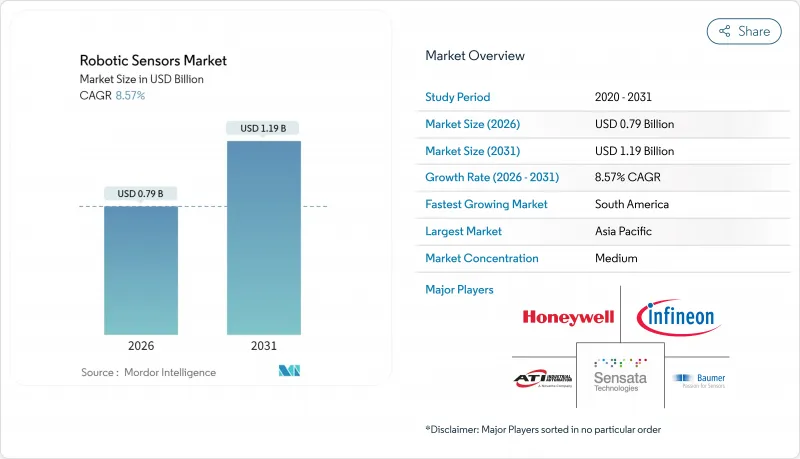
这一增长得益于工业机器人部署量创历史新高、协作机器人和人形机器人平台的快速普及,以及边缘人工智慧模组的稳定应用,这些模组能够提升感知精度和响应速度。力矩测量设备为精密组装提供支持,而随着深度学习模型从云端迁移到机械臂,视觉系统也在加速发展。半导体製造商正在将感测、处理和安全逻辑整合到单一晶片上,从而降低工厂的延迟并增强其网实整合韧性。汽车、电动车和医疗产业的终端用户正在加大对多模态感测技术的投资,以提高产量比率、可追溯性和人机协作能力。从区域来看,亚太地区密集的製造地和政策奖励有助于实现规模经济,而南美洲的自动化追赶需求则为快速成长奠定了基础。
全球机器人感测器市场趋势与洞察
工业机器人安装数量创历史新高
预计到2024年,全球运作将超过400万台,製造商正努力超越编码器,采用包含视觉、力觉和触觉等多种模式的先进感测套件。 FANUC的500i-A数控控制设备(CPU吞吐量提升2.7倍)展示了更快的板载运算如何即时处理复杂的感测器资料流。协作单元推动了对冗余安全感测的需求,而Delta的D-Bot协作机器人则透过与负载容量专用的即插即用感测器套件简化了整合。不断增长的安装量正在缩短先进感知技术的投资回报期,并巩固了机器人感测器市场的订单。
电子商务物流领域对配备感测器的自主移动机器人(AMR)的需求
强劲的线上零售推动全球移动机器人市场规模在2024年达到45亿美元,促使动态仓库对广角感知、地图绘製和包裹品质评估的需求日益增长。像Sonair这样的低成本3D超音波阵列可提供180x180度的覆盖范围,价格比雷射雷达低80%,降低了中型履约中心的资本门槛。人工智慧增强的视觉系统可以识别托盘货架、堆高机和员工着装,从而提高运作和吞吐量。触控式机械手使自主移动机器人(AMR)能够处理易碎的库存单位(SKU),拓展了应用场景,并推动了对感测器的需求。
MEMS供应链持续波动
镓和锑的贸易限制,以及亚洲晶圆代工厂面临的自然灾害风险,正在压缩前置作业时间并推高晶粒级成本。 Sourceability预测,晶圆启动瓶颈将持续到2026年,导致高引脚数感测器ASIC的供应更加紧张。劳动力短缺也加剧了不确定性,一些OEM厂商正在考虑采用双重采购或转移后端封装,但这些措施会增加资本密集度和营运复杂性。
细分市场分析
预计从2026年到2031年,视觉感测器将以13.27%的复合年增长率成长,超过所有其他类别。同时,力/扭力感测器在2025年仍将占据机器人感测器市场27.62%的份额。高速视觉检测和拾取放置操作的普及,使得投资板载GPU和ASIC晶片以将推理延迟降低到30毫秒以下变得合理。随着相机价格的下降,即使是中阶OEM厂商也开始采用双感光元件立体感光元件来支援深度估计。力感测在压入配合、去毛边和电子连接器组装中仍然至关重要,亚牛顿级的精确度可以确保产量比率。康耐视2023年8.375亿美元的营收表明,随着资本支出的復苏,对机器视觉硬体的周期性需求仍然强劲。
感测器小型化使得接近感测器、温度感测器和视觉模组能够整合到机器人纤细的手腕中,从而减少布线和电磁干扰。触觉阵列具有0.1克力灵敏度,例如XELA Robotics的uSkin,可以提高抓取器的灵巧性,但在机器人感测器市场中仍属于「其他」类别。立体视觉、惯性测量单元(IMU)和力向量融合技术增强了不规则零件组装过程中的柔顺性控制,这项特性在穿戴式装置生产线和客製化整形外科器材中备受重视。标准化的M12连接器和乙太网路供电(PoE)技术简化了安装,降低了中小企业的进入门槛。预计在预测期内,提供模组化、人工智慧视觉套件的供应商将在该细分市场中占据更大的增量机器人感测器市场。
工业机器人一直是需求的基石,预计到2025年将占据机器人感测器市场规模的54.62%。它们在焊接、喷涂和电子组装等领域的强大作用确保了其持续的更新换代。然而,在持续的创业投资流入和零件成本下降的推动下,人形机器人平台预计将在2031年之前以36.7%的复合年增长率推动市场成长。 Tacta Systems的资金筹措进一步印证了人们的信念:一旦人形机器人达到人类层面的安全性和灵巧性,它们就能解决物流、零售和老年护理等领域的挑战。
协作机器人正持续在中型工厂中广泛应用,这些工厂需要灵活切换生产线,但又无法负担大规模防护设备的成本。边缘人工智慧子系统支援「零编程」示教模式,降低了技术门槛,扩大了目标使用者群体。医院和机场正在快速采用商用服务机器人,因为感染控制和旅客服务运作需要可靠的感知能力和精细的操作能力。安川马达的「MOTOMAN NEXT」系列展示了自优化运动规划功能,预示着平台感测器数量的成长趋势,旨在提升情境察觉。未来,人形机器人的加速普及将推动机器人感测器市场进一步多元化,并在传统工业自动化之外创造新的市场。
区域分析
亚太地区将在2025年以34.72%的营收份额占据全球榜首,这主要得益于中国的产业升级补贴、日本的「社会5.0」计画以及韩国在记忆体晶片领域的投资热潮。OMRON8761亿日圆的净销售额印证了该地区对感测器驱动自动化技术的强劲需求。接近性MEMS晶圆厂缩短了前置作业时间,而当地顶尖的汽车製造商和电子巨头也确保了基础设施需求。然而,围绕晶片出口限制的地缘政治摩擦可能会导致供应链重组和额外成本。
在德国工业4.0蓝图和严格安全标准的推动下,欧洲市场对认证感测系统的需求日益增长。 SICK公司2024年的销售额预计将达到23.7亿欧元,显示其成长动能良好,尤其是在汽车和物流行业。在南欧,协作机器人的日益普及推动了市场规模的扩大, FANUC在伊比利半岛的扩张便是一个例证。北欧企业正积极推动离岸风力发电和采矿领域的突破性应用,防尘、防水和抗震感测器正逐渐成为业界标准。
北美是创新中心,美国实验室不断改进边缘人工智慧感知技术,加拿大矿业公司则采用坚固耐用的感测器用于自动驾驶车辆。墨西哥的近岸外包趋势正将生产线集中在巴希奥走廊沿线,推动了对高性价比感测技术的需求。儘管南美洲的装机量较小,但预计其复合年增长率将达到10.45%,成为成长最快的地区。这主要得益于巴西汽车製造商、阿根廷粮食加工商和智利锂精炼商为应对劳动力短缺和满足环境、社会及治理(ESG)审核要求而提高自动化程度。区域开发银行和跨国公司正在联合资助先导计画,为机器人感测器市场的长期需求播下种子。
其他福利:
- Excel格式的市场预测(ME)表
- 分析师支持(3个月)
目录
第一章 引言
- 研究假设和市场定义
- 调查范围
第二章调查方法
第三章执行摘要
第四章 市场情势
- 市场概览
- 市场驱动因素
- 工业机器人的安装数量已达到历史最高水准。
- 电子商务物流对配备感测器的自主移动机器人(AMR)的需求
- 六轴力/扭力感测器价格突然下降
- 人机协作的监理激励措施
- 用于人形机器人的边缘AI感测器融合模组
- 开放原始码ROS2 硬体参考设计
- 市场限制
- MEMS供应链持续波动
- 新兴市场中小企业资本投资的障碍
- 智慧感测器的网路安全认证成本
- 先进触觉积体电路的出口管制限制
- 价值/供应链分析
- 监管环境
- 技术展望
- 波特五力分析
- 供应商的议价能力
- 买方的议价能力
- 新进入者的威胁
- 替代品的威胁
- 竞争程度
第五章 市场规模与成长预测
- 依感测器类型
- 力和扭矩感测器
- 视觉感测器
- 接近感测器
- 位置/编码器
- 温度感测器
- 压力感测器
- 其他(触觉、光达、超音波)
- 按机器人类型
- 工业机器人
- 协作机器人(cobots)
- 服务机器人 - 专业人士之选
- 服务机器人 - 家用
- 人形机器人
- 按最终用户行业划分
- 汽车和电动车
- 电子和半导体
- 物流/仓储业
- 食品/饮料
- 医疗和医疗设备
- 其他行业(金属、塑胶等)
- 透过检测技术
- 应变计
- 电容式
- 光学(CMOS、雷射雷达)
- 磁效应和霍尔效应
- 压电
- 按地区
- 北美洲
- 美国
- 加拿大
- 墨西哥
- 欧洲
- 英国
- 德国
- 法国
- 义大利
- 其他欧洲地区
- 亚太地区
- 中国
- 日本
- 印度
- 韩国
- 亚太其他地区
- 中东
- 以色列
- 沙乌地阿拉伯
- 阿拉伯聯合大公国
- 土耳其
- 其他中东地区
- 非洲
- 南非
- 埃及
- 其他非洲地区
- 南美洲
- 巴西
- 阿根廷
- 其他南美洲
- 北美洲
第六章 竞争情势
- 市场集中度
- 策略趋势
- 市占率分析
- 公司简介
- ATI Industrial Automation(Novanta Inc.)
- Bota Systems AG
- Baumer Group
- FANUC Corporation
- FUTEK Advanced Sensor Technology, Inc.
- Honeywell International Inc.
- Infineon Technologies AG
- OMRON Corporation
- Sensata Technologies Holding plc
- TE Connectivity Ltd.
- Tekscan, Inc.
- Sick AG
- Keyence Corporation
- Cognex Corporation
- Epson Robotics(Seiko Epson Corp.)
- Yaskawa Electric Corporation
- Delta Electronics, Inc.
- DENSO Wave Incorporated
- Bosch Rexroth AG
- Rockwell Automation, Inc.
- Schunk GmbH and Co. KG
第七章 市场机会与未来展望
The robotic sensors market is expected to grow from USD 0.73 billion in 2025 to USD 0.79 billion in 2026 and is forecast to reach USD 1.19 billion by 2031 at 8.57% CAGR over 2026-2031.
Growth stems from record-high industrial-robot deployments, rapid gains in collaborative and humanoid platforms, and the steady infusion of edge-AI modules that elevate perception accuracy and response times. Force-torque devices underpin precision assembly lines, while vision systems accelerate as deep-learning models migrate from the cloud to the robot arm. Semiconductor makers now bundle sensing, processing, and safety logic on a single chip, giving factories lower latency and better cyber-physical resilience. End-users in automotive, electric-vehicle, and healthcare domains intensify spending on multimodal sensing to improve yield, traceability, and human-machine cooperation. Regionally, Asia-Pacific's dense manufacturing base and policy incentives support scale economics, whereas South America's automation catch-up provides a high-growth runway.
Global Robotic Sensors Market Trends and Insights
Industrial-robot installations hit record levels
Global operational stock crossed 4 million units in 2024, forcing manufacturers to adopt richer sensing suites that go beyond encoders to vision, force, and tactile modalities. FANUC's 500i-A CNC control, with 2.7X CPU throughput, illustrates how faster on-board computing now digests complex sensor streams in real time. Collaborative cells amplify demand for redundant safety sensing, while Delta's D-Bot cobots demonstrate payload-specific plug-and-play sensor packages that simplify integration. High install volumes shorten the payback period for advanced perception, locking in orders across the robotic sensors market.
E-commerce logistics demand for sensorised AMRs
Robust online retail lifted the global mobile-robot space to USD 4.5 billion in 2024, propelling need for wide-angle perception, mapping, and package-quality assessment inside dynamic warehouses. Low-cost 3D ultrasonic arrays such as Sonair's deliver 180 X 180 degree coverage while undercutting LiDAR by up to 80%, trimming capital hurdles for mid-tier fulfilment centers. AI-enhanced vision now differentiates between pallet racks, forklifts, and staff apparel, boosting uptime and throughput. Touch-enabled grippers let AMRs handle fragile SKUs, expanding use cases and fuelling sensor volumes.
Persistent MEMS supply-chain volatility
Trade restrictions on gallium and antimony alongside natural-disaster risks at Asian foundries strain lead times and elevate die-level costs. Sourceability forecasts continued wafer-start bottlenecks through 2026, squeezing availability for high-pin-count sensor ASICs. Labor shortages add uncertainty, prompting some OEMs to dual-source or relocate backend packaging, yet such moves raise capital intensity and operational complexity.
Other drivers and restraints analyzed in the detailed report include:
- Rapid price decline of six-axis force-torque sensors
- Regulatory incentives for human-robot collaboration
- CapEx barriers for SMEs in emerging markets
For complete list of drivers and restraints, kindly check the Table Of Contents.
Segment Analysis
Vision sensors are forecast to post a 13.27% CAGR from 2026-2031, outpacing all other categories. At the same time, force-torque devices retained 27.62% share of the robotic sensors market in 2025. The mass adoption of high-speed visual inspection and pick-and-place tasks legitimises investment in on-board GPUs and ASICs that compress inference latency below 30 ms. As camera prices slide, even mid-tier OEMs adopt dual-sensor stereo rigs to tackle depth estimation. Force sensing stays indispensable for press-fit, deburring, and electronic-connector assembly, where sub-newton accuracy safeguards yield. Cognex's 2023 revenue of USD 837.5 million signals cyclical yet resilient appetite for machine vision hardware when capex rebounds.
Sensor miniaturization lets builders co-locate proximity, temperature, and vision modules within tight robot wrists, reducing cabling and electromagnetic noise. Tactile arrays such as XELA Robotics' uSkin, with 0.1 gram-force sensitivity, deepen dexterity on grippers, but they still sit in the "others" bucket of the robotic sensors market. The fusion of stereo vision, IMU, and force vectors bolsters compliance control during assembly of irregular parts, a capability prized in wearable-device lines and customised orthopedics. Standardised M12 connectors and Power-over-Ethernet streamline installation, widening accessibility for SMEs. Over the forecast window, suppliers that offer modular, AI-ready vision suites are expected to capture a disproportionate slice of incremental robotic sensors market size in this segment.
Industrial robots have historically anchored demand, accounting for 54.62% of the robotic sensors market size in 2025. Their entrenched role in welding, painting, and electronics assembly ensures a stable replacement cycle. However, humanoid platforms are projected to lead growth with a 36.7% CAGR through 2031, energised by sustained venture capital inflows and component cost deflation. Tacta Systems' capital raise underscores confidence that humanoids can address logistics, retail, and eldercare gaps once safety and dexterity reach human parity.
Collaborative robots continue to win midsize factories that need flexible line changeovers and cannot afford extensive guarding. Edge-AI subsystems now allow 'zero-programming' teach modes, lowering skill thresholds and expanding the addressable user base. Professional service robots surge across hospitals and airports, where infection-control or passenger-service tasks require reliable perception and gentle interaction. Yaskawa's MOTOMAN NEXT family demonstrates self-optimising motion planning, a trend that multiplies sensor count per unit as platforms aim for situational awareness. Over the horizon, accelerated adoption in humanoids will further diversify the robotic sensors market, giving suppliers a potent new volume pool beyond classical industrial automation.
The Robotic Sensors Market Report is Segmented by Sensor Type (Force & Torque Sensors, Vision Sensors, and More), Robot Type (Industrial Robots, Collaborative Robots, Service Robots - Professional, and More), End-User Industry (Automotive & EV, Electronics & Semiconductor, and More), Sensing Technology (Strain-Gauge, Capacitive, Optical, and More), and Geography. The Market Forecasts are Provided in Terms of Value (USD).
Geography Analysis
Asia-Pacific led with 34.72% revenue share in 2025, buoyed by China's industrial-upgrade subsidies, Japan's Society 5.0 blueprint, and South Korea's memory-chip investment wave. OMRON's JPY 876.1 billion net sales validate robust regional appetite for sensor-driven automation. Close proximity to MEMS fabs compresses lead times, while local tier-one automakers and electronics giants guarantee baseline demand. Geopolitical frictions around chip export controls, however, may force supply-chain re-routing and incremental costs.
Europe follows, anchored by Germany's Industry 4.0 roadmap and rigorous safety statutes that elevate certified sensing systems. SICK's EUR 2.307 billion turnover in 2024 underscores healthy momentum, especially in automotive and logistics hubs. Southern Europe's growing cobot footprint, exemplified by FANUC's Iberia expansion, widens market breadth. Nordic firms push envelope applications in offshore wind and mining, where IP-rated, vibration-hardy sensors prevail.
North America remains innovation-centric, with US labs refining AI-on-edge perception and Canadian mines adopting rugged sensors for autonomous hauling. Mexico's near-shoring trend channels production lines into Bajio corridors, pulling demand for cost-effective sensing. South America, despite lower installed base, is on track for the fastest CAGR at 10.45% as Brazilian automakers, Argentinian grain handlers, and Chilean lithium refiners automate to offset labor shortages and meet ESG audits. Regional development banks and multinationals co-finance pilot projects, seeding long-run sensor demand across the robotic sensors market.
- ATI Industrial Automation (Novanta Inc.)
- Bota Systems AG
- Baumer Group
- FANUC Corporation
- FUTEK Advanced Sensor Technology, Inc.
- Honeywell International Inc.
- Infineon Technologies AG
- OMRON Corporation
- Sensata Technologies Holding plc
- TE Connectivity Ltd.
- Tekscan, Inc.
- Sick AG
- Keyence Corporation
- Cognex Corporation
- Epson Robotics (Seiko Epson Corp.)
- Yaskawa Electric Corporation
- Delta Electronics, Inc.
- DENSO Wave Incorporated
- Bosch Rexroth AG
- Rockwell Automation, Inc.
- Schunk GmbH and Co. KG
Additional Benefits:
- The market estimate (ME) sheet in Excel format
- 3 months of analyst support
TABLE OF CONTENTS
1 INTRODUCTION
- 1.1 Study Assumptions and Market Definition
- 1.2 Scope of the Study
2 RESEARCH METHODOLOGY
3 EXECUTIVE SUMMARY
4 MARKET LANDSCAPE
- 4.1 Market Overview
- 4.2 Market Drivers
- 4.2.1 Industrial-robot installations hit record levels
- 4.2.2 E-commerce logistics demand for sensorised AMRs
- 4.2.3 Rapid price decline of six-axis force-torque sensors
- 4.2.4 Regulatory incentives for human-robot collaboration
- 4.2.5 Edge-AI sensor fusion modules for humanoid robots
- 4.2.6 Open-source ROS2 hardware reference designs
- 4.3 Market Restraints
- 4.3.1 Persistent MEMS supply-chain volatility
- 4.3.2 CapEx barriers for SMEs in emerging markets
- 4.3.3 Cyber-security certification costs for smart sensors
- 4.3.4 Export-control limits on advanced tactile ICs
- 4.4 Value / Supply-Chain Analysis
- 4.5 Regulatory Landscape
- 4.6 Technological Outlook
- 4.7 Porter's Five Forces Analysis
- 4.7.1 Bargaining Power of Suppliers
- 4.7.2 Bargaining Power of Buyers
- 4.7.3 Threat of New Entrants
- 4.7.4 Threat of Substitutes
- 4.7.5 Degree of Competition
5 MARKET SIZE AND GROWTH FORECASTS (VALUE)
- 5.1 By Sensor Type
- 5.1.1 Force and Torque Sensors
- 5.1.2 Vision Sensors
- 5.1.3 Proximity Sensors
- 5.1.4 Position/Encoders
- 5.1.5 Temperature Sensors
- 5.1.6 Pressure Sensors
- 5.1.7 Others (Tactile, LiDAR, Ultrasonic)
- 5.2 By Robot Type
- 5.2.1 Industrial Robots
- 5.2.2 Collaborative Robots (Cobots)
- 5.2.3 Service Robots - Professional
- 5.2.4 Service Robots - Domestic
- 5.2.5 Humanoid Robots
- 5.3 By End-user Industry
- 5.3.1 Automotive and EV
- 5.3.2 Electronics and Semiconductor
- 5.3.3 Logistics and Warehousing
- 5.3.4 Food and Beverage
- 5.3.5 Healthcare and Medical Devices
- 5.3.6 Other Industries (Metals, Plastics, etc.)
- 5.4 By Sensing Technology
- 5.4.1 Strain-gauge
- 5.4.2 Capacitive
- 5.4.3 Optical (CMOS, LiDAR)
- 5.4.4 Magnetic and Hall-effect
- 5.4.5 Piezoelectric
- 5.5 By Geography
- 5.5.1 North America
- 5.5.1.1 United States
- 5.5.1.2 Canada
- 5.5.1.3 Mexico
- 5.5.2 Europe
- 5.5.2.1 United Kingdom
- 5.5.2.2 Germany
- 5.5.2.3 France
- 5.5.2.4 Italy
- 5.5.2.5 Rest of Europe
- 5.5.3 Asia-Pacific
- 5.5.3.1 China
- 5.5.3.2 Japan
- 5.5.3.3 India
- 5.5.3.4 South Korea
- 5.5.3.5 Rest of Asia-Pacific
- 5.5.4 Middle East
- 5.5.4.1 Israel
- 5.5.4.2 Saudi Arabia
- 5.5.4.3 United Arab Emirates
- 5.5.4.4 Turkey
- 5.5.4.5 Rest of Middle East
- 5.5.5 Africa
- 5.5.5.1 South Africa
- 5.5.5.2 Egypt
- 5.5.5.3 Rest of Africa
- 5.5.6 South America
- 5.5.6.1 Brazil
- 5.5.6.2 Argentina
- 5.5.6.3 Rest of South America
- 5.5.1 North America
6 COMPETITIVE LANDSCAPE
- 6.1 Market Concentration
- 6.2 Strategic Moves
- 6.3 Market Share Analysis
- 6.4 Company Profiles (includes Global level Overview, Market level overview, Core Segments, Financials as available, Strategic Information, Market Rank/Share for key companies, Products and Services, and Recent Developments)
- 6.4.1 ATI Industrial Automation (Novanta Inc.)
- 6.4.2 Bota Systems AG
- 6.4.3 Baumer Group
- 6.4.4 FANUC Corporation
- 6.4.5 FUTEK Advanced Sensor Technology, Inc.
- 6.4.6 Honeywell International Inc.
- 6.4.7 Infineon Technologies AG
- 6.4.8 OMRON Corporation
- 6.4.9 Sensata Technologies Holding plc
- 6.4.10 TE Connectivity Ltd.
- 6.4.11 Tekscan, Inc.
- 6.4.12 Sick AG
- 6.4.13 Keyence Corporation
- 6.4.14 Cognex Corporation
- 6.4.15 Epson Robotics (Seiko Epson Corp.)
- 6.4.16 Yaskawa Electric Corporation
- 6.4.17 Delta Electronics, Inc.
- 6.4.18 DENSO Wave Incorporated
- 6.4.19 Bosch Rexroth AG
- 6.4.20 Rockwell Automation, Inc.
- 6.4.21 Schunk GmbH and Co. KG
7 MARKET OPPORTUNITIES AND FUTURE OUTLOOK
- 7.1 White-space and Unmet-Need Assessment

 机器人感测器市场分析与预测(至2035年):类型、产品类型、技术、组件、应用、最终用户、功能、安装配置、解决方案
 2026年全球机器人感测器市场报告
 机器人感测器市场规模、份额、趋势分析报告:按感测器类型、应用、机器人类型、地区、细分市场预测,2025-2033
 机器人感测器市场,规模,占有率,趋势,产业分析报告:感测器类别,机器人类别,各用途,各地区,2025年~2034年的市场预测
 机器人感测器市场规模、份额、成长分析(按感测器类型、按机器人类型、按最终用户、按地区)- 产业预测 2025-2032
 2030 年机器人感测器市场预测:按感测器类型、机器人类型、组件类型、应用、最终用户和地区进行的全球分析
 2024-2028年机器人感测器全球市场