


 |
市场调查报告书
商品编码
1911798
印度车床市场:市场占有率分析、产业趋势与统计、成长预测(2026-2031)India Lathe Machines - Market Share Analysis, Industry Trends & Statistics, Growth Forecasts (2026 - 2031) |
||||||

※ 本网页内容可能与最新版本有所差异。详细情况请与我们联繫。
2025 年印度车床市场价值 10.7 亿美元,预计从 2026 年的 12.1 亿美元成长到 2031 年的 22.5 亿美元,预测期(2026-2031 年)复合年增长率为 13.19%。
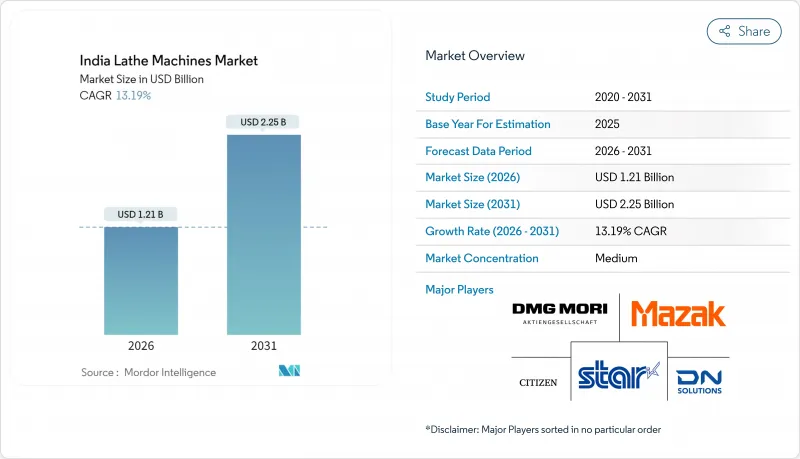
生产连结奖励计画(PLI) 政策、电动车製造业的蓬勃发展以及微型、小型和微企业(MSME) 的广泛自动化,共同推动了印度车床市场的加速成长。航太、国防和医疗设备丛集需求的不断增长,扩大了终端用户群体,并降低了对传统汽车加工的依赖。工业 4.0 赋能的改造套件降低了升级成本,并为二线製造商提供了先进的加工能力,加剧了市场竞争。同时,主要企业正迅速整合物联网 (IoT) 连接、预测性维护和多轴精密加工能力,以订单高利润订单。预计这些协同效应将推动印度车床市场在 2030 年前保持持续成长。
印度车床市场趋势与洞察
政府的生产连结奖励计画(PLI)促进了国内资本财生产。
总额达1.97兆印度卢比的生产连结奖励计画计画(PLI)设定了最低投资标准,要求企业在建厂时必须采购精密数控车床。在浦那、德里、班加罗尔以及班加罗尔中央机械技术研究所(CMTI)设立的智慧先进製造地,提供技术指导,并鼓励永续应用,而非一次性设备采购。 PLI计画的国产化率要求进一步鼓励製造商在地采购。
电动动力传动系统製造推动了对精密加工的需求。
预计到2024年,印度组装150万辆电动车,因此,转子同心度要求低于0.01毫米,这正在加速瑞士型自动车床在泰米尔纳德邦快速发展的电动车走廊地区的应用。 2030年实现70%的本地化目标,可望透过确保国内加工能力的稳定供应和限制进口替代,进一步扩大印度车床市场。
设备投资障碍限制了多轴车床的推广应用。
瑞士製造的工具机售价在500万至5,000万印度卢比之间,是传统工具机价格的三到五倍,这给微企业的预算带来了沉重负担。工具、夹具和CAM软体会使购置成本增加20%至30%,而儘管CGTMSE提供了部分担保,但银行贷款仍需大量抵押品,这限制了其广泛应用。
细分市场分析
到2025年,CNC平台将占印度车床市场收入的53.05%,这印证了可程式加工技术数十年来持续的流行。预计到2031年,瑞士型自动化车床的复合年增长率将达到14.02%,因为电动车、航太和医疗设备行业的客户对复杂的多轴加工能力的需求日益增长。到2031年,瑞士型车床在印度市场的规模可能超过4.7亿美元,儘管随着改装套件缩小价格差距,传统车床的市占率正在下降。为了满足对精密加工的需求,像Nidec Machining Tools这样的全球性公司正在泰米尔纳德邦扩大工具工厂计划。
由于改装方案延长了设备的使用寿命,传统机床和数控机床之间的性能成本差距正在缩小,这使得小规模加工车间能够赢得以前由大型 OEM 供应商主导的高精度合同,从而加速了印度车床市场质量标准的采用。
2025年,半自动化系统占总营收的51.20%,而预计到2031年,全自动设备将占据38.20%的市场份额,复合年增长率(CAGR)为14.08%。随着越来越多的公司面临技术纯熟劳工短缺和严格的可追溯性标准,自动化控制系统在印度车床市场的份额有望成长。远端主轴监控和数位日誌有助于医疗和航太产业遵守监管规定,从而支援企业进行全面自动化投资决策。
同时,人工操作平台仍将在培训中心和小批量工厂中存在,但随着数位素养的提高,预计到 2031 年,其占比将降至 9.60% 以下。对于寻求循序渐进变革的中小型企业 (MSME) 而言,先采用半自动化机器,然后再添加工业 4.0 模组的混合策略仍然是一条经济有效的途径。
其他福利:
- Excel格式的市场预测(ME)表
- 3个月的分析师支持
目录
第一章 引言
- 研究假设和市场定义
- 调查范围
第二章调查方法
第三章执行摘要
第四章 市场情势
- 市场概览
- 市场驱动因素
- 加速印度微企业製造业自动化普及
- 政府生产关联激励措施(PLI)促进国内资本财生产
- 汽车动力系统总成加工需求快速成长
- 医疗设备丛集的快速涌现(泰米尔纳德邦、特伦甘纳邦)
- 工业4.0改造套件可降低升级成本
- 国防抵销合约中在地采购义务
- 市场限制
- 多轴数控系统需要较高的初始资本投入。
- 全国范围内工具机金融产品短缺
- 训练有素的CNC编程人员和操作员短缺
- 区域城市工业中心持续存在的电力品质问题
- 产业价值链分析
- 监管环境
- 技术展望
- 波特五力分析
- 供应商的议价能力
- 买方的议价能力
- 新进入者的威胁
- 替代品的威胁
- 竞争对手之间的竞争
- 宏观经济因素的影响
第五章 市场规模与成长预测
- 依产品类型
- CNC车床
- 传统车床
- 瑞士型自动车床
- 透过控制方法
- 手动的
- 半自动
- 自动的
- 透过操作
- 转弯
- 表面磨削
- 无聊的
- 切割/切割加工
- 按最终用户行业划分
- 车
- 航太与国防
- 一般製造业
- 金属工业
- 其他终端用户产业
- 按地区
- 印度北部
- 西印度群岛
- 南印度
- 东印度
第六章 竞争情势
- 市场集中度
- 策略趋势
- 市占率分析
- 公司简介
- Yamazaki Mazak Corporation
- DMG MORI Aktiengesellschaft
- Doosan Machine Tools Co. Ltd.(DN Solutions)
- Citizen Machinery Co. Ltd.
- Star Micronics Co. Ltd.
- Okuma Corporation
- Haas Automation Inc.
- Tsugami Corporation
- Tornos Group SA
- Bharat Fritz Werner Ltd.
- Lakshmi Machine Works Ltd.
- Ace Micromatic Group(Ace Designers Ltd.)
- Jyoti CNC Automation Ltd.
- HMT Machine Tools Ltd.
- Galaxy-Tajmac India Pvt Ltd.
- Laxmi Metal AND Machines
- Arrow Machine Tools Pvt Ltd.
- Micromatic Machine Tools Pvt Ltd.
- Emag India Pvt Ltd.
- Murata Machinery Ltd.
第七章 市场机会与未来展望
The India Lathe Machines market was valued at USD 1.07 billion in 2025 and estimated to grow from USD 1.21 billion in 2026 to reach USD 2.25 billion by 2031, at a CAGR of 13.19% during the forecast period (2026-2031).
The acceleration is fueled by Production Linked Incentive (PLI) allocations, the electric-vehicle manufacturing surge, and widespread automation adoption among micro-, small-, and medium-enterprises (MSMEs). Growing demand from aerospace, defense, and medical-device clusters is broadening the end-user base and reducing historical reliance on automotive machining. Competition is intensifying as Industry 4.0 retrofit kits lower upgrade costs, enabling tier-2 manufacturers to access advanced capabilities. Meanwhile, global and domestic players are racing to embed Internet of Things (IoT) connectivity, predictive maintenance, and multi-axis precision to win high-margin orders. These converging forces promise sustained momentum for the India Lathe Machines market through 2030.
India Lathe Machines Market Trends and Insights
Government PLI Incentives Accelerate Domestic Capital Goods Production
The INR 1.97 lakh-crore PLI program has set minimum investment thresholds that compel beneficiaries to procure precision CNC lathes during plant build-outs. Dedicated Smart Advanced Manufacturing hubs in Pune, Delhi, Bengaluru, and Bengaluru's CMTI offer technical guidance, ensuring sustained rather than one-off equipment purchases. Domestic content conditions under PLI further push manufacturers toward locally sourced India Lathe Machines market solutions that meet stringent value-addition norms.
EV Power-train Manufacturing Drives Precision Demand
India assembled 1.5 million electric vehicles in 2024, and rotor concentricity requirements below 0.01 mm have accelerated the adoption of Swiss-type automatic lathes in Tamil Nadu's rapidly growing EV corridor. Localization targets of 70% by 2030 guarantee steady domestic machining volumes and limit import substitution, further enlarging the India Lathe Machines market.
Capital Expenditure Barriers Limit Multi-Axis Adoption
Swiss-type models priced at Rs 50 lakh-Rs 5 crore cost three to five times more than conventional units, stretching MSME budgets. Tooling, fixtures, and CAM software add 20-30% to acquisition cost, while collateral-heavy bank lending limits uptake despite partial guarantees under CGTMSE.
Other drivers and restraints analyzed in the detailed report include:
- MSME Automation Adoption Accelerates Across Industrial Clusters
- Medical-Device Clusters Create High-Precision Opportunities
- Skills Shortage Constrains Automation Rollout
For complete list of drivers and restraints, kindly check the Table Of Contents.
Segment Analysis
CNC platforms captured 53.05% of 2025 revenue in the India Lathe Machines market, substantiating decades of programmable machining adoption. Swiss-type automatic models are on track for a 14.02% CAGR through 2031 as EV, aerospace, and medical-device customers demand complex multi-axis capability. The India Lathe Machines market size for Swiss-type solutions could surpass USD 0.47 billion by 2031, while conventional units decline as retrofit kits bridge affordability gaps. Global firms such as Nidec Machine Tool are ramping up tool-factory projects in Tamil Nadu to serve this precision demand.
The performance gap between conventional and CNC machines is narrowing in cost terms as retrofit packages extend equipment life cycles. As a result, small job shops can compete for high-tolerance contracts previously reserved for large OEM suppliers, accelerating diffusion of quality standards across the India Lathe Machines market.
Semi-automatic systems held 51.20% of revenue in 2025; however, automatic units are forecast to command 38.20% of value by 2031 on a 14.08% CAGR. The India Lathe Machines market share for automatic control jumps whenever firms face skilled-labor shortages or stringent traceability norms. Remote spindle monitoring and digital logbooks support regulatory compliance in medical and aerospace verticals, tipping investment decisions toward full automation.
Meanwhile, manual platforms still populate training centers and low-volume shops but are expected to fall below 9.60% by 2031 as digital literacy improves. The hybrid strategy of starting with semi-automatic machines then layering Industry 4.0 modules remains a cost-effective path for MSMEs seeking incremental change.
The India Lathe Machines Market Report is Segmented by Product Type (CNC Lathe, Conventional Lathe, and Swiss-Type Automatic Lathe), Control Type (Manual, Semi-Automatic, and Automatic), Operation (Turning, Facing, and More), End-User Industry (Automotive, Aerospace and Defence, and More), and Region. The Market Forecasts are Provided in Terms of Value (USD).
List of Companies Covered in this Report:
- Yamazaki Mazak Corporation
- DMG MORI Aktiengesellschaft
- Doosan Machine Tools Co. Ltd. (DN Solutions)
- Citizen Machinery Co. Ltd.
- Star Micronics Co. Ltd.
- Okuma Corporation
- Haas Automation Inc.
- Tsugami Corporation
- Tornos Group SA
- Bharat Fritz Werner Ltd.
- Lakshmi Machine Works Ltd.
- Ace Micromatic Group (Ace Designers Ltd.)
- Jyoti CNC Automation Ltd.
- HMT Machine Tools Ltd.
- Galaxy-Tajmac India Pvt Ltd.
- Laxmi Metal AND Machines
- Arrow Machine Tools Pvt Ltd.
- Micromatic Machine Tools Pvt Ltd.
- Emag India Pvt Ltd.
- Murata Machinery Ltd.
Additional Benefits:
- The market estimate (ME) sheet in Excel format
- 3 months of analyst support
TABLE OF CONTENTS
1 INTRODUCTION
- 1.1 Study Assumptions and Market Definition
- 1.2 Scope of the Study
2 RESEARCH METHODOLOGY
3 EXECUTIVE SUMMARY
4 MARKET LANDSCAPE
- 4.1 Market Overview
- 4.2 Market Drivers
- 4.2.1 Accelerated automation adoption in Indian MSME manufacturing
- 4.2.2 Government PLI incentives for domestic capital-goods production
- 4.2.3 Surge in EV power-train machining demand
- 4.2.4 Rapid rise of medical-device clusters (Tamil Nadu, Telangana)
- 4.2.5 Industry 4.0 retro-fit kits lowering upgrade costs
- 4.2.6 Local sourcing mandates in defence offset contracts
- 4.3 Market Restraints
- 4.3.1 High upfront capex for multi-axis CNC systems
- 4.3.2 Inadequate nationwide machine-tool financing instruments
- 4.3.3 Shortage of trained CNC programmers and operators
- 4.3.4 Persistent power-quality issues in tier-2 industrial hubs
- 4.4 Industry Value Chain Analysis
- 4.5 Regulatory Landscape
- 4.6 Technological Outlook
- 4.7 Porter's Five Forces Analysis
- 4.7.1 Bargaining Power of Suppliers
- 4.7.2 Bargaining Power of Buyers
- 4.7.3 Threat of New Entrants
- 4.7.4 Threat of Substitute Products
- 4.7.5 Intensity of Competitive Rivalry
- 4.8 Impact of Macroeconomic Factors
5 MARKET SIZE AND GROWTH FORECASTS (VALUES)
- 5.1 By Product Type
- 5.1.1 CNC Lathe
- 5.1.2 Conventional Lathe
- 5.1.3 Swiss-type Automatic Lathe
- 5.2 By Control Type
- 5.2.1 Manual
- 5.2.2 Semi-automatic
- 5.2.3 Automatic
- 5.3 By Operation
- 5.3.1 Turning
- 5.3.2 Facing
- 5.3.3 Boring
- 5.3.4 Cutting / Parting
- 5.4 By End-user Industry
- 5.4.1 Automotive
- 5.4.2 Aerospace and Defence
- 5.4.3 General Manufacturing
- 5.4.4 Metal Industry
- 5.4.5 Other End-user Industries
- 5.5 By Region
- 5.5.1 North India
- 5.5.2 West India
- 5.5.3 South India
- 5.5.4 East India
6 COMPETITIVE LANDSCAPE
- 6.1 Market Concentration
- 6.2 Strategic Moves
- 6.3 Market Share Analysis
- 6.4 Company Profiles (includes Global level Overview, Market level overview, Core Segments, Financials as available, Strategic Information, Market Rank/Share for key companies, Products and Services, and Recent Developments)
- 6.4.1 Yamazaki Mazak Corporation
- 6.4.2 DMG MORI Aktiengesellschaft
- 6.4.3 Doosan Machine Tools Co. Ltd. (DN Solutions)
- 6.4.4 Citizen Machinery Co. Ltd.
- 6.4.5 Star Micronics Co. Ltd.
- 6.4.6 Okuma Corporation
- 6.4.7 Haas Automation Inc.
- 6.4.8 Tsugami Corporation
- 6.4.9 Tornos Group SA
- 6.4.10 Bharat Fritz Werner Ltd.
- 6.4.11 Lakshmi Machine Works Ltd.
- 6.4.12 Ace Micromatic Group (Ace Designers Ltd.)
- 6.4.13 Jyoti CNC Automation Ltd.
- 6.4.14 HMT Machine Tools Ltd.
- 6.4.15 Galaxy-Tajmac India Pvt Ltd.
- 6.4.16 Laxmi Metal AND Machines
- 6.4.17 Arrow Machine Tools Pvt Ltd.
- 6.4.18 Micromatic Machine Tools Pvt Ltd.
- 6.4.19 Emag India Pvt Ltd.
- 6.4.20 Murata Machinery Ltd.
7 MARKET OPPORTUNITIES AND FUTURE OUTLOOK
- 7.1 White-space and Unmet-need assessment

 自动车床市场:按工具机类型、控制方式、操作方式、轴数、销售管道、应用与最终用户划分-2026-2032年全球市场预测车床市场:2026-2032年全球市场预测(依工具机类型、主轴方向、结构类型及最终用途产业划分)
 2026年全球车床市场报告
 车床市场规模、份额和成长分析(按类型、操作方式、产能、最终用户和地区划分)-2026-2033年产业预测
 2032 年车床市场预测:按产品类型、营运类型、营运模式、最终用户和地区进行的全球分析
 2025 年至 2033 年车床市场报告(按类型、营运、容量、最终用户和地区)
 气举阀工作筒市场报告:趋势、预测和竞争分析(至 2030 年)车床市场,按产品类型、按操作、最终用户、按国家和地区 - 2024-2032 年行业分析、市场规模、市场份额和预测