


 |
市场调查报告书
商品编码
1911825
印尼数位广告市场:市场占有率分析、产业趋势与统计、成长预测(2026-2031)Indonesia Digital Advertising - Market Share Analysis, Industry Trends & Statistics, Growth Forecasts (2026 - 2031) |
||||||

※ 本网页内容可能与最新版本有所差异。详细情况请与我们联繫。
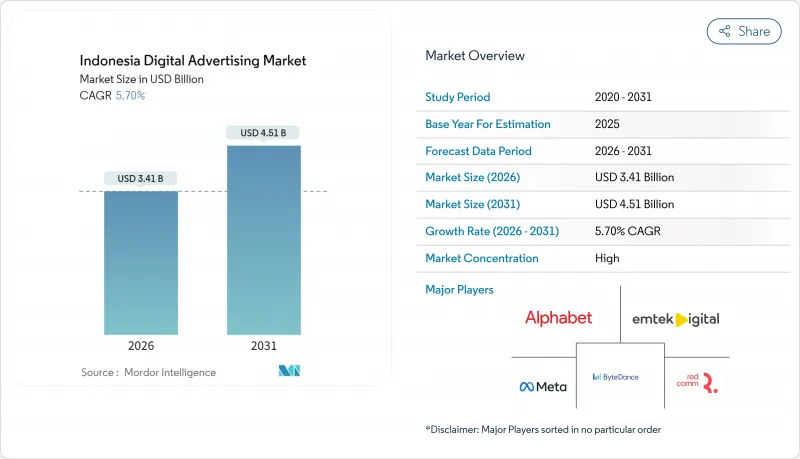
预计印尼数位广告市场将从 2025 年的 32.3 亿美元成长到 2026 年的 34.1 亿美元,到 2031 年将达到 45.1 亿美元,2026 年至 2031 年的复合年增长率为 5.70%。
宽频智慧型手机的日益普及、与社群电商的融合以及影片为中心的消费模式,持续重塑着媒体预算格局;与此同时,随着品牌对可衡量结果的需求日益增长,效果驱动型模式也愈发强劲。超级应用程式之间活性化的整合谈判、政府主导的人工智慧投资以实现创新的大规模在地化,以及日益严格的资料隐私法规,都在共同重塑平台经济和竞争策略。此外,联网电视的扩展和直播电商的货币化正在释放新的广告资源,并推动全通路策略的发展,从而实现跨装置的品牌认知与转换。同时,品牌安全标准的加强和情境检验工具的普及,在不影响品牌触达率的前提下,有效维护了品牌声誉。
印尼数位广告市场趋势与洞察
智慧型手机的普及和行动互联网的快速发展
印尼向行动优先策略的转型正在加速广告预算的转移。智慧型手机普及率预计将从2025年的86%上升到2028年的91.3%。目前,用户每日应用程式使用时间超过5小时,4G网路覆盖了96.48%的人口密集区域,即使在城市边缘地区也能实现可靠的程式化广告触达。以Telkomsel、Indosat和XL Axiata为主要通讯业者的集中式网路提供了大规模的广告资源和确定性的受众数据。 Telkomsel的TADEX平台也整合了来自数千家发布商的优质广告曝光率。预计到2024年,行动流量将年增17.99%,因此,在可预见的未来,印尼的数位广告市场必将继续依赖行动萤幕。
预算从传统媒体转向数位媒体
面对线性电视收视率的下滑和分散式户外广告成效的日益减弱,行销人员正逐步提高网路广告在其总支出中的占比。在投资报酬率的显着提升以及传统媒体无法实现的精准定位的推动下,印尼全国性广告商计划在2023年至2025年间将7个百分点的预算从传统媒体转向数位媒体。这项转变主要由总部位于雅加达的跨国公司主导,但区域性品牌也正透过效果行销培训迅速采纳最佳实践。因此,印尼的数位广告市场正受益于多种形式的尝试,动态创新优化和系列故事行销宣传活动正在取代静态的大众广告。
广告诈欺和品牌安全问题
今年大选期间,假讯息氾滥,大多数消费者认为假新闻是一个严重的问题。为了应对这个问题,品牌方选择与能够对页面层级内容进行分类的检验合作伙伴合作,而不是采用关键字屏蔽等更广泛的方法。对广告曝光率量级透明度的需求日益增长,而发布商品质的差异以及直播的复杂性推高了监控成本。在检验标准成熟之前,印尼部分数位广告市场可能会面临供应方定价压力。
细分市场分析
到2025年,影片广告将占印尼数位广告支出的34.02%,占印尼数位广告市场最大份额,每月OTT观看时间将超过35亿小时。高完成率和改进的衡量工具吸引了来自快速消费品、汽车和通讯业的预算,而六秒贴片广告即使在频宽有限的频宽连线下也能保障用户体验。同时,社群媒体预计将以6.11%的复合年增长率实现最快成长,这主要得益于TikTok 1.576亿的用户基数以及其与Tokopedia整合后打造的便捷购物结帐流程。儘管社群电商监管日益严格,但可见的品牌内容和第一方数据的可获取性支撑了其稳定的业绩表现和持续的市场份额成长。
展示广告和横幅广告格式正在向响应式设计演进,以优化垂直影片串流,而搜寻广告对于高意图转换仍然至关重要,尤其是在旅游和金融服务行业。音讯广告提供了一个品牌安全的叙事环境,其播客每週覆盖率高达 42.6%。原生广告和电子邮件行销流程则有助于提升广告曝光率。随着广告商不断丰富创新以适应消费者行为的细微变化,这些协同效应正在推动印尼数位广告市场的扩张。
这显示智慧型手机正在推动印尼数位广告市场份额的成长。到2025年,行动装置广告支出将占印尼广告总支出的68.10%,SIM卡普及率将超过人口总数,67%的电商支付将透过行动装置完成。轻量级SDK能够压缩低频宽环境下的创新,在不增加延迟的情况下扩大广告覆盖范围。同时,联网电视广告支出预计将以6.72%的复合年增长率成长,将客厅萤幕转化为可导向广告位。随着订阅影片服务用户数量超过付费电视用户,动态广告插入和家庭级频次限製成为可能,这对于传统上依赖样本组研究的品牌提升研究而言是一项重大进步。
持续的桌面端宣传活动将继续用于B2B意向收集和深入研究,而平板电脑将提升教育和儿童内容的广告曝光率。泗水和棉兰的下一代5G网路部署将进一步减少缓衝,并支援结合QR码和影像的互动式购物广告。光纤到府覆盖率已达该地区97.86%,确保尖峰时段的网路品质稳定。随着印尼数位广告市场的日趋成熟,这些基础设施的提升将为全设备广告计画提供支援。
其他福利:
- Excel格式的市场预测(ME)表
- 3个月的分析师支持
目录
第一章 引言
- 研究假设和市场定义
- 调查范围
第二章调查方法
第三章执行摘要
第四章 市场情势
- 市场概览
- 市场驱动因素
- 智慧型手机的普及和行动互联网的快速发展
- 预算从传统媒体转向数位媒体
- 电子商务和社交电商的快速成长
- OTT/短影片消费的快速成长
- 政府「印尼4.0」中小企业数位化促进措施
- 利用叫车和销售点数据实现人工智慧驱动的超当地语系化定向
- 市场限制
- 广告诈欺和品牌安全问题
- 碎片化的测量和归因
- 《个人资料保护法》(PDP) 合规负担
- 区域城市宽频环境的异质性
- 监管环境
- 技术展望
- 波特五力分析
- 买方的议价能力
- 供应商的议价能力
- 新进入者的威胁
- 替代品的威胁
- 竞争对手之间的竞争
第五章 市场规模与成长预测
- 广告格式
- 展示广告/横幅广告
- 影片
- 社群媒体
- 搜寻
- 音讯/播客
- 原生广告
- 电子邮件
- 透过装置
- 行动装置
- 桌上型电脑/笔记型电脑
- 联网电视
- 平板电脑及其他
- 按行业
- 快速消费品(日用消费品)
- 沟通
- 医疗和药品
- 媒体与娱乐
- 金融服务
- 旅游
- 电子商务与市场
- 其他行业部门
- 按购买模式
- 每次点击费用 (CPC)
- 广告曝光率成本 (CPM)
- 每次获客成本 (CPA)
- 每次观看成本(CPV)
- 混合/其他购买模式
第六章 竞争情势
- 市场集中度
- 策略趋势
- 市占率分析
- 公司简介
- PT Google Indonesia(Alphabet Inc.)
- Meta Platforms Inc.
- ByteDance Ltd.(TikTok Indonesia)
- PT GoTo Gojek Tokopedia Tbk(GoTo Ads)
- PT Shopee Internasional Indonesia(Sea Ltd.)
- PT Telekomunikasi Indonesia Tbk(IndiHome Ads)
- PT Bukalapak.com Tbk
- PT Traveloka Digital Indonesia
- Dentsu Group Inc.(PT Dentsu Indonesia)
- WPP plc(GroupM Indonesia)
- Omnicom Group Inc.(OMD/PHD Indonesia)
- Publicis Groupe SA(Publicis Indonesia)
- Havas Group SA(Havas Indonesia)
- PT Emtek Digital
- PT ADA Asia(ADA Indonesia)
- PT RedComm Indonesia
- PT HeartMedia Digital(IDN Media)
- PT Verizon Media Indonesia(Yahoo Ads)
- PT InMobi Indonesia
- PT Revindo Jakarta(Reevo)
- PT Kantar Indonesia
- PT Comscore Indonesia
- PT MOLOCO Indonesia
- PT Samsung Ads Indonesia
第七章 市场机会与未来展望
The Indonesia digital advertising market is expected to grow from USD 3.23 billion in 2025 to USD 3.41 billion in 2026 and is forecast to reach USD 4.51 billion by 2031 at 5.70% CAGR over 2026-2031.
Rising broadband smartphone adoption, social-commerce integration, and video-first consumption patterns continue to redefine media budgets, while performance-oriented models gain traction as brands demand measurable outcomes. Intensifying consolidation talks among super-apps, sovereign AI investments that localize creative at scale, and stricter data-privacy enforcement collectively reshape platform economics and competitive tactics. Meanwhile, connected-TV expansion and live-commerce monetization unlock fresh inventory, encouraging omnichannel strategies that link awareness to conversion across devices. In parallel, higher brand-safety standards and contextual verification tools protect reputation without eroding reach.
Indonesia Digital Advertising Market Trends and Insights
Smartphone penetration and mobile internet boom
Indonesia's mobile-first transition accelerates advertising-budget shifts as smartphone ownership is forecast to climb from 86% in 2025 to 91.3% by 2028. Daily app usage now exceeds 5 hours, and 4G coverage blankets 96.48% of populated areas, enabling reliable programmatic reach even in peri-urban zones. Operator concentration around Telkomsel, Indosat, and XL Axiata provides scaled inventory and deterministic audience data, while Telkomsel's TADEX platform packages premium impressions across thousands of publishers. Rising mobile traffic, up 17.99% YoY in 2024, ensures that the Indonesia digital advertising market remains anchored to handheld screens for the foreseeable future.
Budget shift from traditional to digital media
Marketers allocate progressively larger shares of total spend online as linear-TV ratings wane and OOH fragmentation dilutes impact. National advertisers moved 7 percentage-points of budget from analog to digital between 2023-2025, spurred by compelling ROI evidence and granular targeting unavailable on legacy channels. The shift is led by Jakarta-based multinationals, yet regional brands quickly replicate best practices through performance-marketing workshops. The Indonesia digital advertising market consequently benefits from multi-format experimentation, with dynamic creative optimization and sequential-storytelling campaigns replacing static mass-reach placements.
Ad-fraud and brand-safety concerns
Election-year misinformation surged, with most of consumers perceiving fake news as severe. Brands thus tighten controls, opting for verification partners that classify content at page level rather than blunt keyword blocks. Demand for impression-level transparency grows, yet fragmented publisher quality and livestream complexity raise monitoring costs. Until verification standards mature, pockets of the Indonesia digital advertising market may face supply-side pricing pressure.
Other drivers and restraints analyzed in the detailed report include:
- E-commerce and social-commerce surge
- OTT / short-form video consumption spike
- Personal-Data Protection Law compliance burden
For complete list of drivers and restraints, kindly check the Table Of Contents.
Segment Analysis
Video ads represented 34.02% of spend in 2025, capturing the largest slice of the Indonesia digital advertising market size as OTT viewership soared beyond 3.5 billion monthly hours. High completion rates and improved measurement tools attracted FMCG, automotive, and telco budgets, while six-second bumper ads safeguarded user experience on constrained bandwidth connections. Social media, however, is poised for the quickest ascent at a 6.11% CAGR, buoyed by TikTok's 157.6 million users and frictionless commerce checkout journeys forged after its Tokopedia merger. Even with stricter social-commerce rules, branded-content labeling and first-party data access underpin performance consistency, ensuring continued share gains.
Display and banner formats evolve with responsive designs optimized for vertical video feeds, whereas search remains indispensable for high-intent conversions, especially within travel and financial-services categories. Audio ads benefit from a weekly podcast reach of 42.6%, providing brand-safe storytelling environments. Native integrations and email nurture flows add complementary frequency touches. Collectively, these dynamics keep the Indonesia digital advertising market expanding as advertisers diversify creative to match nuanced consumer moments.
Mobile handsets absorbed 68.10% of expenditure in 2025, underlining the Indonesia digital advertising market share leadership of smartphones in a country where SIM penetration exceeds population and 67% of e-commerce checkouts occur on handhelds. Lightweight SDKs that compress creatives for low-bandwidth regions drive incremental reach without compromising latency. Simultaneously, connected-TV spending is forecast to grow at 6.72% CAGR, turning living-room screens into addressable inventory. Subscription-video households surpass pay-TV, enabling dynamic ad insertion and household-level frequency capping, a boon for brand-lift studies that previously relied on panel-based measurement.
Desktop campaigns persist for B2B intent harvesting and long-form research journeys, while tablets furnish incremental impressions across education and children's content. Next-generation 5G rollouts across Surabaya and Medan further reduce buffering, allowing interactive shoppable ads that merge QR codes with broadcast visuals. Fiber-to-home coverage reaching 97.86% of districts cushions peak-time quality. These infrastructure upgrades reinforce omni-device planning as the Indonesia digital advertising market matures.
The Indonesia Digital Advertising Market Report is Segmented by Advertising Format (Display/Banner, Video, and More), Device (Mobile Handset, Desktop/Laptop, and More), Industry Vertical (FMCG, Telecom, Healthcare and Pharma, and More), Buying Model (Cost-Per-Click, Cost-Per-Mille, and More), and Geography. The Market Forecasts are Provided in Terms of Value (USD).
List of Companies Covered in this Report:
- PT Google Indonesia (Alphabet Inc.)
- Meta Platforms Inc.
- ByteDance Ltd. (TikTok Indonesia)
- PT GoTo Gojek Tokopedia Tbk (GoTo Ads)
- PT Shopee Internasional Indonesia (Sea Ltd.)
- PT Telekomunikasi Indonesia Tbk (IndiHome Ads)
- PT Bukalapak.com Tbk
- PT Traveloka Digital Indonesia
- Dentsu Group Inc. (PT Dentsu Indonesia)
- WPP plc (GroupM Indonesia)
- Omnicom Group Inc. (OMD/PHD Indonesia)
- Publicis Groupe SA (Publicis Indonesia)
- Havas Group SA (Havas Indonesia)
- PT Emtek Digital
- PT ADA Asia (ADA Indonesia)
- PT RedComm Indonesia
- PT HeartMedia Digital (IDN Media)
- PT Verizon Media Indonesia (Yahoo Ads)
- PT InMobi Indonesia
- PT Revindo Jakarta (Reevo)
- PT Kantar Indonesia
- PT Comscore Indonesia
- PT MOLOCO Indonesia
- PT Samsung Ads Indonesia
Additional Benefits:
- The market estimate (ME) sheet in Excel format
- 3 months of analyst support
TABLE OF CONTENTS
1 INTRODUCTION
- 1.1 Study Assumptions and Market Definition
- 1.2 Scope of the Study
2 RESEARCH METHODOLOGY
3 EXECUTIVE SUMMARY
4 MARKET LANDSCAPE
- 4.1 Market Overview
- 4.2 Market Drivers
- 4.2.1 Smartphone penetration and mobile internet boom
- 4.2.2 Budget shift from traditional to digital media
- 4.2.3 E-commerce and social-commerce surge
- 4.2.4 OTT / short-form video consumption spike
- 4.2.5 Govt "Making Indonesia 4.0" SME digitization incentives
- 4.2.6 AI-driven hyper-local targeting via ride-hailing and POS data
- 4.3 Market Restraints
- 4.3.1 Ad-fraud and brand-safety concerns
- 4.3.2 Measurement and attribution fragmentation
- 4.3.3 Personal-Data Protection Law (PDP) compliance burden
- 4.3.4 Uneven broadband outside tier-1 cities
- 4.4 Regulatory Landscape
- 4.5 Technological Outlook
- 4.6 Porter's Five Forces Analysis
- 4.6.1 Bargaining Power of Buyers
- 4.6.2 Bargaining Power of Suppliers
- 4.6.3 Threat of New Entrants
- 4.6.4 Threat of Substitutes
- 4.6.5 Intensity of Competitive Rivalry
5 MARKET SIZE AND GROWTH FORECASTS (VALUE)
- 5.1 By Advertising Format
- 5.1.1 Display/Banner
- 5.1.2 Video
- 5.1.3 Social Media
- 5.1.4 Search
- 5.1.5 Audio/Podcast
- 5.1.6 Native
- 5.1.7 Email
- 5.2 By Device
- 5.2.1 Mobile Handset
- 5.2.2 Desktop / Laptop
- 5.2.3 Connected TV
- 5.2.4 Tablet and Others
- 5.3 By Industry Vertical
- 5.3.1 FMCG
- 5.3.2 Telecom
- 5.3.3 Healthcare and Pharma
- 5.3.4 Media and Entertainment
- 5.3.5 Financial Services
- 5.3.6 Travel and Tourism
- 5.3.7 E-commerce and Marketplaces
- 5.3.8 Others Industry Verticals
- 5.4 By Buying Model
- 5.4.1 Cost-Per-Click (CPC)
- 5.4.2 Cost-Per-Mille (CPM)
- 5.4.3 Cost-Per-Acquisition (CPA)
- 5.4.4 Cost-Per-View (CPV)
- 5.4.5 Hybrid / Other Buying Models
6 COMPETITIVE LANDSCAPE
- 6.1 Market Concentration
- 6.2 Strategic Moves
- 6.3 Market Share Analysis
- 6.4 Company Profiles (includes Global level Overview, Market level overview, Core Segments, Financials as available, Strategic Information, Market Rank/Share for key companies, Products and Services, and Recent Developments)
- 6.4.1 PT Google Indonesia (Alphabet Inc.)
- 6.4.2 Meta Platforms Inc.
- 6.4.3 ByteDance Ltd. (TikTok Indonesia)
- 6.4.4 PT GoTo Gojek Tokopedia Tbk (GoTo Ads)
- 6.4.5 PT Shopee Internasional Indonesia (Sea Ltd.)
- 6.4.6 PT Telekomunikasi Indonesia Tbk (IndiHome Ads)
- 6.4.7 PT Bukalapak.com Tbk
- 6.4.8 PT Traveloka Digital Indonesia
- 6.4.9 Dentsu Group Inc. (PT Dentsu Indonesia)
- 6.4.10 WPP plc (GroupM Indonesia)
- 6.4.11 Omnicom Group Inc. (OMD/PHD Indonesia)
- 6.4.12 Publicis Groupe SA (Publicis Indonesia)
- 6.4.13 Havas Group SA (Havas Indonesia)
- 6.4.14 PT Emtek Digital
- 6.4.15 PT ADA Asia (ADA Indonesia)
- 6.4.16 PT RedComm Indonesia
- 6.4.17 PT HeartMedia Digital (IDN Media)
- 6.4.18 PT Verizon Media Indonesia (Yahoo Ads)
- 6.4.19 PT InMobi Indonesia
- 6.4.20 PT Revindo Jakarta (Reevo)
- 6.4.21 PT Kantar Indonesia
- 6.4.22 PT Comscore Indonesia
- 6.4.23 PT MOLOCO Indonesia
- 6.4.24 PT Samsung Ads Indonesia
7 MARKET OPPORTUNITIES AND FUTURE OUTLOOK
- 7.1 White-space and Unmet-Need Assessment


