


 |
市场调查报告书
商品编码
1934608
汽车自动变速箱:市场份额分析、行业趋势和统计数据、成长预测(2026-2031)Automotive Automatic Transmission - Market Share Analysis, Industry Trends & Statistics, Growth Forecasts (2026 - 2031) |
||||||

※ 本网页内容可能与最新版本有所差异。详细情况请与我们联繫。
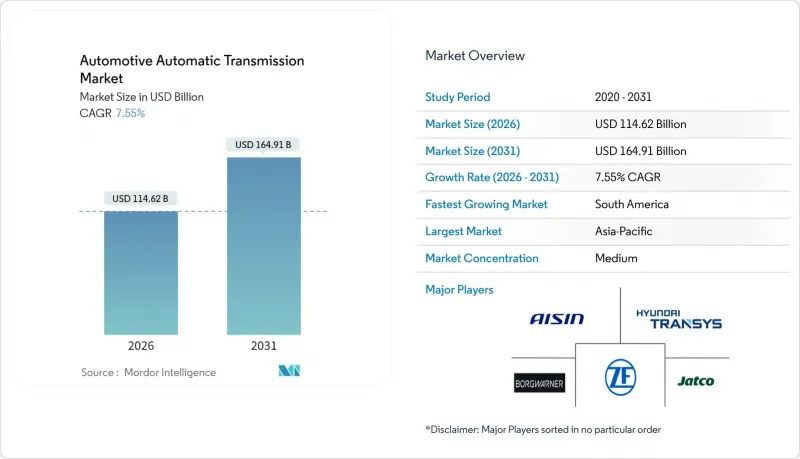
汽车自排变速箱市场预计将从 2025 年的 1,065.7 亿美元成长到 2026 年的 1,146.2 亿美元,预计到 2031 年将达到 1,649.1 亿美元,2026 年至 2031 年的复合年增长率为 7.55%。
日益严格的温室气体排放法规、快速的电气化以及消费者对无缝驾驶体验的需求,持续重塑汽车变速箱市场的技术投资重点。关键的监管目标——尤其是美国环保署 (EPA) 提出的在 2027-2032 年款车型中将车辆平均二氧化碳排放降低 50% 的目标——正推动着汽车製造商 (OEM) 向高效自动变速箱、无段变速箱(CVT) 和双离合器变速箱 (DCT) 转型。电气化动力总成正在加速这项变革。专用混合动力变速箱、多段电力驱动桥和软体定义控制模组是车型更新周期中的核心。竞争优势取决于人工智慧赋能的换檔策略和空中升级架构的集成,这将有助于降低合规成本、创造业务收益并降低汽车变速箱市场的保固风险。
全球汽车自动变速箱市场趋势与洞察
加强全球二氧化碳排放法规
美国环保署 (EPA) 设定了到 2032 年年轻型车辆平均燃油经济性达到 85 克/英里的目标,因此提高变速箱效率对于实现这一目标至关重要。虽然乘用车和轻型卡车每年 2% 的企业平均燃油经济性 (CAFE) 提升目标日益紧迫,但重型皮卡则面临着更严格的每年 10% 的增幅。在模拟测试中,预测性人工智慧换檔策略已将油耗降低了 10.42%。在充电基础设施不完善的地区,汽车製造商正将变速箱升级定位为更快、更经济的减排方式,这使得汽车变速箱市场成为推动监管的关键因素。
转向缓解都市区的拥堵
儘管在印度,自动变速箱的价格比手排变速箱高出约6109美元,但孟买和雅加达等主要城市的走走停停的交通状况仍然推动了对自动变速箱的需求。印度政府的「印度製造」计画和东协的混合动力汽车税收优惠等本土化方案正在缩小这一价格差距。更年轻、更精通技术的消费者越来越倾向于将自动变速箱与减少驾驶疲劳和提高实际燃油经济性联繫起来,加速了自动变速箱在汽车变速箱市场的普及。
高成本且复杂
自动变速箱价格溢价显着,61%的印度买家选择手排变速箱。 8速和10速等多速变速箱增加了电子控制阀体和复杂的液压系统,这限制了研讨会的数量,并增加了总拥有成本(TCO)。虽然爱信等供应商的本地化努力降低了进口关税,但无法完全消除材料成本差距,这限制了它们在汽车变速箱市场的普及。
细分市场分析
到2025年,自动变速箱将占汽车变速箱市场45.60%的份额。高性能双离合器变速箱目前正以3.63%的复合年增长率快速增长,吸引了新兴市场从豪华轿车到紧凑型轿车等各类车型的需求,从而支撑了该细分市场的强劲势头。在日益严格的燃油经济性法规下,人工智慧驱动的换檔逻辑、快速换檔功能和锁定式液压变速箱等技术也推动了这一成长。
电气化代表设计上的转折点,而非生存威胁。例如,伊顿的四速变速箱等商用电动卡车多速变速箱表明,当负载容量和爬坡能力至关重要时,效率的提升足以抵消重量的增加。在汽车变速箱市场,随着原始设备製造商(OEM)透过机械改进和软体更新相结合的方式提供售后升级,自动变速箱平台预计将继续存在。
到2025年,汽油动力系统将占汽车总销量的60.95%,而混合动力汽车预计将以12.62%的复合年增长率成长,成为汽车变速箱市场中成长最快的细分市场。泰国和印尼的监管机构已降低了符合条件的混合动力汽车的销售税和增值税税率,这将加速汽车製造商将专用混合动力变速箱整合到其区域产品阵容中。
虽然电池式电动车主要依赖单速减速器,但研究表明,多级电动驱动装置有望延长高速公路行驶里程。同时,柴油引擎在重型商用车领域仍然占据主导地位,因为该领域对扭矩的需求需要坚固耐用的齿轮组。随着各国充电基础设施发展不平衡,混合动力系统用汽车变速箱的市场规模将持续扩大。
区域分析
亚太地区仍然是汽车变速箱市场最大的贡献者,这主要得益于中国庞大的市场规模以及印度在「印度製造」倡议下大力推进的本地化生产。采埃孚在中国拥有超过50家工厂和技术中心,并计划在2031年将其在该地区的销售份额提升至30%。
到2031年,南美洲将以12.76%的复合年增长率实现最快增长。阿根廷的税收改革使中檔汽车价格降低了高达20%,提高了汽车的可负担性,并促进了自动变速箱的普及。哥伦比亚的八家组装厂和巴西成熟的供应链为该地区製造地的扩张提供了支持,儘管货币波动和政治风险限制了资本投资决策。
北美和欧洲的汽车产量保持稳定,但技术创新步伐迅速。汽车变速箱市场持续专注于高端升级,美国环保署(EPA)的温室气体减排目标和联合国欧洲经济委员会(UNECE)R155网路安全法规推动了对新一代控制模组和软体硬体的需求。中东和非洲地区受都市化和车辆现代化进程的驱动,拥有长期成长潜力,但目前较低的车辆普及率正在减缓近期的成长速度。
其他福利:
- Excel格式的市场预测(ME)表
- 分析师支持(3个月)
目录
第一章 引言
- 研究假设和市场定义
- 调查范围
第二章调查方法
第三章执行摘要
第四章 市场情势
- 市场概览
- 市场驱动因素
- 日益严格的全球二氧化碳排放标准和CAFE法规正在推动汽车製造商对高效自动变速箱、无段变速箱和双离合器变速箱(DCT)的需求。
- 都市区拥挤促使新兴经济体的消费者转向自动驾驶汽车
- 随着混合动力汽车和XEV的普及,需要专用的电子控制变速箱(ECTV、DHT)。
- 可透过OTA升级的TCMS系统开启了新的软体业务收益来源。
- 亚太地区先进自动变速箱製造的生产连结奖励计画
- 人工智慧优化的换班调度可提高燃油经济性并延长动力传动系统寿命
- 市场限制
- 与手排变速箱相比,单位成本更高,维修更复杂。
- 半导体短缺扰乱了传统中医药和机电一体化供应链
- 输电ECU网路安全成本不断增加(UNECE WP.29)
- 保固问题(例如通用汽车8速变速箱震动)会削弱消费者信心。
- 价值/供应链分析
- 监管环境
- 技术展望
- 波特五力模型
- 新进入者的威胁
- 买方的议价能力
- 供应商的议价能力
- 替代品的威胁
- 竞争对手之间的竞争
第五章 市场规模与成长预测
- 按变速器类型
- 自动变速箱(AT)/液力变矩器
- 自动手排变速箱(AMT)
- 无段变速箱(CVT)
- 双离合器变速箱(DCT)
- 按燃料类型
- 汽油
- 柴油引擎
- 油电混合车
- 电池电动(单速电动驱动)
- 按车辆类型
- 搭乘用车
- 轻型商用车
- 中型和重型商用车辆
- 按组件
- 液力变矩器
- 行星齿轮装置
- 液压和机电一体化控制
- 变速箱油
- 按地区
- 北美洲
- 我们
- 加拿大
- 北美其他地区
- 欧洲
- 德国
- 英国
- 法国
- 义大利
- 俄罗斯
- 其他欧洲地区
- 亚太地区
- 中国
- 日本
- 印度
- 韩国
- 亚太其他地区
- 南美洲
- 巴西
- 阿根廷
- 其他南美洲
- 中东和非洲
- 阿拉伯聯合大公国
- 沙乌地阿拉伯
- 南非
- 其他中东和非洲地区
- 北美洲
第六章 竞争情势
- 市场集中度
- 策略趋势
- 市占率分析
- 公司简介
- Aisin Seiki Co., Ltd.
- ZF Friedrichshafen AG
- JATCO Ltd.
- Hyundai Transys
- Allison Transmission Holdings
- BorgWarner Inc.
- Magna International Inc.
- Continental AG
- Schaeffler AG
- Eaton Corporation plc
- Valeo SA
- Punch Powertrain NV
- Tremec
- Shaanxi Fast Auto Drive
第七章 市场机会与未来展望
The Automotive Automatic Transmission market is expected to grow from USD 106.57 billion in 2025 to USD 114.62 billion in 2026 and is forecast to reach USD 164.91 billion by 2031 at 7.55% CAGR over 2026-2031.
Tightening greenhouse-gas rules, rapid electrification, and consumer demand for seamless driving continue to recalibrate technology investment priorities across the automotive transmission market. Regulatory milestones-most notably the Environmental Protection Agency's 50% fleet-average CO2 reduction target for model years 2027-2032-are steering original-equipment manufacturers toward higher-efficiency automatic, continuously variable, and dual-clutch systems. Electrified drivelines amplify this shift: dedicated hybrid transmissions, multi-speed e-axles, and software-defined control modules are now central to model-year refresh cycles. Competitive advantage hinges on integrating AI-enabled shift strategies and over-the-air update architectures, which lower compliance costs, unlock service revenue, and cushion warranty risk in the automotive transmission market.
Global Automotive Automatic Transmission Market Trends and Insights
Tight global CO2 regs
The Environmental Protection Agency now targets an 85 g/mile fleet average for light-duty vehicles by 2032, a mandate that elevates transmission efficiency to compliance linchpin status. Corporate Average Fuel Economy increments of 2% per year for cars and light trucks amplify the urgency, while heavy-duty pickups face a steeper 10% annual climb Predictive AI shift strategies have already cut fuel use by 10.42% in simulation trials. OEMs now treat transmission upgrades as a quicker, lower-cost path to reducing tailpipe emissions where charging infrastructure is immature, positioning the automotive transmission market as a key compliance lever
Urban Congestion Shift
Stop-and-go traffic in megacities such as Mumbai and Jakarta bolsters demand for automated gearboxes, despite price premiums hovering near USD 6,109 over manual variants in India. Government localization schemes under Make-in-India and ASEAN hybrid tax breaks are narrowing that pricing gap. Younger, tech-savvy buyers now associate automatics with lower fatigue and better real-world mileage, accelerating penetration in the automotive transmission market.
High cost & complexity
Automatic gearboxes command notable price premiums that retain 61% of India's buyers in manual segments. Multi-speed 8- and 10-speed designs add electronic valve bodies and complex hydraulics, narrowing the pool of service-ready workshops and heightening total cost of ownership. Localization efforts by suppliers such as Aisin ease import duties but cannot fully erase material cost differentials, restraining adoption in the automotive transmission market
Other drivers and restraints analyzed in the detailed report include:
- Hybrid/xEV e-transmissions
- OTA-ready TCMs
- Semiconductor Shortages
For complete list of drivers and restraints, kindly check the Table Of Contents.
Segment Analysis
Automatic units captured 45.60% of the automotive transmission market share in 2025. Performance-oriented dual-clutch variants, now advancing at 3.63% CAGR, appeal to both premium sedans and emerging-market compacts, reinforcing segment resilience. AI-driven shift logic, gear-jump capability, and lock-up torque converters underpin these gains amid mounting fuel-economy regulations.
E-mobility poses design pivots rather than existential threats. Multi-speed boxes for electric commercial trucks, such as Eaton's 4-speed, show that efficiency gains justify added mass when payload or gradeability is critical. The automotive transmission market size for automatic platforms will therefore persist as OEMs combine mechanical refinement with software updates that unlock post-sale upgrades.
Gasoline powertrains held 60.95% revenue in 2025, yet hybrids are surging with a 12.62% CAGR, the highest within the automotive transmission market. Regulators in Thailand and Indonesia cut excise and VAT rates for qualified hybrids, propelling OEMs to bundle dedicated hybrid transmissions into regional line-ups.
Battery-electric vehicles rely mainly on single-speed reducers, but research suggests multi-speed e-drives could extend highway range. Meanwhile, diesel remains entrenched in heavy-duty fleets where torque demands require robust gearsets. The automotive transmission market size for hybrid systems will keep expanding as charging infrastructure matures unevenly across countries.
The Automotive Automatic Transmission Market Report is Segmented by Transmission Type (Automatic Transmission (AT)/Torque Converter, Automatic Manual (AMT), and More), Fuel Type (Gasoline, Diesel, and More), Vehicle Type (Passenger Cars, Light Commercial Vehicles, and More), Component (Torque Converter, Planetary Gear-Set, and More), and Geography. The Market Forecasts are Provided in Terms of Value (USD) and Volume (Units).
Geography Analysis
Asia-Pacific remains the largest contributor to the automotive transmission market, buoyed by China's scale and India's localisation push under the Make-in-India program. ZF targets raising its regional sales share to 30% by 2031, supported by over 50 plants and technical centres in China .
South America posts the fastest growth at 12.76% CAGR through 2031. Argentina's tax reform slashed mid-range vehicle prices by up to 20%, improving affordability and spurring automatic uptake. Colombia's eight assembly plants and Brazil's established supply base underscore the region's widening manufacturing footprint, even as currency volatility and political risk temper capital-spending decisions.
North America and Europe display stable volumes but high technology churn. EPA greenhouse-gas targets and UNECE R155 cybersecurity rules elevate demand for next-generation control modules and software-friendly hardware, keeping the automotive transmission market focused on premium upgrades. The Middle East and Africa offer long-run upside linked to urbanisation and fleet modernisation, though low current motorisation levels delay near-term scale.
- Aisin Seiki Co., Ltd.
- ZF Friedrichshafen AG
- JATCO Ltd.
- Hyundai Transys
- Allison Transmission Holdings
- BorgWarner Inc.
- Magna International Inc.
- Continental AG
- Schaeffler AG
- Eaton Corporation plc
- Valeo SA
- Punch Powertrain NV
- Tremec
- Shaanxi Fast Auto Drive
Additional Benefits:
- The market estimate (ME) sheet in Excel format
- 3 months of analyst support
TABLE OF CONTENTS
1 Introduction
- 1.1 Study Assumptions and Market Definition
- 1.2 Scope of the Study
2 Research Methodology
3 Executive Summary
4 Market Landscape
- 4.1 Market Overview
- 4.2 Market Drivers
- 4.2.1 Tightening Global CO2 / CAFE Regulations Spur OEM Demand For High-Efficiency AT, CVT and DCT
- 4.2.2 Urban Congestion Drives Consumer Shift To Automatics in Emerging Economies
- 4.2.3 Hybrid and XEV Proliferation Necessitates Dedicated E-Transmissions (ECTV, DHT)
- 4.2.4 OTA-Upgradeable TCMS Open New Software-Service Revenue Streams
- 4.2.5 Asia-Pacific Production-Linked Incentives for Advanced AT Manufacturing
- 4.2.6 AI-Optimized Shift Scheduling Boosts Fuel Economy and Extends Powertrain Life
- 4.3 Market Restraints
- 4.3.1 High Unit Cost and Repair Complexity Versus Manual Transmissions
- 4.3.2 Semiconductor Shortages Disrupting TCM and Mechatronics Supply Chain
- 4.3.3 Rising Cybersecurity-Compliance Costs for Transmission ECUs (UNECE WP.29)
- 4.3.4 Warranty Issues (E.G., GM 8-Speed Shudder) Dent Consumer Confidence
- 4.4 Value / Supply-Chain Analysis
- 4.5 Regulatory Landscape
- 4.6 Technological Outlook
- 4.7 Porter's Five Forces
- 4.7.1 Threat of New Entrants
- 4.7.2 Bargaining Power of Buyers
- 4.7.3 Bargaining Power of Suppliers
- 4.7.4 Threat of Substitutes
- 4.7.5 Competitive Rivalry
5 Market Size and Growth Forecasts (Value (USD), and Volume (Units))
- 5.1 By Transmission Type
- 5.1.1 Automatic (AT)/Torque-Converter
- 5.1.2 Automated Manual (AMT)
- 5.1.3 Continuously Variable (CVT)
- 5.1.4 Dual-Clutch (DCT)
- 5.2 By Fuel Type
- 5.2.1 Gasoline
- 5.2.2 Diesel
- 5.2.3 Hybrid-Electric
- 5.2.4 Battery-Electric (single-speed e-drive)
- 5.3 By Vehicle Type
- 5.3.1 Passenger Cars
- 5.3.2 Light Commercial Vehicles
- 5.3.3 Medium and Heavy Commercial Vehicles
- 5.4 By Component
- 5.4.1 Torque Converter
- 5.4.2 Planetary Gear-set
- 5.4.3 Hydraulic and Mechatronic Controls
- 5.4.4 Transmission Fluid
- 5.5 By Geography
- 5.5.1 North America
- 5.5.1.1 United States
- 5.5.1.2 Canada
- 5.5.1.3 Rest of North America
- 5.5.2 Europe
- 5.5.2.1 Germany
- 5.5.2.2 United Kingdom
- 5.5.2.3 France
- 5.5.2.4 Italy
- 5.5.2.5 Russia
- 5.5.2.6 Rest of Europe
- 5.5.3 Asia-Pacific
- 5.5.3.1 China
- 5.5.3.2 Japan
- 5.5.3.3 India
- 5.5.3.4 South Korea
- 5.5.3.5 Rest of Asia-Pacific
- 5.5.4 South America
- 5.5.4.1 Brazil
- 5.5.4.2 Argentina
- 5.5.4.3 Rest of South America
- 5.5.5 Middle East and Africa
- 5.5.5.1 United Arab Emirates
- 5.5.5.2 Saudi Arabia
- 5.5.5.3 South Africa
- 5.5.5.4 Rest of Middle East and Africa
- 5.5.1 North America
6 Competitive Landscape
- 6.1 Market Concentration
- 6.2 Strategic Moves
- 6.3 Market Share Analysis
- 6.4 Company Profiles (Includes Global Level Overview, Market Level Overview, Core Segments, Financials as Available, Strategic Information, Market Rank/Share for Key Companies, Products and Services, SWOT Analysis, and Recent Developments)
- 6.4.1 Aisin Seiki Co., Ltd.
- 6.4.2 ZF Friedrichshafen AG
- 6.4.3 JATCO Ltd.
- 6.4.4 Hyundai Transys
- 6.4.5 Allison Transmission Holdings
- 6.4.6 BorgWarner Inc.
- 6.4.7 Magna International Inc.
- 6.4.8 Continental AG
- 6.4.9 Schaeffler AG
- 6.4.10 Eaton Corporation plc
- 6.4.11 Valeo SA
- 6.4.12 Punch Powertrain NV
- 6.4.13 Tremec
- 6.4.14 Shaanxi Fast Auto Drive
7 Market Opportunities and Future Outlook

 2026年全球汽车变速箱工程服务外包市场报告
 全球自动变速箱市场规模、份额、趋势和成长分析报告(2026-2034年)汽车变速箱市场规模、份额、成长率和全球产业分析:按类型、应用和地区划分 - 洞察与预测(2026-2034 年)
 中重型商用车变速箱市场-全球产业规模、份额、趋势、机会及预测(按类型、燃料类型、齿轮类型、地区和竞争格局划分,2021-2031年)汽车变速箱工程服务外包市场-全球产业规模、份额、趋势、机会及预测(按变速箱类型、动力传动系统类型、服务、地区和竞争格局划分,2021-2031)
 汽车变速箱市场机会、成长要素、产业趋势分析及预测(2026年至2035年)
 变速箱再製造市场:按变速箱类型、车辆类型、工艺类型和分销管道划分,全球预测,2026-2032年变速箱同步器用黄铜环市场按类型、分销管道、车辆类型和最终用途行业划分-2026年至2032年全球预测
 汽车自动变速箱市场规模、份额和成长分析(按变速箱类型、车辆类型、驱动系统和地区划分)-2026-2033年产业预测汽车自排变速箱市场-全球产业规模、份额、趋势、机会及预测。依车辆类型、燃料类型、类型、地区和竞争格局划分(2021-2031年预测)