


 |
市场调查报告书
商品编码
1934721
骨材:市占率分析、产业趋势与统计、成长预测(2026-2031)Aggregates - Market Share Analysis, Industry Trends & Statistics, Growth Forecasts (2026 - 2031) |
||||||

※ 本网页内容可能与最新版本有所差异。详细情况请与我们联繫。
预计到 2026 年,骨材市场规模将达到 623 亿吨,高于 2025 年的 586.7 亿吨。
预计到 2031 年将达到 841.2 亿吨,2026 年至 2031 年的复合年增长率为 6.19%。
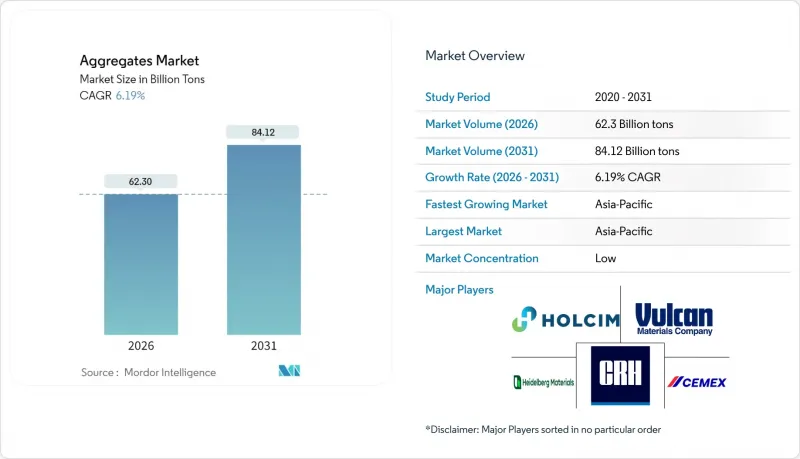
政府不断增加的资本支出计画旨在实现公路、铁路、港口和可再生能源设施的现代化,这支撑了成长前景。新兴经济体的快速都市化、预拌混凝土的日益普及以及公共部门对低碳建筑材料的奖励也推动了需求。主要生产商正在深化垂直整合,以共用采石场所有权,并提高沥青和预拌混凝土业务的物流和采购效率。同时,循环经济政策正在加速对再生骨材加工的投资。然而,柴油价格上涨推高了运输成本,缓慢的环境审批流程延缓了新采石场的开发,而监管机构对再生材料微塑胶污染的审查日益严格,也带来了合规方面的挑战。
全球骨材市场趋势与洞察
亚太新兴市场基础建设投资激增
中国的「十四五」规划提出,到2025年将高速铁路里程延长3800公里,光是安定器、砂和碎石就需要数千万吨。同时,核能发电投资(装置容量。核子反应炉2024-2025财年联邦预算将资本支出增加17.1%,达到111兆印度卢比(约1340亿美元),其中24.5%分配给了公路运输和公路部。这将促进公路、桥樑和地铁线路的采石场产量。预计2020年至2035年间,亚洲整体交通基础设施需求将达到43兆美元,其中63%用于公路建设,这将巩固该地区作为建筑骨材市场关键成长引擎的地位。印尼、越南和菲律宾的智慧城市规划对用于绿色路面和雨水管理系统的透水骨材产生了特殊需求。
扩大预拌混凝土的使用,这需要高规格的骨材
预拌混凝土搅拌站如今在都市区供应链中占据主导地位,提高了高强度混凝土混合料对骨材粒径分布、形状和洁净度的要求。 Aggregate Industries公司将于2024年在伯明罕开设产能120立方公尺/小时的搅拌站,专注于生产低碳ECOPact混凝土。采石场作业中混合料的改进层出不穷,显示对破碎和清洁程度更高的石材供应需求日益增长。随着联准会计画在2025年中期将利率引导至5.5%,美国住宅建设产业的景气预计将会增强,从而维持住宅和资料中心建设对高品质骨材的需求。由两党基础设施法案资金筹措的高速公路维修需要使用Superpave沥青混合料,而这种混合料需要使用由先进的立轴衝击式破碎生产线生产的立方体、低吸水率骨材。新兴的资料中心和人工智慧 (AI) 计算园区指定使用骨材来支撑混凝土混合物,以实现热品质和电磁屏蔽,这为富含磁铁矿和赤铁矿的矿物填料开闢了一个利润丰厚的细分市场。
运输和处理成本不断上涨
对于平均运输距离超过 50 英里的路段,柴油燃料成本可高达交货骨材的 25%。研究表明,缩短 15 英里的运输路线每年可减少 1.78 亿英里的卡车运输里程,节省 2,300 万加仑燃料,并避免 23.8 万吨二氧化碳排放——相当于节省 4.46 亿美元的物流成本。铁路运输的燃油效率是卡车运输的三倍,但由于缺乏专用线和定价机制的不确定性阻碍了铁路运输的普及,美国祇有 9% 的运输量采用铁路运输。地缘政治事件导致的燃料价格波动加剧了预算风险,而欧盟的碳定价机制提高了货运附加费,迫使一些承包商为了控制计划预算,不得不使用当地可获得的低品质骨材。
细分市场分析
到2025年,砂将占骨材市场的40.03%,这反映了其在预拌混凝土、抹灰和沥青中的重要作用。砂的复合年增长率将维持在6.19%,与整体骨材市场趋势一致,亚洲和中东的大型城市大型企划是推动砂需求成长的主要因素。砾石紧随其后,主要用于路基和排水层;而碎石则为结构混凝土和桥面提供了精确的粒径分布。儘管砂製骨材的骨材规模预计将稳定成长,但中国、越南和马来西亚对河砂开采的限制正在促使市场需求转向玄武岩和花岗岩等人工砂。
其他骨材(例如再生混凝土、人造砂和轻质合成骨材)是成长最快的细分市场,年复合成长率达7.6%。再生混凝土骨材目前已符合国家吸水率和洛杉矶磨耗试验标准,并首次获准在德国和荷兰用于结构用途。 CEMEX位于柏林的工厂每年处理40万吨建筑废弃物,证明了其商业规模的可行性,并为其他城市中心提供了借鉴。 2024年,伦敦一栋办公大楼在其楼板中使用了25%的再生骨材,蕴藏量碳排放强度降低了12%——这项指标正日益被纳入资产估值。随着房地产开发商积极寻求绿色建筑认证,预计再生材料在建筑骨材市场中的份额将从目前的个位数增长。
骨材市场报告按骨材类型(砂、砾石、碎石、矿渣、其他骨材类型(再生骨材、人工骨材等))、应用领域(建筑、隔热材料、其他应用)和地区(亚太地区、北美地区、欧洲地区、南美地区、中东和非洲地区)进行细分。市场预测以吨为单位。
区域分析
到2025年,亚太地区将占全球总量的52.07%,并在2031年之前以7.33%的复合年增长率成长。中国到2025年需要新建3800公里高速铁路和新增11.9吉瓦核能发电发电容量,推动了采石场产量创历史新高。同时,印度11.1兆卢比的资本计画提振了对碎花岗岩的需求,特别是用于黄金四边形高速公路的升级改造。日本对抗震交通干线和防波堤维修的投资也维持了对碎硬岩的需求。
北美则位居第二:2023年美国采石场预计出货量为25.2亿吨(价值368亿美元),较上年增长12.5%,这主要得益于两党共同支持的基础设施立法以及製造业回流趋势。在加拿大,安大略省和不列颠哥伦比亚省的铁路分离工程正在加速推进;而在墨西哥,近岸外包推动了巴希奥地区和北部走廊沿线工业园区的建设,从而提振了石灰石需求。强劲的公共预算和预期中的降息週期将支撑2025-2026年的生产。
政策主导的消费将在欧洲保持稳定。欧盟强制推行的建筑废弃物回收政策正在推动对再生骨材的需求,尤其是在德国、法国和北欧国家,公共采购优先考虑低碳替代品。斯堪地那维亚国家对被动式房屋标准的重视也促进了对轻质保温骨材的需求。南美洲和中东及非洲地区的需求相对滞后,但部分地区已呈现加速成长的迹象。沙乌地阿拉伯的NEOM(新未来)计划利用国内采石场的花岗岩辉长岩,以及巴西重启联邦公路养护工程,都为全球建筑骨材市场做出了贡献。
其他福利:
- Excel格式的市场预测(ME)表
- 3个月的分析师支持
目录
第一章 引言
- 研究假设和市场定义
- 调查范围
第二章调查方法
第三章执行摘要
第四章 市场情势
- 市场概览
- 市场驱动因素
- 快速的基础建设投资,尤其是在新兴的亚太市场
- 预拌混凝土的日益普及推动了对高品质骨材的需求。
- 政府奖励策略低碳建筑解决方案
- 循环经济政策鼓励使用再生骨材。
- 物联网赋能的「智慧骨材」用于结构健康监测
- 市场限制
- 高昂的运输和处理成本
- 新采石场需要严格的环境许可
- 柴油价格波动会影响采石场的营运成本。
- 人们对再生骨材中微塑胶污染的担忧
- 价值/供应链分析
- 监管环境
- 技术展望
- 波特五力模型
- 新进入者的威胁
- 买方的议价能力
- 供应商的议价能力
- 替代品的威胁
- 竞争程度
第五章 市场规模与成长预测
- 依骨材类型
- 沙
- 碎石
- 碎石
- 矿渣
- 其他骨材类型(再生骨材、人造骨材等)
- 透过使用
- 建造
- 大楼
- 铁路
- 路
- 其他的
- 隔热材料
- 其他用途
- 建造
- 按地区
- 亚太地区
- 中国
- 日本
- 印度
- 韩国
- 东南亚国协
- 亚太其他地区
- 北美洲
- 我们
- 加拿大
- 墨西哥
- 欧洲
- 德国
- 英国
- 法国
- 义大利
- 西班牙
- 俄罗斯
- 北欧国家
- 其他欧洲地区
- 南美洲
- 巴西
- 阿根廷
- 其他南美洲
- 中东和非洲
- 沙乌地阿拉伯
- 南非
- 其他中东和非洲地区
- 亚太地区
第六章 竞争情势
- 市场集中度
- 策略趋势
- 市占率(%)/排名分析
- 公司简介
- Breedon Group plc
- Buzzi SpA
- Cemex SAB DE CV
- China Resources Building Materials Technology Holdings
- CRH
- Eurocem Limited
- Heidelberg Materials AG
- HOLCIM
- Luck Stone
- Martin Marietta Materials
- Rogers Group Inc.
- Vulcan Materials Company
第七章 市场机会与未来展望
Aggregates market size in 2026 is estimated at 62.3 Billion tons, growing from 2025 value of 58.67 Billion tons with 2031 projections showing 84.12 Billion tons, growing at 6.19% CAGR over 2026-2031.
Rising governmental capital-expenditure programs designed to modernize roads, railways, ports, and renewable-energy sites anchor the growth outlook. Demand also benefits from rapid urbanization in emerging economies, widening adoption of ready-mix concrete, and public-sector incentives for low-carbon building materials. Leading producers are deepening vertical integration so that quarry ownership, asphalt, and ready-mix operations share logistics and procurement efficiencies, while circular-economy mandates accelerate investments in recycled aggregates processing. However, high diesel costs inflate haulage expenses, time-consuming environmental approvals delay new quarries, and regulators increasingly scrutinize recycled materials for micro-plastic contamination, creating compliance hurdles.
Global Aggregates Market Trends and Insights
Surging Infrastructure Spending in Emerging Asia-Pacific Markets
China's five-year plan requires 3,800 km of additional high-speed rail lines by 2025, a target that alone necessitates tens of millions of tons of ballast, sand, and crushed stone. Parallel investments in nuclear energy from 58.08 million kW installed in 2024 to 70 million kW by 2025 further expand concrete demand for reactor bases and ancillary facilities. India's 2024-25 Union Budget raised capital outlays by 17.1% to INR 11.1 lakh crore (USD 134 billion), with 24.5% earmarked for the Ministry of Road Transport and Highways, propelling quarry output for highways, bridges, and metro corridors. Across Asia, transport infrastructure needs of USD 43 trillion between 2020 and 2035, of which 63% is dedicated to roads, cement the region's status as the prime growth engine for the construction aggregates market . Smart-city programs in Indonesia, Vietnam, and the Philippines add specialized demand for permeable aggregates used in green pavements and stormwater management systems.
Rising Adoption of Ready-mix Concrete Requiring High-Spec Aggregates
Ready-mix concrete plants now dominate urban supply chains, pushing baseline specifications for gradation, shape, and cleanliness of aggregates used in high-strength mixes. Aggregate Industries opened a 120 m3/hour plant in Birmingham in 2024, emphasizing low-carbon ECOPact concrete, illustrating how formulation changes ripple back to quarry operations that must supply more precisely crushed and washed stone. US residential-construction sentiment is expected to firm as the Federal Reserve guides policy rates to 5.5% by mid-2025, sustaining premium-grade aggregate demand in housing and data-center builds. Highway refurbishments funded by the Bipartisan Infrastructure Law require Superpave asphalt mixes demanding cubical, low-absorption aggregates derived from advanced vertical-shaft impact crushing lines. Emerging data-center and Artificial Intelligence (AI)-compute campuses specify aggregates that support concrete mixes engineered for thermal mass and electromagnetic shielding, opening high-margin niches for mineral fillers rich in magnetite or hematite.
High Transportation and Handling Costs
Diesel-fuel expenses can equal 25% of delivered aggregate price when average haul distances exceed 50 miles. Research shows that trimming haul routes by 15 miles could cut 178 million truck-miles, save 23 million gallons of fuel, and avoid 238,000 tons of CO2 yearly, translating into USD 446 million of logistical savings. Rail is 3-times more fuel-efficient than trucks, yet only 9% of United States shipments move by rail because limited sidings and opaque rate-setting deter adoption . Fuel-price volatility following geopolitical events magnifies budget risk, and carbon-pricing schemes in the EU raise freight surcharges, prompting some contractors to substitute locally available yet lower-quality aggregates to stay within project budgets.
Other drivers and restraints analyzed in the detailed report include:
- Government Stimulus for Low-Carbon Construction Solutions
- Circular-Economy Mandates Boosting Use of Recycled Aggregates
- Stringent Environmental Permitting for New Quarries
For complete list of drivers and restraints, kindly check the Table Of Contents.
Segment Analysis
Sand commanded 40.03% of the Aggregates market in 2025, reflecting its indispensable role in ready-mix concrete, plaster, and asphalt. At 6.19% CAGR, sand remains aligned with the overall Aggregates market trajectory as urban mega-projects across Asia and the Middle East sustain bulk demand. Gravel follows, preferred for road bases and drainage layers, while crushed stone supplies precise gradation for structural concrete and bridge decks. The Aggregates market size attributed to sand is projected to climb steadily, but permit caps on river-sand extraction in China, Vietnam, and Malaysia shift volumes toward manufactured sand sourced from basalt and granite.
Other aggregate types, including recycled concrete, manufactured sand, and lightweight synthetics, represent the fastest-growing slice at a 7.6% CAGR. Recycled concrete aggregates now meet national-standard water-absorption and Los Angeles-abrasion limits, allowing use in structural elements for the first time in Germany and the Netherlands. Cemex's Berlin plant processes 400,000 tons of CDW annually, signalling commercial-scale viability and offering a template for other urban nodes . When a London office tower reused 25% recycled aggregate in its floor slabs in 2024, embodied-carbon intensity fell by 12%, a metric increasingly embedded in asset valuations. As property developers chase green-building credits, the construction aggregates market share of recycled materials is poised to widen beyond its current single-digit level.
The Aggregate Market Report is Segmented by Aggregate Type (Sand, Gravel, Crushed Stone, Slag, and Other Aggregate Types (Recycled, Manufactured, Etc. )), Application (Construction, Insulation, and Other Applications), and Geography (Asia-Pacific, North America, Europe, South America, and Middle East and Africa). The Market Forecasts are Provided in Terms of Volume (tons).
Geography Analysis
Asia-Pacific held 52.07% of global volume in 2025 and is pacing at 7.33% CAGR to 2031. China's need for 3,800 km of new high-speed rail by 2025 and a nuclear-power-capacity uplift of 11.9 million kW push quarry production to records, while India's INR 11.1 lakh crore capital program enriches demand for crushed granite, especially in the Golden Quadrilateral highway upgrades. Japan invests in earthquake-resilient transport arteries and seawall refurbishments, sustaining orders for hard-rock rip-rap.
North America ranks second: United States quarries shipped 2.52 billion tons in 2023 valued at USD 36.8 billion, a 12.5% year-over-year gain, on the back of the Bipartisan Infrastructure Law and manufacturing-onshoring wave. Canada accelerates rail-grade separations in Ontario and British Columbia, while Mexico's nearshoring adds industrial parks along the Bajio and northern corridors that favour limestone. Robust public budgets and an anticipated interest-rate easing cycle underpin 2025-26 pour volumes.
Europe maintains stable, policy-driven consumption. European Union (EU)-wide Construction and Demolition Waste (CDW) recycling mandates create pull-through for secondary aggregates, particularly in Germany, France, and the Nordics, where public procurement favors low-carbon alternatives. Scandinavia's emphasis on passive-house standards lifts demand for lightweight insulation aggregates. South America and the Middle East & Africa trail but exhibit pockets of acceleration: Saudi Arabia's NEOM (New Future) project sources granitic gabbro from domestic quarries, and Brazil revives its federal-road-maintenance backlog, each injecting incremental demand into the global construction aggregates market.
- Breedon Group plc
- Buzzi S.p.A.
- Cemex S.A.B DE C.V.
- China Resources Building Materials Technology Holdings
- CRH
- Eurocem Limited
- Heidelberg Materials AG
- HOLCIM
- Luck Stone
- Martin Marietta Materials
- Rogers Group Inc.
- Vulcan Materials Company
Additional Benefits:
- The market estimate (ME) sheet in Excel format
- 3 months of analyst support
TABLE OF CONTENTS
1 Introduction
- 1.1 Study Assumptions and Market Definition
- 1.2 Scope of the Study
2 Research Methodology
3 Executive Summary
4 Market Landscape
- 4.1 Market Overview
- 4.2 Market Drivers
- 4.2.1 Surging Infrastructure Spending, Especially in Emerging Asia-Pacific Markets
- 4.2.2 Rising Adoption of Ready-mix Concrete Driving Demand for High-spec Aggregates
- 4.2.3 Government Stimulus for Low-Carbon Construction Solutions
- 4.2.4 Circular-economy Mandates Boosting Use of Recycled Aggregates
- 4.2.5 Internet of Things (IoT)-enabled "Smart Aggregates" for Structural Health Monitoring
- 4.3 Market Restraints
- 4.3.1 High Transportation and Handling Costs
- 4.3.2 Stringent Environmental Permitting for New Quarries
- 4.3.3 Volatility in Diesel Prices Impacting Quarry Opex
- 4.3.4 Micro-plastic Contamination Concerns in Recycled Aggregates
- 4.4 Value / Supply-Chain Analysis
- 4.5 Regulatory Landscape
- 4.6 Technological Outlook
- 4.7 Porter's Five Forces
- 4.7.1 Threat of New Entrants
- 4.7.2 Bargaining Power of Buyers
- 4.7.3 Bargaining Power of Suppliers
- 4.7.4 Threat of Substitutes
- 4.7.5 Degree of Competition
5 Market Size and Growth Forecasts (Volume)
- 5.1 By Aggregate Type
- 5.1.1 Sand
- 5.1.2 Gravel
- 5.1.3 Crushed Stone
- 5.1.4 Slag
- 5.1.5 Other Aggregate Types (Recycled, Manufactured, etc.)
- 5.2 By Application
- 5.2.1 Construction
- 5.2.1.1 Buildings
- 5.2.1.2 Railways
- 5.2.1.3 Roadways
- 5.2.1.4 Others
- 5.2.2 Insulation
- 5.2.3 Other Applications
- 5.2.1 Construction
- 5.3 By Geography
- 5.3.1 Asia-Pacific
- 5.3.1.1 China
- 5.3.1.2 Japan
- 5.3.1.3 India
- 5.3.1.4 South Korea
- 5.3.1.5 ASEAN Countries
- 5.3.1.6 Rest of Asia-Pacific
- 5.3.2 North America
- 5.3.2.1 United States
- 5.3.2.2 Canada
- 5.3.2.3 Mexico
- 5.3.3 Europe
- 5.3.3.1 Germany
- 5.3.3.2 United Kingdom
- 5.3.3.3 France
- 5.3.3.4 Italy
- 5.3.3.5 Spain
- 5.3.3.6 Russia
- 5.3.3.7 NORDIC Countries
- 5.3.3.8 Rest of Europe
- 5.3.4 South America
- 5.3.4.1 Brazil
- 5.3.4.2 Argentina
- 5.3.4.3 Rest of South America
- 5.3.5 Middle East and Africa
- 5.3.5.1 Saudi Arabia
- 5.3.5.2 South Africa
- 5.3.5.3 Rest of Middle East and Africa
- 5.3.1 Asia-Pacific
6 Competitive Landscape
- 6.1 Market Concentration
- 6.2 Strategic Moves
- 6.3 Market Share(%)/Ranking Analysis
- 6.4 Company Profiles (includes Global level Overview, Market level overview, Core Segments, Financials as available, Strategic Information, Market Rank/Share for key companies, Products and Services, and Recent Developments)
- 6.4.1 Breedon Group plc
- 6.4.2 Buzzi S.p.A.
- 6.4.3 Cemex S.A.B DE C.V.
- 6.4.4 China Resources Building Materials Technology Holdings
- 6.4.5 CRH
- 6.4.6 Eurocem Limited
- 6.4.7 Heidelberg Materials AG
- 6.4.8 HOLCIM
- 6.4.9 Luck Stone
- 6.4.10 Martin Marietta Materials
- 6.4.11 Rogers Group Inc.
- 6.4.12 Vulcan Materials Company
7 Market Opportunities and Future Outlook
- 7.1 White-space and unmet-need assessment
- 7.2 Smart and Self-Healing Concrete Transforming Aggregate Market

 2034年废弃物衍生建筑骨材市场预测:按材料类型、加工技术、应用、最终用户和地区分類的全球分析
 2026年全球道路建设用骨材市场报告电子废弃物回收材料市场预测至2034年-按材料类型、来源、回收流程、应用、最终用户、收集管道和地区分類的全球分析
 2026-2034年全球骨材市场规模、份额、趋势和成长分析报告全球建筑骨材市场规模、份额、趋势和成长分析报告(2026-2034)
 建筑骨材市场:按类型、材料和最终用途划分,全球预测(2026-2032年)
 骨材骨材市场规模、份额和成长分析:按产品类型、应用、最终用户、原材料来源、通路和地区划分-2026-2033年产业预测2026年全球建筑骨材市场报告
 建筑骨材市场分析及预测(至2035年):依类型、产品、应用、材料类型、製程、最终用户、技术、安装类型、设备及解决方案划分
 日本建筑骨材市场规模、份额、趋势和预测:按类型、应用和地区划分,2026-2034年