


 |
市场调查报告书
商品编码
1934766
欧洲发电机组:市场占有率分析、产业趋势与统计、成长预测(2026-2031 年)Europe Generator Sets - Market Share Analysis, Industry Trends & Statistics, Growth Forecasts (2026 - 2031) |
||||||

※ 本网页内容可能与最新版本有所差异。详细情况请与我们联繫。
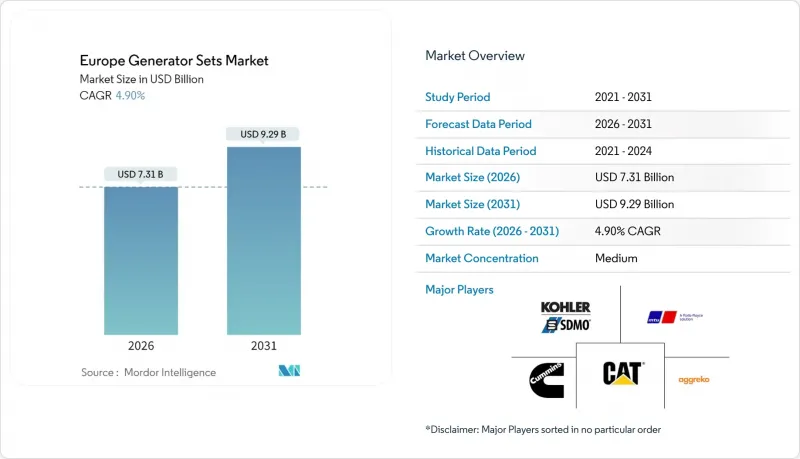
预计到 2026 年,欧洲发电机组市场价值将达到 73.1 亿美元。
预计该产业规模将从 2025 年的 69.7 亿美元成长到 2031 年的 92.9 亿美元,2026 年至 2031 年的复合年增长率为 4.9%。
随着资料中心、医疗机构和可再生能源计划寻求低碳备用电源,市场需求正从纯柴油产品转向双燃料、天然气和氢燃料平台。企业永续发展计画、第五阶段排放法规以及大都会圈的电网拥塞正在加速这一转型,而电池-发电机混合系统和模组化建筑则正在改变采购趋势。德国仍然是最大的单一国家市场,但西班牙快速的可再生能源部署和基础设施规划正推动最快的成长。在容量方面,75kVA至375kVA的容量仍占据出货量的主导地位,但超大规模资料中心正在推动750kVA至2000kVA机组的需求激增。竞争策略的重点是燃料独立式发动机、氢燃料试点项目和数位化互联的租赁车队,这些都为微电网部署、孤岛供电和建筑工地开闢了新的机会。
欧洲发电机组市场趋势与洞察
资料中心和医疗领域对可靠备用电源的需求日益增长
法兰克福、阿姆斯特丹、巴黎和都柏林的资料中心营运商正在增设兆瓦级发电机组,以缓解电网压力,满足Tier III运作,并在频率响应市场实现容量货币化。医院正在升级到模组化、可并联运转的发电机组,以满足EN 50172切换规则和24小时燃料储备要求。康明斯预计2024年欧洲资料中心订单将实现两位数成长,其中3500 kVA QSK95成为首选平台。设备越来越多地被指定用于备用和尖峰用电调节,从而延长平均运作并推动对低氮氧化物燃气机组的需求。医疗保健采购者更倾向于选择具备远距离诊断功能的设备,以支援预防性保养和ISO 22301业务连续性审核。
欧洲各地建筑业蓬勃发展,基础建设升级改造。
西班牙的太阳能和交通基础设施扩建、波兰的铁路网路更新以及义大利的国家復苏和韧性计划,都导致计划工期延长,并促使行动电源租赁合约的期限也随之延长。预计到2024年,欧洲建设产业的产值将达到1.6兆欧元,而对于缺乏固定现场电源的场所而言,100kVA至500kVA的可携式发电机仍然至关重要。 Aggreko公司在2024年将其欧洲租赁设备规模扩大了12%,推出了符合欧V排放标准的柴油-电池混合动力发电机,这些发电机在低负载运转时可降低30%的油耗。承包商越来越多地要求使用具备遥测功能的设备,以便即时监控运作时间、排放和油耗,并且越来越多地将发电机整合到更广泛的现场管理仪錶板中。
欧盟第五/六阶段排放气体法规将增加资本支出(CAPEX)和营运费用(OPEX)。
第五阶段排放标准将于2024年全面实施,届时功率超过56千瓦的柴油发电机必须配备柴油颗粒过滤器(DPF)、选择性催化还原(SCR)和废气再循环(EGR)系统,将使购置成本增加高达18%。此外,柴油引擎废气处理液(DEF)的添加和过滤器再生维护成本将增加0.02至0.04欧元/kWh。功率在75千伏安至375千伏安之间的小规模用户正在推迟升级或转向燃气发电机,阿特拉斯·科普柯公司200千伏安以下柴油发电机订单下降9%,而燃气和混合动力机组的出货量增长14%,便印证了这一点。提案的第六阶段排放标准将从2027年起进一步收紧氮氧化物(NOx)排放标准,提高30%。这将迫使原始设备製造商(OEM)采用氨逃逸催化剂,进一步增加成本并促使用户转向其他燃料。
细分市场分析
2025年,75kVA至375kVA功率等级的发电机组将占据欧洲发电机组市场34.62%的份额,这得益于标准化的机壳、大规模生产和具有竞争力的价格。这些机组为零售连锁店和商业建筑的空调、冷冻和销售点系统提供备用电源。随着电池储能技术在小规模併网负载中的渗透率不断提高,市场增长速度有所放缓,但由于第五阶段排放法规要求使用新型硬件,替换需求仍将持续存在。
750 kVA 至 2,000 kVA 容量段的复合年增长率将达到 6.25%,主要成长动力来自资料中心园区和大型製造厂部署的 N+1 模组化不间断不断电系统系统。康明斯 3,500 kVA QSK95 机组允许操作员在不重新设计开关设备的情况下增加 1 MW 的容量模组,从而缩短安装时间。 2,000 kVA 以上的容量段,併网电力公司和独立电力公司正在部署 Walsill 和 Caterpillar 的燃气或双燃料机组。 75 kVA 以下的容量段,在停电时间不超过四小时的地区,住宅和小规模商业用电需求正在下降,因此电池-逆变器组合更受欢迎。
到2025年,柴油将占燃料结构的52.88%,这主要归功于其大规模的装机量和广泛的供应。第五阶段排放标准、都市区低排放区以及范围2排放目标正在推动双燃料引擎的普及,这类引擎可减少30%的二氧化碳排放和50%的颗粒物排放。天然气引擎的需求量将占约22%,主要集中在德国和荷兰等天然气管道密集的地区。同时,生质燃料车型的占比将维持在3%以下,但随着Neste公司氢化植物油(HVO)供应量的增加,其规模正在扩大。
康明斯、沃尔西尔和罗尔斯·罗伊斯的氢燃料引擎于2024年投入商业应用。目前氢燃料引擎的普及率仍低于1%,但随着电解建设和管道基础设施的成熟,预计普及率将会上升。丙烷、沼气和垃圾掩埋沼气引擎的应用则更为有限。预计到2031年,柴油引擎的市占率将降至47.50%以下,但这主要是由于天然气和混合动力产品的快速成长,而非柴油引擎将被完全取代。
欧洲发电机组市场报告按容量(小于 75KVA、75-375KVA、375-750KVA、750-2,000KVA、大于2,000KVA)、燃料类型(柴油、天然气、双燃料/混合动力、可再生/生质燃料、其他)、应用(紧急电源、市电/不间断电源、其他)、最终用户(住宅、商业建筑、资料中心、其他)和地区(德国、英国、西班牙、其他)进行细分。
其他福利:
- Excel格式的市场预测(ME)表
- 3个月的分析师支持
目录
第一章 引言
- 市场定义与研究假设
- 调查范围
第二章调查方法
第三章执行摘要
第四章 市场情势
- 市场概览
- 市场驱动因素
- 资料中心和医疗领域对可靠备用电源的需求日益增长
- 欧洲各地的建筑业蓬勃发展和基础建设也在加速发展。
- 电网基础设施老化和气候变迁导致停电
- 在岛屿和矿区引进柴油-太阳能混合微电网
- 企业永续性目标推动了对天然气和生质燃料发电机的需求
- 氢燃料电池发电机组的商业化进程开始
- 市场限制
- 欧盟第五/六阶段排放标准增加了资本支出(CAPEX)和营运成本(OPEX)。
- 提高电网可靠性可降低备用需求
- 电池成本的急剧下降(超过200欧元/千瓦时)对小型柴油发电机构成了挑战。
- 欧盟碳边境调节机制导致出口成本增加
- 供应链分析
- 监管环境
- 技术展望
- 波特五力分析
- 供应商的议价能力
- 消费者议价能力
- 新进入者的威胁
- 替代产品和服务的威胁
- 竞争对手之间的竞争
第五章 市场规模与成长预测
- 按产能
- 小于75千伏安
- 75~375kVA
- 375~750 kVA
- 750~2,000 kVA
- 2000千伏安或以上
- 按燃料类型
- 柴油引擎
- 天然气
- 双燃料和混合动力
- 可再生能源/生质燃料
- 其他的
- 透过使用
- 应急电源
- 主电源/持续电源
- 尖峰用电调节
- 租赁/临时电源
- 微电网和混合支持
- 最终用户
- 住宅
- 商业建筑
- 工业/製造业
- 资料中心
- 医疗设施
- 石油和天然气
- 公共产业/电力
- 采矿和建设业
- 按地区
- 德国
- 英国
- 法国
- 义大利
- 西班牙
- 北欧国家
- 俄罗斯
- 其他欧洲地区
第六章 竞争情势
- 市场集中度
- 策略性倡议(併购、伙伴关係、购电协议)
- 市场占有率分析(主要企业的市场排名和份额)
- 公司简介
- Cummins Inc.
- Caterpillar Inc.
- Rolls-Royce Power Systems(MTU)
- Generac Holdings Inc.
- Kohler Co./SDMO
- Aggreko plc
- Wartsila Corp.
- Yanmar Holdings Co. Ltd.
- Mitsubishi Heavy Industries Ltd.
- Perkins Engines Company Ltd.
- FG Wilson
- HIMOINSA SL
- Volvo Penta
- Kirloskar Oil Engines Ltd.
- Pramac SpA
- Atlas Copco AB
- Doosan Portable Power
- DEUTZ AG
- Honda Power Products
- Briggs & Stratton
第七章 市场机会与未来展望
Europe Generator Sets market size in 2026 is estimated at USD 7.31 billion, growing from 2025 value of USD 6.97 billion with 2031 projections showing USD 9.29 billion, growing at 4.9% CAGR over 2026-2031.
Demand is shifting from diesel-only products to dual-fuel, gas and hydrogen-ready platforms as data centers, healthcare facilities, and renewable energy projects seek lower-carbon back-up power. Corporate sustainability programs, Stage V emissions rules, and grid congestion in metropolitan clusters are accelerating the transition, while battery-genset hybrids and modular architectures are reshaping procurement preferences. Germany remains the single-largest country market, but Spain's rapid renewable build-out and infrastructure programs are creating the fastest incremental growth. At the capacity level, the 75 kVA to 375 kVA segment still dominates shipments, yet hyperscale data centers are driving a swift rise in demand for 750 kVA to 2,000 kVA units. Competitive strategies center on fuel-agnostic engines, hydrogen pilots, and digitally connected rental fleets, which open up opportunities in microgrid deployments, island utilities, and construction sites.
Europe Generator Sets Market Trends and Insights
Growing Demand for Reliable Back-Up Power in Data Centers & Healthcare
Data-center operators in Frankfurt, Amsterdam, Paris, and Dublin are adding multi-megawatt generators to offset grid constraints, satisfy Tier III uptime, and monetize capacity in frequency-response markets. Hospitals are upgrading to modular, parallel-capable gensets to meet EN 50172 switchover rules and 24-hour fuel reserve requirements. Cummins logged a double-digit increase in European data-center orders in 2024, with its 3,500 kVA QSK95 emerging as a preferred platform. Equipment is increasingly specified for both standby and peak-shaving roles, lifting average runtime and driving demand for low-NOx gas units. Healthcare buyers favor units with remote diagnostics to support preventive maintenance and ISO 22301 business continuity audits.
Construction Boom & Infrastructure Upgrades Across Europe
Spain's solar and transport build-out, Poland's rail overhaul, and Italy's National Recovery and Resilience Plan are stretching project timelines and extending rental contracts for mobile power. The European construction sector generated EUR 1.6 trillion of output in 2024, and portable gensets between 100 kVA and 500 kVA remain essential where sites lack a permanent grid supply. Aggreko expanded its European rental fleet by 12% in 2024, with Stage V-compliant diesel-battery hybrids cutting fuel by 30% during low-load hours. Contractors increasingly demand telemetry-enabled sets to monitor runtime, emissions, and fuel use in real time, embedding gensets into broader site-management dashboards.
EU Stage V/VI Emission Norms Heighten CAPEX & OPEX
Stage V rules, fully effective from 2024, compel diesel gensets above 56 kW to add diesel particulate filters, SCR, and EGR, lifting capital cost by up to 18% and adding EUR 0.02-0.04 /kWh in maintenance for DEF replenishment and filter regeneration. Smaller buyers in the 75 kVA-375 kVA range are deferring replacements or shifting to gas units, evidenced by a 9% drop in diesel orders below 200 kVA at Atlas Copco and a 14% rise in gas and hybrid shipments. Proposed Stage VI limits would tighten NOx thresholds by an additional 30% after 2027, prompting OEMs to adopt ammonia-slip catalysts, which would drive further cost escalation and encourage fuel switching.
Other drivers and restraints analyzed in the detailed report include:
- Aging Grid Infrastructure & Climate-Driven Outages
- Hybrid Diesel-Solar Micro-Grids on Islands & Mine Sites
- Battery Storage Cost Plunge Challenges Small Diesel Sets
For complete list of drivers and restraints, kindly check the Table Of Contents.
Segment Analysis
The 75 kVA-375 kVA bracket accounted for 34.62% of the European generator sets market share in 2025, supported by standardized enclosures, high-volume production, and competitive pricing. These units back up HVAC, refrigeration, and point-of-sale systems in retail chains and commercial buildings. Growth is flattening as battery storage penetrates small, grid-connected loads, yet replacement demand persists because Stage V compliance mandates newer hardware.
The 750 kVA-2,000 kVA segment is on track for a 6.25% CAGR, propelled by data-center campuses and large-scale manufacturing that implement modular sets in N+1 layouts to achieve uninterrupted power. Cummins' 3,500 kVA QSK95 enables operators to add 1 MW blocks without re-engineering switchgear, reducing installation timelines. Above 2,000 kVA, applications include grid-balancing and island utilities deploying gas or dual-fuel units from Wartsila and Caterpillar. Below 75 kVA, residential and small commercial demand is shrinking as battery-inverter combinations gain favor in regions with outage durations of four hours or less.
Diesel held 52.88% of the 2025 fuel mix, mostly due to a large installed base and universal fuel availability. Stage V costs, urban low-emission zones, and Scope 2 targets are prompting buyers to adopt dual-fuel sets that emit 30% less CO2 and 50% less particulates. Natural-gas units represent roughly 22% of demand, concentrated in pipeline-dense regions such as Germany and the Netherlands, while bio-fuel-ready models remain below 3% but are scaling with HVO supply increases from Neste.
Hydrogen-ready engines from Cummins, Wartsila, and Rolls-Royce entered commercial portfolios in 2024; adoption is still under 1% but is expected to climb once electrolyzer build-outs and pipeline infrastructure mature. Propane, biogas, and landfill-gas engines serve tighter, niche sectors. Diesel's share is forecast to drop below 47.50% by 2031, not due to outright displacement, but rather because of faster growth in gas and hybrid offerings.
The Europe Generator Sets Market Report is Segmented by Capacity (Below 75 KVA, 75 To 375 KVA, 375 To 750 KVA, 750 To 2, 000 KVA, and Above 2, 000 KVA), Fuel Type (Diesel, Natural Gas, Dual-Fuel and Hybrid, Renewable/Bio-fuel, and Others), Application (Standby Power, Prime/Continuous Power, and More), End-User (Residential, Commercial Buildings, Data Centers, and More), and Geography (Germany, United Kingdom, Spain, and More).
List of Companies Covered in this Report:
- Cummins Inc.
- Caterpillar Inc.
- Rolls-Royce Power Systems (MTU)
- Generac Holdings Inc.
- Kohler Co. / SDMO
- Aggreko plc
- Wartsila Corp.
- Yanmar Holdings Co. Ltd.
- Mitsubishi Heavy Industries Ltd.
- Perkins Engines Company Ltd.
- FG Wilson
- HIMOINSA S.L.
- Volvo Penta
- Kirloskar Oil Engines Ltd.
- Pramac S.p.A.
- Atlas Copco AB
- Doosan Portable Power
- DEUTZ AG
- Honda Power Products
- Briggs & Stratton
Additional Benefits:
- The market estimate (ME) sheet in Excel format
- 3 months of analyst support
TABLE OF CONTENTS
1 Introduction
- 1.1 Market Definition & Study Assumptions
- 1.2 Scope of the Study
2 Research Methodology
3 Executive Summary
4 Market Landscape
- 4.1 Market Overview
- 4.2 Market Drivers
- 4.2.1 Growing demand for reliable back-up power in data centres & healthcare
- 4.2.2 Construction boom & infrastructure upgrades across Europe
- 4.2.3 Aging grid infrastructure & climate-driven outages
- 4.2.4 Hybrid diesel-solar microgrids adoption on islands & mine sites
- 4.2.5 Corporate sustainability targets boosting gas & biofuel gensets
- 4.2.6 Commercial launch of hydrogen-ready generator engines
- 4.3 Market Restraints
- 4.3.1 EU Stage V/VI emission norms heighten CAPEX & OPEX
- 4.3.2 Grid reliability improvements curb standby demand
- 4.3.3 Battery storage cost plunge (More Than EUR 200/kWh) challenges small diesel sets
- 4.3.4 EU Carbon Border Adjustment Mechanism raises export costs
- 4.4 Supply-Chain Analysis
- 4.5 Regulatory Landscape
- 4.6 Technological Outlook
- 4.7 Porter's Five Forces Analysis
- 4.7.1 Bargaining Power of Suppliers
- 4.7.2 Bargaining Power of Consumers
- 4.7.3 Threat of New Entrants
- 4.7.4 Threat of Substitute Products & Services
- 4.7.5 Intensity of Competitive Rivalry
5 Market Size & Growth Forecasts
- 5.1 By Capacity
- 5.1.1 Below 75 kVA
- 5.1.2 75 to 375 kVA
- 5.1.3 375 to 750 kVA
- 5.1.4 750 to 2,000 kVA
- 5.1.5 Above 2,000 kVA
- 5.2 By Fuel Type
- 5.2.1 Diesel
- 5.2.2 Natural Gas
- 5.2.3 Dual-Fuel and Hybrid
- 5.2.4 Renewable/Bio-fuel
- 5.2.5 Others
- 5.3 By Application
- 5.3.1 Standby Power
- 5.3.2 Prime/Continuous Power
- 5.3.3 Peak-Shaving
- 5.3.4 Rental/Temporary Power
- 5.3.5 Micro-grid and Hybrid Support
- 5.4 By End-User
- 5.4.1 Residential
- 5.4.2 Commercial Buildings
- 5.4.3 Industrial and Manufacturing
- 5.4.4 Data Centers
- 5.4.5 Healthcare Facilities
- 5.4.6 Oil and Gas
- 5.4.7 Utilities and Power
- 5.4.8 Mining and Construction
- 5.5 By Geography
- 5.5.1 Germany
- 5.5.2 United Kingdom
- 5.5.3 France
- 5.5.4 Italy
- 5.5.5 Spain
- 5.5.6 NORDIC Countries
- 5.5.7 Russia
- 5.5.8 Rest of Europe
6 Competitive Landscape
- 6.1 Market Concentration
- 6.2 Strategic Moves (M&A, Partnerships, PPAs)
- 6.3 Market Share Analysis (Market Rank/Share for key companies)
- 6.4 Company Profiles (includes Global level Overview, Market level overview, Core Segments, Financials as available, Strategic Information, Products & Services, and Recent Developments)
- 6.4.1 Cummins Inc.
- 6.4.2 Caterpillar Inc.
- 6.4.3 Rolls-Royce Power Systems (MTU)
- 6.4.4 Generac Holdings Inc.
- 6.4.5 Kohler Co. / SDMO
- 6.4.6 Aggreko plc
- 6.4.7 Wartsila Corp.
- 6.4.8 Yanmar Holdings Co. Ltd.
- 6.4.9 Mitsubishi Heavy Industries Ltd.
- 6.4.10 Perkins Engines Company Ltd.
- 6.4.11 FG Wilson
- 6.4.12 HIMOINSA S.L.
- 6.4.13 Volvo Penta
- 6.4.14 Kirloskar Oil Engines Ltd.
- 6.4.15 Pramac S.p.A.
- 6.4.16 Atlas Copco AB
- 6.4.17 Doosan Portable Power
- 6.4.18 DEUTZ AG
- 6.4.19 Honda Power Products
- 6.4.20 Briggs & Stratton
7 Market Opportunities & Future Outlook
- 7.1 White-space & Unmet-Need Assessment

 发电机组市场:依燃料类型、型号、相数、额定输出功率及最终用户划分-2026-2032年全球市场预测防水发电机组市场:依燃料类型、额定功率、应用、便携性、相数、冷却方式和机壳类型划分,全球预测,2026-2032年
 尖峰用电调节发电机组市场:商业机会、成长要素、产业趋势分析及2026-2035年预测重油发电机组市场(依引擎类型、额定功率、安装方式、冷却方式、燃油管理系统及最终用途划分),全球预测(2026-2032)2026 年至 2035 年商用发电机市场机会、成长要素、产业趋势分析及预测。
 发电机组:市场占有率分析、产业趋势与统计、成长预测(2026-2031)
 2026年全球发电机组市场报告
 发电机市场-全球产业规模、份额、趋势、机会、预测:按燃料类型、功率输出、便携性、应用、地区和竞争格局划分,2021-2031年发电机组市场 - 全球产业规模、份额、趋势、机会及预测(按容量、应用、最终用户、燃料、地区和竞争格局划分),2021-2031年发电机组市场机会、成长要素、产业趋势分析及2026年至2035年预测