


 |
市场调查报告书
商品编码
1934895
泰国施工机械市场占有率分析、产业趋势及统计、成长预测(2026-2031)Thailand Construction Equipment - Market Share Analysis, Industry Trends & Statistics, Growth Forecasts (2026 - 2031) |
||||||

※ 本网页内容可能与最新版本有所差异。详细情况请与我们联繫。
2025年泰国施工机械市场价值12.2亿美元,预计到2031年将达到16.1亿美元,高于2026年的12.8亿美元。
预计在预测期(2026-2031 年)内,复合年增长率将达到 4.72%。
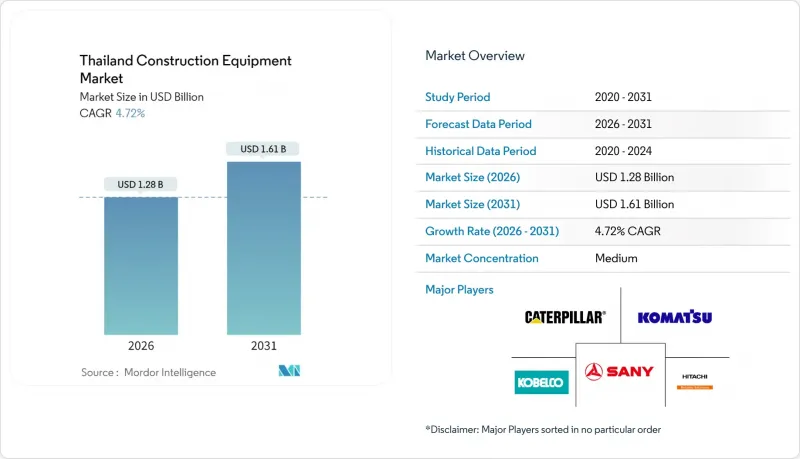
这一成长轨迹反映了泰国作为东南亚当地基础设施枢纽的地位、东部经济走廊(EEC)大型企划计画以及政府对多式联运网路的持续投入。泰国迅速崛起为电动车製造地也促进了需求,维持了工厂建设的势头。施工机械供应商正抓住旅游业主导旅馆业復苏、可再生能源设施扩张以及「设备即服务」模式转变带来的机会,该模式旨在解决承包商利润率低的问题。竞争日趋激烈,全球原始设备製造商(OEM)试图抵御来自中国成本优势製造商的市场份额挑战,而本地租赁业者则在拓展附加价值服务以应对熟练操作人员短缺的问题。
泰国施工机械市场趋势与洞察
东部经济走廊(EEC)大型企划的激增
东欧经济走廊二期工程包含77个计划,港口、铁路和高速公路的同步建设将推动2025年至2027年间对设备的需求。走廊内的资料中心建设需要具备严格耐热和抗震性能的精密基础设备,而先进製造区对大容量起重机和物料输送解决方案的订单也在不断增长。一体化物流模式正在缩短计划工期,并将尖峰运转率推至历史新高。竞标中的环保条款正在加速低排放车型的更新换代,鼓励承包商用符合Tier-4和Stage V排放标准的新型设备替换老旧的内燃机设备。
可再生能源的扩张将推动对起重机和土木机械的需求。
泰国东北部的大型太阳能发电厂和电池储能计划需要低接地压力推土机、用于追踪器基础的打桩机以及用于货柜式电池储能係统模组的重型起重机。与奖励相关的工期压缩,导致现有设备压力增大,并在高峰期推高了每日租金。併网工程也增加了对用于架设高压线路的专用张紧设备和牵引机的需求。
熟练操作人员短缺导致租赁需求超过购买需求。
影响跨境劳动力的政策变化减少了外国建筑工人的数量。这推高了人事费用,也使得寻找经验丰富的重型设备操作员变得更加困难。租赁公司采取的应对措施包括:将认证操作员与设备捆绑销售、提供培训项目,以及引入半自动挖土机以缩短学习曲线。承包商转向租赁设备,以避免固定的人事费用,并确保操作员能够根据计划週期灵活安排。
细分市场分析
预计2025年,挖土机在泰国施工机械市场总销售量中占比将达45.12%。其需求涵盖大型企划高速公路专案的土方工程、公用设施走廊的沟槽挖掘以及资料中心的基础开挖等。挖土机适用于各种小规模的土木工程项目,确保了租赁车队的高运转率。装载机和后铲挖土机的成长速度最快,复合年增长率达5.19%,主要受可再生的推动。起重机的采购量激增,用于风力发电机安装和高层建筑玻璃幕墙工程;伸缩臂叉装机则满足了电子商务成长带来的仓库建设需求。平地平土机在区域道路建设工程中维持了稳定的需求。专用挖泥船和两栖挖土机则为港口扩建提供了支持,这表明计划复杂性正在推动泰国施工机械市场产品组合的多样化。
多功能性是挖土机优势的关键。诸如破碎锤、螺旋钻和倾斜铲斗等附件无需底盘投资底盘即可扩展作业范围。经销商提供快速连接器套件和预测性维护套餐,以最大限度地减少停机时间并提升价值。同时,起重机供应商也透过推出专为高起重能力和狭小空间设计的机型来区分产品。因此,各种类型的机器既包括多用途主力机型,也包括高规格的专业产品,随着基础设施设计的不断发展,每种机器都在不断扩大市场份额。
儘管内燃机在2025年仍占据94.08%的市场份额,但预计到2031年,电池电动马达的市场份额将以10.84%的复合年增长率增长,从而挤压内燃机的市场份额。都市区排放法规和工地噪音管制条例正促使建筑公司试用电动小型挖土机、装载机和剪叉式升降机。混合模式将小型引擎与电力驱动系统相结合,透过消除对固定充电桩的依赖并降低油耗,填补了基础设施的空白。虽然初始成本较高,但整体拥有成本模型在两班制下可在三年内收回成本,这有助于证明曼谷一家大型建筑公司进行车队试用的合理性。
挑战依然存在:农村地区电力供应匮乏,电池系统零件供应链尚未成熟,进口关税推高了售价。原始设备製造商(OEM)正透过在当地组装电池组或将充电设备租赁纳入购置合约来应对这些挑战。随着东部经济走廊(EEC)沿线港口和工业园区扩大电网容量,电气化进程预计将进一步加速,并在未来十年内推动泰国施工机械市场向更清洁的动力系统转型。
泰国施工机械市场报告按机器类型(例如,起重机、伸缩臂叉装车)、动力方式(例如,内燃机)、功率输出(例如,小于100马力)、最终用户(例如,基础设施、住宅和商业建筑)、应用领域(例如,土方工程、物料输送)和地区进行细分。市场预测以价值(美元)和数量(台)为单位。
其他福利:
- Excel格式的市场预测(ME)表
- 3个月的分析师支持
目录
第一章 引言
- 研究假设和市场定义
- 调查范围
第二章调查方法
第三章执行摘要
第四章 市场情势
- 市场概览
- 市场驱动因素
- 东部经济走廊(EEC)大型企划的激增
- 透过公私合营加速基础建设
- 旅游业主导商业和旅馆业復苏
- 可再生能源设施(太阳能发电厂、储能係统)的扩建将提升对起重机和土木机械的需求。
- 待开发区工厂对于实现电动车供应链工厂的本地化至关重要。
- 快速采用机器控制和BIM整合设备以降低成本计划超支
- 市场限制
- 建筑材料价格上涨给承包商的资本投资带来了压力。
- 熟练操作人员短缺导致租赁需求超过购买需求。
- 高昂的电价和充电基础设施的缺乏正在减缓电动重型机械的普及。
- 小型企业信贷环境严峻,导致车队更新周期放缓。
- 价值/供应链分析
- 监管环境
- 技术展望
- 波特五力分析
- 新进入者的威胁
- 买方的议价能力
- 供应商的议价能力
- 替代品的威胁
- 竞争对手之间的竞争
第五章 市场规模与成长预测
- 按机器类型
- 起重机
- 伸缩臂堆高机
- 挖土机
- 装载机和后铲
- 平土机机
- 其他机器类型
- 透过推进力
- 内燃机
- 电动/混合动力
- 透过输出
- 不到100马力
- 101-200马力
- 超过200马力
- 最终用户
- 基础设施
- 住宅及商业建筑
- 采矿和工业
- 农业
- 能源与公共产业
- 透过使用
- 土木工程施工
- 物料输送
- 道路建设
- 吊起吊装置
- 按地区
- 曼谷大都会
- 泰国中部
- 泰国北部
- 泰国东北部
- 泰国南部
第六章 竞争情势
- 市场集中度
- 策略趋势
- 市占率分析
- 公司简介
- Caterpillar Inc.
- Komatsu Ltd.
- Hitachi Construction Machinery Co. Ltd.
- Kobelco Construction Machinery Co. Ltd.
- SANY Group
- XCMG Group
- Zoomlion Heavy Industry Science & Technology Co. Ltd.
- Hyundai Construction Equipment Co. Ltd.
- Liebherr Group
- CNH Industrial NV
- JC Bamford Excavators Ltd(JCB)
- Volvo Construction Equipment
- Doosan Bobcat
- Wirtgen Group(John Deere)
- Yanmar Holdings Co. Ltd.
- Takeuchi Mfg. Co. Ltd.
- Kubota Corporation
- Sumitomo Construction Machinery Co. Ltd.
- Terex Corporation
- Manitowoc Company Inc.
第七章 市场机会与未来展望
The Thailand construction equipment market was valued at USD 1.22 billion in 2025 and estimated to grow from USD 1.28 billion in 2026 to reach USD 1.61 billion by 2031, at a CAGR of 4.72% during the forecast period (2026-2031).
The growth trajectory reflects the nation's role as an infrastructure hub for mainland Southeast Asia, the megaproject pipeline of the Eastern Economic Corridor (EEC), and continued state commitment to multi-modal transport links. Demand also benefits from Thailand's rapid emergence as an electric-vehicle manufacturing base, which keeps factory construction momentum high. Equipment suppliers are capitalizing on the rebound in tourism-led hospitality developments, the renewable-energy build-out, and the shift toward equipment-as-a-service models that address tight contractor margins. Competitive intensity rises as global OEMs defend share against cost-aggressive Chinese entrants, while local rental operators broaden value-added services to counter skilled-operator shortages.
Thailand Construction Equipment Market Trends and Insights
Surge in Megaprojects Under Eastern Economic Corridor (EEC)
Phase-2 EEC developments span 77 projects and introduce simultaneous port, rail, and highway workstreams concentrating equipment demand over 2025-2027. Data-center builds within the corridor require precision foundation equipment capable of strict thermal and seismic tolerances, while advanced-manufacturing zones drive orders for high-capacity cranes and material-handling solutions. The integrated logistics approach compresses project timelines, lifting utilization peaks above historic norms. Environmental compliance clauses in EEC tenders accelerate fleet renewal toward low-emission models, nudging contractors to replace aging internal-combustion units with newer Tier-4 and Stage V machines.
Renewable-Energy Build-Out Lifting Demand for Cranes and Earth-Moving Gear
Large-scale solar farms and battery-energy-storage projects in Northeastern Thailand need low-ground-pressure dozers, pile drivers for tracker foundations, and heavy-lift cranes for containerized BESS modules. Compressed construction schedules tied to incentive windows strain existing fleets, pushing daily rental rates upward during peak months. Grid-connection works add demand for specialized tensioners and pullers used in high-voltage line stringing.
Skilled-Operator Shortages Pushing Renters Over Buyers
Policy shifts affecting cross-border labor reduced the available foreign construction workforce, raising labor costs and limiting experienced operators for heavy machinery. Rental companies respond by bundling certified operators with equipment, offering training programs, and adopting semi-autonomous excavators that cut the learning curve. Contractors migrate to rental to avoid fixed payroll costs and ensure operator availability aligned with project cycles.
Other drivers and restraints analyzed in the detailed report include:
- Public-Private Partnerships Accelerating Infrastructure Roll-Outs
- Rapid Adoption of Machine-Control and BIM-Integrated Equipment
- Tight Credit Conditions for SMEs Slowing Fleet Renewal Cycles
For complete list of drivers and restraints, kindly check the Table Of Contents.
Segment Analysis
The Thailand construction equipment market size for excavators stood at 45.12% of total revenue in 2025. Demand spans earthworks for megaproject highways, trenching for utility corridors, and foundation digging for data centers. Rental fleets keep high utilization because excavators suit both small and large civil packages. Loaders and backhoe units record the quickest rise at a 5.19% CAGR, favored for renewable-energy site prep and industrial estate grading. Crane purchases surge for wind-turbine erection and high-rise glazing, while telescopic handlers satisfy warehouse builds tied to e-commerce growth. Motor graders remain stable on provincial road programs. Specialist dredgers and amphibious excavators underpin port expansions, illustrating how project complexity diversifies unit mix within the Thailand construction equipment market.
Versatility explains excavators' dominance: attachments such as rock-breakers, augers, and tilt buckets extend task scope without extra chassis investment. Dealers deepen value by offering quick-coupler kits and predictive-maintenance packages that minimize downtime. Conversely, crane suppliers differentiate through high-lift capacity and narrow-footprint models tailored to congested urban sites. The machinery-type landscape therefore reflects both multi-purpose workhorses and high-spec niche products, each carving share as infrastructure designs evolve.
Internal-combustion engines supplied 94.08% of 2025 units, but their share slips as battery-electric machines log an 10.84% CAGR to 2031. Urban emission curbs and site-noise ordinances encourage contractors to trial electric mini-excavators, loaders, and scissors lifts. Hybrid models bridge the infrastructure gap by pairing smaller engines with electrified drive trains, cutting fuel use without reliance on fixed chargers. Despite upfront premiums, total-cost-of-ownership models show breakeven within three years on two-shift operations, helping justify fleet pilots among leading contractors in Bangkok.
Challenges persist: rural sites lack power supply, spare-parts channels for battery systems are nascent, and import duties inflate sticker prices. OEMs respond by localizing battery-pack assembly and bundling charging-equipment leases within purchase deals. As EEC ports and industrial estates expand grid capacity, electric adoption is expected to accelerate further, lifting the Thailand construction equipment market toward cleaner propulsion over the decade.
The Thailand Construction Equipment Report is Segmented by Machinery Type (Cranes, Telescopic Handlers, and More), Propulsion (Internal Combustion Engine and More), Power Output (Below 100 HP and More), End-User (Infrastructure, Residential and Commercial Construction, and More), Application (Earth-Moving, Material Handling, and More), and Geography. The Market Forecasts are Provided in Terms of Value (USD) and Volume (Units).
List of Companies Covered in this Report:
- Caterpillar Inc.
- Komatsu Ltd.
- Hitachi Construction Machinery Co. Ltd.
- Kobelco Construction Machinery Co. Ltd.
- SANY Group
- XCMG Group
- Zoomlion Heavy Industry Science & Technology Co. Ltd.
- Hyundai Construction Equipment Co. Ltd.
- Liebherr Group
- CNH Industrial N.V.
- JC Bamford Excavators Ltd (JCB)
- Volvo Construction Equipment
- Doosan Bobcat
- Wirtgen Group (John Deere)
- Yanmar Holdings Co. Ltd.
- Takeuchi Mfg. Co. Ltd.
- Kubota Corporation
- Sumitomo Construction Machinery Co. Ltd.
- Terex Corporation
- Manitowoc Company Inc.
Additional Benefits:
- The market estimate (ME) sheet in Excel format
- 3 months of analyst support
TABLE OF CONTENTS
1 Introduction
- 1.1 Study Assumptions & Market Definition
- 1.2 Scope of the Study
2 Research Methodology
3 Executive Summary
4 Market Landscape
- 4.1 Market Overview
- 4.2 Market Drivers
- 4.2.1 Surge In Megaprojects Under Eastern Economic Corridor (EEC)
- 4.2.2 Public-Private Partnerships Accelerating Infrastructure Roll-Outs
- 4.2.3 Tourism-Led Rebound in Commercial and Hospitality Construction
- 4.2.4 Renewable-Energy Build-Out (Solar Farms, BESS) Lifting Demand for Cranes and Earth-Moving Gear
- 4.2.5 Localization of EV Supply-Chain Plants Requiring Green-Field Factory Construction
- 4.2.6 Rapid Adoption of Machine-Control & BIM-Integrated Equipment to Cut Project Over-Runs
- 4.3 Market Restraints
- 4.3.1 Construction-Input Inflation Squeezing Contractor CAPEX
- 4.3.2 Skilled-Operator Shortages Pushing Renters Over Buyers
- 4.3.3 High Import Duties and Sparse Charging Infra Delaying Electric Heavy Machinery Uptake
- 4.3.4 Tight Credit Conditions for SMEs Slowing Fleet Renewal Cycles
- 4.4 Value / Supply-Chain Analysis
- 4.5 Regulatory Landscape
- 4.6 Technological Outlook
- 4.7 Porter's Five Forces Analysis
- 4.7.1 Threat of New Entrants
- 4.7.2 Bargaining Power of Buyers
- 4.7.3 Bargaining Power of Suppliers
- 4.7.4 Threat of Substitutes
- 4.7.5 Intensity of Competitive Rivalry
5 Market Size & Growth Forecasts (Value (USD), Volume (Units))
- 5.1 By Machinery Type
- 5.1.1 Cranes
- 5.1.2 Telescopic Handlers
- 5.1.3 Excavators
- 5.1.4 Loaders & Backhoe
- 5.1.5 Motor Graders
- 5.1.6 Other Machinery Types
- 5.2 By Propulsion
- 5.2.1 Internal Combustion Engine
- 5.2.2 Electric & Hybrid
- 5.3 By Power Output
- 5.3.1 Below 100 HP
- 5.3.2 101 - 200 HP
- 5.3.3 Above 200 HP
- 5.4 By End-user
- 5.4.1 Infrastructure
- 5.4.2 Residential and Commercial Construction
- 5.4.3 Mining and Industrial
- 5.4.4 Agriculture
- 5.4.5 Energy and Utilities
- 5.5 By Application
- 5.5.1 Earth-moving
- 5.5.2 Material Handling
- 5.5.3 Road Construction
- 5.5.4 Lifting & Hoisting
- 5.6 By Region
- 5.6.1 Bangkok Metropolitan Area
- 5.6.2 Central Thailand
- 5.6.3 Northern Thailand
- 5.6.4 Northeastern Thailand
- 5.6.5 Southern Thailand
6 Competitive Landscape
- 6.1 Market Concentration
- 6.2 Strategic Moves
- 6.3 Market Share Analysis
- 6.4 Company Profiles (Includes Global level Overview, Market level overview, Core Segments, Financials as available, Strategic Information, Market Rank/Share for key companies, Products & Services, Recent Developments)
- 6.4.1 Caterpillar Inc.
- 6.4.2 Komatsu Ltd.
- 6.4.3 Hitachi Construction Machinery Co. Ltd.
- 6.4.4 Kobelco Construction Machinery Co. Ltd.
- 6.4.5 SANY Group
- 6.4.6 XCMG Group
- 6.4.7 Zoomlion Heavy Industry Science & Technology Co. Ltd.
- 6.4.8 Hyundai Construction Equipment Co. Ltd.
- 6.4.9 Liebherr Group
- 6.4.10 CNH Industrial N.V.
- 6.4.11 JC Bamford Excavators Ltd (JCB)
- 6.4.12 Volvo Construction Equipment
- 6.4.13 Doosan Bobcat
- 6.4.14 Wirtgen Group (John Deere)
- 6.4.15 Yanmar Holdings Co. Ltd.
- 6.4.16 Takeuchi Mfg. Co. Ltd.
- 6.4.17 Kubota Corporation
- 6.4.18 Sumitomo Construction Machinery Co. Ltd.
- 6.4.19 Terex Corporation
- 6.4.20 Manitowoc Company Inc.
7 Market Opportunities & Future Outlook

 施工机械市场规模、份额、趋势和预测:按解决方案类型、机器类型、应用、行业和地区划分,2026-2034年
 2026年全球挖沟机市场报告2026年全球施工机械售后市场报告2026年全球水泥和砂浆测试设备市场报告
 施工机械市场:2026-2032年全球市场预测(依产品类型、功率输出、燃料类型、设计类型、运作小时数、销售管道和最终用户划分)橡胶压机市场:依橡胶类型、压机类型、操作模式、产能、应用及通路划分-全球预测,2026-2032年电动施工机械市场:依设备类型、推进系统和应用划分-全球预测,2026-2032年自动液压机市场:按压机类型、控制类型、操作模式和终端用户产业划分,全球预测,2026-2032年
 2026 年至 2035 年施工机械轮胎市场的商业机会、成长要素、产业趋势分析与预测。
 东协施工机械:市场占有率分析、产业趋势与统计、成长预测(2026-2031)