


 |
市场调查报告书
商品编码
1937256
非洲棉花:市场份额分析、行业趋势和统计数据、成长预测(2026-2031)Africa Cotton - Market Share Analysis, Industry Trends & Statistics, Growth Forecasts (2026 - 2031) |
||||||

※ 本网页内容可能与最新版本有所差异。详细情况请与我们联繫。
预计到 2026 年,非洲棉花市场价值将达到 62.7 亿美元,高于 2025 年的 60 亿美元。
预计到 2031 年将达到 78.2 亿美元,2026 年至 2031 年的复合年增长率为 4.53%。
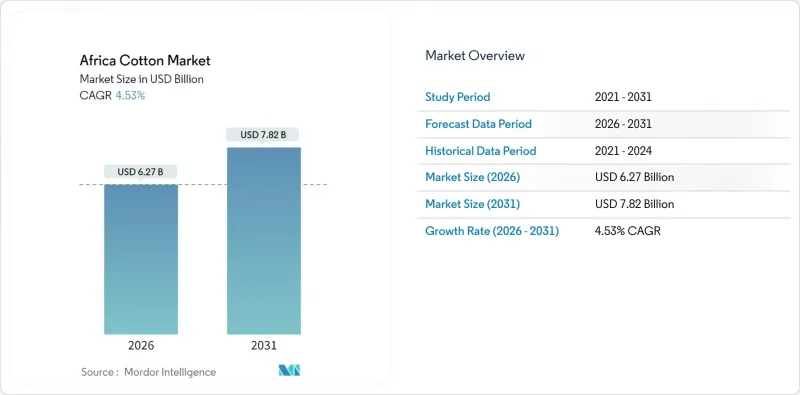
这项成长主要得益于萨赫勒地区灌溉网络的扩张、中国对西非棉花日益增长的需求,以及政府改善农民获取水资源、农业投入品和数位化咨询服务的政策。根据美国农业部海外农业局的数据,象牙海岸共和国和布吉纳法索是非洲12个棉花生产国中最大的两个国家,预计在研究期间产量将持续成长。根据联合国粮食及农业组织(粮农组织)企业统计资料库,马利共和国2023年的棉花产量将超过68.5万吨,创历史新高。这些国家的大量棉花产量正在推动非洲棉花市场的成长。永续性认证透过可追溯性实现了溢价,而以影响力为导向的资金筹措则支持了小规模的现代化。儘管生产较为分散,但大型贸易业者正透过投资棉花加工厂和永续农业实践来促进垂直整合。农村基础设施不足、农业劳动力老化以及外汇限制阻碍了现代化进程。新技术和耐旱灌溉系统的引入为生产者提供了满足品质要求的潜在改进空间。
非洲棉花市场趋势与洞察
扩大棉花种植面积
随着西非各国透过公共投资改善灌溉和仓储基础设施,扩大棉花种植面积,非洲棉花市场持续成长。伊斯兰开发银行集团成员国际伊斯兰贸易融资公司(ITFC)已核准一项1.06亿欧元(约11.194亿日圆)的贷款,用于支持布吉纳法索的棉花产业。该笔资金是根据与布吉纳法索纺织协会(Sofitex)签订的「穆拉巴哈」(Murabaha)协议提供的。根据联合国粮食及农业组织(FAO)预测,马利共和国的棉花种植面积预计将从2022年的59万公顷增加到2023年的71万公顷。马利共和国的尼日尔国家公司目前管理着7.4万公顷农田,其中包括棉花种植区,并计划将种植面积扩大3,300平方公里,显示未来棉花供应潜力巨大。虽然耕地面积的扩大将增加农民的收入,但多边组织正在努力实施气候智慧型灌溉指南,以保护雨养农业系统免受气候变迁的影响。耕地面积的永续扩张取决于气候适应型水资源管理系统和获得价格合理的农业投入品。
中国对西非棉花的需求日益增长
中国进口西非棉花出口的90%,透过维持长绒棉的溢价,支撑着非洲棉花市场的获利成长。非洲棉花的高纤维强度符合中国纺织品生产的要求。这种依赖性使得非洲棉花生产商容易受到中国政策变化的影响,尤其是中国囤积采购行为的影响。为了保护收入免受市场波动的影响,非洲生产商必须在维持棉花高品质的同时,实现出口管道多元化。为了确保原料供应稳定,中国持续增加对非洲棉花整个价值链的投资,涵盖从种植到服饰製造的各个环节。 「非洲製造棉花(CmiA)」等项目体现了中国对非洲棉花产业的承诺,并促进了非洲农民、纺织企业和中国市场之间的合作。
与全球同业其他公司相比,脱棉率较低
非洲棉花加工厂每吨棉花耗电78千瓦时,远高于基准值。这降低了企业的竞争力,也减少了农民的利润。引入自动化锯辊可以在保持纤维长度的同时,将能耗降低50%。对喀麦隆的SODECOTON公司而言,棉花加工过程中产生的棉壳废弃物蕴藏着巨大的未开发能源潜力,凸显了上述挑战。效率低下会增加加工成本,并影响纤维质量,因为过时的棉花技术会伤害棉纤维,降低其市场价值。这形成了一个恶性循环:盈利下降限制了对现代化设备的投资。
细分市场分析
非洲棉花市场报告按地区划分(布吉纳法索、马利共和国、贝南、象牙海岸共和国、喀麦隆、苏丹、奈及利亚、埃及等)。研究包括产量分析(数量)、消费量分析(价值和数量)、出口量分析(价值和数量)、进口量分析(价值和数量)以及价格趋势分析。市场预测以价值(美元)和数量(公吨)表示。
其他福利:
- Excel格式的市场预测(ME)表
- 3个月的分析师支持
目录
第一章 引言
- 研究假设和市场定义
- 调查范围
第二章调查方法
第三章执行摘要
第四章 市场情势
- 市场概览
- 市场驱动因素
- 扩大棉花种植面积
- 中国市场对西非棉花的需求不断成长
- 扩大灌溉走廊
- 引进基因改造棉种子
- 数位化传播平台
- 来自註重ESG品牌的可追溯性溢价
- 市场限制
- 与其他全球竞争对手相比,脱粒率较低
- 小规模人口老化
- 欠发达的农村物流
- 由于外汇短缺,进口原料受到限制
- 价值/供应链分析
- 监管环境
- 技术展望
- PESTEL 分析
第五章 市场规模和成长预测(价值和数量)
- 按地区划分(生产分析、消费分析(数量和价值)、进口分析(数量和价值)、出口分析(数量和价值)、价格趋势分析)
- 布吉纳法索
- 马利共和国
- 贝南
- 象牙海岸共和国
- 喀麦隆
- 苏丹
- 奈及利亚
- 埃及
- 辛巴威
- 摩洛哥
- 迦纳
- 南非
第六章 竞争情势
- 相关利益者名单
- Olam International Limited
- Louis Dreyfus Company BV
- Cargill, Incorporated
- Plexus Cotton Limited(RCMA Group)
- Paul Reinhart AG
- Compagnie Malienne pour le Developpement des Textiles SA
- Societe Burkinabe des Fibres Textiles(SOFITEX)
- Ivoire Coton SA
- Societe de Developpement du Coton(SODECOTON)
- Devcot SA
- West African Cotton Company Limited(WACOT)
- Branson Commodities
- ETG Commodities(ETC Group)
- Cotton Company of Zimbabwe Limited(COTTCO)
- Alliance Ginneries Limited
第七章 市场机会与未来展望
Africa cotton market size in 2026 is estimated at USD 6.27 billion, growing from 2025 value of USD 6.0 billion with 2031 projections showing USD 7.82 billion, growing at 4.53% CAGR over 2026-2031.
The growth stems from expanded irrigation networks in the Sahel region, increased Chinese demand for West African cotton, and government policies improving farmers' access to water, agricultural inputs, and digital advisory services. According to the USDA's Foreign Agricultural Service, among the twelve cotton-producing nations in Africa, Cote d'Ivoire and Burkina Faso are the largest producers, with production projected to increase during the study period. Mali achieved its highest cotton production of over 685,000 metric tons in 2023, as reported by the Food and Agriculture Organization Corporate Statistical Database. The significant production volumes from these countries drive growth in the African cotton market. Sustainability certifications enable premium pricing through traceability, while impact-focused financing supports smallholder farm modernization. Despite fragmented production, major traders are pursuing vertical integration, investing in ginning facilities and sustainable farming practices. Inadequate rural infrastructure, an aging agricultural workforce, and foreign exchange limitations constrain modernization efforts. The adoption of new technologies and drought-resistant irrigation systems offers potential improvements for producers who meet quality requirements.
Africa Cotton Market Trends and Insights
Rising Area Under Cotton Cultivation
The African cotton market is expanding as West African producers increase planted areas through public investments in irrigation and storage infrastructure. The International Islamic Trade Finance Corporation (ITFC), a member of the Islamic Development Bank Group, has approved a €106 million ($119.4 million) financing facility for Burkina Faso to support its cotton industry. The funding was granted under a 'Mourabaha' agreement with the Burkinabe Society of Textile Fibers (Sofitex). According to the Food and Agriculture Organization, Mali's cotton cultivation area increased from 590,000 hectares in 2022 to 710,000 hectares in 2023. Mali's Office du Niger currently manages 74,000 hectares of agricultural land, including cotton farming, and plans to expand by 3,300 square kilometers, indicating significant future supply potential. While these expansions increase farmer revenues, they expose rain-fed systems to climate variability, leading multilateral agencies to implement climate-smart irrigation guidelines. The sustained growth in planted area depends on climate-resilient water management systems and access to affordable agricultural inputs.
Growing Chinese Demand for West-African Lint
China imports 90% of West African cotton exports, maintaining price premiums for long-staple lint and supporting revenue growth in the African cotton market. The high fiber strength of African cotton meets Chinese textile manufacturing requirements. This dependency makes producers vulnerable to Chinese policy changes, particularly in reserve buying practices. African producers need to diversify their export channels while maintaining premium quality to protect their income from market fluctuations. China continues to expand its investments across the African cotton value chain, from cultivation to garment manufacturing, to ensure a consistent raw material supply. Programs such as Cotton made in Africa (CmiA) demonstrate China's commitment to African cotton and facilitate connections between African farmers, textile companies, and the Chinese market.
Low Ginning Out-Turn Ratios vs. Global Peers
African cotton gins consume 78 kWh per metric ton, significantly exceeding benchmark levels, which reduces competitiveness and decreases farmer margins. Automated saw cylinders can reduce energy consumption by 50% while maintaining fiber length integrity. In Cameroon, SODECOTON's operations demonstrate these challenges, as cotton shell waste from processing contains substantial untapped energy potential. The efficiency gap increases processing costs and affects fiber quality, as outdated ginning technology can damage cotton fibers and lower their market value. This creates a cycle where reduced profitability constrains investment in modern equipment.
Other drivers and restraints analyzed in the detailed report include:
- Expansion of Irrigation Corridors
- Adoption of Genetically Modified Cotton Seeds
- Aging Smallholder Farmer Base
For complete list of drivers and restraints, kindly check the Table Of Contents.
Segment Analysis
The Africa Cotton Market Report is Segmented by Geography (Burkina Faso, Mali, Benin, Cote D'Ivoire, Cameroon, Sudan, Nigeria, Egypt, and More). The Study Includes Production Analysis (Volume), Consumption Analysis (Value and Volume), Export Analysis (Value and Volume), Import Analysis (Value and Volume), and Price Trend Analysis. The Market Forecasts are Provided in Terms of Value (USD) and Volume (Metric Tons).
List of Companies Covered in this Report:
- Market Overview
- Market Drivers
- Market Restraints
- Value / Supply-Chain Analysis
- Regulatory Landscape
- Technological Outlook
- PESTLE Analysis
- List of Stakeholders
Additional Benefits:
- The market estimate (ME) sheet in Excel format
- 3 months of analyst support
TABLE OF CONTENTS
1 Introduction
- 1.1 Study Assumptions and Market Definition
- 1.2 Scope of the Study
2 Research Methodology
3 Executive Summary
4 Market Landscape
- 4.1 Market Overview
- 4.2 Market Drivers
- 4.2.1 Rising Area Under Cotton Cultivation
- 4.2.2 Growing Chinese Demand for West-African Lint
- 4.2.3 Expansion of Irrigation Corridors
- 4.2.4 Adoption of Genetically Modified Cotton Seeds
- 4.2.5 Digitized Extension Platforms
- 4.2.6 Traceability Premiums from ESG-Oriented Brands
- 4.3 Market Restraints
- 4.3.1 Low Ginning Out-Turn Ratios vs. Global Peers
- 4.3.2 Aging Smallholder Farmer Base
- 4.3.3 Under-Developed Rural Logistics
- 4.3.4 Foreign Exchange Shortages Restricting Input Imports
- 4.4 Value / Supply-Chain Analysis
- 4.5 Regulatory Landscape
- 4.6 Technological Outlook
- 4.7 PESTLE Analysis
5 Market Size and Growth Forecasts (Value and Volume)
- 5.1 By Geography (Production Analysis (Volume), Consumption Analysis (Volume and Value), Import Analysis (Volume and Value), Export Analysis (Volume and Value), and Price Trend Analysis)
- 5.1.1 Burkina Faso
- 5.1.2 Mali
- 5.1.3 Benin
- 5.1.4 Cote d'Ivoire
- 5.1.5 Cameroon
- 5.1.6 Sudan
- 5.1.7 Nigeria
- 5.1.8 Egypt
- 5.1.9 Zimbabwe
- 5.1.10 Morocco
- 5.1.11 Ghana
- 5.1.12 South Africa
6 Competitive Landscape
- 6.1 List of Stakeholders
- 6.1.1 Olam International Limited
- 6.1.2 Louis Dreyfus Company B.V.
- 6.1.3 Cargill, Incorporated
- 6.1.4 Plexus Cotton Limited (RCMA Group)
- 6.1.5 Paul Reinhart AG
- 6.1.6 Compagnie Malienne pour le Developpement des Textiles SA
- 6.1.7 Societe Burkinabe des Fibres Textiles (SOFITEX)
- 6.1.8 Ivoire Coton SA
- 6.1.9 Societe de Developpement du Coton (SODECOTON)
- 6.1.10 Devcot SA
- 6.1.11 West African Cotton Company Limited (WACOT)
- 6.1.12 Branson Commodities
- 6.1.13 ETG Commodities (ETC Group)
- 6.1.14 Cotton Company of Zimbabwe Limited (COTTCO)
- 6.1.15 Alliance Ginneries Limited
7 Market Opportunities and Future Outlook

 2026-2030年全球棉花市场
 棉浆市场:依产品类型、形态、加工方法、等级、应用和销售管道划分-2026-2032年全球预测
 日本有机棉市场规模、份额、趋势和预测:按类型、品质类型、应用和地区划分,2026-2034年100%有机棉卫生棉条市场:依产品类型、吸收量、包装类型、年龄层、价格范围、皮肤刺激性和通路划分-2026-2032年全球预测硝化精棉市场按类型、原料、纯度等级、终端用户产业及通路划分-2026年至2032年全球预测精棉纤维素醚市场:依纤维素醚类型、等级、生产流程、应用和分销管道划分-2026年至2032年全球预测精炼棉市场按类型、技术、等级、应用、最终用户和通路划分-2026-2032年全球预测
 全球棉花市场-2025年至2030年预测
 棉纤维市场:依纤维等级、应用和地区划分
 棉花:市场份额分析、行业趋势、统计数据和成长预测(2025-2030 年)