


 |
市场调查报告书
商品编码
1939038
生物表面活性剂:市场占有率分析、产业趋势与统计、成长预测(2026-2031)Biosurfactants - Market Share Analysis, Industry Trends & Statistics, Growth Forecasts (2026 - 2031) |
||||||

※ 本网页内容可能与最新版本有所差异。详细情况请与我们联繫。
预计生物界面活性剂市场将从 2025 年的 28.4 亿美元成长到 2026 年的 29.9 亿美元,到 2031 年将达到 38.9 亿美元,2026 年至 2031 年的复合年增长率为 5.41%。
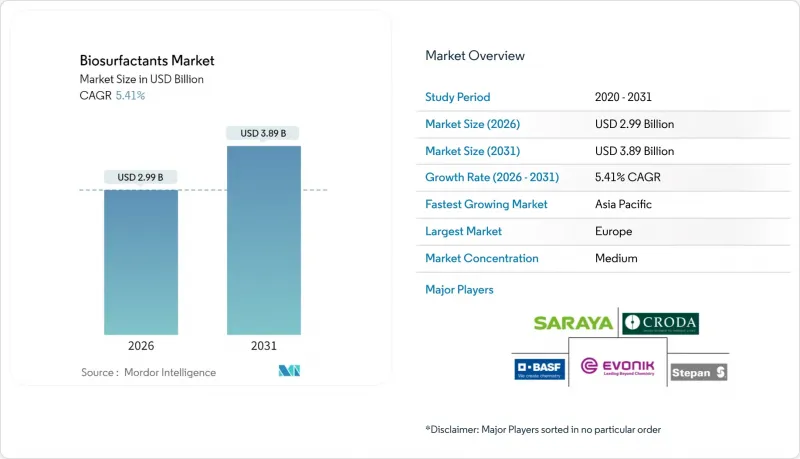
对可生物降解原料的强有力政策要求、大规模发酵技术的持续创新以及个人护理和油田化学品应用领域日益增长的需求,共同支撑着这一增长趋势。随着生产商整合成本更低的废弃物基材,生产经济效益正向微生物合成方向转变,而蓬勃发展的亚太地区供应基地正在改变全球贸易格局。如今,竞争策略的重点在于控制上游原料供应和下游精炼工艺,这种转变有利于拥有垂直整合营运模式的公司。
全球生物界面活性剂市场趋势与洞察
亚太地区对个人护理和化妆品的需求不断增长
区域收入的增长以及消费者对「洁净标示」成分日益增长的偏好,正在推动对天然来源的温和表面活性剂的需求。醣脂分子具有优异的皮肤相容性,能够满足此需求,使其成为配方者取代合成乙氧基化物的理想选择。BASF顺应这一趋势,推出了Dehyton PK45 GA/RA,这是一款获得雨林联盟认证的椰子油衍生表面活性剂,专为温和护肤产品而设计。本地製造商正利用其与棕榈仁油和椰子供应链的地理接近性,进一步降低成本并缩短交货时间。消费者期望的不断提高,加上供应链的结构性优势,正在加速生物界面活性剂市场在个人护理领域的普及。预计这一转变将缓解亚太地区对欧洲特种界面活性剂的进口依赖,并从长远来看重塑全球贸易格局。
欧盟和美国对可生物降解表面活性剂的监管
欧盟修订后的清洁剂法规引入了数位产品护照、严格的生物降解性标准和磷含量上限,这增加了化石基界面活性剂重新配製的成本。同时,美国环保署 (EPA) 将《有毒物质控制法》(TSCA) 的註册范围扩大到 Locus Ingredients 的整个 Amphi 生物表面活性剂产品线,这表明微生物衍生表面活性剂在工业应用中得到了明确的认可。这些同步的政策发展形成了一个跨大西洋的合规走廊,生物表面活性剂在该走廊中展现出固有的优势。符合新标准的公司可以快速获得产品核可,并在主要零售商处获得货架空间,因为在这些零售商处,永续性评分除了价格和性能之外,也受到优先考虑。因此,监管的确定性直接转化为生物表面活性剂市场渗透率的提高。
食品级和医药级原料的纯度有严格的规定。
食品和製药应用对内毒素含量和批次间一致性要求极高,因此需要多道下游纯化步骤。每道步骤都需要资金投入并产量比率产品产量,进而推高产品成本。监管机构要求在核准新的生物界面活性剂活性剂添加剂之前提供安全数据和过敏原测试结果,这延缓了商业化。小规模公司往往缺乏资金投入这类研究,只有资金雄厚的成熟公司才能涉足这些高端市场。结果是市场两极化,大宗商品的需求稳定成长,而超高纯度细分市场则因进入障碍而受到保护。
细分市场分析
2025年,醣脂占据生物界面活性剂市场68.87%的份额,巩固了其在销售和收入方面的结构性优势。到2031年,年复合成长率(CAGR)也高达5.78%,显示围绕这一单分子类别的规模经济效益正在持续增长。赢创在其斯洛伐克工厂成功实现鼠李醣脂的商业化,证明优化的假单胞菌发酵製程能够维持大宗商品等级的产量并降低转换成本。槐醣脂是目前最先进的醣脂变体,吸引了像HoliPharma这样的新进者,该公司于2025年运作了一条中试生产线。如今,竞争差异化正转向广泛的智慧财产权,包括菌株设计和整合纯化技术。
脂肽类化合物,例如界面活性素,在农业生物防治领域正占据越来越大的市场份额,其抗菌特性使其兼具界面活性剂和活性成分的双重功效。磷脂类化合物虽然体积较小,但由于亲和性,被用于创伤治疗膏和静脉注射製剂中,因此能够获得更高的定价和利润率。生物界面活性剂和地衣素则占据了工业脱脂和高温油萃取等需要耐热性的技术领域。不断丰富的产品系列表明,随着生物界面活性剂市场的扩张,产品多样性能够支撑多种价格点,使供应商能够在批量生产大宗商品和实现特种产品盈利之间取得平衡。
生物界面活性剂报告按产品类型(醣脂、磷脂质、界面活性素、地衣素等)、原料(植物油、工业废甘油、农业残渣等)、应用(清洁剂/工业清洁剂、化妆品、食品加工、油田化学品等)和地区(亚太地区、北美、欧洲、南美、中东和非洲)进行分析。
区域分析
到2025年,欧洲将占全球收入的51.62%,这主要得益于其成熟的生物技术基础和有利于植物来源原料的严格环保政策。清洁剂指令的修订提高了生物降解性基准值,扩大了欧洲製造商的产能,并增强了市场需求。例如,赢创的工业鼠李醣脂工厂和BASF的RSPO认证界面活性剂生产线等设施,都体现了旨在维持其所在地区主导的资本投资。
预计亚太地区将成为主要需求中心,到2031年将以5.98%的复合年增长率成长。中国正大力投资精准发酵技术和产业生物园区基础设施,以建立国内大规模生产生物界面活性剂的能力。印度不断壮大的中阶正在推动个人护理支出,接近性植物油人工林的地理优势也有助于高效的原材料物流。日本化妆品製造商正在寻求用于药妆的高纯度醣脂,并利用日本先进的监管体系来获取溢价。
北美仍然是强劲的市场基础,这得益于有利的政策支持,包括美国环保署的核准和联邦生物经济津贴。工业清洁剂和油田化学品仍然是最强劲的推动要素,这主要得益于该地区庞大的製造业和能源产业。南美洲丰富的原料资源使其生产成本具有竞争力,但由于发酵基础设施有限,产量仍小规模。中东和非洲的细分市场机会正在扩大,海湾产油国正在进行使用鼠李醣脂进行储存增产的初步试验,而非洲消费品公司正在测试面向城市市场的植物来源清洁剂。
其他福利:
- Excel格式的市场预测(ME)表
- 3个月的分析师支持
目录
第一章 引言
- 研究假设和市场定义
- 调查范围
第二章调查方法
第三章执行摘要
第四章 市场情势
- 市场概览
- 市场驱动因素
- 亚太地区对个人护理和化妆品的需求不断增长
- 欧盟和美国对可生物降解表面活性剂的监管
- 主要企业推出的品牌层面永续性倡议
- 透过发酵规模化降低成本曲线
- 生物界面活性剂活性剂产品碳抵消额度
- 市场限制
- 与石油基界面活性剂相比,生产成本较高
- 食品级和医药级原料的纯度有严格的规定。
- 专利拥堵对生产造成压力
- 价值链分析
- 波特五力模型
- 供应商的议价能力
- 买方的议价能力
- 新进入者的威胁
- 替代品的威胁
- 竞争对手之间的竞争
第五章 市场规模与成长预测
- 依产品类型
- 醣脂
- 磷脂
- 表面活性素
- 地衣鲱鱼
- 聚合物生物界面活性剂
- 其他产品类型
- 按原料
- 植物油(大豆油、棕榈油、芥花油)
- 工业废甘油
- 农业残渣(糖蜜、乳清)
- 其他(动物脂肪和油脂、合成糖)
- 透过使用
- 清洁剂和工业清洁剂
- 化妆品(个人护理)
- 食品加工
- 油田化学品
- 农业化学品
- 纤维
- 其他用途
- 按地区
- 亚太地区
- 中国
- 印度
- 日本
- 韩国
- ASEAN
- 亚太其他地区
- 北美洲
- 我们
- 加拿大
- 墨西哥
- 欧洲
- 德国
- 英国
- 法国
- 义大利
- 西班牙
- 俄罗斯
- 其他欧洲地区
- 南美洲
- 巴西
- 阿根廷
- 其他南美洲
- 中东和非洲
- 沙乌地阿拉伯
- 南非
- 其他中东和非洲地区
- 亚太地区
第六章 竞争情势
- 市场集中度
- 策略趋势
- 市占率(%)/排名分析
- 公司简介
- AGAE Technologies, LLC
- AmphiStar Biosurfactants
- BASF
- Biotensidon GmbH
- Croda International Plc
- Dispersa Inc.
- Ecover
- Evonik Industries AG
- Givaudan
- GlycoSurf
- Jeneil Biotech
- Kaneka Corporation
- Saraya.Co.Ltd
- Stepan Company
- Syensqo
- TeeGene Biotech
- TensioGreen
- WHEATOLEO
第七章 市场机会与未来展望
The Biosurfactants market is expected to grow from USD 2.84 billion in 2025 to USD 2.99 billion in 2026 and is forecast to reach USD 3.89 billion by 2031 at 5.41% CAGR over 2026-2031.
Robust policy mandates for biodegradable ingredients, steady breakthroughs in large-scale fermentation, and rising demand from personal care and oilfield chemicals applications collectively anchor this trajectory. Production economics have begun tilting toward microbial synthesis as producers integrate low-cost waste substrates, while fast-growing Asia-Pacific supply hubs reshape global trade flows. Competitive strategies now revolve around controlling both upstream feedstock and downstream purification, a shift that favors companies with vertically integrated operations.
Global Biosurfactants Market Trends and Insights
Expansion of Personal-Care and Cosmetics Demand in APAC
Regional income growth and a consumer pivot toward "clean label" ingredients have intensified demand for mild surfactants that are naturally derived. Glycolipid molecules meet this need through excellent dermatological compatibility, giving formulators a clear alternative to synthetic ethoxylates. BASF responded by unveiling Dehyton PK45 GA/RA, a Rainforest Alliance-certified coconut-oil surfactant that targets gentle skin-care products. Local manufacturers leverage proximity to palm kernel and coconut supply chains to further compress costs and shorten delivery cycles. This combination of rising consumer expectations and structural supply advantages accelerates the biosurfactants market toward mainstream personal-care adoption. Over time the shift is expected to rebalance global trade patterns by lowering Asia-Pacific's import dependence on European specialty surfactants.
Regulatory Push for Biodegradable Surfactants in EU and US
The European Union's updated detergent regulation introduces digital product passports, stringent biodegradability metrics, and phosphorus ceilings, measures that make fossil-based surfactants costlier to reformulate. In parallel, the U.S. Environmental Protection Agency expanded Toxic Substances Control Act registration to cover Locus Ingredients' full Amphi biosurfactant line, sending a clear acceptance signal for microbial surfactants across industrial uses. These synchronized policy moves create a trans-Atlantic compliance corridor in which biosurfactants hold an intrinsic advantage. Companies meeting the new criteria secure faster product approvals, protecting shelf space at major retailers that now rank sustainability scores alongside price and performance. Regulatory certainty, therefore, translates directly into rising biosurfactants market penetration.
Tight Purity Specs for Food and Pharma-Grade Material
Food and pharmaceutical end uses require low endotoxin levels and batch-to-batch consistency, which demand multistep downstream polishing. Each step adds capital expense and yield losses, inflating cost of goods. Regulatory bodies insist on safety dossiers and allergen studies before approving new biosurfactant excipients, slowing commercial timelines. Small firms often lack resources to fund these studies, allowing only well-capitalized incumbents to pursue these premium segments. The result is a bifurcated market in which bulk commodity demand grows steadily but ultra-high-purity niches remain protected by entry barriers.
Other drivers and restraints analyzed in the detailed report include:
- Brand-Level Sustainability Commitments by FMCG Majors
- Fermentation Scale-Up Lowering Cost Curves
- Patent Thickets Around Production Strains
For complete list of drivers and restraints, kindly check the Table Of Contents.
Segment Analysis
Glycolipids captured 68.87% of the biosurfactants market share in 2025, confirming their structural dominance in both volume and revenue terms. They also deliver the fastest 5.78% CAGR to 2031, underscoring how economies of scale continue to build around a single molecular class. Rhamnolipid commercialization at Evonik's Slovak plant shows that optimized Pseudomonas fermentation can sustain commodity output and drive down conversion costs. Sophorolipids represent the most advanced glycolipid variant and attract new entrants like Holiferm that commission pilot lines in 2025. Competitive differentiation now shifts toward intellectual-property breadth, covering strain engineering and integrated purification.
Lipopeptides such as surfactin gain share in agricultural biocontrol, where antimicrobial action offers dual utility as a surfactant and active ingredient. Phospholipids remain small but deliver outsized margins in wound-healing creams and intravenous formulations where their human-cell compatibility commands premium pricing. Polymeric biosurfactants and lichenysin occupy technical niches, industrial degreasing and high-temperature oil extraction, requiring thermal resilience. The evolving portfolio demonstrates that as the biosurfactants market size broadens, product diversity supports multiple price ladders, enabling suppliers to balance commodity volumes with specialty profits.
The Biosurfactants Report is Segmented by Product Type (Glycolipids, Phospholipids, Surfactin, Lichenysin, and More), Feedstock (Vegetable Oils, Industrial Waste Glycerol, Agricultural Residues, Others), Application (Detergents and Industrial Cleaners, Cosmetics, Food Processing, Oilfield Chemicals, and More), and Geography (Asia-Pacific, North America, Europe, South America, and Middle-East and Africa).
Geography Analysis
Europe anchored 51.62% of 2025 revenue through entrenched biotechnology infrastructure and stringent environmental policy that favors plant-based inputs. Updated detergent directives strengthen demand by mandating higher biodegradability thresholds, thereby expanding addressable volumes for European producers. Facilities such as Evonik's industrial rhamnolipid plant and BASF's RSPO-certified surfactant lines reflect capital commitment to maintaining home-region leadership.
Asia-Pacific is forecast to grow at 5.98% CAGR to 2031, turning into the primary demand center. China directs considerable state investment toward precision fermentation and industrial bio-park infrastructure, creating domestic capacity for large-volume biosurfactant output. India's expanding middle class drives personal-care spending, while proximity to vegetable-oil plantations keeps raw-material logistics efficient. Japanese formulators seek high-purity glycolipids for cosmeceuticals, leveraging the country's advanced regulatory system to command price premiums.
North America maintains a sizable base that benefits from favorable policy signals, including EPA approvals and federal bio-economy grants. Given the region's large manufacturing and energy sectors, industrial cleaning and oilfield chemicals remain the strongest pull factors. South America's feedstock abundance offers competitive manufacturing costs, but limited fermentation infrastructure keeps output small. Middle East and Africa develop niche opportunities; Gulf oil producers run pilot trials using rhamnolipids for reservoir stimulation, while African consumer goods companies test plant-based cleaners for urban markets.
- AGAE Technologies, LLC
- AmphiStar Biosurfactants
- BASF
- Biotensidon GmbH
- Croda International Plc
- Dispersa Inc.
- Ecover
- Evonik Industries AG
- Givaudan
- GlycoSurf
- Jeneil Biotech
- Kaneka Corporation
- Saraya.Co.Ltd
- Stepan Company
- Syensqo
- TeeGene Biotech
- TensioGreen
- WHEATOLEO
Additional Benefits:
- The market estimate (ME) sheet in Excel format
- 3 months of analyst support
TABLE OF CONTENTS
1 Introduction
- 1.1 Study Assumptions and Market Definition
- 1.2 Scope of the Study
2 Research Methodology
3 Executive Summary
4 Market Landscape
- 4.1 Market Overview
- 4.2 Market Drivers
- 4.2.1 Expansion of Personal-Care and Cosmetics Demand In APAC
- 4.2.2 Regulatory Push for Biodegradable Surfactants in EU and US
- 4.2.3 Brand-Level Sustainability Commitments by FMCG Majors
- 4.2.4 Fermentation Scale-Up Lowering Cost Curves
- 4.2.5 Carbon-Offset Credits for Biosurfactant-Based SKUs
- 4.3 Market Restraints
- 4.3.1 High Production Cost Vs Petro-Surfactants
- 4.3.2 Tight Purity Specs for Food and Pharma-Grade Material
- 4.3.3 Patent Thickets around Production Strains
- 4.4 Value Chain Analysis
- 4.5 Porter's Five Forces
- 4.5.1 Bargaining Power of Suppliers
- 4.5.2 Bargaining Power of Buyers
- 4.5.3 Threat of New Entrants
- 4.5.4 Threat of Substitutes
- 4.5.5 Competitive Rivalry
5 Market Size and Growth Forecasts (Value)
- 5.1 By Product Type
- 5.1.1 Glycolipids
- 5.1.2 Phospholipids
- 5.1.3 Surfactin
- 5.1.4 Lichenysin
- 5.1.5 Polymeric Bio-surfactants
- 5.1.6 Other Product Types
- 5.2 By Feedstock
- 5.2.1 Vegetable Oils (soy, palm, rapeseed)
- 5.2.2 Industrial Waste Glycerol
- 5.2.3 Agricultural Residues (molasses, whey)
- 5.2.4 Others (Animal Fat, Synthesised Sugars)
- 5.3 By Application
- 5.3.1 Detergents and Industrial Cleaners
- 5.3.2 Cosmetics (Personal Care)
- 5.3.3 Food Processing
- 5.3.4 Oilfield Chemicals
- 5.3.5 Agricultural Chemicals
- 5.3.6 Textiles
- 5.3.7 Other Applications
- 5.4 By Geography
- 5.4.1 Asia-Pacific
- 5.4.1.1 China
- 5.4.1.2 India
- 5.4.1.3 Japan
- 5.4.1.4 South Korea
- 5.4.1.5 ASEAN
- 5.4.1.6 Rest of Asia-Pacific
- 5.4.2 North America
- 5.4.2.1 United States
- 5.4.2.2 Canada
- 5.4.2.3 Mexico
- 5.4.3 Europe
- 5.4.3.1 Germany
- 5.4.3.2 United Kingdom
- 5.4.3.3 France
- 5.4.3.4 Italy
- 5.4.3.5 Spain
- 5.4.3.6 Russia
- 5.4.3.7 Rest of Europe
- 5.4.4 South America
- 5.4.4.1 Brazil
- 5.4.4.2 Argentina
- 5.4.4.3 Rest of South America
- 5.4.5 Middle-East and Africa
- 5.4.5.1 Saudi Arabia
- 5.4.5.2 South Africa
- 5.4.5.3 Rest of Middle-East and Africa
- 5.4.1 Asia-Pacific
6 Competitive Landscape
- 6.1 Market Concentration
- 6.2 Strategic Moves
- 6.3 Market Share (%)/Ranking Analysis
- 6.4 Company Profiles (includes Global level Overview, Market level overview, Core Segments, Financials as available, Strategic Information, Market Rank/Share for key companies, Products and Services, Recent Developments)
- 6.4.1 AGAE Technologies, LLC
- 6.4.2 AmphiStar Biosurfactants
- 6.4.3 BASF
- 6.4.4 Biotensidon GmbH
- 6.4.5 Croda International Plc
- 6.4.6 Dispersa Inc.
- 6.4.7 Ecover
- 6.4.8 Evonik Industries AG
- 6.4.9 Givaudan
- 6.4.10 GlycoSurf
- 6.4.11 Jeneil Biotech
- 6.4.12 Kaneka Corporation
- 6.4.13 Saraya.Co.Ltd
- 6.4.14 Stepan Company
- 6.4.15 Syensqo
- 6.4.16 TeeGene Biotech
- 6.4.17 TensioGreen
- 6.4.18 WHEATOLEO
7 Market Opportunities and Future Outlook
- 7.1 White-space and Unmet-Need Assessment

 生物界面活性剂市场:依类型(醣脂、脂肽、磷脂质、聚合物生物界面活性剂)、应用和来源(微生物来源、植物来源) - 全球预测(~2036年)
 2026年全球植物来源生物界面活性剂市场报告2026年全球生物界面活性剂市场报告
 生物界面活性剂市场机会、成长要素、产业趋势分析及预测(2026-2035年)
 生物界面活性剂市场-全球产业规模、份额、趋势、机会及按类型、应用、地区和竞争格局分類的预测(2021-2031年)
 生物界面活性剂市场规模、份额及成长分析(按产品类型、原料、应用及地区划分)-2026-2033年产业预测
 全球可生物降解界面活性剂市场预测(至2032年):依产品类型、原料、应用、最终用户及地区划分
 日本生物界面活性剂市场报告:按产品、原料、应用和地区划分(2026-2034年)
 全球生物界面活性剂市场(至2030年):依类型(醣脂(槐醣脂、鼠李醣脂、脂肽)、应用(清洁剂、个人护理、食品加工、农药)及地区划分生物界面活性剂市场报告(按产品(鼠李醣脂、槐醣脂、甲酯磺酸盐、烷基多醣苷、脱水山梨醇酯、蔗糖酯等)、来源、应用和地区划分,2025-2033 年