


 |
市场调查报告书
商品编码
1939086
汽车电力电子:市场占有率分析、产业趋势与统计、成长预测(2026-2031)Automotive Power Electronics - Market Share Analysis, Industry Trends & Statistics, Growth Forecasts (2026 - 2031) |
||||||

※ 本网页内容可能与最新版本有所差异。详细情况请与我们联繫。
汽车电力电子市场预计将从 2025 年的 51.7 亿美元成长到 2026 年的 57.5 亿美元,并预计在 2031 年达到 97.6 亿美元,2026 年至 2031 年的复合年增长率为 11.18%。
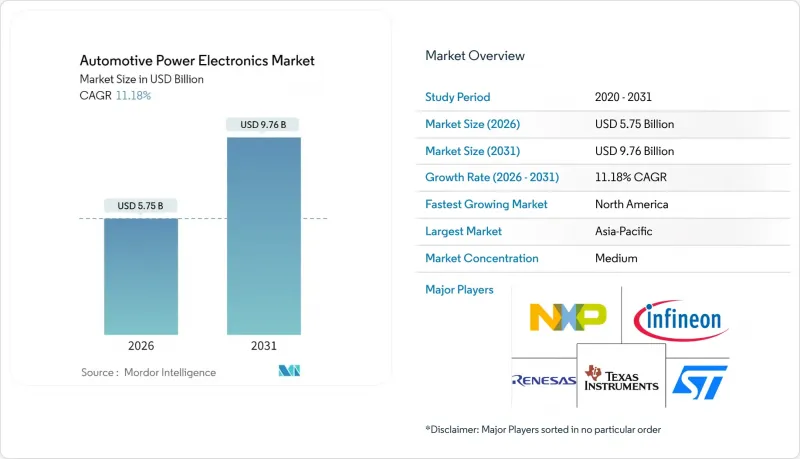
这一增长与全球汽车保有量加速电气化、向800V电气架构的过渡以及为提高能源效率和热性能而日益广泛应用的宽能带隙半导体相吻合。需求主要集中在牵引逆变器、车载充电器和DC-DC转换器上,这些产品构成了现代电池式电动车的电子基础。
汽车电力电子市场全球趋势及展望
电动车普及率的快速成长和充电基础设施建设的进步
电动车的加速普及将对电力电子需求产生倍增效应,因为每辆电动车所需的半导体元件数量是传统汽车的三到五倍。预计2023年,中国电动车市场渗透率将达到35.7%,不同地区由于充电基础设施的可用性和消费者偏好不同,对电力电子的需求也各不相同。向150kW及以上直流快速充电的过渡将需要能够处理高电流密度并保持热稳定性的先进功率模组,这为功率转换、保护和温度控管整合解决方案的供应商创造了机会。
加强全球汽车排放气体法规
主要汽车市场的法规结构正从传统的废气排放气体扩展到涵盖全生命週期碳排放和能源效率要求。欧盟的欧盟7排放标准(将于2025年生效)对氮氧化物和颗粒物排放设定了严格的限制,并强制要求几乎所有车型采用混合动力或纯电动动力传动系统。中国的双轨制和加州的先进清洁汽车II法规也施加了类似的合规压力,同时也为电力电子系统设定了最低能源效率标准,并鼓励宽能带隙半导体而非传统的硅装置。这些法规迫使汽车製造商优先考虑能够最大限度提高能量转换效率的电力电子解决方案,加速了碳化硅(SiC)和氮化镓(GaN)技术的应用,儘管它们的初始成本较高。法规的影响不仅限于动力传动系统,还包括温度控管系统、照明和辅助动力单元(APU),从而扩大了汽车电力电子供应商的潜在市场。
高功率密度下的温度控管挑战
对紧凑轻巧的电力电子模组的需求造成了散热瓶颈,限制了其性能和可靠性,尤其是在驱动逆变器应用中功率密度超过 50 kW/L 时。对于工作频率高于 20 kHz 的 800 V 系统,传统的风冷方案已无法满足需求,需要采用液冷系统,这会增加车辆架构的成本、复杂性和潜在的故障模式。先进的导热界面材料和嵌入式冷却通道可将散热效率提高 30%–40%。然而,这些解决方案需要大量的工程投资和製造流程的改进,从而导致开发週期延长和认证成本增加。在商用车和摩托车领域,由于空间限制和成本敏感性,温度控管的挑战更为严峻,这可能会延缓这些领域向更高电压架构的过渡。
细分市场分析
到2025年,功率模组将占汽车电力电子市场46.52%的份额,这反映出汽车製造商倾向于选择将多个半导体装置、闸极驱动器和保护电路整合到散热优化封装中的解决方案。随着OEM厂商寻求简化组装并增强空间受限应用中的温度控管,产业向更高整合度的转变推动了这个细分市场的发展。在800V牵引逆变器应用中,SiC功率模组凭藉其卓越的效率和散热性能,预计将在2031年之前以20.98%的复合年增长率实现显着增长。功率IC在车身电子设备和辅助系统中将保持稳定的需求,而分立元件将用于需要客製化散热解决方案和极高可靠性的特殊应用。
整合化趋势已超越传统界限,供应商正在开发整合微控制器、电流感测和诊断功能的智慧电源模组,以实现预测性维护和系统最佳化。这种向「智慧」电源模组的演进为供应商提供了差异化机会,同时也满足了汽车製造商对降低系统复杂性和提高功能安全合规性的需求。 ISO 26262认证要求更加强调模组化方法以及可验证的故障隔离和诊断覆盖范围,这进一步推动了电源模组市场在所有车型和驱动配置中的成长。
到2025年,动力传动系统系统将占汽车电力电子市场62.04%的份额,预计到2031年将保持18.75%的强劲复合年增长率,因为电气化将传统的机械系统转变为电子控制的电力转换网络。该细分市场包括牵引逆变器、直流-直流转换器、车载充电器和电池管理系统,这些组件共同决定了车辆的续航里程、充电速度和能源效率。车身电子应用(例如照明、空调和资讯娱乐系统)是一个规模虽小但稳定的市场细分,受益于LED技术的应用和每辆车电子元件数量的增加。由于高级驾驶辅助系统(ADAS)的广泛应用和日益增长的网路安全需求,安全电子正在成为一个高成长的细分市场,需要专门的电源管理解决方案。
动力传动系统产业的领先地位反映了能量转换方式从机械能向电能的根本性转变,电力电子效率直接影响车辆性能和消费者接受度。新一代驱动逆变器透过先进的温度控管技术(包括嵌入式冷却和相变材料)实现了超过100kW/L的功率密度,而宽能带隙半导体与硅基解决方案相比,可将开关损耗降低60-80%。这种技术进步为能够提供整合式动力传动系统总成解决方案的供应商创造了机会,这些解决方案可以优化整个子系统而非单一组件。
区域分析
到2025年,亚太地区汽车电力电子市场份额将达到42.35%,这主要得益于中国作为全球最大电动车市场的地位以及日本在宽能带隙半导体製造领域的领先地位。从原料到成品车的一体化供应链,使得电力电子产品的生产能够快速扩张,同时保持成本竞争力。韩国专注于高阶电动车平台,而印度两轮车电动化进程的加速,都催生了对量产型和专用型电力电子产品的需求。该地区的製造生态系统受益于汽车製造商和半导体晶圆代工厂之间建立的稳固合作关係,从而促进了碳化硅功率模组和整合域控制器等下一代技术的快速应用。
预计到2031年,北美将以19.53%的复合年增长率实现最高增长,这主要得益于《通膨控制法案》中3700亿美元的清洁能源计划以及汽车製造商在国内生产电动车的努力。该地区对800V架构和快速充电基础设施的重视,正在创造对宽能带隙半导体的高端需求。同时,製造业回流计画旨在建立关键电力电子元件的国内供应链。加拿大的采矿业为电力电子製造提供了必要的原料。相较之下,墨西哥的汽车製造地为寻求降低供应链风险的北美原始设备製造商(OEM)提供了经济高效的组装能力。
欧洲在高端汽车领域保持强大的地位和监管主导。欧盟的「绿色交易」推动了积极的电气化目标和排放标准,从而促进了先进电力电子解决方案的发展。该地区在功能安全标准和环境法规方面的专业知识使其在全球市场中拥有竞争优势。同时,现有汽车供应商正利用与整车製造商(OEM)的合作关係,在转型为电动过程中获取价值。德国的工业基础和法国的半导体技术为该地区的电力电子发展提供了支持,而北欧国家的可再生能源资源则有助于实现符合汽车製造商碳中和目标的永续製造流程。
其他福利:
- Excel格式的市场预测(ME)表
- 3个月的分析师支持
目录
第一章 引言
- 研究假设和市场定义
- 调查范围
第二章调查方法
第三章执行摘要
第四章 市场情势
- 市场概览
- 市场驱动因素
- 电动车日益普及以及充电基础建设的进步
- 加强全球汽车排放气体法规
- 对先进ADAS和安全电子产品的需求不断增长
- 原始设备製造商转向 800V 电气架构
- 一级供应商快速采用SiC/GaN功率元件设计
- 将逆变器功能整合到网域控制器中
- 市场限制
- 高功率密度下的温度控管挑战
- 半导体供应週期性受限
- 宽能带隙材料的初始成本较高
- 高压元件缺乏统一的全球标准
- 价值/价值链分析
- 监管环境
- 技术展望
- 波特五力模型
- 新进入者的威胁
- 供应商的议价能力
- 买方的议价能力
- 替代品的威胁
- 竞争对手之间的竞争
第五章 市场规模及成长预测(价值(美元))
- 依设备类型
- 功率积体电路
- 电源模组
- 分立元件
- 透过使用
- 动力传动系统系统
- 人体电子系统
- 安全电子设备
- 按车辆类型
- 搭乘用车
- 轻型商用车
- 摩托车
- 中型和重型商用车辆
- 按驱动类型
- 内燃机车辆
- 混合动力电动车(HEV)
- 电池式电动车(BEV)
- 按组件
- 电源模组
- 转换器
- 控制器
- 转变
- 电池管理系统
- 车用充电器
- 按地区
- 北美洲
- 我们
- 加拿大
- 北美其他地区
- 南美洲
- 巴西
- 阿根廷
- 其他南美洲
- 欧洲
- 德国
- 英国
- 法国
- 义大利
- 西班牙
- 俄罗斯
- 其他欧洲地区
- 亚太地区
- 中国
- 印度
- 日本
- 韩国
- 亚太其他地区
- 中东和非洲
- 阿拉伯聯合大公国
- 沙乌地阿拉伯
- 南非
- 土耳其
- 其他中东和非洲地区
- 北美洲
第六章 竞争情势
- 市场集中度
- 策略趋势
- 市占率分析
- 公司简介
- Infineon Technologies AG
- Semiconductor Components Industries, LLC(onsemi)
- STMicroelectronics NV
- Renesas Electronics Corporation
- ROHM Co., Ltd.
- Mitsubishi Electric Corporation
- NXP Semiconductors NV
- Texas Instruments Incorporated
- Robert Bosch GmbH(Semiconductors for Mobility)
- Vishay Intertechnology, Inc.
- Toshiba Electronic Devices & Storage Corporation
- Littelfuse Inc.
- Analog Devices, Inc.
- Semikron Danfoss International GmbH
- Astemo, Ltd.
- Valeo SA
- Continental AG
- Wolfspeed, Inc.
- StarPower Semiconductor Ltd.
第七章 市场机会与未来展望
The automotive power electronics market is expected to grow from USD 5.17 billion in 2025 to USD 5.75 billion in 2026 and is forecast to reach USD 9.76 billion by 2031 at 11.18% CAGR over 2026-2031.
This growth aligns with the accelerating electrification of global vehicle fleets, the migration to 800V electrical architectures, and the rising use of wide-bandgap semiconductors that enhance energy efficiency and thermal performance. Demand is concentrated in traction inverters, on-board chargers, and DC-DC converters, which form the electronic backbone of modern battery-electric vehicles.
Global Automotive Power Electronics Market Trends and Insights
Surge in EV Adoption and Charging Infrastructure Build-Out
The acceleration of electric vehicle adoption creates a multiplicative effect on power electronics demand, as each EV requires 3-5 times more semiconductor content than conventional vehicles. China's EV market reached 35.7% penetration in 2023, with each region driving distinct power electronics requirements based on charging infrastructure capabilities and consumer preferences. The shift toward 150 kW+ DC fast charging necessitates advanced power modules capable of handling higher current densities while maintaining thermal stability, creating opportunities for suppliers who can deliver integrated solutions that combine power conversion, protection, and thermal management functions.
Stricter Global Vehicle-Emission Regulations
Regulatory frameworks across major automotive markets have intensified beyond traditional tailpipe emissions to encompass lifecycle carbon footprints and energy efficiency mandates. The European Union's Euro 7 standards, practical from 2025, impose stringent limits on nitrogen oxides and particulate matter that effectively mandate hybrid or electric powertrains for most vehicle segments. China's dual-credit system and California's Advanced Clean Cars II regulation create similar compliance pressures, while also establishing minimum efficiency thresholds for power electronics systems that favor wide-bandgap semiconductors over traditional silicon devices. These regulations drive automakers to prioritize power electronics solutions that maximize energy conversion efficiency, leading to accelerated adoption of SiC and GaN technologies despite their higher initial costs. The regulatory influence extends beyond powertrains to encompass thermal management systems, lighting, and auxiliary power units, broadening the addressable market for automotive power electronics suppliers.
Thermal-Management Challenges at Higher Power Densities
The push toward compact, lightweight power electronics modules creates thermal bottlenecks that limit performance and reliability, particularly as power densities exceed 50kW/L in traction inverter applications. Traditional air-cooling solutions prove inadequate for 800V systems operating at switching frequencies above 20kHz, necessitating liquid cooling systems that add cost, complexity, and potential failure modes to vehicle architectures. Advanced thermal interface materials and embedded cooling channels can improve heat dissipation by 30-40%. However, these solutions require significant engineering investment and manufacturing process changes, which extend development timelines and increase qualification costs. The thermal management challenge becomes more acute in commercial vehicles and two-wheelers, where space constraints and cost sensitivity limit the adoption of sophisticated cooling solutions, potentially slowing the transition to higher-voltage architectures in these segments.
Other drivers and restraints analyzed in the detailed report include:
- Rising Demand for Advanced ADAS and Safety Electronics
- OEM Migration to 800V Electrical Architectures
- Cyclical Semiconductor Supply Constraints
For complete list of drivers and restraints, kindly check the Table Of Contents.
Segment Analysis
Power modules captured 46.52% of the automotive power electronics market share in 2025, reflecting automakers' preference for integrated solutions that combine multiple semiconductor devices, gate drivers, and protection circuits in thermally optimized packages. The segment benefits from the industry's shift toward higher integration levels, as OEMs seek to simplify assembly and enhance thermal management in space-constrained applications. SiC power modules are expected to demonstrate exceptional growth, with a 20.98% CAGR through 2031, driven by their superior efficiency and thermal performance in 800V traction inverter applications. Power ICs maintain steady demand in body electronics and auxiliary systems, while discrete devices serve specialized applications that require custom thermal solutions or extreme reliability.
The integration trend extends beyond traditional boundaries, with suppliers developing intelligent power modules that incorporate microcontrollers, current sensing, and diagnostic capabilities to enable predictive maintenance and system optimization. This evolution toward "smart" power modules creates differentiation opportunities for suppliers while addressing automakers' demands for reduced system complexity and improved functional safety compliance. ISO 26262 certification requirements are increasingly favoring modular approaches that can demonstrate fault isolation and diagnostic coverage, further supporting the growth trajectory of the power module segment across all vehicle types and drive configurations.
Powertrain systems command 62.04% of the automotive power electronics market share in 2025. They are expected to maintain a robust 18.75% CAGR growth through 2031, as electrification transforms traditional mechanical systems into electronically controlled power conversion networks. The segment encompasses traction inverters, DC-DC converters, onboard chargers, and battery management systems that collectively determine vehicle range, charging speed, and energy efficiency. Body electronics applications, including lighting, climate control, and infotainment systems, represent a smaller but stable market segment that benefits from the adoption of LED technology and the increasing electronic content per vehicle. Safety and security electronics emerge as a high-growth niche, driven by the proliferation of ADAS and cybersecurity requirements that demand specialized power management solutions.
The powertrain segment's dominance reflects the fundamental shift from mechanical to electrical energy conversion, where power electronics efficiency directly impacts vehicle performance and consumer acceptance. Advanced thermal management techniques, including embedded cooling and phase-change materials, enable power densities exceeding 100 kW/L in next-generation traction inverters. Meanwhile, wide-bandgap semiconductors reduce switching losses by 60-80% compared to silicon-based solutions. This technological evolution creates opportunities for suppliers who can deliver integrated powertrain solutions that optimize across multiple subsystems rather than individual components.
The Automotive Power Electronics Market Report is Segmented by Device Type (Power ICs, Power Modules, Discrete Devices), Application (Powertrain Systems, Body Electronics, Safety and Security Electronics), Vehicle Type (Passenger Cars and More), Drive Type (ICE Vehicles and More), Component (Power Modules and More), and Geography (North America and More). The Market Forecasts are Provided in Terms of Value (USD).
Geography Analysis
Asia-Pacific commands 42.35% of the automotive power electronics market share in 2025, driven by China's position as the world's largest EV market and Japan's leadership in wide-bandgap semiconductor manufacturing. The region's integrated supply chain, spanning from raw materials to finished vehicles, enables rapid scaling of power electronics production while maintaining cost competitiveness. South Korea's focus on premium EV platforms and India's emerging two-wheeler electrification create diverse demand patterns that support both high-volume and specialized power electronics applications. The region's manufacturing ecosystem benefits from established relationships between automotive OEMs and semiconductor foundries, facilitating the rapid deployment of next-generation technologies like SiC power modules and integrated domain controllers.
North America exhibits the fastest regional growth at 19.53% CAGR through 2031, supported by the Inflation Reduction Act's USD 370 billion in clean energy incentives and automakers' commitments to domestic EV production. The region's focus on 800V architectures and fast-charging infrastructure creates premium demand for wide-bandgap semiconductors, while reshoring initiatives aim to establish domestic supply chains for critical power electronics components. Canada's mining sector provides access to essential materials for the manufacturing of power electronics. In contrast, Mexico's automotive manufacturing base offers cost-effective assembly capabilities for North American OEMs seeking to reduce supply chain risks.
Europe maintains a strong position in premium vehicle segments and regulatory leadership, with the European Union's Green Deal driving aggressive electrification targets and emissions standards that favor advanced power electronics solutions. The region's expertise in functional safety standards and environmental regulations creates competitive advantages in global markets. At the same time, established automotive suppliers leverage their OEM relationships to capture value in the transition to electric mobility. Germany's industrial base and France's semiconductor capabilities support regional power electronics development, while Nordic countries' renewable energy resources enable sustainable manufacturing processes that align with automakers' carbon neutrality commitments.
- Infineon Technologies AG
- Semiconductor Components Industries, LLC (onsemi)
- STMicroelectronics NV
- Renesas Electronics Corporation
- ROHM Co., Ltd.
- Mitsubishi Electric Corporation
- NXP Semiconductors N.V.
- Texas Instruments Incorporated
- Robert Bosch GmbH (Semiconductors for Mobility)
- Vishay Intertechnology, Inc.
- Toshiba Electronic Devices & Storage Corporation
- Littelfuse Inc.
- Analog Devices, Inc.
- Semikron Danfoss International GmbH
- Astemo, Ltd.
- Valeo SA
- Continental AG
- Wolfspeed, Inc.
- StarPower Semiconductor Ltd.
Additional Benefits:
- The market estimate (ME) sheet in Excel format
- 3 months of analyst support
TABLE OF CONTENTS
1 Introduction
- 1.1 Study Assumptions and Market Definition
- 1.2 Scope of the Study
2 Research Methodology
3 Executive Summary
4 Market Landscape
- 4.1 Market Overview
- 4.2 Market Drivers
- 4.2.1 Surge in EV Adoption and Charging Infrastructure Build-Out
- 4.2.2 Stricter Global Vehicle-Emission Regulations
- 4.2.3 Rising Demand for Advanced ADAS and Safety Electronics
- 4.2.4 OEM Migration to 800 V Electrical Architectures
- 4.2.5 Rapid Design-In of SiC/GaN Power Devices by Tier-1 Suppliers
- 4.2.6 Integration of Inverter Functions Into Domain Controllers
- 4.3 Market Restraints
- 4.3.1 Thermal-Management Challenges at Higher Power Densities
- 4.3.2 Cyclical Semiconductor Supply Constraints
- 4.3.3 High Upfront Cost of Wide-Band-Gap Materials
- 4.3.4 Absence of Unified Global Standards for High-Voltage Components
- 4.4 Value/Supply-Chain Analysis
- 4.5 Regulatory Landscape
- 4.6 Technological Outlook
- 4.7 Porter's Five Forces
- 4.7.1 Threat of New Entrants
- 4.7.2 Bargaining Power of Suppliers
- 4.7.3 Bargaining Power of Buyers
- 4.7.4 Threat of Substitutes
- 4.7.5 Competitive Rivalry
5 Market Size and Growth Forecasts (Value (USD))
- 5.1 By Device Type
- 5.1.1 Power ICs
- 5.1.2 Power Modules
- 5.1.3 Discrete Devices
- 5.2 By Application
- 5.2.1 Powertrain Systems
- 5.2.2 Body Electronics
- 5.2.3 Safety and Security Electronics
- 5.3 By Vehicle Type
- 5.3.1 Passenger Cars
- 5.3.2 Light Commercial Vehicles
- 5.3.3 Two-Wheelers
- 5.3.4 Medium and Heavy-Duty Commercial Vehicles
- 5.4 By Drive Type
- 5.4.1 Internal Combustion Engine (ICE) Vehicles
- 5.4.2 Hybrid Electric Vehicles (HEVs)
- 5.4.3 Battery Electric Vehicles (BEVs)
- 5.5 By Component
- 5.5.1 Power Modules
- 5.5.2 Converters
- 5.5.3 Controllers
- 5.5.4 Switches
- 5.5.5 Battery Management Systems
- 5.5.6 On-Board Chargers
- 5.6 By Geography
- 5.6.1 North America
- 5.6.1.1 United States
- 5.6.1.2 Canada
- 5.6.1.3 Rest of North America
- 5.6.2 South America
- 5.6.2.1 Brazil
- 5.6.2.2 Argentina
- 5.6.2.3 Rest of South America
- 5.6.3 Europe
- 5.6.3.1 Germany
- 5.6.3.2 United Kingdom
- 5.6.3.3 France
- 5.6.3.4 Italy
- 5.6.3.5 Spain
- 5.6.3.6 Russia
- 5.6.3.7 Rest of Europe
- 5.6.4 Asia-Pacific
- 5.6.4.1 China
- 5.6.4.2 India
- 5.6.4.3 Japan
- 5.6.4.4 South Korea
- 5.6.4.5 Rest of Asia-Pacific
- 5.6.5 Middle East and Africa
- 5.6.5.1 United Arab Emirates
- 5.6.5.2 Saudi Arabia
- 5.6.5.3 South Africa
- 5.6.5.4 Turkey
- 5.6.5.5 Rest of Middle East and Africa
- 5.6.1 North America
6 Competitive Landscape
- 6.1 Market Concentration
- 6.2 Strategic Moves
- 6.3 Market Share Analysis
- 6.4 Company Profiles (Includes Global level Overview, Market level overview, Core Segments, Financials as available, Strategic Information, Market Rank/Share for key companies, Products and Services, and Recent Developments)
- 6.4.1 Infineon Technologies AG
- 6.4.2 Semiconductor Components Industries, LLC (onsemi)
- 6.4.3 STMicroelectronics NV
- 6.4.4 Renesas Electronics Corporation
- 6.4.5 ROHM Co., Ltd.
- 6.4.6 Mitsubishi Electric Corporation
- 6.4.7 NXP Semiconductors N.V.
- 6.4.8 Texas Instruments Incorporated
- 6.4.9 Robert Bosch GmbH (Semiconductors for Mobility)
- 6.4.10 Vishay Intertechnology, Inc.
- 6.4.11 Toshiba Electronic Devices & Storage Corporation
- 6.4.12 Littelfuse Inc.
- 6.4.13 Analog Devices, Inc.
- 6.4.14 Semikron Danfoss International GmbH
- 6.4.15 Astemo, Ltd.
- 6.4.16 Valeo SA
- 6.4.17 Continental AG
- 6.4.18 Wolfspeed, Inc.
- 6.4.19 StarPower Semiconductor Ltd.
7 Market Opportunities and Future Outlook
- 7.1 White-space and Unmet-Need Assessment

 2035年电动车电力电子氮化镓市场分析与预测:按类型、产品、服务、技术、组件、应用、材料类型、装置、製程和最终用户划分汽车电力电子市场分析及预测(至2035年):依类型、产品类型、服务、技术、组件、应用、材料类型、装置、最终用户划分
 全球汽车电力电子市场规模、份额、趋势和成长分析报告(2026-2034)
 汽车电力电子市场-全球产业规模、份额、趋势、机会及预测(按元件类型、应用类型、驱动类型、车辆类型、地区和竞争格局划分,2021-2031年)
 新能源汽车电驱动系统智慧製造生产线市场:依产品类型、组件、功能、生命週期阶段、最终用户和自动化程度划分-2026-2032年全球预测氮化镓逆变器市场:额定功率、相数、冷却方式、安装类型、应用及最终用户,全球预测(2026-2032年)
 汽车电力电子市场规模、份额和成长分析(按元件、应用、材料、车辆类型、电动车和地区划分)-2026-2033年产业预测
 汽车电力电子市场预测(至 2032 年):按组件、材料、车辆类型、分销管道、应用和地区进行的全球分析