


 |
市场调查报告书
商品编码
1939132
防水卷材:市场占有率分析、产业趋势与统计、成长预测(2026-2031)Waterproofing Membranes - Market Share Analysis, Industry Trends & Statistics, Growth Forecasts (2026 - 2031) |
||||||

※ 本网页内容可能与最新版本有所差异。详细情况请与我们联繫。
预计到 2026 年,防水膜市场规模将达到 246.3 亿美元,高于 2025 年的 233.6 亿美元。
预计到 2031 年将达到 321.1 亿美元,2026 年至 2031 年的复合年增长率为 5.45%。
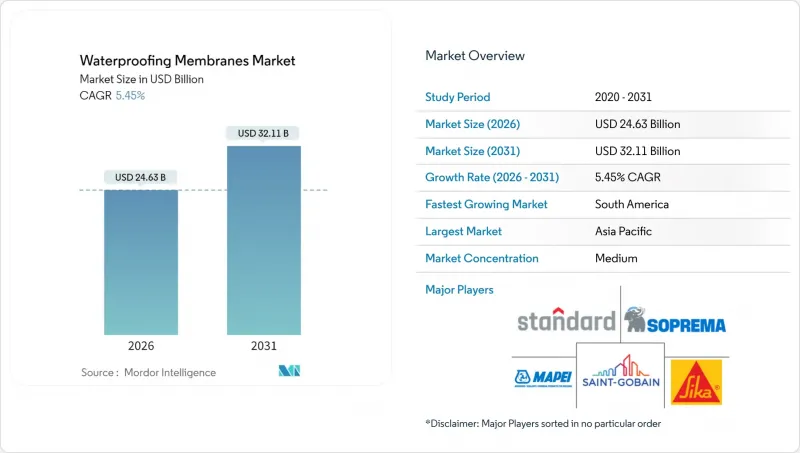
加速的都市化、日益严格的建筑围护结构节能规范以及基础设施现代化项目推动了这一增长,这些因素将潜在需求转化订单住宅、商业和基础设施等领域稳定的企划为基础。防水保护结构免受水的侵蚀,这是贯穿整个经济週期的基本需求,因此产品替代的可能性有限。模组化建筑、快速的城市发展以及绿色屋顶激励措施正在改变防水应用格局,安装人员越来越倾向于使用喷涂式液体系统,因为这种系统可以缩短安装週期并缓解熟练劳动力短缺的问题。盈利取决于原料的及时避期保值、灵活的配送以及符合最新消防安全和能源性能法规的产品系列。
全球篷布市场趋势与洞察
快速的都市化和基础建设
在大都会圈,随着地铁网路、交通走廊和综合用途大楼的扩张,城市人口不断增长,采购模式也随之改变。中国的都市化将在2024年达到66.2%,并计画在2030年达到75%。印度的智慧城市计画已累计280亿美元用于城市基础建设。这些计画明确规定,隧道、地下室和裙楼等设施必须采用高品质、长寿命的防水膜,以防止连锁失效,保障公共和经济持续发展。由于地下结构需要多层防护,防水膜市场正受惠于单一计划用量的增加。公私合营下的长期特许经营协议进一步刺激了市场需求,因为它锁定了维护义务,并鼓励业主选择能够最大限度降低全生命週期成本的耐用解决方案。
加强建筑围护结构的能源标准
能源性能法规将防水卷材视为保温层内的功能层,模糊了气密层、防潮层和防水层之间的界线。欧盟的《建筑能源性能指令》要求新建筑实现净零能耗,鼓励设计人员采用能同时控制水分和热通量的整合式防水系统。在北美,ASHRAE 90.1-2022 标准规定连续气密层为一项监管要求,这推动了对能够与基材无缝过渡的液态防水卷材的需求。随着法规的不断完善,供应商正在利用高隔热添加剂和反射颜料的附加价值来获利,这些添加剂和颜料能够将传统的防水捲材转变为多功能层,从而支撑其在维修和新建市场中的溢价。
沥青价格波动
炼油厂减产和地缘政治衝击导致2024年沥青价格上涨23%,连续三次涨价对整体计划预算造成了影响。改质沥青卷材约占全球消费量的40%,直接吸收原料价格的波动。对成本敏感的住宅屋顶维修承包商无法将额外成本转嫁给住宅,导致工程延期,并选择性地转向热塑性树脂。儘管製造商透过长期供应合约和生物基因改质剂来规避成本,但风险敞口仍然是一个结构性挑战,将在短期内抑制防水捲材市场的成长。
细分市场分析
到2025年,冷涂式防水卷材将占据防水卷材市场最大的份额(33.92%),这主要得益于其能够在拐角、穿孔和復杂的建筑幕墙构件周围形成无缝屏障。全黏合片材系统的市场占有率较小,但预计到2031年将以7.38%的复合年增长率成长,因为建筑师看重其尺寸稳定性和卓越的A级防火性能。热涂式防水卷材系统在需要耐高温的工业环境中仍被应用。同时,儘管销售量有所下降,但摊舖式防水卷材仍能满足对成本敏感的屋顶维修的需求。
冷浸防水捲材市场的扩张主要得益于模组化生产线的快速应用,在这些生产线中,速度和品质稳定性至关重要。供应商正将自修復复合材料融入聚氨酯和PMMA基体中,以减少维护返工并延长保固期。同时,全黏合PVC和TPO捲材也越来越受到资料中心建置者的青睐,他们需要低卤素、阻燃的组件来满足关键任务型安装的需求。产品组合趋势正转向混合型产品,将喷涂基层与预製面层结合,充分发挥两种技术的优势。
区域分析
到2025年,亚太地区将占全球收入的36.08%,这主要得益于中国的「一带一路」计划和印度城市轨道交通的快速发展。中印两国的地铁建设规划和智慧城市建设倡议,持续推动膜材供应链的订单。日本和韩国将继续保持对抗震加固和建筑维修的需求,而印尼、越南和泰国则将因工业园区和物流中心的兴起而实现两位数增长。
北美和欧洲是成熟且技术先进的市场。在美国,修订后的ASHRAE 90.1-2022标准预计将推动对气密膜的采购。加拿大的基础设施改善计画优先考虑地方政府用水和污水处理设施,因此增加了对耐化学腐蚀液体涂覆系统的采购。欧洲的需求集中在强制推行绿屋顶上,柏林和维也纳都强制要求在大型平屋顶上安装植被。膜材市场正在积极响应,推出兼具抗根扎性能和抗穿刺性能的新型配方,以确保与植被结构的兼容性。
预计到2031年,南美洲将引领成长,年复合成长率将达到5.94%,主要得益于巴西一项价值150亿美元的排水和防洪项目以及阿根廷布宜诺斯艾利斯的商业重建。儘管汇率波动和资金筹措缺口造成了暂时的挫折,但计划储备依然充足。供应商正在建造本地混合工厂,以对冲外汇风险并降低运输成本。中东和非洲地区预计将温和成长,因为经济多元化政策将为社会住宅、旅游业和公共产业大型企划提供资金筹措。
其他福利:
- Excel格式的市场预测(ME)表
- 3个月的分析师支持
目录
第一章 引言
- 研究假设和市场定义
- 调查范围
第二章调查方法
第三章执行摘要
第四章 市场情势
- 市场概览
- 市场驱动因素
- 快速的都市化和不断扩大的基础设施建设
- 更严格的建筑围护结构能源标准
- 扩大推广绿屋顶的措施
- 都市区地铁和隧道建设的快速扩张
- 自修復奈米复合膜的出现
- 模组化建筑中液态涂覆膜的强劲转型
- 市场限制
- 沥青价格波动
- 熟练安装人员短缺
- 某些防水卷材的防火等级A级相容性限制
- 价值链分析
- 监管环境
- 波特五力模型
- 新进入者的威胁
- 供应商的议价能力
- 买方的议价能力
- 替代品的威胁
- 竞争对手之间的竞争
第五章 市场规模与成长预测
- 依产品类型
- 低温液体应用
- 高温液体应用
- 全黏性片材
- 鬆散铺垫
- 按最终用途
- 商业的
- 工业和公共设施
- 基础设施
- 住宅
- 按地区
- 亚太地区
- 澳洲
- 中国
- 印度
- 印尼
- 日本
- 马来西亚
- 韩国
- 泰国
- 越南
- 亚太其他地区
- 北美洲
- 加拿大
- 墨西哥
- 我们
- 欧洲
- 法国
- 德国
- 义大利
- 俄罗斯
- 西班牙
- 英国
- 其他欧洲地区
- 南美洲
- 阿根廷
- 巴西
- 其他南美洲
- 中东和非洲
- 沙乌地阿拉伯
- 阿拉伯聯合大公国
- 其他中东和非洲地区
- 亚太地区
第六章 竞争情势
- 市场集中度
- 策略趋势
- 市占率(%)/排名分析
- 公司简介
- Ardex Group
- Beijing Oriental Yuhong Waterproof Technology Co., Ltd.
- HOLCIM
- Hongyuan Waterproof Technology Group Co., Ltd.
- Johns Manville
- Keshun Waterproof Technology Co., Ltd.
- Kingspan Group
- MAPEI SpA
- Minerals Technologies Inc.
- RPM International Inc.
- Saint-Gobain
- Sika AG
- SOPREMA Group
- Standard Industries Inc.
- Thermax Limited
第七章 市场机会与未来展望
第八章:执行长面临的关键策略问题
Waterproofing Membranes Market size in 2026 is estimated at USD 24.63 billion, growing from 2025 value of USD 23.36 billion with 2031 projections showing USD 32.11 billion, growing at 5.45% CAGR over 2026-2031.
This growth is anchored in accelerating urbanization, stringent building-envelope energy codes, and infrastructure modernization programs that convert pent-up demand into steady, project-backed orders across residential, commercial, and infrastructure sites. Product substitution is limited because waterproofing protects structural assets from water ingress, a fundamental requirement that remains constant throughout economic cycles. Modular construction, rapid metro development, and green-roof incentives are reshaping the application mix, while contractors increasingly favor spray-applied liquid systems that shorten installation cycles and mitigate skilled-installer shortages. Profitability hinges on timely raw material hedging, agile distribution, and product portfolios that meet emerging fire safety and energy performance mandates.
Global Waterproofing Membranes Market Trends and Insights
Rapid Urbanization and Infrastructure Build-out
Urban population growth is reshaping procurement patterns as megacities extend their underground networks, transit corridors, and mixed-use towers. China's urbanization rate reached 66.2% in 2024, with a national target of 75% by 2030, and India's Smart Cities Mission has earmarked USD 28 billion for urban infrastructure upgrades. These programs specify premium, long-service-life membranes for tunnels, basements, and podium decks to prevent cascading failures that would otherwise threaten public safety and economic continuity. The waterproofing membranes market benefits from the fact that below-grade structures require multiple layers of protection, driving higher volumes per project. Long concession tenures in public-private partnerships further reinforce demand by locking in maintenance obligations and encouraging owners to choose durable solutions that minimize life-cycle cost.
Tightening Building-Envelope Energy Codes
Energy-performance regulations now treat waterproofing membranes as functional layers within the thermal envelope, blurring the lines between air, vapor, and water barriers. The European Union's Energy Performance of Buildings Directive mandates near-zero-energy new construction, pushing designers to specify integrated membrane systems that control moisture and heat flow simultaneously. In North America, ASHRAE 90.1-2022 lists continuous air barriers as a prescriptive requirement, prompting demand for liquid membranes that create seamless transitions across substrates. As codes evolve, suppliers monetize higher R-value additives and reflective pigments that transform traditional waterproofing into multifunctional layers, supporting premium pricing in both retrofit and new-build markets.
Bitumen Price Volatility
Refinery curtailments and geopolitical shocks lifted bitumen prices by 23% in 2024, prompting three consecutive list-price increases that rippled across project budgets. Modified-bitumen sheets comprise roughly 40% of global consumption and absorb raw-material shocks directly. Contractors in cost-sensitive residential reroofing struggle to pass surcharges to homeowners, causing postponements and selective specification switches to thermoplastics. Manufacturers are hedging through long-term supply contracts and bio-based modifiers, but exposure remains a structural risk that dampens the waterproofing membranes market growth in the short term.
Other drivers and restraints analyzed in the detailed report include:
- Expansion of Green-Roof Incentives
- Rapid Urban Metro and Tunnel Build-outs
- Skilled-Installer Shortages
For complete list of drivers and restraints, kindly check the Table Of Contents.
Segment Analysis
Cold-liquid-applied membranes held the largest share at 33.92% of the waterproofing membranes market in 2025, thanks to their ability to form seamless barriers around angles, penetrations, and complex facade elements. Fully adhered sheet systems trail but register a 7.38% CAGR through 2031 as architects value their dimensional stability and superior Class A fire performance. Hot liquid systems persist in industrial settings where process temperatures demand thermal resistance, whereas loose-laid sheets continue to cater to cost-sensitive reroofing despite eroding volumes.
The waterproofing membranes market size for cold liquid-applied products is driven by the rapid adoption in modular manufacturing lines that prioritize speed and uniform quality. Suppliers integrate self-healing nano-composites into polyurethane and PMMA matrices, reducing maintenance callbacks and supporting longer warranties. Meanwhile, fully adhered PVC and TPO sheets attract data center builders who require low-halogen, flame-retardant assemblies for mission-critical installations. The product mix is trending toward hybrids that combine spray-applied base layers with prefabricated cap sheets, capitalizing on the respective strengths of each technology.
The Global Waterproofing Membranes Market Report is Segmented by Product Type (Cold Liquid Applied, Hot Liquid Applied, Fully Adhered Sheet, and Loose-Laid Sheet), End-Use Sector (Commercial, Industrial and Institutional, Infrastructure, and Residential), and Geography (Asia-Pacific, North America, Europe, South America, and Middle-East and Africa). The Market Forecasts are Provided in Terms of Value (USD).
Geography Analysis
Asia-Pacific recorded a 36.08% share of global revenue in 2025, propelled by China's Belt and Road projects and India's surge in urban rail. China and India's metro pipeline and Smart Cities Mission funnel continuous orders into membrane supply chains. Japan and South Korea sustain demand through seismic retrofitting and building rehabilitation, while Indonesia, Vietnam, and Thailand post double-digit growth as industrial parks and logistics hubs proliferate.
North America and Europe represent mature but technologically advanced markets. In the United States, the upgraded ASHRAE 90.1-2022 standards are expected to stimulate spending on membranes that integrate air-barrier functionality. Canada's infrastructure improvement plan prioritizes municipal water and wastewater facilities, increasing procurement of chemically resistant liquid-applied systems. European demand centers on green-roof mandates, with Berlin and Vienna mandating vegetation on expansive flat roofs. The waterproofing membranes market responds by introducing root-resistant formulations that combine elongation with puncture resistance, ensuring compatibility with vegetated assemblies.
South America leads regional growth with a 5.94% CAGR forecast through 2031, guided by Brazil's USD 15 billion drainage and flood-control program and Argentina's commercial redevelopment in Buenos Aires. Currency volatility and financing gaps create intermittent pauses, but project backlogs remain healthy. Suppliers build local blending plants to hedge currency risk and slash freight costs. The Middle East and Africa follow with gradual gains as economic diversification funds public housing, tourism, and utility megaprojects.
- Ardex Group
- Beijing Oriental Yuhong Waterproof Technology Co., Ltd.
- HOLCIM
- Hongyuan Waterproof Technology Group Co., Ltd.
- Johns Manville
- Keshun Waterproof Technology Co., Ltd.
- Kingspan Group
- MAPEI S.p.A.
- Minerals Technologies Inc.
- RPM International Inc.
- Saint-Gobain
- Sika AG
- SOPREMA Group
- Standard Industries Inc.
- Thermax Limited
Additional Benefits:
- The market estimate (ME) sheet in Excel format
- 3 months of analyst support
TABLE OF CONTENTS
1 Introduction
- 1.1 Study Assumptions and Market Definition
- 1.2 Scope of the Study
2 Research Methodology
3 Executive Summary
4 Market Landscape
- 4.1 Market Overview
- 4.2 Market Drivers
- 4.2.1 Rapid urbanisation and infrastructure build-out
- 4.2.2 Tightening building-envelope energy-codes
- 4.2.3 Expansion of green-roof incentives
- 4.2.4 Rapid urban metro and tunnel build-outs
- 4.2.5 Emergence of self-healing nano-composite membranes
- 4.2.6 Robust shift towards liquid-applied membranes in modular construction
- 4.3 Market Restraints
- 4.3.1 Bitumen price volatility
- 4.3.2 Skilled-installer shortages
- 4.3.3 Fire-class-A compliance limits for some membranes
- 4.4 Value Chain Analysis
- 4.5 Regulatory Landscape
- 4.6 Porter's Five Forces
- 4.6.1 Threat of New Entrants
- 4.6.2 Bargaining Power of Suppliers
- 4.6.3 Bargaining Power of Buyers
- 4.6.4 Threat of Substitutes
- 4.6.5 Competitive Rivalry
5 Market Size and Growth Forecasts (Value)
- 5.1 By Product Type
- 5.1.1 Cold Liquid Applied
- 5.1.2 Hot Liquid Applied
- 5.1.3 Fully Adhered Sheet
- 5.1.4 Loose-Laid Sheet
- 5.2 By End-Use Sector
- 5.2.1 Commercial
- 5.2.2 Industrial and Institutional
- 5.2.3 Infrastructure
- 5.2.4 Residential
- 5.3 By Geography
- 5.3.1 Asia-Pacific
- 5.3.1.1 Australia
- 5.3.1.2 China
- 5.3.1.3 India
- 5.3.1.4 Indonesia
- 5.3.1.5 Japan
- 5.3.1.6 Malaysia
- 5.3.1.7 South Korea
- 5.3.1.8 Thailand
- 5.3.1.9 Vietnam
- 5.3.1.10 Rest of Asia-Pacific
- 5.3.2 North America
- 5.3.2.1 Canada
- 5.3.2.2 Mexico
- 5.3.2.3 United States
- 5.3.3 Europe
- 5.3.3.1 France
- 5.3.3.2 Germany
- 5.3.3.3 Italy
- 5.3.3.4 Russia
- 5.3.3.5 Spain
- 5.3.3.6 United Kingdom
- 5.3.3.7 Rest of Europe
- 5.3.4 South America
- 5.3.4.1 Argentina
- 5.3.4.2 Brazil
- 5.3.4.3 Rest of South America
- 5.3.5 Middle-East and Africa
- 5.3.5.1 Saudi Arabia
- 5.3.5.2 United Arab Emirates
- 5.3.5.3 Rest of Middle-East and Africa
- 5.3.1 Asia-Pacific
6 Competitive Landscape
- 6.1 Market Concentration
- 6.2 Strategic Moves
- 6.3 Market Share(%)/Ranking Analysis
- 6.4 Company Profiles (includes Global level Overview, Market level overview, Core Segments, Financials as available, Strategic Information, Market Rank/Share for key companies, Products and Services, Recent Developments)
- 6.4.1 Ardex Group
- 6.4.2 Beijing Oriental Yuhong Waterproof Technology Co., Ltd.
- 6.4.3 HOLCIM
- 6.4.4 Hongyuan Waterproof Technology Group Co., Ltd.
- 6.4.5 Johns Manville
- 6.4.6 Keshun Waterproof Technology Co., Ltd.
- 6.4.7 Kingspan Group
- 6.4.8 MAPEI S.p.A.
- 6.4.9 Minerals Technologies Inc.
- 6.4.10 RPM International Inc.
- 6.4.11 Saint-Gobain
- 6.4.12 Sika AG
- 6.4.13 SOPREMA Group
- 6.4.14 Standard Industries Inc.
- 6.4.15 Thermax Limited
7 Market Opportunities and Future Outlook
- 7.1 White-space and Unmet-Need Assessment
8 Key Strategic Questions for CEOS

 防水膜市场-全球产业规模、份额、趋势、机会、预测:按材料、类型、应用、地区和竞争格局划分,2021-2031年
 全球地下防水卷材市场:市场规模、份额、成长率、产业分析、类型、应用和地区因素及未来预测(2026-2034)
 防水材料市场规模、份额、成长分析(按原料、类型、技术、用途、价格分布、销售管道、应用、最终用户产业和地区划分)-2026-2033年产业预测
 防水卷材市场按技术、应用、最终用户和分销管道划分-2025-2032年全球预测
 防水膜市场机会、成长动力、产业趋势分析及2025-2034年预测
 全球防水布市场全球防水膜市场规模(依材料类型、最终用户、区域范围、预测)
 2032 年地下防水膜市场预测:按产品、材料、安装类型、应用、最终用户和地区进行的全球分析
 2025-2033年防水膜市场报告(依产品、用途、应用及地区)绿色水处理化学品市场按类型、形式、应用和最终用途行业划分 - 2025-2030 年全球预测