


 |
市场调查报告书
商品编码
1939590
婴儿食品包装:市场占有率分析、产业趋势与统计、成长预测(2026-2031)Baby Food Packaging - Market Share Analysis, Industry Trends & Statistics, Growth Forecasts (2026 - 2031) |
||||||

※ 本网页内容可能与最新版本有所差异。详细情况请与我们联繫。
预计到 2026 年,婴儿食品包装市场规模将达到 88.6 亿美元,高于 2025 年的 82.6 亿美元。
预计到 2031 年将达到 125.4 亿美元,2026 年至 2031 年的复合年增长率为 7.22%。
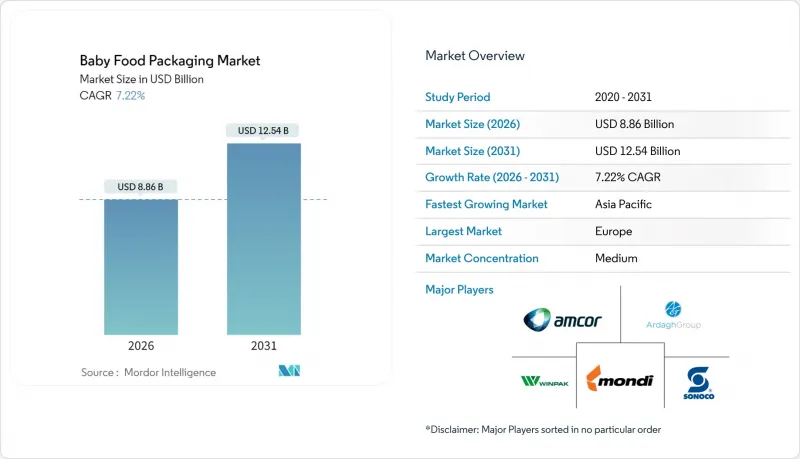
婴儿食品包装产业的成长速度超过了整体食品包装产业,这主要得益于都市区家庭对即食产品的需求、监管机构对婴幼儿食品安全法规的严格执行,以及加工商引入智慧材料以增强消费者互动并延长保质期。婴幼儿专用树脂价格的稳定溢价使得供应商能够将合规成本转嫁给消费者,而生产者延伸责任制(EPR)计划则推动了对可回收或生物基复合材料的需求。预计从2025年到2030年,吸嘴袋、无菌填充线和人工智慧驱动的可追溯性仍将是区分婴幼儿食品包装市场中表现优异的供应商与普通商品竞争对手的关键创新领域。由于全球树脂价格波动和自製食物泥的趋势会週期性地抑制该行业的成长,因此加强医药级吸嘴和阻隔膜的供应链管理仍然至关重要。
全球婴幼儿食品包装市场趋势与洞察
为了方便起见,婴儿食品袋被广泛采用。
由于吸嘴袋轻巧、易于携带且不易洒漏,它们已经取代玻璃瓶,占据了婴儿食品包装市场超过30%的份额。千禧世代的父母认为可重复密封和降低破损风险是至关重要的优势,这支撑了吸嘴袋的溢价和重复购买率。耐热复合材料使其能够进行高温填充、蒸馏和高压灭菌,无需添加防腐剂即可确保货架期稳定性。品牌在改用吸嘴袋包装后,销售量实现了两位数的成长,尤其是有机食物泥。这些因素共同促成了吸嘴袋包装成为婴儿食品包装市场中规模最大、成长最快的细分市场。
都市区的双薪家庭正在寻求节省时间的模式。
人口密集的都市区对即食包装的需求日益增长,这有助于职业父母减少烹饪时间和清洁工作。为了满足这项需求,Once Upon a Farm 将其自动化生产线扩建至每週 120 万包,2020 年的产量增加了两倍。亚太地区的特大城市正经历着最快的销售成长,而与此同时,来自大家庭的育儿支持却在减少。电子商务的兴起进一步加速了这一趋势,因为与玻璃容器相比,包装袋和加固纸盒更能承受运输衝击。儘管价格溢价高达 20-30%,但由于家庭用户将包装的便利性与节省时间的无形价值相结合,需求依然强劲,这为婴幼儿食品包装市场提供了持续的利好因素。
塑胶永续性的反弹和立法
加州、缅因州、奥勒冈州和科罗拉多的「生产者延伸责任制」(EPR)法律要求生产商资金筹措并遵守回收设计标准。欧盟的《包装和包装废弃物条例》进一步规定,到2030年,包装材料中再生材料的含量必须达到30%。食品级再生聚丙烯(PP)的产能仍只占再生聚合物总产量的约10%,导致供应紧张和成本上升。虽然能够证明产品可回收性和可堆肥性的品牌正在赢得消费者的信任,但传统的多层结构正日益被淘汰,这给整个婴幼儿食品包装市场的短期利润率带来了压力。
细分市场分析
到2025年,塑胶将维持26.42%的收入份额,这反映了其完善的加工基础设施。同时,随着监管机构和品牌商收紧碳减排目标,生质塑胶目前以9.53%的复合年增长率(CAGR)位居成长最快。 Braskem公司利用废弃食用油製成的生物再生聚丙烯可直接取代传统塑料,从而简化生产线改造。 AD 生物塑胶已将一种专门用于婴儿食物泥的100%可堆肥树脂商业化。早期采用者正在获得生产者责任延伸(EPR)积分和市场优势,将生物聚合物定位为一种战略对冲工具,即便传统塑胶仍保持着规模和成本优势。
这种材料转变正在推动供应链重组:加工商与生物聚合物供应商谈判长期供应协议,消费品製造商重新设计标籤以突出产品报废后的特性。随着产量增加,规模经济将缩小成本差距,预计生质塑胶将在婴儿食品包装市场占据更有利的地位。
区域分析
到2025年,欧洲将维持25.55%的收入份额,这主要得益于鼓励可回收设计和规范化学危害的前瞻性立法。 2025年1月双酚A(BPA)的禁用将迫使产品即时重新设计,从而对拥有合格材料和合规文件的供应商提出更高要求。德国和法国已建立活跃的永续包装研发丛集,而英国对采用内置追溯晶片的智慧包装袋包装的高端有机食物泥的需求持续旺盛。
亚太地区将呈现最快成长速度,到2031年复合年增长率将达到7.69% 。中阶收入的成长和城市生活方式的兴起推动了便利型产品的需求,使该地区成为婴幼儿食品包装市场新增需求的最大来源。随着中国婴幼儿奶粉市场的復苏,预计H&H集团在2025年第一季的销售额将增加44.3%,这表明在经历了过去的食品安全问题后,消费者对品牌营养食品的信任正在恢復。印度强制禁止使用不含双酚A(BPA)的产品,加上安姆科(Amcor)以2000万美元收购凤凰软包装(Phoenix Flexibles),将增强古吉拉突邦当地的软包装薄膜生产能力。日本和韩国正率先采用双QR码追踪系统,这反映了消费者对安全检验的偏好。
由于美国食品药物管理局 (FDA) 的严格监管和较高的电子商务渗透率,北美仍然是一个高附加价值市场。四个州已颁布生产者责任延伸 (EPR) 法,要求品牌製造商承担回收成本,这促进了单一材料复合材料的快速普及。为因应 2022 年奶粉短缺,美国国内产能正在扩张:Bobby's 位于俄亥俄州的工厂(占地 9 万平方英尺)在严格的微生物控制下生产罐装牛奶和奶粉。加拿大统一的跨省 EPR 网路促进了软包装和硬包装容器的可回收设计,并维持了持续的技术创新。
其他福利:
- Excel格式的市场预测(ME)表
- 3个月的分析师支持
目录
第一章 引言
- 研究假设和市场定义
- 调查范围
第二章调查方法
第三章执行摘要
第四章 市场情势
- 市场概览
- 市场驱动因素
- 便利婴儿食品袋的普及
- 都市区双薪家庭对省时格式的需求
- 由于婴儿安全法规加强,高檔包装价格上涨。
- 带有无菌喷嘴的袋装填充生产线越来越受欢迎。
- 生产者延伸责任奖励促进可回收性
- 利用人工智慧创新个人化营养方案设计
- 市场限制
- 针对塑胶永续性的强烈反对和立法
- 双酚A/化学品监管成本压力
- 医药级浇注树脂供应瓶颈
- 由于自製婴儿食品的趋势,包装需求下降。
- 供应链分析
- 监管环境
- 技术展望
- 波特五力模型
- 新进入者的威胁
- 买方的议价能力
- 供应商的议价能力
- 替代品的威胁
- 竞争对手之间的竞争
- 对影响市场的宏观经济因素进行评估
第五章 市场规模与成长预测
- 材料
- 塑胶
- 纸板
- 金属
- 玻璃
- 生质塑胶
- 按包装类型
- 瓶子
- 纸盒
- 罐
- 小袋
- 盒中袋
- 副产品
- 液体配方
- 婴儿干粮
- 奶粉
- 已烹调的婴儿辅食
- 婴儿零食
- 按地区
- 北美洲
- 我们
- 加拿大
- 墨西哥
- 南美洲
- 巴西
- 阿根廷
- 南美洲其他地区
- 欧洲
- 德国
- 英国
- 法国
- 义大利
- 西班牙
- 其他欧洲地区
- 亚太地区
- 中国
- 日本
- 印度
- 韩国
- 东南亚
- 亚太其他地区
- 中东和非洲
- 中东
- 沙乌地阿拉伯
- 阿拉伯聯合大公国
- 土耳其
- 其他中东地区
- 非洲
- 南非
- 奈及利亚
- 埃及
- 其他非洲地区
- 中东
- 北美洲
第六章 竞争情势
- 市场集中度
- 策略趋势
- 市占率分析
- 公司简介
- Amcor PLC
- Tetra Laval Group
- Mondi Group
- Berry Global Inc.(incl. former RPC)
- Silgan Holdings Inc.
- Sonoco Products Company
- Ardagh Group
- Winpak Ltd
- DS Smith PLC
- SIG Combibloc Group
- Cheer Pack North America
- Gualapack Group
- Scholle IPN
- UFlex Ltd
- ProAmpac LLC
- Huhtamaki Oyj
- AptarGroup Inc.
- Plastipak Packaging Inc.
- Crown Holdings Inc.
- Sealed Air Corp.
第七章 市场机会与未来展望
The baby food packaging market size in 2026 is estimated at USD 8.86 billion, growing from 2025 value of USD 8.26 billion with 2031 projections showing USD 12.54 billion, growing at 7.22% CAGR over 2026-2031.
This growth rate exceeds the broader food-packaging category as urban families seek ready-to-serve formats, regulators impose strict infant-safety rules, and converters deploy smart materials that lengthen shelf life while enabling consumer interaction. Steady premium-price tolerance for infant-grade resins allows suppliers to pass through compliance costs, while extended-producer-responsibility (EPR) programs propel demand for recyclable or bio-based laminates. During 2025-2030, spouted pouches, aseptic filling lines, and AI-enabled traceability are expected to remain the pivotal innovation fronts that separate high-performing vendors from commodity competitors in the baby food packaging market. Heightened supply-chain discipline around pharmaceutical-grade spouts and barrier films will remain essential as global resin volatility and DIY puree trends periodically temper category momentum.
Global Baby Food Packaging Market Trends and Insights
Convenience-Driven Adoption of Baby Food Pouches
Spouted pouches have secured more than 30% share of the baby food packaging market by displacing glass jars through lighter weight, portability, and mess-free dispensing. Millennial parents view resealability and reduced breakage risk as decisive benefits, supporting price premiums and repeat purchases. Heat-resistant laminates enable hot-fill, retort, and high-pressure pasteurization, delivering preservative-free shelf stability. Brand case studies show double-digit sales lifts after switching to pouch formats, particularly in organic purees. Together, these factors underpin the segment's dual status as both largest and fastest growth engine of the baby food packaging market.
Urban Dual-Income Households Demanding Time-Saving Formats
In dense metros, working parents trade up to ready-to-consume packages that cut prep time and washing. Once Upon a Farm scaled automated lines to 1.2 million packs per week triple 2020 throughput-to meet this demand.Asia Pacific megacities show the sharpest volume increases as extended-family childcare support wanes. E-commerce penetration amplifies the trend because pouches and reinforced cartons tolerate parcel-handling shocks better than glass. Despite 20-30% price premiums, elasticity remains favorable as households equate packaging convenience with intangible time savings, providing sustained tailwinds for the baby food packaging market.
Plastics Sustainability Backlash & Legislation
EPR statutes in California, Maine, Oregon, and Colorado obligate producers to bankroll recycling systems and meet design-for-recovery criteria.The EU's Packaging and Packaging Waste Regulation further mandates 30% recycled content by 2030. Food-grade recycled PP capacity sits near 10% of total recycled polymer output, tightening supply and inflating costs. Brands able to validate recyclability or compostability gain consumer trust, whereas legacy multilayer formats face accelerating obsolescence, weighing on near-term margins across the baby food packaging market.
Other drivers and restraints analyzed in the detailed report include:
- Stricter Infant-Safety Regulations Expanding Premium Packaging
- Aseptic Spouted-Pouch Filling Lines Gaining Ground
- Supply Bottlenecks of Pharma-Grade Spout Resins
For complete list of drivers and restraints, kindly check the Table Of Contents.
Segment Analysis
Plastic maintained 26.42% revenue share in 2025, reflecting extensive processing infrastructure, but bioplastics now post the quickest 9.53% CAGR as regulators and brands escalate carbon-reduction targets. Braskem's bio-circular polypropylene derived from used cooking oil offers a drop-in alternative that eases line changeovers. ADBioplastics commercialized a 100% compostable resin tailored for wet baby purees. Early adopters secure EPR credits and marketing lift, positioning biopolymers as a strategic hedge even while traditional plastics keep scale and cost advantages.
The material shift galvanizes supply-chain reengineering: converters negotiate long-term offtake with bio-polymer suppliers, and CPGs redesign labels to highlight end-of-life credentials. As volumes rise, economies of scale are expected to narrow the cost delta, further embedding bioplastics within the baby food packaging market.
Baby Food Packaging Market Report is Segmented by Material (Plastic, Paperboard, Metal, Glass, Bioplastics), Package Type (Bottles, Cartons, Jars, Pouches, Bag-In-Box), Product (Liquid Milk Formula, Dried Baby Food, Powder Milk Formula, Prepared Baby Food, Baby Snacks), and by Geography. The Market Forecasts are Provided in Terms of Value (USD).
Geography Analysis
Europe maintained a 25.55% revenue lead in 2025, propelled by progressive regulation that rewards recyclable designs and punishes chemical hazards. The January 2025 BPA prohibition forces immediate reformulations, channeling business toward suppliers with qualifying materials and compliance documentation. Germany and France house active clusters of sustainable-packaging R&D, while the UK displays sustained demand for premium organic purees sold in smart pouches that embed traceability chips.
Asia Pacific shows the fastest 7.69% CAGR through 2031. Rising middle-class incomes and urban lifestyles accelerate convenience-focused SKUs, positioning the region as the largest incremental volume source for the baby food packaging market. China's infant-formula rebound H&H Group recorded 44.3% Q1 2025 revenue growth signals renewed confidence in branded nutrition after earlier safety scares. India's BPA-free mandate aligns with Amcor's USD 20 million purchase of Phoenix Flexibles, which boosts local flexible-film capacity in Gujarat. Japan and South Korea pioneer dual-QR traceability, reflecting consumer penchant for safety verification.
North America remains a high-value arena given stringent FDA rules and wide e-commerce penetration. EPR laws in four states obligate brands to finance recycling, pushing quick adoption of mono-material laminates. The 2022 formula shortage catalyzed domestic capacity investments: Bobbie's 90,000 sq ft Ohio plant now produces canned and powdered formula under strict microbiological controls. Canada's harmonized provincial EPR network incentivizes design-for-recycling across flexible and rigid formats alike, sustaining steady innovation.
- Amcor PLC
- Tetra Laval Group
- Mondi Group
- Berry Global Inc. (incl. former RPC)
- Silgan Holdings Inc.
- Sonoco Products Company
- Ardagh Group
- Winpak Ltd
- DS Smith PLC
- SIG Combibloc Group
- Cheer Pack North America
- Gualapack Group
- Scholle IPN
- UFlex Ltd
- ProAmpac LLC
- Huhtamaki Oyj
- AptarGroup Inc.
- Plastipak Packaging Inc.
- Crown Holdings Inc.
- Sealed Air Corp.
Additional Benefits:
- The market estimate (ME) sheet in Excel format
- 3 months of analyst support
TABLE OF CONTENTS
1 INTRODUCTION
- 1.1 Study Assumptions and Market Definition
- 1.2 Scope of the Study
2 RESEARCH METHODOLOGY
3 EXECUTIVE SUMMARY
4 MARKET LANDSCAPE
- 4.1 Market Overview
- 4.2 Market Drivers
- 4.2.1 Convenience-driven adoption of baby food pouches
- 4.2.2 Urban dual-income households demanding time-saving formats
- 4.2.3 Stricter infant-safety regulations expanding premium packaging
- 4.2.4 Aseptic spouted-pouch filling lines gaining ground
- 4.2.5 Extended-producer-responsibility incentives for recyclability
- 4.2.6 AI-led personalised-nutrition pack design innovations
- 4.3 Market Restraints
- 4.3.1 Plastics sustainability backlash and legislation
- 4.3.2 BPA/chemicals compliance cost pressures
- 4.3.3 Supply bottlenecks of pharma-grade spout resins
- 4.3.4 DIY baby-food trend reducing packaged demand
- 4.4 Supply-Chain Analysis
- 4.5 Regulatory Landscape
- 4.6 Technological Outlook
- 4.7 Porter's Five Forces
- 4.7.1 Threat of New Entrants
- 4.7.2 Bargaining Power of Buyers
- 4.7.3 Bargaining Power of Suppliers
- 4.7.4 Threat of Substitute Products
- 4.7.5 Intensity of Competitive Rivalry
- 4.8 Assesment of Macroeconomic Factors on the Market
5 MARKET SIZE AND GROWTH FORECASTS (VALUE)
- 5.1 By Material
- 5.1.1 Plastic
- 5.1.2 Paperboard
- 5.1.3 Metal
- 5.1.4 Glass
- 5.1.5 Bioplastics
- 5.2 By Package Type
- 5.2.1 Bottles
- 5.2.2 Cartons
- 5.2.3 Jars
- 5.2.4 Pouches
- 5.2.5 Bag-in-Box
- 5.3 By Product
- 5.3.1 Liquid Milk Formula
- 5.3.2 Dried Baby Food
- 5.3.3 Powder Milk Formula
- 5.3.4 Prepared Baby Food
- 5.3.5 Baby Snacks
- 5.4 By Geography
- 5.4.1 North America
- 5.4.1.1 United States
- 5.4.1.2 Canada
- 5.4.1.3 Mexico
- 5.4.2 South America
- 5.4.2.1 Brazil
- 5.4.2.2 Argentina
- 5.4.2.3 Rest of South America
- 5.4.3 Europe
- 5.4.3.1 Germany
- 5.4.3.2 United Kingdom
- 5.4.3.3 France
- 5.4.3.4 Italy
- 5.4.3.5 Spain
- 5.4.3.6 Rest of Europe
- 5.4.4 Asia-Pacific
- 5.4.4.1 China
- 5.4.4.2 Japan
- 5.4.4.3 India
- 5.4.4.4 South Korea
- 5.4.4.5 Southeast Asia
- 5.4.4.6 Rest of Asia-Pacific
- 5.4.5 Middle East and Africa
- 5.4.5.1 Middle East
- 5.4.5.1.1 Saudi Arabia
- 5.4.5.1.2 United Arab Emirates
- 5.4.5.1.3 Turkey
- 5.4.5.1.4 Rest of Middle East
- 5.4.5.2 Africa
- 5.4.5.2.1 South Africa
- 5.4.5.2.2 Nigeria
- 5.4.5.2.3 Egypt
- 5.4.5.2.4 Rest of Africa
- 5.4.5.1 Middle East
- 5.4.1 North America
6 COMPETITIVE LANDSCAPE
- 6.1 Market Concentration
- 6.2 Strategic Moves
- 6.3 Market Share Analysis
- 6.4 Company Profiles (includes Global level Overview, Market level overview, Core Segments, Financials as available, Strategic Information, Market Rank/Share for key companies, Products and Services, and Recent Developments)
- 6.4.1 Amcor PLC
- 6.4.2 Tetra Laval Group
- 6.4.3 Mondi Group
- 6.4.4 Berry Global Inc. (incl. former RPC)
- 6.4.5 Silgan Holdings Inc.
- 6.4.6 Sonoco Products Company
- 6.4.7 Ardagh Group
- 6.4.8 Winpak Ltd
- 6.4.9 DS Smith PLC
- 6.4.10 SIG Combibloc Group
- 6.4.11 Cheer Pack North America
- 6.4.12 Gualapack Group
- 6.4.13 Scholle IPN
- 6.4.14 UFlex Ltd
- 6.4.15 ProAmpac LLC
- 6.4.16 Huhtamaki Oyj
- 6.4.17 AptarGroup Inc.
- 6.4.18 Plastipak Packaging Inc.
- 6.4.19 Crown Holdings Inc.
- 6.4.20 Sealed Air Corp.
7 MARKET OPPORTUNITIES AND FUTURE OUTLOOK
- 7.1 White-space and Unmet-need Assessment

 婴儿食品包装市场规模、份额和成长分析(按材料、包装类型、食品类型、分销管道和地区划分)-2026-2033年产业预测
 婴儿食品包装市场按包装材料、包装形式、封盖类型和类别划分-2025-2032年全球预测
 婴儿食品包装市场 - 预测 2025-2030
 亚太地区婴幼儿食品包装:市场份额分析、行业趋势、统计数据和成长预测(2025-2030 年)
 婴儿食品包装市场规模、份额、趋势分析报告:按材料、产品、地区、细分市场、预测,2025-2030 年婴儿食品玻璃包装:市场占有率分析、产业趋势与成长预测(2025-2030)
 2025 年至 2033 年婴儿食品包装市场报告(按产品、材料、包装类型和地区)中东和非洲婴儿食品包装:市场占有率分析、产业趋势、成长预测(2025-2030)北美婴儿食品包装:市场占有率分析、行业趋势和成长预测(2025-2030)拉丁美洲婴儿食品包装:市场占有率分析、产业趋势与成长预测(2025-2030)