


 |
市场调查报告书
商品编码
1939644
车载资讯服务:市场占有率分析、产业趋势与统计、成长预测(2026-2031 年)Telematics - Market Share Analysis, Industry Trends & Statistics, Growth Forecasts (2026 - 2031) |
||||||

※ 本网页内容可能与最新版本有所差异。详细情况请与我们联繫。
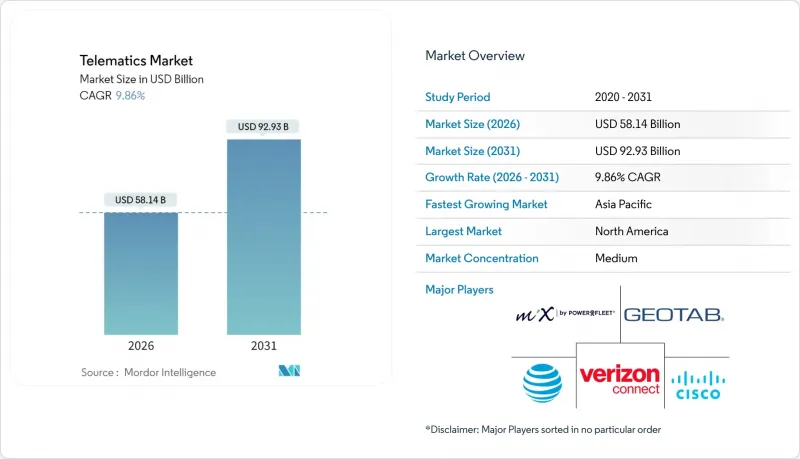
2025 年,车载资讯服务市场价值 529.3 亿美元,预计到 2031 年将达到 929.3 亿美元,而 2026 年为 581.4 亿美元。
预计在预测期(2026-2031 年)内,复合年增长率将达到 9.86%。
监管要求,特别是欧洲的eCall和印度的AIS 140,正迫使汽车製造商和车队营运商在工厂层面就将互联功能整合到车辆中,从而加速了原始设备製造商(OEM)的需求。预计到2030年,每辆车的半导体数量将翻一番,这将推高硬体成本,但同时也将支援丰富的资料流,进而推动进阶分析。利用即时驾驶数据的基于使用量的保险计划正在北美和欧洲迅速发展,进一步增强了联网汽车的商业价值。 5G和边缘运算的快速普及正在将车载资讯服务从简单的车辆追踪转变为预测性维护和车联网(V2X)。根据联合国欧洲经济委员会(UNECE)WP.29和ISO/SAE 21434标准,网路安全合规成本的不断攀升给小型供应商带来了压力,但也为资金雄厚的公司提供了竞争优势。
全球车载资讯服务市场趋势与洞察
扩大的OEM嵌入式连线义务
为了遵守新的资料共用法规,例如将于2025年生效的欧盟《资料法案》,汽车製造商正将车载资讯系统直接整合到车辆电子设备中。该法案要求製造商向第三方服务供应商开放车辆资料。 Geotab与沃尔沃汽车的合作使其OEM整合范围扩展至157个品牌,这显示嵌入式连接技术的快速普及。分析师估计,互联服务预计将为每辆车带来1,600美元的收入,这促使汽车製造商将数据视为新的收入来源。像WirelessCar这样的专业供应商现在提供工具包,帮助OEM厂商落实数据法规,并加快了采用速度。日益严格的法规正在推动工厂出货时装载单元的标准化,并缩小售后市场规模,从而整合车载资讯系统市场。
自2025年起,基于使用量的保险普及率将大幅提升。
保险公司正利用即时驾驶数据,从基于人口统计的定价模式转向行为模式的定价模式。 Intuit 将 Zendrive 的分析功能整合到其 Credit Karma 应用中,计划到 2025 年向 600 万会员发送 400 万份保单报价,这表明该技术已被广泛接受。起亚汽车和 LexisNexis 在欧盟 27 国推出了驾驶员评分共用服务,简化了客户註册流程,同时确保符合 GDPR 法规。安全驾驶员可获得高达 30% 的保费折扣,这不仅刺激了消费者需求,还有助于保险公司降低赔付率。 Cambridge Mobile Telematics 增加了燃油消耗评级,显示保险公司现在除了奖励安全驾驶外,也奖励环保节能驾驶。这些发展正在加强数据驱动的承保业务,并加速远端资讯处理市场的成长。
网路安全应对成本不断上升
联合国欧洲经济委员会 (UNECE) WP.29 要求汽车製造商在车辆整个生命週期内运行经认证的网路安全管理系统。合规要求持续监控、事件报告和安全更新管道,这会增加工程成本并延长开发週期。 ISO/SAE 21434 增加了生命週期风险管理程序,而美国目前禁止从某些国家采购联网汽车零件,并强制要求进行供应链审核。哈曼等供应商提供咨询服务,帮助原始设备製造商 (OEM) 获得认证,这表明合规正在从一项工程任务转变为支出。小型供应商可能难以承担这些成本,这可能会减缓新进入远端资讯处理市场的企业的速度。
细分市场分析
到2025年,售后市场解决方案将占据车载资讯服务市场56.30%的份额,这反映了其在售后市场和混合车队中的历史地位。到2031年,OEM系统将以11.62%的复合年增长率快速成长,这标誌着市场正朝着工厂互联的方向发展,从而实现更清晰的数据流和无缝的保固整合。车载资讯服务市场受益于这种双渠道结构,因为新车出厂时就已集成,而老旧车辆仍需加装设备。
儘管售后市场紧急呼叫(eCall)的监管标准化将使第三方供应商保持竞争力,但诸如欧盟资料法等原始设备製造商(OEM)资料共用规则更有利于嵌入式通路。随着汽车製造商将联网汽车订阅服务商业化,下游价值获取将会增加,从而降低售后市场的利润率。因此,供应商正在加强其分析能力和多车队管理能力,以维持其在车载资讯服务市场的地位。
至2025年,嵌入式单元将占车载资讯服务市场规模的47.80%,年复合成长率(CAGR)高达12.94%,成为成长最快的细分市场。这项转变主要受多种因素驱动,例如预测性维护、电动车电池管理以及监管资料共用义务等,这些因素需要深度整合到车辆中。基于智慧型手机的解决方案也能为对成本敏感的车队提供价值,但它们在效能和资料精度方面不如嵌入式架构。
车队营运商更倾向于使用嵌入式硬体进行关键任务分析,例如智慧充电演算法,该演算法可将电动车队的能源成本降低 55%。随着 5G 模组的标准化,嵌入式解决方案将成为 V2X 和高精度定位等高阶应用的主流选择,从而巩固其在车载资讯服务市场的战略地位。
区域分析
预计到2025年,欧洲将以31.95%的市场份额引领远端资讯处理市场,这主要得益于强制性的eCall指令、GDPR的保护以及预计到2028年将达到2760万套车队管理设备的安装基础。欧盟将于2025年生效的资料保护法预计将强制要求资料共用,从而在保障隐私保护的同时,催生新一轮的第三方服务浪潮。为了满足更严格的整合和合规要求,供应商正在为其连接套件建立品牌,例如大陆集团的「Aumovio」。
亚太地区是成长最快的地区,预计到2031年将维持12.26%的复合年增长率。印度的AIS 140强制令以及政府10亿卢比(约1200万美元)的地理空间投资将扩大基础地图基础设施。中国新的驾驶辅助安全法规也提高了整车製造商的互联互通标准。快速的都市化和庞大的商用车保有量正在创造需求,促使全球供应商与当地企业建立伙伴关係,并扩大全部区域的远端资讯处理市场规模。
北美市场虽已成熟,但仍在持续成长,这主要得益于政府车队的大规模应用,包括电子记录设备(ELD)的强制实施以及美国总务管理局与Geotab签订的部署40万辆政府车辆的合约。预计到2028年,美洲地区的车队管理车辆数量将达到4,300万辆。限制某些外国製造零件的供应链安全法规可能会增加硬体成本,但也可能促进国内半导体投资,为远端资讯处理市场带来长期的供应稳定性。
其他福利:
- Excel格式的市场预测(ME)表
- 3个月的分析师支持
目录
第一章 引言
- 研究假设和市场定义
- 调查范围
第二章调查方法
第3章执行摘要
第四章 市场情势
- 市场概览
- 市场驱动因素
- 扩大OEM嵌入式连接性要求
- 预计从2025年起,基于使用量的保险(UBI)的采用率将大幅成长。
- 政府电子呼叫和AIS 140法规
- 支援 5G/Edge 的空中下载 (OTA) 分析
- 车队电气化需要即时电池分析
- 旅游即服务 (MaaS) 平台的兴起
- 市场限制
- 网路安全回应成本不断增加
- TCU*硬体价格在初始部署阶段波动性较大
- 多司法管辖区资料主权障碍
- 现有商用车队的惯性
- 产业价值链分析
- 监管环境
- 技术展望
- ポーターの五力分析
- 新进入者的威胁
- 买方的议价能力
- 供应商的议价能力
- 替代品的威胁
- 竞争对手之间的竞争
第五章 市场规模与成长预测
- 按频道
- 原始设备製造商 (OEM)
- 售后市场
- 透过解决方案
- 嵌入式
- スマートフォンベース
- 可携式/プラグイン
- 提供形态别
- 硬体
- サービス- エントリーレベル
- サービス- ミッドティア
- 高阶服务
- 按车辆类型
- 搭乘用车
- 小型商用车(LCV)
- 大型商用车(HCV)
- 透过使用
- 车队管理
- 保険テレマティクス
- 予知保全および诊断
- ナビゲーションおよびインフォテインメント
- 汽车共享和订阅服务
- 按地区
- 北美洲
- 我们
- 加拿大
- 墨西哥
- 欧洲
- 英国
- 德国
- 法国
- 义大利
- 其他欧洲地区
- 亚太地区
- 中国
- 日本
- 印度
- 韩国
- 其他亚洲地区
- 中东
- 以色列
- 沙乌地阿拉伯
- 阿拉伯聯合大公国
- 土耳其
- 其他中东地区
- 非洲
- 南非
- 埃及
- 其他非洲地区
- 南美洲
- 巴西
- 阿根廷
- 南美洲其他地区
- 北美洲
第6章 竞合情势
- 市场集中度
- 策略趋势
- 市占率分析
- 公司简介
- Verizon Communications Inc.(Verizon Connect)
- Geotab Inc.
- Trimble Inc.
- TomTom NV
- MiX Telematics Ltd
- ATandT Inc.
- Cisco Systems Inc.
- LG Electronics Inc.
- Continental AG
- Robert Bosch GmbH
- ZF Friedrichshafen AG
- Harman International Industries Inc.
- Valeo SA
- Inseego Corp.(Ctrack)
- Microlise Group PLC
- Aplicom Oy
- Huawei Technologies Co. Ltd.
- Sierra Wireless Inc.
- Octo Telematics SpA
- CalAmp Corp.
第七章 市场机会与未来展望
The telematics market was valued at USD 52.93 billion in 2025 and estimated to grow from USD 58.14 billion in 2026 to reach USD 92.93 billion by 2031, at a CAGR of 9.86% during the forecast period (2026-2031).
Regulatory mandates, especially eCall in Europe and AIS 140 in India, are compelling automakers and fleets to embed connectivity at the factory level, which accelerates OEM demand. Semiconductor content per vehicle is set to double by 2030, raising hardware costs yet enabling richer data streams that underpin advanced analytics. Usage-based insurance programs, powered by real-time driving data, are expanding quickly across North America and Europe, reinforcing the business case for connected cars. Rapid adoption of 5G and edge computing is transforming telematics from simple tracking to predictive maintenance and vehicle-to-everything communication. Rising cybersecurity compliance costs under UNECE WP.29 and ISO/SAE 21434 are pressuring smaller vendors but giving well-capitalized players a competitive edge.
Global Telematics Market Trends and Insights
Expanding OEM-embedded connectivity mandates
Automakers are integrating telematics directly into vehicle electronics to meet new data-sharing rules such as the EU Data Act, which applies from 2025 and obliges manufacturers to open vehicle data to third-party service providers. Geotab's collaboration with Volvo Cars lifts its OEM integrations to more than 157 brands, proving that embedded connectivity is scaling quickly. Analysts estimate connected services could yield USD 1,600 revenue per car, incentivizing automakers to treat data as a profit center. Specialized vendors like WirelessCar now offer compliance toolkits that help OEMs operationalize the Data Act, accelerating rollout timelines. As regulations tighten, factory-fitted units are becoming standard, shrinking the addressable aftermarket and reshaping the telematics market.
Usage-based insurance adoption surging post-2025
Insurance carriers are shifting from demographic to behaviour-based pricing, fuelled by real-time driving data. Intuit embedded Zendrive analytics into the Credit Karma app, sending 4 million policy offers to its 6 million members in 2025, which demonstrates mainstream scale. Kia and LexisNexis rolled out driver-score sharing in 27 EU countries, simplifying customer enrolment while preserving GDPR compliance. Safe drivers can secure premium cuts of up to 30%, boosting consumer demand and improving loss ratios for insurers. Cambridge Mobile Telematics added fuel consumption scoring, proving that insurers now value eco-efficient driving as well as safety. These advances reinforce data-centric underwriting and amplify the telematics market's growth.
Escalating cybersecurity compliance cost
UNECE WP.29 obliges automakers to operate certified Cyber Security Management Systems across the vehicle lifecycle. Compliance demands continuous monitoring, incident reporting and secure update channels, which raises engineering costs and lengthens development cycles. ISO/SAE 21434 adds lifecycle risk-management steps, while the U.S. now blocks connected-vehicle components sourced from certain countries, forcing supply-chain audits. Vendors like HARMAN have built consulting practices to help OEMs navigate certification, showing that compliance is transforming from an engineering task to a line-item expense. Smaller suppliers may struggle to shoulder these costs, slowing new-entrant momentum within the telematics market.
Other drivers and restraints analyzed in the detailed report include:
- Government eCall and AIS 140 regulations
- 5G/edge-enabled over-the-air analytics
- High upfront TCU hardware price volatility
For complete list of drivers and restraints, kindly check the Table Of Contents.
Segment Analysis
Aftermarket solutions held 56.30% of the telematics market share in 2025, reflecting their historical role in retrofits and mixed fleets. OEM systems are scaling faster at an 11.62% CAGR to 2031, signalling a pivot toward factory-installed connectivity that delivers cleaner data streams and seamless warranty integration. The telematics market benefits from this dual-channel structure because older vehicles still need retrofit devices, while new cars roll off the line connected.
Regulatory standardization of aftermarket eCall ensures that third-party providers remain relevant, yet OEM data-sharing rules like the EU Data Act favour embedded channels. As automakers commercialize connected-car subscriptions, they capture more downstream value, narrowing the aftermarket's margin pool. Providers are thus emphasizing analytics and cross-fleet compatibility to preserve their position in the telematics market.
Embedded units accounted for 47.80% of the telematics market size in 2025 and exhibit the highest growth at a 12.94% CAGR. The shift is propelled by predictive maintenance, battery management in EVs, and regulatory data-sharing obligations that all require deep vehicle integration. Smartphone-based offerings remain viable in cost-sensitive fleets, but performance and data fidelity lag behind embedded architectures.
Fleet operators prefer embedded hardware for mission-critical analytics such as smart charging algorithms that cut energy expenses by 55% in electric fleets. As 5G modules become standard, embedded solutions will dominate advanced applications like V2X and high-accuracy positioning, cementing their strategic weight in the telematics market.
The Telematics Market Report is Segmented by Channel (OEM, and Aftermarket), Solution (Embedded, Smartphone-Based, Portable/Plug-in), Offering Type (Hardware, Services - Entry-Level, Services - Mid-Tier, and More), Vehicle Type (Passenger Cars, Light Commercial Vehicles, and More), Application (Fleet Management, and More), and Geography (North America, Europe, and More). The Market Forecasts are Provided in Terms of Value (USD).
Geography Analysis
Europe led the telematics market with a 31.95% share in 2025, underpinned by mandatory eCall, GDPR protections, and an installed base of 27.6 million fleet management units projected by 2028. The EU Data Act, effective in 2025, compels data sharing and is expected to stimulate a new wave of third-party services while maintaining privacy safeguards. Suppliers are branding connectivity suites, such as Continental's Aumovio, to meet tighter integration and compliance demands.
Asia-Pacific is the fastest-growing region, forecast at a 12.26% CAGR through 2031. India's AIS 140 mandate and the government's geospatial investment of INR 100 crore (USD 12 million) will broaden foundational mapping infrastructure. China's new driver-assistance safety rules also raise the bar for OEM connectivity. Rapid urbanization and large commercial fleets create volume, pulling global vendors into local partnerships and expanding the telematics market size across the region.
North America maintains a mature but still growing base, helped by ELD mandates and sizeable government-fleet deployments such as the US General Services Administration's 400,000-vehicle contract with Geotab. Fleet management units in the Americas are projected to reach 43 million by 2028. Supply-chain security rules limiting certain foreign components could elevate hardware costs yet may also spur domestic chip investments that stabilize long-term supply for the telematics market.
- Verizon Communications Inc. (Verizon Connect)
- Geotab Inc.
- Trimble Inc.
- TomTom N.V.
- MiX Telematics Ltd
- ATandT Inc.
- Cisco Systems Inc.
- LG Electronics Inc.
- Continental AG
- Robert Bosch GmbH
- ZF Friedrichshafen AG
- Harman International Industries Inc.
- Valeo SA
- Inseego Corp. (Ctrack)
- Microlise Group PLC
- Aplicom Oy
- Huawei Technologies Co. Ltd.
- Sierra Wireless Inc.
- Octo Telematics S.p.A.
- CalAmp Corp.
Additional Benefits:
- The market estimate (ME) sheet in Excel format
- 3 months of analyst support
TABLE OF CONTENTS
1 INTRODUCTION
- 1.1 Study Assumptions and Market Definition
- 1.2 Scope of the Study
2 RESEARCH METHODOLOGY
3 EXECUTIVE SUMMARY
4 MARKET LANDSCAPE
- 4.1 Market Overview
- 4.2 Market Drivers
- 4.2.1 Expanding OEM-embedded connectivity mandates
- 4.2.2 Usage-based insurance (UBI) adoption surging post-2025
- 4.2.3 Government eCall and AIS 140 regulations
- 4.2.4 5G/edge-enabled over-the-air (OTA) analytics
- 4.2.5 Fleet electrification demands real-time battery analytics
- 4.2.6 Rise of mobility-as-a-service (MaaS) platforms
- 4.3 Market Restraints
- 4.3.1 Escalating cybersecurity compliance cost
- 4.3.2 High upfront TCU* hardware price volatility
- 4.3.3 Multi-jurisdictional data-sovereignty hurdles
- 4.3.4 Inertia in legacy commercial fleets
- 4.4 Industry Value-Chain Analysis
- 4.5 Regulatory Landscape
- 4.6 Technological Outlook
- 4.7 Porter's Five Forces Analysis
- 4.7.1 Threat of New Entrants
- 4.7.2 Bargaining Power of Buyers
- 4.7.3 Bargaining Power of Suppliers
- 4.7.4 Threat of Substitutes
- 4.7.5 Intensity of Competitive Rivalry
5 MARKET SIZE AND GROWTH FORECASTS (VALUE)
- 5.1 By Channel
- 5.1.1 Original-Equipment Manufacturer (OEM)
- 5.1.2 Aftermarket
- 5.2 By Solution
- 5.2.1 Embedded
- 5.2.2 Smartphone-based
- 5.2.3 Portable/Plug-in
- 5.3 By Offering Type
- 5.3.1 Hardware
- 5.3.2 Services - Entry-level
- 5.3.3 Services - Mid-tier
- 5.3.4 Services - High-end
- 5.4 By Vehicle Type
- 5.4.1 Passenger Cars
- 5.4.2 Light Commercial Vehicles (LCV)
- 5.4.3 Heavy Commercial Vehicles (HCV)
- 5.5 By Application
- 5.5.1 Fleet Management
- 5.5.2 Insurance Telematics
- 5.5.3 Predictive Maintenance and Diagnostics
- 5.5.4 Navigation and Infotainment
- 5.5.5 Car-sharing and Subscription Services
- 5.6 By Geography
- 5.6.1 North America
- 5.6.1.1 United States
- 5.6.1.2 Canada
- 5.6.1.3 Mexico
- 5.6.2 Europe
- 5.6.2.1 United Kingdom
- 5.6.2.2 Germany
- 5.6.2.3 France
- 5.6.2.4 Italy
- 5.6.2.5 Rest of Europe
- 5.6.3 Asia-Pacific
- 5.6.3.1 China
- 5.6.3.2 Japan
- 5.6.3.3 India
- 5.6.3.4 South Korea
- 5.6.3.5 Rest of Asia
- 5.6.4 Middle East
- 5.6.4.1 Israel
- 5.6.4.2 Saudi Arabia
- 5.6.4.3 United Arab Emirates
- 5.6.4.4 Turkey
- 5.6.4.5 Rest of Middle East
- 5.6.5 Africa
- 5.6.5.1 South Africa
- 5.6.5.2 Egypt
- 5.6.5.3 Rest of Africa
- 5.6.6 South America
- 5.6.6.1 Brazil
- 5.6.6.2 Argentina
- 5.6.6.3 Rest of South America
- 5.6.1 North America
6 COMPETITIVE LANDSCAPE
- 6.1 Market Concentration
- 6.2 Strategic Moves
- 6.3 Market Share Analysis
- 6.4 Company Profiles (includes Global level Overview, Market level overview, Core Segments, Financials as available, Strategic Information, Market Rank/Share for key companies, Products and Services, and Recent Developments)
- 6.4.1 Verizon Communications Inc. (Verizon Connect)
- 6.4.2 Geotab Inc.
- 6.4.3 Trimble Inc.
- 6.4.4 TomTom N.V.
- 6.4.5 MiX Telematics Ltd
- 6.4.6 ATandT Inc.
- 6.4.7 Cisco Systems Inc.
- 6.4.8 LG Electronics Inc.
- 6.4.9 Continental AG
- 6.4.10 Robert Bosch GmbH
- 6.4.11 ZF Friedrichshafen AG
- 6.4.12 Harman International Industries Inc.
- 6.4.13 Valeo SA
- 6.4.14 Inseego Corp. (Ctrack)
- 6.4.15 Microlise Group PLC
- 6.4.16 Aplicom Oy
- 6.4.17 Huawei Technologies Co. Ltd.
- 6.4.18 Sierra Wireless Inc.
- 6.4.19 Octo Telematics S.p.A.
- 6.4.20 CalAmp Corp.
7 MARKET OPPORTUNITIES AND FUTURE OUTLOOK
- 7.1 White-space and Unmet-need Assessment

 车队远端资讯处理系统市场:按部署类型、通讯技术、组件类型、车辆类型、应用和最终用户产业划分-2026-2032年全球市场预测
 2026年全球车载资讯服务市场报告车用通讯系统售后服务资讯处理市场:按组件类型、连接类型、部署模式、应用、最终用户和分销管道划分-2026-2032年全球市场预测
 2026-2034年全球车用通讯系统市场规模、份额、趋势和成长分析报告
 赛车遥测市场:按组件、应用、国家和地区划分-全球产业分析、市场规模、市场份额及2025年至2032年预测
 全球保险远距资讯处理市场,2025-2029年
 共享出行远端资讯处理市场 - 全球产业规模、份额、趋势、机会及预测(按服务类型、车辆类型、产品/服务、技术、地区和竞争格局划分,2021-2031)轻型商用车远端资讯处理市场-全球产业规模、份额、趋势、机会、预测:按解决方案类型、应用、最终用户、地区和竞争对手划分,2021-2031年车载资讯系统备用电池市场(按电池化学成分、车辆类型、应用、最终用户和分销管道划分)-2026-2032年全球预测
 欧洲车载资讯服务市场:市场占有率分析、产业趋势与统计、成长预测(2026-2031 年)