


 |
市场调查报告书
商品编码
1910851
欧洲车载资讯服务市场:市场占有率分析、产业趋势与统计、成长预测(2026-2031 年)Europe Telematics - Market Share Analysis, Industry Trends & Statistics, Growth Forecasts (2026 - 2031) |
||||||

※ 本网页内容可能与最新版本有所差异。详细情况请与我们联繫。
欧洲车载资讯服务市场预计将从 2025 年的 2,449 万台装机量成长到 2026 年的 2,816 万台,到 2031 年达到 5,663 万台,2026 年至 2031 年的复合年增长率为 14.97%。
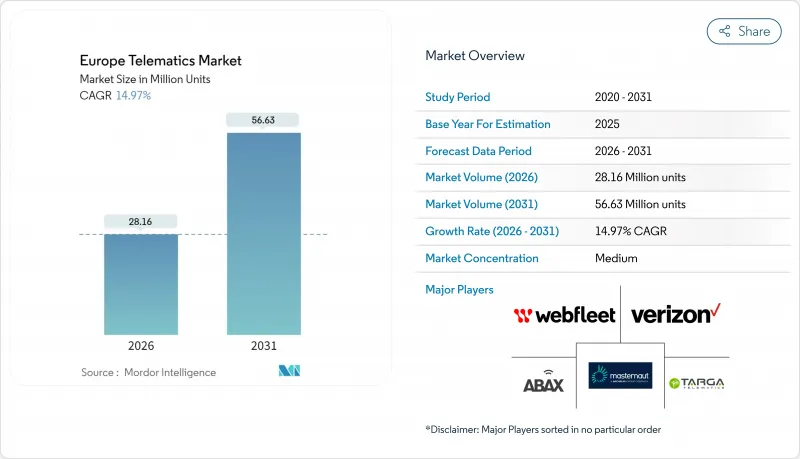
这一增长得益于欧盟统一的法规、原始设备製造商 (OEM) 的互联互通战略以及快速推进的车队数位化项目,这些因素正将车载资讯服务从可选附加功能提升为核心移动基础设施层。乘用车嵌入式互联功能的普及、物流需求的持续增长以及从 2G/3G 向 4G/5G 的监管过渡,共同为欧洲车载资讯服务市场奠定了坚实的基础。同时,感测器成本的下降正推动这项技术在大型车队以外的领域中得到应用。竞争格局正围绕着与 OEM 直接对接的数据通道而重塑,大众汽车集团的Line-Fit合作项目便是一个例证。为此,售后市场专家正利用跨车队分析来捍卫其市场份额。儘管资料隐私要求和改装的复杂性限制了技术的普及,但技术和监管方面的商业因素共同推动欧洲市场的强劲成长。
欧洲车载资讯服务市场趋势与洞察
欧盟eCall和智慧行车记录器相容时间表
欧洲车载资讯服务市场正受益于欧盟指令的同步实施,这些指令强制要求2.5吨以上的货车配备下一代eCall紧急呼叫系统和智慧行车记录器。硬体更新週期围绕着2026年7月的行车记录器部署截止日期和2027年1月的4G/5G eCall过渡期展开,这为供应商提供了清晰的市场需求预测,并使他们能够将合规模块与高收益的分析服务捆绑销售。随着营运商整合采购以满足这些不可更改的里程碑,解决方案供应商将受益于相关人员反对意见的减少和更清晰的预算核准。这将缩短冗长的销售流程,并加快整个欧洲车载资讯服务市场的销售成长。
OEM厂商迅速转向嵌入式连线平台
如今,汽车製造商将联网汽车数据视为提升客户终身价值的策略资产。 Targa Telematics 与大众汽车集团的合作标誌着这项变革的开端。车辆标配的模组简化了车队部署,实现了每週的功能更新,并减少了因售后设备故障而产生的支援电话。嵌入式通道还支援独特的诊断、空中下载 (OTA) 更新和能源管理控制,从而在首次销售后长期拓展收入来源。因此,欧洲车载资讯服务市场正日益青睐那些掌握了 OEM 资料收集和大规模增强型分析技术的供应商。
混合车队的高转换和整合成本
欧洲车队很少采购同质化的车辆,车龄、品牌和引擎技术差异很大。安装不同的车载黑盒子设备会造成资料孤岛和支援混乱,给个体经营者带来负担,尤其是那些利润微薄的个体经营者。整合成本,包括硬体、驾驶员培训、韧体更新以及传统CAN总线相容性等,都会占用有限的营运资金。因此,小规模的车队可能会推迟采用,或仅满足监管规定的最低要求,这可能会削弱欧洲车载资讯服务市场复合年增长率的潜在成长。
细分市场分析
2025年,商用车辆将占据欧洲远端资讯处理市场64.21%的份额,并透过节省燃油、提高路线遵守率和改善驾驶行为,带来可预测的投资收益(ROI)。随着监管报告与欧洲各地产能扩张的同步,市场需求依然强劲,而稳定的重型车辆基数也支撑着欧洲远端资讯处理市场的规模。此外,由于电动公共运输车辆需要电池充电监控和车库充电协调(现有票价系统无法涵盖这些任务),因此巴士和长途客车也将带来额外收入。
儘管乘用车目前仍处于小型化阶段,但嵌入式SIM卡和基于使用量的保险(UBI)的普及将推动乘用车市场的发展,预计到2031年,其复合年增长率将达到16.79%,成为成长最快的细分市场。有效的UBI保单数量将从2023年的1300万份增长到2028年的1760万份,为精算模型提供新的数据,从而通过实际的保费折扣奖励安全驾驶。轻型商用车(LCV)则弥合了乘用车和轻型商用车之间的差距,在预测期内将保持两位数的普及率,因为它们既能满足商用物流指标的要求,又能兼容乘用车的电子设备。
到2025年,车队管理和资产追踪平台将占欧洲远端资讯处理市场规模的37.12%,反映出其在燃油成本、维护计画和尽职调查合规性等方面的成熟价值主张。不断扩展的功能、映像基础的驾驶员指导、货物温度检验和多模态仪錶板聚合等,将使大型物流运营商的续订率保持在高位。
同时,保险和基于使用量的远端资讯处理技术以15.61%的复合年增长率实现了最高增长,这得益于精算模型从静态人口统计资料转向即时行为评分。光是义大利就有950万份保险远距资讯处理保单运作,最佳实践也正在向德国、英国和法国推广。安全领域主要受eCall强制令的推动,而远距离诊断也日益普及,因为原始设备製造商(OEM)向第三方开发人员开放了其预测程式码库,从而拓宽了欧洲远端资讯处理市场的解决方案选择。
其他福利
- Excel格式的市场预测(ME)表
- 3个月的分析师支持
目录
第一章 引言
- 研究假设和市场定义
- 调查范围
第二章调查方法
第三章执行摘要
第四章 市场情势
- 市场概览
- 市场驱动因素
- 欧盟eCall和智慧行车记录器相容时间表
- 原始设备製造商 (OEM) 正在迅速转向嵌入式连接平台
- 促进电子商务和最后一公里物流的优化
- 车队所有者的连接性和感测器成本下降
- 强制过渡到下一代(4G/5G)电子呼叫
- 重型车辆二氧化碳监测法规促进节能驾驶分析
- 市场限制
- 混合车队的高转换和整合成本
- 资料隐私和GDPR供应商责任风险
- 由于2G/3G服务终止,需要提前更换硬体。
- 车载资讯服务资料科学人才短缺
- 监管环境
- 技术展望
- 波特五力分析
- 供应商的议价能力
- 买方的议价能力
- 新进入者的威胁
- 替代品的威胁
- 竞争对手之间的竞争
- 宏观经济因素如何影响市场
第五章 市场规模及成长预测(单位)
- 按车辆类型
- 商用车辆(轻型商用车、中型商用车、重型商用车、巴士)
- 搭乘用车
- 按解决方案类型
- 车队管理和资产跟踪
- 安全保障(eCall、SVT)
- 保险/基于使用量的远端资讯处理
- 资讯娱乐和导航
- 远端诊断和预测性维护
- 透过技术
- 嵌入式
- 有线连接类型/智慧型手机整合类型
- 售后黑盒子
- 透过部署模式
- OEMLine-Fit平台
- 售后服务服务供应商
- 按国家/地区
- 英国
- 德国
- 法国
- 义大利
- 西班牙
- 荷兰
- 瑞典
- 挪威
- 丹麦
- 芬兰
- 波兰
- 俄罗斯
- 其他欧洲
第六章 竞争情势
- 市场集中度
- 策略趋势
- 市占率分析
- 公司简介
- Webfleet Solutions BV
- Targa Telematics SpA
- Verizon Communications Inc.(Verizon Connect)
- ABAX UK Ltd.
- Masternaut Limited
- Gurtam Inc.
- MiX Telematics Limited
- Mercedes-Benz Group AG
- Volvo Group
- Scania AB
- MAN Truck and Bus SE
- DAF Trucks NV
- Robert Bosch GmbH
- Continental AG
- Trimble Inc.
- CalAmp Corp.
- Geotab Inc.
- Teletrac Navman Group Ltd.
- AddSecure AB
- Microlise Group PLC
- Trakm8 Holdings PLC
- OCTO Telematics SpA
- Transics International BVBA
第七章 市场机会与未来展望
The Europe telematics market is expected to grow from 24.49 million installed units in 2025 to 28.16 million installed units in 2026 and is forecast to reach 56.63 million installed units by 2031 at 14.97% CAGR over 2026-2031.
Growth is underpinned by synchronized European Union (EU) mandates, original-equipment-manufacturer (OEM) connectivity strategies, and fast-moving fleet-digitization programs that pull telematics from a discretionary add-on to a core mobility infrastructure layer. Rising embedded connectivity in passenger cars, the ongoing logistics boom, and the regulatory migration from 2G/3G to 4G/5G collectively set a robust baseline for the Europe telematics market, while declining sensor costs broaden adoption beyond large fleets. Competitive intensity is reshaping around direct OEM data pipes, evidenced by Volkswagen Group's line-fit partnerships, even as aftermarket specialists position themselves with cross-fleet analytics to defend share. Data privacy obligations and retrofit complexity temper rollout speed, but overall momentum remains firmly positive thanks to overlapping technology, regulatory, and business case catalysts across the continent.
Europe Telematics Market Trends and Insights
EU eCall and Smart Tachograph Compliance Timeline
The Europe telematics market receives a direct uplift from synchronized EU directives that stipulate Next Generation eCall readiness and Smart Tachograph 2 installation across vans above 2.5 tonnes. Hardware refresh cycles concentrate around the July 2026 tachograph deadline and the January 2027 4G/5G eCall cut-over, giving providers reliable demand visibility while allowing bundling of compliance modules with higher-margin analytics services. As operators consolidate procurement to meet these immovable milestones, solution vendors benefit from fewer stakeholder objections and clearer budget approvals, effectively flattening lengthy sales funnels and accelerating unit run-rates across the Europe telematics market.
Rapid OEM Shift to Embedded Connectivity Platforms
OEMs now view connected-vehicle data as a strategic asset for lifetime customer monetization. Partnerships such as Targa Telematics and Volkswagen Group demonstrate a structural pivot: line-fit modules ship with the vehicle, streamlining fleet onboarding, enabling weekly feature drops, and reducing support queries tied to aftermarket device faults. Embedded channels also unlock proprietary diagnostics, over-the-air (OTA) updates, and energy-management controls, extending revenue streams long after initial sale. Consequently, the Europe telematics market increasingly rewards providers that master OEM data ingestion and analytic enrichment at scale.
High Retrofit and Integration Costs for Mixed Fleets
European fleets seldom buy homogenous vehicle batches; age, make, and engine technology vary widely. Installing disparate black-box devices leads to data silos and support churn, especially for owner-operators juggling thin profit margins. Integration expenses roll beyond hardware, driver onboarding, firmware updates, and legacy CAN-bus quirks consume scarce operating capital. Consequently, smaller fleets defer deployments or restrict rollouts to regulatory minimums, shaving a potential rate off the Europe telematics market CAGR in the near term.
Other drivers and restraints analyzed in the detailed report include:
- E-commerce and Last-Mile Logistics Optimization Push
- Falling Connectivity and Sensor Costs for Fleet Owners
- Data-Privacy and GDPR-Driven Vendor Liability Risk
For complete list of drivers and restraints, kindly check the Table Of Contents.
Segment Analysis
Commercial vehicles accounted for 64.21% of the Europe telematics market share in 2025, delivering predictable ROI through fuel saving, route adherence, and driver-behavior improvements. Demand stays resilient as regulatory reporting aligns with freight-capacity expansion across pan-European corridors, anchoring the Europe telematics market size to a stable, heavy-duty foundation. Buses and coaches add incremental revenue as electrified public-transport fleets require battery-state-of-charge monitoring and depot-charging orchestration, tasks unserved by legacy ticketing systems.
Passenger cars, while smaller today, post the highest growth pace at a 16.79% CAGR to 2031 as embedded SIM penetration and usage-based insurance (UBI) unlock consumer segments. Active UBI policies are set to climb from 13.0 million in 2023 to 17.6 million in 2028, funneling fresh data volumes into actuarial models that reward safe driving with tangible premium discounts. Light commercial vehicles (LCVs) bridge both worlds, absorbing passenger-car electronics while satisfying business-grade logistics metrics, ensuring sustained double-digit adoption rates throughout the forecast window.
Fleet-management and asset-tracking platforms held 37.12% of the Europe telematics market size in 2025, reflecting mature value proofs around fuel costs, maintenance scheduling, and duty-of-care compliance. Continuous feature enrichment, video-based driver coaching, cargo-temperature validation, and multi-modal dashboard aggregation, keeps renewal rates high among large logistics operators.
Insurance and usage-based telematics, however, top the growth chart at a 15.61% CAGR as actuarial models migrate from static demographics to real-time behavioral scoring. Italy alone hosts 9.5 million active insurance-telematics policies, propagating best practices to Germany, the UK, and France. Safety-and-security sub-verticals ride mandatory eCall adoption, while remote diagnostics gain traction as OEMs expose prognostic code libraries to third-party developers, widening the solutions funnel across the Europe telematics market.
The Europe Telematics Market Report is Segmented by Vehicle Type (Commercial Vehicles and Passenger Cars), Solution Type (Fleet Management and Asset Tracking, and More), Technology (Embedded, Tethered/Smartphone-Integrated, and Aftermarket Black-Box), Deployment Mode (OEM Line-Fit Platforms and Aftermarket Service Providers), and Geography. The Market Forecasts are Provided in Terms of Volume (Units).
List of Companies Covered in this Report:
- Webfleet Solutions B.V.
- Targa Telematics S.p.A.
- Verizon Communications Inc. (Verizon Connect)
- ABAX UK Ltd.
- Masternaut Limited
- Gurtam Inc.
- MiX Telematics Limited
- Mercedes-Benz Group AG
- Volvo Group
- Scania AB
- MAN Truck and Bus SE
- DAF Trucks N.V.
- Robert Bosch GmbH
- Continental AG
- Trimble Inc.
- CalAmp Corp.
- Geotab Inc.
- Teletrac Navman Group Ltd.
- AddSecure AB
- Microlise Group PLC
- Trakm8 Holdings PLC
- OCTO Telematics S.p.A.
- Transics International BVBA
Additional Benefits:
- The market estimate (ME) sheet in Excel format
- 3 months of analyst support
TABLE OF CONTENTS
1 INTRODUCTION
- 1.1 Study Assumptions and Market Definition
- 1.2 Scope of the Study
2 RESEARCH METHODOLOGY
3 EXECUTIVE SUMMARY
4 MARKET LANDSCAPE
- 4.1 Market Overview
- 4.2 Market Drivers
- 4.2.1 EU eCall and Smart Tachograph compliance timeline
- 4.2.2 Rapid OEM shift to embedded connectivity platforms
- 4.2.3 E-commerce and last-mile logistics optimisation push
- 4.2.4 Falling connectivity and sensor costs for fleet owners
- 4.2.5 Next-Gen (4G/5G) eCall migration mandate
- 4.2.6 HDV CO2 monitoring rules nudging eco-driving analytics
- 4.3 Market Restraints
- 4.3.1 High retrofit and integration costs for mixed fleets
- 4.3.2 Data-privacy and GDPR-driven vendor liability risk
- 4.3.3 2G/3G sunset forcing premature hardware replacement
- 4.3.4 Shortage of telematics data-science talent
- 4.4 Regulatory Landscape
- 4.5 Technological Outlook
- 4.6 Porter's Five Forces Analysis
- 4.6.1 Bargaining Power of Suppliers
- 4.6.2 Bargaining Power of Buyers
- 4.6.3 Threat of New Entrants
- 4.6.4 Threat of Substitute Products
- 4.6.5 Intensity of Competitive Rivalry
- 4.7 Impact of Macroeconomic Factors on the Market
5 MARKET SIZE AND GROWTH FORECASTS (UNITS)
- 5.1 By Vehicle Type
- 5.1.1 Commercial Vehicles (LCV, MCV, HCV, Buses)
- 5.1.2 Passenger Cars
- 5.2 By Solution Type
- 5.2.1 Fleet Management and Asset Tracking
- 5.2.2 Safety and Security (eCall, SVT)
- 5.2.3 Insurance / Usage-Based Telematics
- 5.2.4 Infotainment and Navigation
- 5.2.5 Remote Diagnostics and Predictive Maintenance
- 5.3 By Technology
- 5.3.1 Embedded
- 5.3.2 Tethered / Smartphone-Integrated
- 5.3.3 Aftermarket Black-Box
- 5.4 By Deployment Mode
- 5.4.1 OEM Line-Fit Platforms
- 5.4.2 Aftermarket Service Providers
- 5.5 By Country
- 5.5.1 United Kingdom
- 5.5.2 Germany
- 5.5.3 France
- 5.5.4 Italy
- 5.5.5 Spain
- 5.5.6 Netherlands
- 5.5.7 Sweden
- 5.5.8 Norway
- 5.5.9 Denmark
- 5.5.10 Finland
- 5.5.11 Poland
- 5.5.12 Russia
- 5.5.13 Rest of Europe
6 COMPETITIVE LANDSCAPE
- 6.1 Market Concentration
- 6.2 Strategic Moves
- 6.3 Market Share Analysis
- 6.4 Company Profiles (includes Global level Overview, Market level overview, Core Segments, Financials as available, Strategic Information, Market Rank/Share for key companies, Products and Services, and Recent Developments)
- 6.4.1 Webfleet Solutions B.V.
- 6.4.2 Targa Telematics S.p.A.
- 6.4.3 Verizon Communications Inc. (Verizon Connect)
- 6.4.4 ABAX UK Ltd.
- 6.4.5 Masternaut Limited
- 6.4.6 Gurtam Inc.
- 6.4.7 MiX Telematics Limited
- 6.4.8 Mercedes-Benz Group AG
- 6.4.9 Volvo Group
- 6.4.10 Scania AB
- 6.4.11 MAN Truck and Bus SE
- 6.4.12 DAF Trucks N.V.
- 6.4.13 Robert Bosch GmbH
- 6.4.14 Continental AG
- 6.4.15 Trimble Inc.
- 6.4.16 CalAmp Corp.
- 6.4.17 Geotab Inc.
- 6.4.18 Teletrac Navman Group Ltd.
- 6.4.19 AddSecure AB
- 6.4.20 Microlise Group PLC
- 6.4.21 Trakm8 Holdings PLC
- 6.4.22 OCTO Telematics S.p.A.
- 6.4.23 Transics International BVBA
7 MARKET OPPORTUNITIES AND FUTURE OUTLOOK
- 7.1 White-space and Unmet-Need Assessment

 车队远端资讯处理系统市场:按部署类型、通讯技术、组件类型、车辆类型、应用和最终用户产业划分-2026-2032年全球市场预测
 2026年全球车载资讯服务市场报告车用通讯系统售后服务资讯处理市场:按组件类型、连接类型、部署模式、应用、最终用户和分销管道划分-2026-2032年全球市场预测
 车载资讯服务:市场占有率分析、产业趋势与统计、成长预测(2026-2031 年)
 2026-2034年全球车用通讯系统市场规模、份额、趋势和成长分析报告
 赛车遥测市场:按组件、应用、国家和地区划分-全球产业分析、市场规模、市场份额及2025年至2032年预测
 全球保险远距资讯处理市场,2025-2029年
 共享出行远端资讯处理市场 - 全球产业规模、份额、趋势、机会及预测(按服务类型、车辆类型、产品/服务、技术、地区和竞争格局划分,2021-2031)轻型商用车远端资讯处理市场-全球产业规模、份额、趋势、机会、预测:按解决方案类型、应用、最终用户、地区和竞争对手划分,2021-2031年车载资讯系统备用电池市场(按电池化学成分、车辆类型、应用、最终用户和分销管道划分)-2026-2032年全球预测