


 |
市场调查报告书
商品编码
1939683
瓦楞纸包装:市占率分析、产业趋势与统计、成长预测(2026-2031)Corrugated Board Packaging - Market Share Analysis, Industry Trends & Statistics, Growth Forecasts (2026 - 2031) |
||||||

※ 本网页内容可能与最新版本有所差异。详细情况请与我们联繫。
预计到 2026 年,瓦楞纸包装市场价值将达到 2,057.4 亿美元,高于 2025 年的 1,983.4 亿美元,预计到 2031 年将达到 2,471 亿美元。
预计2026年至2031年年复合成长率(CAGR)为3.73%。
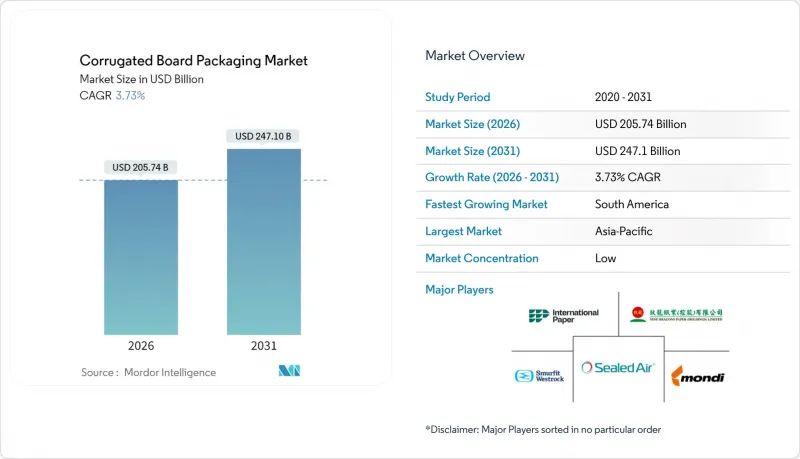
这种稳步扩张反映了政策主导的塑胶替代、蓬勃发展的电子商务以及数位化和人工智慧製造工具的快速普及。欧盟的《包装和包装废弃物法规》以及美国五个州的《生产者延伸责任法》等监管压力,正促使品牌所有者转向更易于回收的包装形式,从而加速纤维需求的成长。供应面的限制(受旧瓦楞纸板价格和能源成本波动的影响)有助于维持价格稳定,而混合式数位柔版印刷机等下游技术则为大规模客製化创造了机会。竞争优势正向垂直整合的生产商转移,这些生产商能够确保纤维原料,投资建造节能工厂,并利用人工智慧优化包装盒设计。
全球瓦楞纸包装市场趋势与洞察
强制使用环保材质促进纤维替代
新的可回收性法规正推动包装选择转向纤维基材料。欧盟要求所有包装在2030年之前必须可回收,加上塑胶的最低再生材料含量配额,使得瓦楞纸板成为低风险的合规选择。美国已有五个州实施了奖励可回收基材的收费系统,与塑胶包装相比,可回收基材的成本优势高达15%。由于塑胶回收再利用基础设施建设的延误导致2030年的最后期限被推迟,各大品牌正在加速转型。瓦楞纸板71%至76%的回收率简化了审核追踪,有助于企业履行其环境、社会和治理(ESG)承诺,并降低被处罚的风险。造纸厂报告称,在加工商重新配置生产线以满足零售商标准后,纤维基SKU的订单前置作业时间缩短了两週。
电子商务小包裹数量的激增正在重塑包装规格。
全球电子商务运输量预计将从2024年的2,200亿件增加到2029年的3,400亿件,这使得跌落测试耐久性和体积重量效率等特性变得癒发重要。目前,主要物流供应商超过四分之一的小包裹都采用双层瓦楞纸板或微瓦楞纸板製成。设备供应商正积极回应此需求,推出按需製箱系统,透过减少缓衝材料的使用,将每笔订单的人事费用降低40%,材料成本降低15%。订阅电商企业对可印刷内衬的需求日益增长,希望透过内衬展现品牌故事,这进一步推动了运输容器内数位印刷图形的应用。这些变化巩固了瓦楞纸包装作为运输媒介和行销工具的双重角色。
可重复使用塑胶容器和可回收垃圾桶的兴起,应对了一次性使用需求带来的挑战。
零售商正在扩大用于盛装生鲜和肉类的可回收塑胶容器(RPC)的使用范围,因为这种容器可以减少门市层面的浪费和人工成本。法国、德国和韩国已经实施了重复使用配额和押金制度,鼓励使用耐用塑胶箱而不是一次性纸板箱。自动化清洁网路可以将每个RPC的成本在25次循环后降低到0.25美元以下,低于可预测的生鲜食品供应链中一次性容器的成本。瓦楞纸板加工商正在使用高阻隔阻隔性防潮涂层和防篡改锁扣来保住市场份额,但在高周转率通路中,他们正面临利润率压力。
细分市场分析
截至2025年,在成熟的回收网络和有利的生产者延伸责任制(EPR)收费系统的支撑下,再生纸将占瓦楞纸包装市场55.05%的份额。随着品牌商提高再生纸含量标准,预计该细分市场将以4.56%的复合年增长率成长。原生牛皮纸衬纸仍然是重型出口纸箱的重要组成部分,但其市场份额持续下降。小麦秸秆、稻壳和番茄茎秆纸浆目前正处于商业试点阶段。实验室研究表明,与传统再生纸浆相比,这些纸浆的抗张强度提高了25%。投资建造区域性纸浆生产设施对于控制原料水分和降低物流成本至关重要。成功的规模化生产可望缓解再生纸价格波动,并透过纤维来源多元化增强供应链的韧性。
农业废弃物纸浆也具有环境效益,它无需砍伐森林,与原生木纤维相比,可降低20-25%的碳排放强度。义大利和印度的领先已在瓦楞纸板生产设备的基础上,以15-20%的混合比例添加农业废弃物。儘管食品接触认证框架仍在发展完善中,但生产商预计到2027年监管将趋于统一。这些创新标誌着瓦楞纸包装市场正从「原生与再生」的二元对立转向多元化的纤维组合,从而更好地适应当地资源限制。
2025年,传统常规开槽纸箱(RSC)的市占率为32.05%,而折迭式纸箱预计到2031年将以5.48%的复合年增长率成长。这主要得益于电商品牌商对快速组装设计的需求,以提升拆箱体验。自动化组装设备每分钟可处理35个折迭式纸箱,比人工RSC生产线快40%,显着降低了履约中心的人事费用。就瓦楞纸包装市场规模而言,预计此转变将在2026年至2031年间新增89亿美元的市场规模。
在体积效率和托盘堆迭性至关重要的领域,例如工业备件分销,开槽纸箱保持着成本优势。伸缩纸箱和硬纸箱则占据高端市场,例如高阶电子产品领域,在这些领域,视觉美感和抗压性能比材料成本更为重要。可数位印刷的折迭纸箱结构越来越多地采用易撕条和回封条,以适应全通路物流流程。结构技术的演进表明,性能标准、自动化能力和消费者参与度如何共同影响瓦楞纸包装市场的规格趋势。
区域分析
到2025年,亚太地区将占全球瓦楞纸包装市场收入的39.85%,主要得益于製造业整合和成本效益高的纤维采购。九龙纸业正在将其年产能扩大至2537万吨,进一步巩固了该地区的供应优势。中国的经济奖励策略正在提振国内消费,而越南和马来西亚的出口型纸厂也正积极服务「一带一路」贸易走廊。此外,废纸进口配额的投资也促进了当地农业废弃物製浆试验计画的发展,从而降低了对旧瓦楞纸板(OCC)的依赖。
南美洲是成长最快的走廊,预计2031年复合年增长率将达到7.05%。儘管面临宏观经济逆风,巴西瓦楞纸箱出货量仍然成长,因为生产商调整了工厂布局以适应出口市场。克拉文公司在巴拉那州新建的工厂代表着对未来产能扩张的投资,而智利和哥伦比亚的加工商则正在投资自动化折迭和黏合设备,以满足电商包装盒的需求。该地区拥有丰富的甘蔗渣和桉树种植园,实现了纤维自给自足,使其成为未来农业废弃物供应中心。
北美和欧洲正保持稳定的中个位数成长,这主要得益于监管合规和增值创新。随着欧盟回收强制令于2025年生效,目前已有6%的塑胶运输包装被瓦楞纸板取代。国际纸业以72亿美元收购DS Smith,扩大了其在两大洲的永续包装平台,预计到2027年将产生6亿至7亿美元的协同效应。能源效率是欧洲造纸厂维修的重点,斯道拉恩索位于奥卢的生产线温室气体排放强度比传统造纸机降低了20%。在美国,数位印刷机的应用已超过瓦楞纸板印刷产能的18%,加速了消费品产业的大量客製化进程。
其他福利:
- Excel格式的市场预测(ME)表
- 分析师支持(3个月)
目录
第一章 引言
- 研究假设和市场定义
- 调查范围
第二章调查方法
第三章执行摘要
第四章 市场情势
- 市场概览
- 市场驱动因素
- 强制使用环保材料
- 电子商务小包裹激增
- 数位印刷机和柔版印刷机混合技术的进展
- 轻质箱板纸的经济性
- 人工智慧驱动的包装盒设计优化
- 农业废弃物製浆
- 市场限制
- 采用可重复使用的塑胶和可回收塑胶容器
- 回收纸(OCC)和能源价格波动
- 纸板製造机的电力消耗量上限
- 对工厂工业用水取水的限制
- 供应链分析
- 监管环境
- 技术展望
- 波特五力分析
- 供应商的议价能力
- 买方的议价能力
- 新进入者的威胁
- 替代品的威胁
- 竞争对手之间的竞争
第五章 市场规模与成长预测
- 依材料类型
- 原生货柜纸板
- 再生纸箱
- 盒子样式/结构
- 开槽盒
- 望远镜收纳盒
- 硬盒
- 文件夹盒
- 按最终用户行业划分
- 食物
- 加工食品
- 生鲜食品和农产品
- 饮料
- 个人护理和家居用品
- 电子商务与履约
- 医疗和药品
- 电气和电子设备
- 产业
- 其他终端用户产业
- 食物
- 依电路板类型
- 单层壁
- 双层壁
- 三层壁
- 微型长笛
- 透过印刷技术
- 柔版印刷
- 数位的
- 光刻
- 萤幕
- 按地区
- 北美洲
- 我们
- 加拿大
- 墨西哥
- 欧洲
- 德国
- 英国
- 法国
- 义大利
- 西班牙
- 荷兰
- 俄罗斯
- 其他欧洲地区
- 亚太地区
- 中国
- 日本
- 印度
- 韩国
- 澳洲
- 新加坡
- 亚太其他地区
- 中东和非洲
- 中东
- 沙乌地阿拉伯
- 阿拉伯聯合大公国
- 土耳其
- 其他中东地区
- 非洲
- 南非
- 奈及利亚
- 埃及
- 其他非洲地区
- 中东
- 南美洲
- 巴西
- 阿根廷
- 南美洲其他地区
- 北美洲
第六章 竞争情势
- 市场集中度
- 策略趋势
- 市占率分析
- 公司简介
- International Paper Company
- Smurfit WestRock
- Mondi Group
- Nine Dragons Paper(Holdings)Limited
- Georgia-Pacific LLC
- Oji Holdings Corporation
- Stora Enso Oyj
- Sealed Air Corporation
- Pratt Industries
- Rengo Co., Ltd.
- Packaging Corporation of America
- Lee & Man Paper Manufacturing
- Klabin SA
- Cascades Inc.
- SCG Packaging
- Saica Group
- Orora Limited
- Visy Industries
- Grupo Gondi
- Astron Paper & Board Mill
- APP(Sinar Mas)
- Napco National
第七章 市场机会与未来展望
The Corrugated Board Packaging Market size in 2026 is estimated at USD 205.74 billion, growing from 2025 value of USD 198.34 billion with 2031 projections showing USD 247.1 billion, growing at 3.73% CAGR over 2026-2031.
The measured expansion reflects policy-driven substitution of plastics, fast-growing e-commerce volumes, and rapid adoption of digital and AI manufacturing tools. Regulatory pressure, led by the European Union's Packaging and Packaging Waste Regulation and five U.S. state Extended Producer Responsibility laws, is accelerating fiber demand as brand owners pivot toward readily recyclable formats. Supply-side tightness-caused by volatile old-corrugated-cardboard (OCC) prices and energy costs-supports pricing discipline, while downstream technology such as hybrid digital-flexo presses unlocks mass customization opportunities. Competitive advantage is shifting toward vertically integrated producers able to secure raw fiber, invest in energy-efficient mills, and deploy AI-enabled box-design optimization.
Global Corrugated Board Packaging Market Trends and Insights
Eco-friendly material mandates drive fiber substitution
New recyclability rules are tilting packaging material choices toward fiber. The EU requirement that all packaging be recyclable by 2030, alongside minimum recycled-content quotas for plastics, has made corrugated the low-risk compliance option. Five U.S. states impose fee scales that reward recyclable substrates, creating cost advantages of up to 15% versus plastic formats. Brands are accelerating specification changes because plastic recycling infrastructure lag times exceed the 2030 deadline. Corrugated's 71-76% recovery rate simplifies audit trails, supports corporate ESG pledges, and limits penalty exposure. Mill operators report order lead-times for fiber-based SKUs shortening by two weeks as converters re-tool lines to meet retailer scorecard requirements.
E-commerce parcel explosion reshapes packaging specifications
Global e-commerce shipping volumes grew from 220 billion parcels in 2024 to a projected 340 billion by 2029, elevating functional priorities such as drop-test durability and dimensional-weight efficiency. Double-wall and micro-flute boards now constitute over one-quarter of parcels shipped via major integrators. Equipment suppliers respond with on-demand boxmaking systems that trim labor by 40% while reducing void-fill needs, thereby cutting per-order materials cost by 15%. Subscription-commerce operators are specifying printable interiors for brand storytelling, which further boosts the loading of digitally printed graphics inside the shipping container. These shifts cement corrugated's role as both a transport medium and a marketing surface.
Reusable plastics and RPCs adoption challenges single-use demand
Retailers expand returnable-plastic-container (RPC) pools for produce and meat because they cut shrinkage and reduce labor at the store level. France, Germany, and South Korea have introduced reuse quotas or deposit schemes that favor durable crates over single-use corrugated. Automated wash-back networks lower per-trip RPC cost below USD 0.25 when cycle counts exceed 25, undercutting single-use units for predictable fresh-food supply chains. Corrugated converts defend share using high-barrier moisture-resistant coatings and tamper-evident locking tabs, but face margin squeeze in high-turnover channels.
Other drivers and restraints analyzed in the detailed report include:
- Advances in digital and flexo hybrid presses enable mass customization
- AI-driven box-design optimisation reduces material consumption
- Volatile OCC and energy prices compress manufacturing margins
For complete list of drivers and restraints, kindly check the Table Of Contents.
Segment Analysis
Recycled grades commanded 55.05% of the corrugated board packaging market share in 2025, buoyed by mature collection networks and favorable EPR fee structures. The segment is forecast to grow at 4.56% CAGR as brand owners raise post-consumer-content thresholds. Virgin Kraft liner retains relevance for heavy-duty export cartons, but its volume share continues to erode. Wheat-straw, rice-husk, and tomato-stem pulps are entering commercial pilots; laboratory work shows tensile strength gains of up to 25% over conventional recycled pulp. Investment in regional decentralized pulping units is crucial to control raw-material moisture and logistics costs. Successful scale-up would temper OCC price cycles and diversify fiber sourcing, strengthening supply-chain resilience.
Agricultural-waste pulps also deliver environmental gains, trimming carbon intensity by 20-25% relative to virgin wood fiber because they bypass forest-harvesting steps. Early adopters in Italy and India are integrating agri-waste at 15-20% blend ratios without modifying corrugator settings. Though certification frameworks for food-contact compliance remain nascent, producers expect regulatory alignment by 2027. These innovations signal that the corrugated board packaging market will shift from a binary virgin-versus-recycled narrative to a broader multi-fiber portfolio, reinforcing its adaptability to regional resource constraints.
Traditional regular slotted containers (RSCs) held a 32.05% share in 2025, but folder-type formats are projected to increase at a 5.48% CAGR through 2031, propelled by e-commerce brand owners seeking quick-assembly designs that enhance the unboxing experience. Automated erecting equipment processes folder styles at 35 boxes min-1, 40% faster than manual RSC lines, saving fulfillment centers significant labor. In the corrugated board packaging market size context, this shift translates into incremental revenue of USD 8.9 billion between 2026 and 2031.
Slotted boxes retain cost advantages where cube efficiency and palletization are paramount, such as industrial spare parts distribution. Telescope and rigid-set boxes occupy premium niches, including luxury electronics, where visual aesthetics and crush prevention outweigh material cost. Digital print-ready folder constructions increasingly integrate tear-strips and returnable seals, aligning with omnichannel logistics flows. The evolving construction landscape illustrates how performance criteria, automation capability, and consumer engagement jointly influence specification trends within the corrugated board packaging market.
The Corrugated Board Packaging Market Report is Segmented by Material Type (Virgin Containerboard, and Recycled Containerboard), Box Style (Slotted Boxes, Telescope Boxes, and More), End-User Industry (Food, Beverages, Personal and Household Care, and More), Board Type (Single Wall, Double Wall, and More), Printing Technology (Flexography, Digital, and More), and Geography. The Market Forecasts are Provided in Terms of Value (USD).
Geography Analysis
Asia-Pacific accounted for 39.85% of global corrugated board packaging market revenue in 2025 and continues to leverage manufacturing integration and cost-effective fiber sourcing. Nine Dragons Paper expanded annual capacity to 25.37 million tonnes, underpinning the region's supply dominance. China's stimulus measures stimulate domestic consumption, yet export-oriented plants in Vietnam and Malaysia now serve Belt-and-Road trade corridors. Investment in waste-paper-import quotas also encourages local agri-waste pulping pilots, mitigating OCC dependency.
South America represents the fastest-growing corridor, with a 7.05% CAGR projected to 2031. Brazil's containerboard shipments increased despite macro headwinds as producers realigned mills for export markets. Klabin's new Parana facility exemplifies forward-capacity bets, while Chilean and Colombian converters invest in folder-gluer automation to meet e-commerce box styles. Fiber self-sufficiency, anchored in abundant sugar-cane bagasse and eucalyptus plantations, positions the region as a future agri-waste supply hub.
North America and Europe exhibit steady mid-single-digit growth anchored in regulatory compliance and value-added innovation. The EU recyclability mandate that took effect in 2025 has already shifted 6% of plastic transit-packaging volume into corrugated. International Paper's USD 7.2 billion buyout of DS Smith extends its sustainable-packaging footprint across both continents and is expected to unlock USD 600-700 million in synergy by 2027. European mill upgrades prioritize energy conservation, with Stora Enso's Oulu line claiming 20% lower greenhouse-gas intensity than legacy paper machines. In the United States, digital press penetration exceeds 18% of installed corrugated print capacity, accelerating mass customization in consumer packaged goods.
- International Paper Company
- Smurfit WestRock
- Mondi Group
- Nine Dragons Paper (Holdings) Limited
- Georgia-Pacific LLC
- Oji Holdings Corporation
- Stora Enso Oyj
- Sealed Air Corporation
- Pratt Industries
- Rengo Co., Ltd.
- Packaging Corporation of America
- Lee & Man Paper Manufacturing
- Klabin S.A.
- Cascades Inc.
- SCG Packaging
- Saica Group
- Orora Limited
- Visy Industries
- Grupo Gondi
- Astron Paper & Board Mill
- APP (Sinar Mas)
- Napco National
Additional Benefits:
- The market estimate (ME) sheet in Excel format
- 3 months of analyst support
TABLE OF CONTENTS
1 INTRODUCTION
- 1.1 Study Assumptions and Market Definition
- 1.2 Scope of the Study
2 RESEARCH METHODOLOGY
3 EXECUTIVE SUMMARY
4 MARKET LANDSCAPE
- 4.1 Market Overview
- 4.2 Market Drivers
- 4.2.1 Eco-friendly material mandates
- 4.2.2 E-commerce parcel explosion
- 4.2.3 Advances in digital and flexo hybrid presses
- 4.2.4 Light-weight containerboard economics
- 4.2.5 AI-driven box-design optimisation
- 4.2.6 Agricultural-waste fibre pulping
- 4.3 Market Restraints
- 4.3.1 Reusable plastics and RPCs adoption
- 4.3.2 Volatile OCC and energy prices
- 4.3.3 Corrugator electricity-intensity caps
- 4.3.4 Industrial-water withdrawal limits at mills
- 4.4 Supply-Chain Analysis
- 4.5 Regulatory Landscape
- 4.6 Technological Outlook
- 4.7 Porter's Five Forces Analysis
- 4.7.1 Bargaining Power of Suppliers
- 4.7.2 Bargaining Power of Buyers
- 4.7.3 Threat of New Entrants
- 4.7.4 Threat of Substitutes
- 4.7.5 Intensity of Competitive Rivalry
5 MARKET SIZE AND GROWTH FORECASTS (VALUES)
- 5.1 By Material Type
- 5.1.1 Virgin Containerboard
- 5.1.2 Recycled Containerboard
- 5.2 By Box Style / Construction
- 5.2.1 Slotted Boxes
- 5.2.2 Telescope Boxes
- 5.2.3 Rigid Boxes
- 5.2.4 Folder Boxes
- 5.3 By End-User Industry
- 5.3.1 Food
- 5.3.1.1 Processed Foods
- 5.3.1.2 Fresh Food and Produce
- 5.3.2 Beverages
- 5.3.3 Personal and Household Care
- 5.3.4 E-commerce and Fulfilment
- 5.3.5 Healthcare and Pharmaceuticals
- 5.3.6 Electrical and Electronics
- 5.3.7 Industrial
- 5.3.8 Other End-user Industry
- 5.3.1 Food
- 5.4 By Board Type
- 5.4.1 Single Wall
- 5.4.2 Double Wall
- 5.4.3 Triple Wall
- 5.4.4 Micro-flute
- 5.5 By Printing Technology
- 5.5.1 Flexography
- 5.5.2 Digital
- 5.5.3 Lithography
- 5.5.4 Screen
- 5.6 By Geography
- 5.6.1 North America
- 5.6.1.1 United States
- 5.6.1.2 Canada
- 5.6.1.3 Mexico
- 5.6.2 Europe
- 5.6.2.1 Germany
- 5.6.2.2 United Kingdom
- 5.6.2.3 France
- 5.6.2.4 Italy
- 5.6.2.5 Spain
- 5.6.2.6 Netherlands
- 5.6.2.7 Russia
- 5.6.2.8 Rest of Europe
- 5.6.3 Asia-Pacific
- 5.6.3.1 China
- 5.6.3.2 Japan
- 5.6.3.3 India
- 5.6.3.4 South Korea
- 5.6.3.5 Australia
- 5.6.3.6 Singapore
- 5.6.3.7 Rest of Asia-Pacific
- 5.6.4 Middle East and Africa
- 5.6.4.1 Middle East
- 5.6.4.1.1 Saudi Arabia
- 5.6.4.1.2 United Arab Emirates
- 5.6.4.1.3 Turkey
- 5.6.4.1.4 Rest of Middle East
- 5.6.4.2 Africa
- 5.6.4.2.1 South Africa
- 5.6.4.2.2 Nigeria
- 5.6.4.2.3 Egypt
- 5.6.4.2.4 Rest of Africa
- 5.6.4.1 Middle East
- 5.6.5 South America
- 5.6.5.1 Brazil
- 5.6.5.2 Argentina
- 5.6.5.3 Rest of South America
- 5.6.1 North America
6 COMPETITIVE LANDSCAPE
- 6.1 Market Concentration
- 6.2 Strategic Moves
- 6.3 Market Share Analysis
- 6.4 Company Profiles (includes Global level Overview, Market level overview, Core Segments, Financials as available, Strategic Information, Market Rank/Share for key companies, Products and Services, and Recent Developments)
- 6.4.1 International Paper Company
- 6.4.2 Smurfit WestRock
- 6.4.3 Mondi Group
- 6.4.4 Nine Dragons Paper (Holdings) Limited
- 6.4.5 Georgia-Pacific LLC
- 6.4.6 Oji Holdings Corporation
- 6.4.7 Stora Enso Oyj
- 6.4.8 Sealed Air Corporation
- 6.4.9 Pratt Industries
- 6.4.10 Rengo Co., Ltd.
- 6.4.11 Packaging Corporation of America
- 6.4.12 Lee & Man Paper Manufacturing
- 6.4.13 Klabin S.A.
- 6.4.14 Cascades Inc.
- 6.4.15 SCG Packaging
- 6.4.16 Saica Group
- 6.4.17 Orora Limited
- 6.4.18 Visy Industries
- 6.4.19 Grupo Gondi
- 6.4.20 Astron Paper & Board Mill
- 6.4.21 APP (Sinar Mas)
- 6.4.22 Napco National
7 MARKET OPPORTUNITIES AND FUTURE OUTLOOK
- 7.1 White-space and Unmet-Need Assessment


