


 |
市场调查报告书
商品编码
1940591
蜂蜡:市场占有率分析、产业趋势与统计、成长预测(2026-2031)Beeswax - Market Share Analysis, Industry Trends & Statistics, Growth Forecasts (2026 - 2031) |
||||||

※ 本网页内容可能与最新版本有所差异。详细情况请与我们联繫。
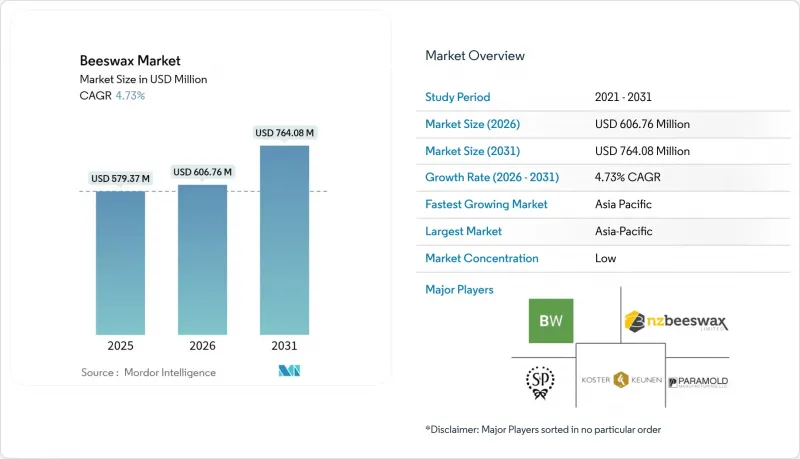
2025年全球蜂蜡市场价值为5.7937亿美元,预计到2031年将达到7.6408亿美元,高于2026年的6.0676亿美元。
预计在预测期(2026-2031 年)内,复合年增长率将达到 4.73%。
市场扩张的主要驱动力是蜂蜡在化妆品配方、药品和天然食品涂层等领域的应用日益广泛,这主要是由于製造商积极响应不断变化的成分透明度监管要求。亚太地区在蜂蜡的生产和消费方面均保持主导地位,其中印度贡献巨大,年产量达100万公斤。同时,成熟市场透过提供符合严格品质标准(包括残留限量和产品真实性)的认证蜂蜡产品,获得了更高的收益。虽然合成蜡替代品已经出现,并具有品质稳定、污染风险低等优势,但天然蜂蜡凭藉其监管优势和广泛的消费者认可度,尤其是在高价值产品应用领域,仍然保持着强劲的市场地位。
全球蜂蜡市场趋势及展望
化妆品和个人护理产品对天然/有机成分的需求日益增长
化妆品行业向天然成分的根本性转变,使蜂蜡作为一种乳化剂和质地改良剂,尤其是在唇部护理和防护屏障配方中,占据了高端地位。为了回应市场需求,各大化工企业正在加强其天然成分产品组合,例如路博润公司推出的Carbopols Biosens和BASF公司推出的玉米衍生成膜剂Verdescens Maize。蜂蜡凭藉其全面的功能性,兼具乳化能力、成膜性能以及经证实对金黄色葡萄球菌和白色念珠菌的抗菌功效,从而展现出巨大的价值。这些特性直接满足了配方师对成分整合日益增长的需求,同时也支持了洁净标示概念。监管方面的优势也进一步巩固了蜂蜡的市场地位,由于其已获得美国FDA的GRAS认证(21 CFR 184.1973)和欧盟食品添加剂核准(E-901),因此可以无缝应用于化妆品和食品接触领域。
护肤和化妆品领域的清洁美容和透明度趋势
消费者对个人保健产品成分透明度的日益关注和需求显着提升了蜂蜡的市场地位。作为一种天然成分,蜂蜡拥有完善的安全性记录和数百年的传统应用历史,完美契合了当前消费者的偏好。日益兴起的「清洁美容」运动强调可生物降解和无毒配方,促使製造商逐渐抛弃石油基替代品,蜂蜡的使用量也显着增加。随着监管机构为应对日益严重的环境问题(尤其是微塑胶问题)而对合成聚合物实施更严格的管控,这项转变正在加速。化妆品级蜂蜡(每盎司2美元)和蜡烛级蜂蜡(每盎司1.25美元)之间出现了明显的价格差距,这反映了化妆品应用对品质和纯度的严格要求。现代法规结构正在不断发展,要求全面披露成分资讯并提供永续性证明,这为蜂蜡等成熟的天然成分创造了有利的环境。同时,新的合成替代品则面临着漫长而高成本的安全检验流程。
受环境和天气因素影响,原料供应出现波动
气候变迁导致的蜂群损失正对全球蜂蜡供应链产生重大影响。拉丁美洲的综合研究揭示了令人震惊的蜂群年死亡率,墨西哥高达16.2%,哥伦比亚则高达47.7%。包括自然栖息地持续丧失、季节性开花模式紊乱以及极端天气事件频繁在内的多重环境挑战,正显着降低蜂群的生产力和蜂蜡产量。蜂蜡的生产过程特别敏感,工蜂在关键的12-18天蜂蜡分泌期内需要精确的环境条件。全球蜂群面临的最主要生物威胁仍然是蜜蜂跳蚤(瓦螨)的侵扰,严重的虫害会显着降低蜂群的存活率和蜂蜡的累积。这种供应的不确定性导致市场对稳定、高品质的蜂蜡需求旺盛,迫使价格敏感的生产商转向合成替代品。儘管监管机构日益关注供应链的透明度和韧性,但与蜂蜜市场相比,蜂蜡产业仍然缺乏全面的品质标准。
细分市场分析
受消费者对天然和可生物降解成分需求不断增长的推动,天然蜂蜡预计到2025年将继续占据市场主导地位,市场份额将达到84.65%。此外,天然蜂蜡已获得包括食品、化妆品和製药等多个行业的监管部门批准,进一步巩固了其市场核准。在这些产业中,产品安全性和天然来源至关重要。
合成蜡市场正以5.70%的复合年增长率强劲成长,这主要得益于其稳定的供应能力以及对敏感应用无污染的特性。费托合成蜡,尤其是沙索公司产品系列中的佼佼者,在石蜡、微晶蜡和合成硬蜡等多种类型中均展现出优异的热稳定性和可调熔点。这些产品广泛应用于从化妆品到工业涂料等各个行业。合成蜡市场不受农业和气候变迁因素的影响,从而避免了天然蜂蜡市场面临的供应链不确定性。合成蜡生产商能够精确控製成分,确保产品不含农药残留,这使其在对纯度要求极高的医药和食品接触应用中尤为重要。
区域分析
亚太地区目前占全球蜂蜡市场最大份额,预计2025年将达到37.84%。这一主导地位主要归功于印度,它是世界上最大的蜂蜡生产国,每年产量达2,460万公斤。中国已成为一个重要的消费市场,但准确的产量数据仍难以取得。日本对进口的依赖程度很高,蜂蜜自给率仅6%,而且该国需要大量进口蜂蜡用于各种工业用途。
该地区的年复合成长率高达5.24%,远超其他所有区域市场。韩国380万公斤的大规模产能支撑了这一加速成长,巩固了其作为世界第五大蜂蜡生产国的地位。然而,近期美国对韩国美容产品出口征收的关税压力,改变了含蜂蜡化妆品配方的需求格局,这可能会影响未来的成长率。
北美和欧洲市场仍然成熟,法规结构完善,消费者也愿意为天然成分支付溢价。虽然美国市场对蜂箱进口和牲畜饲料用途有所限制,但可以透过美国动植物卫生检验局(APHIS)核准的精炼蜂蜡出口途径出口到欧盟。欧洲市场着重永续性和污染监测,并制定了具体的进口通讯协定,例如英国的第三类物质标准。在南美洲,阿根廷(500万公斤)和巴西(180万公斤)是主要的生产国,但面临高达16.2%至47.7%的蜂群损失率。非洲拥有悠久的养蜂传统,但技术和市场进入的限制使其产量未能充分发挥潜力,仅占全球蜂蜡产量的不到25%。
其他福利:
- Excel格式的市场预测(ME)表
- 3个月的分析师支持
目录
第一章 引言
- 研究假设和市场定义
- 调查范围
第二章调查方法
第三章执行摘要
第四章 市场情势
- 市场概览
- 市场驱动因素
- 化妆品和个人护理产品对天然和有机成分的需求日益增长
- 护肤和化妆品领域的清洁美容和透明度趋势
- 在製药领域,尤其是在软膏和药膏中的应用日益广泛
- 不含致敏物质、无毒的食品添加物和涂层的需求
- 手工製品和传统工艺品的受欢迎程度。
- 蜂蜡精炼加工的技术进步
- 市场限制
- 受环境和天气条件影响,原料供应出现波动。
- 全球食品和药品成分监管日益收紧
- 农产品中农药污染及残留风险
- 养蜂业对劳动力和专业知识要求很高
- 供应链分析
- 监理展望
- 波特五力模型
- 新进入者的威胁
- 买方和消费者的议价能力
- 供应商的议价能力
- 替代品的威胁
- 竞争对手之间的竞争
第五章 市场规模与成长预测
- 依产品类型
- 自然的
- 合成
- 按形式
- 堵塞
- 颗粒/片剂
- 片状/珠状
- 透过使用
- 化妆品
- 製药
- 其他用途
- 按地区
- 北美洲
- 我们
- 墨西哥
- 北美其他地区
- 欧洲
- 德国
- 英国
- 义大利
- 法国
- 其他欧洲地区
- 亚太地区
- 中国
- 印度
- 澳洲
- 亚太其他地区
- 南美洲
- 巴西
- 阿根廷
- 其他南美洲
- 中东和非洲
- 南非
- 沙乌地阿拉伯
- 其他中东和非洲地区
- 北美洲
第六章 竞争情势
- 市场集中度
- 策略趋势
- 市场排名分析
- 公司简介
- Koster Keunen Inc.
- Strahl & Pitsch Inc.
- British Wax Refining Co. Ltd.
- New Zealand Beeswax Ltd.
- Paramold Manufacturing LLC
- AADRA International
- Melland Ecogreen Technology Co., Ltd.
- Alfa Chemistry
- Beeswax Products Company LLC
- Beeswax-Store.com
- Roger A. Reed Inc.
- Poth Hille & Co. Ltd.
- Seidler Chemical Company
- Frank B. Ross Co. Inc.
- Taiwan San-Ei Oil Co., Ltd.
- Qian Xiao Beeswax Co., Ltd.
- Hase Petroleum Wax Co.
- Bioscope Sdn Bhd
- Tekwax Ltd.
- Thorne Corporation
第七章 市场机会与未来展望
The global beeswax market was valued at USD 579.37 million in 2025 and estimated to grow from USD 606.76 million in 2026 to reach USD 764.08 million by 2031, at a CAGR of 4.73% during the forecast period (2026-2031).
The market expansion is primarily driven by the increased adoption of beeswax in cosmetics formulations, pharmaceutical products, and natural food coatings, as manufacturers respond to evolving regulatory requirements for ingredient transparency. The Asia-Pacific region maintains its position as the dominant force in both production and consumption, with India's substantial contribution of one million kilograms per year. Meanwhile, established markets generate higher revenues through certified beeswax grades that satisfy stringent quality standards for residue limits and product authenticity. Although synthetic wax alternatives are emerging with benefits such as quality consistency and reduced contamination risks, natural beeswax continues to hold a strong market position due to its favorable regulatory status and widespread consumer acceptance, particularly in high-value product applications.
Global Beeswax Market Trends and Insights
Rising Demand for Natural/Organic Ingredients in Cosmetics and Personal Care
The cosmetics industry's fundamental transformation toward natural ingredients has elevated beeswax to a premium status as an emulsifier and texture enhancer, particularly benefiting lip care and protective barrier formulations. In response to market demands, major chemical suppliers have strengthened their natural ingredient portfolios, evidenced by Lubrizol's introduction of Carbopol BioSense and BASF's launch of Verdessense Maize as corn-derived film-formers. Beeswax brings significant value through its comprehensive functional properties, combining emulsification capabilities, film formation characteristics, and proven antimicrobial effectiveness against Staphylococcus aureus and Candida albicans. These attributes directly address formulators' growing requirements for ingredient consolidation while supporting clean-label initiatives. The regulatory framework further reinforces beeswax's market position, with FDA GRAS status (21 CFR 184.1973) and EU food additive approval (E-901) enabling manufacturers to incorporate it seamlessly across both cosmetics and food-contact applications.
Clean Beauty and Transparency Trends in Skincare/Cosmetics
The increasing consumer awareness and demand for ingredient transparency in personal care products has significantly enhanced beeswax's position in the market. As a natural component with well-documented safety records and centuries of traditional use, beeswax aligns perfectly with current consumer preferences. The clean beauty movement, which prioritizes biodegradable and non-toxic formulations, has created a substantial shift toward beeswax as manufacturers move away from petroleum-based alternatives. This transition has gained momentum as regulatory bodies implement stricter controls on synthetic polymers, particularly due to growing environmental concerns about microplastics. The market demonstrates clear price differentiation between cosmetic-grade beeswax, which commands USD 2.00 per ounce, and candle-grade beeswax at USD 1.25 per ounce, reflecting the stringent quality standards and purity requirements for cosmetic applications. Modern regulatory frameworks have evolved to mandate comprehensive ingredient disclosure and sustainability documentation, creating a favorable environment for established natural ingredients like beeswax, while new synthetic alternatives face lengthy and costly safety validation processes.
Fluctuations in Raw Material Supply Due to Environment/Weather
Climate-driven colony losses significantly impact the global beeswax supply chain, as evidenced by comprehensive studies from Latin America that reveal concerning annual colony mortality rates ranging from 16.2% in Mexico to 47.7% in Colombia. Multiple environmental challenges, including the ongoing loss of natural habitats, disruptions in seasonal flowering patterns, and the increasing frequency of extreme weather events, have substantially reduced both colony productivity and wax production capabilities. The process of wax production is particularly sensitive, as worker bees require precise environmental conditions during their critical 12-18 day wax-secretion phase. The Varroa destructor mite infestation continues to pose the most significant biological threat to colonies worldwide, with severe infestations dramatically decreasing both colony survival rates and wax accumulation. These supply uncertainties have created a market environment where premium prices are commanded for consistent, high-quality beeswax, consequently pushing manufacturers in price-sensitive industries toward synthetic alternatives. While regulatory bodies have increased their focus on supply chain transparency and resilience, the industry still lacks comprehensive quality standards compared to the well-established specifications in the honey market.
Other drivers and restraints analyzed in the detailed report include:
- Growing Use in Pharmaceuticals, Especially for Ointments and Salves
- Demand for Allergen-Free, Non-Toxic Food Additives/Coating Agents
- Stringent Global Regulations on Food and Pharma Ingredients
For complete list of drivers and restraints, kindly check the Table Of Contents.
Segment Analysis
Natural beeswax continues to dominate the market with an 84.65% share in 2025, as consumers increasingly gravitate toward natural and biodegradable ingredients. This market leadership is further reinforced by well-established regulatory approvals across multiple industries, including food, cosmetic, and pharmaceutical applications, where product safety and natural origin remain paramount considerations.
The synthetic wax segment demonstrates robust growth with a CAGR of 5.70%, primarily due to its ability to deliver consistent supply and contamination-free properties for sensitive applications. Fischer-Tropsch synthetic waxes, particularly notable in Sasol's product portfolio, offer enhanced thermal stability and adjustable melting points across paraffin, microcrystalline, and synthetic hard wax varieties. These products serve diverse industries from cosmetics to industrial coatings. The synthetic segment's independence from agricultural and climatic variables addresses the supply chain uncertainties that affect natural beeswax markets. Manufacturers of synthetic waxes can maintain precise composition control and ensure products free from pesticide residues, making them particularly valuable for pharmaceutical and food-contact applications where stringent purity standards must be met.
The Beewax Market Report is Segmented by Product Type (Natural, and Synthetic), Form (Blocks, Pellets / Pastilles, and Sheets / Beads), Application (Cosmetics, Pharmaceuticals, and Other Applications), and Geography (North America, Europe, Asia-Pacific, South America, and Middle East and Africa). The Market Forecasts are Provided in Terms of Value (USD).
Geography Analysis
The Asia-Pacific region currently commands the largest share of the global beeswax market, accounting for 37.84% in 2025. This dominance is primarily attributed to India's position as the world's largest producer, contributing 24.6 million kg annually to the global supply. China has emerged as a significant consumption market, although precise production figures remain unavailable. Japan's heavy reliance on imports, reflected in its mere 6% self-sufficiency in honey production, indicates substantial beeswax import requirements for various industrial applications.
The region's growth trajectory stands at an impressive 5.24% CAGR, outpacing all other geographical segments. This accelerated growth is supported by South Korea's substantial production capacity of 3.8 million kg, positioning it as the fifth-largest global producer. However, recent tariff pressures on Korean beauty exports to the US market have introduced new dynamics in the demand patterns for beeswax-containing cosmetic formulations, potentially influencing future growth rates.
In other regions, North America and Europe maintain their positions as mature markets, characterized by well-established regulatory frameworks and consumer willingness to pay premium prices for natural ingredients. The US market benefits from APHIS-approved refined beeswax export pathways to the EU, despite facing limitations on honeycomb imports and livestock feeding applications. European markets emphasize sustainability and contamination monitoring, with specific import protocols such as the UK's Category 3 material standards. South America contributes significantly through Argentina (5.0 million kg) and Brazil (1.8 million kg), though facing challenges from high colony loss rates ranging from 16.2% to 47.7%. Africa's production remains below its potential, contributing less than 25% of global beeswax output despite its rich beekeeping heritage, primarily due to technological and market access limitations.
- Koster Keunen Inc.
- Strahl & Pitsch Inc.
- British Wax Refining Co. Ltd.
- New Zealand Beeswax Ltd.
- Paramold Manufacturing LLC
- AADRA International
- Melland Ecogreen Technology Co., Ltd.
- Alfa Chemistry
- Beeswax Products Company LLC
- Beeswax-Store.com
- Roger A. Reed Inc.
- Poth Hille & Co. Ltd.
- Seidler Chemical Company
- Frank B. Ross Co. Inc.
- Taiwan San-Ei Oil Co., Ltd.
- Qian Xiao Beeswax Co., Ltd.
- Hase Petroleum Wax Co.
- Bioscope Sdn Bhd
- Tekwax Ltd.
- Thorne Corporation
Additional Benefits:
- The market estimate (ME) sheet in Excel format
- 3 months of analyst support
TABLE OF CONTENTS
1 INTRODUCTION
- 1.1 Study Assumptions and Market Definition
- 1.2 Scope of the Study
2 RESEARCH METHODOLOGY
3 EXECUTIVE SUMMARY
4 MARKET LANDSCAPE
- 4.1 Market Overview
- 4.2 Market Drivers
- 4.2.1 Rising demand for natural/organic ingredients in cosmetics and personal care
- 4.2.2 Clean beauty and transparency trends in skincare/cosmetics
- 4.2.3 Growing use in pharmaceuticals, especially for ointments and salves
- 4.2.4 Demand for allergen-free, non-toxic food additives/coating agents
- 4.2.5 Popularity of artisanal, hand-made, and heritage crafts.
- 4.2.6 Technological advancements in beeswax purification/processing
- 4.3 Market Restraints
- 4.3.1 Fluctuations in raw material supply due to environment/weather
- 4.3.2 Stringent global regulations on food and pharma ingredients
- 4.3.3 Pesticide contamination and residue risks in output
- 4.3.4 High labor and expertise requirements in beekeeping
- 4.4 Supply Chain Analysis
- 4.5 Regulatory Outlook
- 4.6 Porter's Five Forces
- 4.6.1 Threat of New Entrants
- 4.6.2 Bargaining Power of Buyers/Consumers
- 4.6.3 Bargaining Power of Suppliers
- 4.6.4 Threat of Substitute Products
- 4.6.5 Intensity of Competitive Rivalry
5 MARKET SIZE AND GROWTH FORECASTS (VALUE)
- 5.1 By Product Type
- 5.1.1 Natural
- 5.1.2 Synthetic
- 5.2 By Form
- 5.2.1 Blocks
- 5.2.2 Pellets / Pastilles
- 5.2.3 Sheets / Beads
- 5.3 By Application
- 5.3.1 Cosmetics
- 5.3.2 Pharmaceuticals
- 5.3.3 Other Applications
- 5.4 By Geography
- 5.4.1 North America
- 5.4.1.1 United States
- 5.4.1.2 Mexico
- 5.4.1.3 Rest of North America
- 5.4.2 Europe
- 5.4.2.1 Germany
- 5.4.2.2 United Kingdom
- 5.4.2.3 Italy
- 5.4.2.4 France
- 5.4.2.5 Rest of Europe
- 5.4.3 Asia-Pacific
- 5.4.3.1 China
- 5.4.3.2 India
- 5.4.3.3 Australia
- 5.4.3.4 Rest of Asia-Pacific
- 5.4.4 South America
- 5.4.4.1 Brazil
- 5.4.4.2 Argentina
- 5.4.4.3 Rest of South America
- 5.4.5 Middle East and Africa
- 5.4.5.1 South Africa
- 5.4.5.2 Saudi Arabia
- 5.4.5.3 Rest of Middle East and Africa
- 5.4.1 North America
6 COMPETITIVE LANDSCAPE
- 6.1 Market Concentration
- 6.2 Strategic Moves
- 6.3 Market Ranking Analysis
- 6.4 Company Profiles (includes Global-level Overview, Market-level Overview, Core Segments, Financials (if available), Strategic Information, Market Rank/Share, Products and Services, Recent Developments)
- 6.4.1 Koster Keunen Inc.
- 6.4.2 Strahl & Pitsch Inc.
- 6.4.3 British Wax Refining Co. Ltd.
- 6.4.4 New Zealand Beeswax Ltd.
- 6.4.5 Paramold Manufacturing LLC
- 6.4.6 AADRA International
- 6.4.7 Melland Ecogreen Technology Co., Ltd.
- 6.4.8 Alfa Chemistry
- 6.4.9 Beeswax Products Company LLC
- 6.4.10 Beeswax-Store.com
- 6.4.11 Roger A. Reed Inc.
- 6.4.12 Poth Hille & Co. Ltd.
- 6.4.13 Seidler Chemical Company
- 6.4.14 Frank B. Ross Co. Inc.
- 6.4.15 Taiwan San-Ei Oil Co., Ltd.
- 6.4.16 Qian Xiao Beeswax Co., Ltd.
- 6.4.17 Hase Petroleum Wax Co.
- 6.4.18 Bioscope Sdn Bhd
- 6.4.19 Tekwax Ltd.
- 6.4.20 Thorne Corporation


