


 |
市场调查报告书
商品编码
1940696
亚太地区数位户外(DOOH):市场占有率分析、产业趋势与统计、成长预测(2026-2031)Asia Pacific Digital-Out-of-Home (DOOH) - Market Share Analysis, Industry Trends & Statistics, Growth Forecasts (2026 - 2031) |
||||||

※ 本网页内容可能与最新版本有所差异。详细情况请与我们联繫。
亚太地区数位户外(DOOH) 市场预计将从 2025 年的 216.4 亿美元成长到 2026 年的 239.4 亿美元,预计到 2031 年将达到 397.1 亿美元,2026 年至 2031 年的复合年增长率为 10.65%。
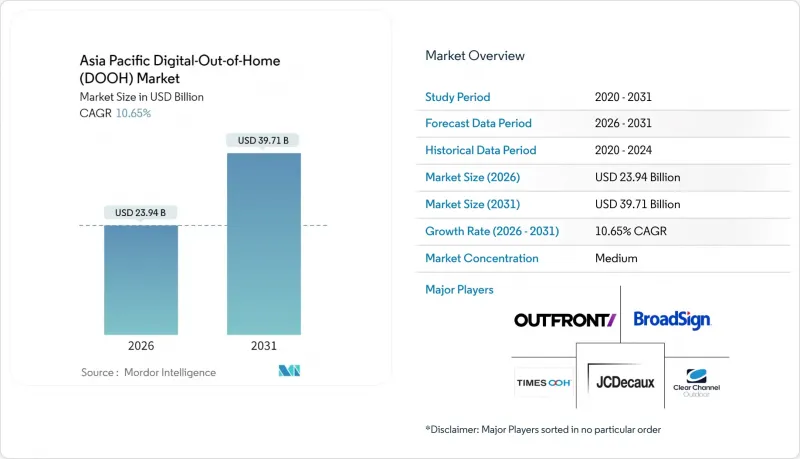
加速的都市化、5G 连接的扩展以及 LED 硬体价格的下降,正推动媒体营运商将路边、交通和室内网路数位化,从而实现更丰富的创新表达和更可靠的效果衡量。到 2025 年,光是中国就将占全球广告支出的 51.2%,凸显了全部区域依赖。同时,随着地铁、机场和高速公路计划的建设释放出优质广告资源并推动程序化购买,印度的广告支出正经历两位数的成长。广告主正迅速将预算转移到经过受众检验的地点,因为位置资料为依赖 cookie 的数位管道提供了品牌安全的替代方案。德高集团 (JCDecaux) 的程序化广告支出将在 2024 年成长 45.6%,这印证了全部区域自动化购买技术的成熟。
亚太地区数位户外(DOOH)市场趋势与洞察
城市轨道交通线路的快速扩张释放了优质房源。
大规模地铁、机场和快速公车(BRT)计划正在打造封闭式环境,为乘客提供更长的停留时间和更丰富的上下文资料馈送。印度Times OOH获得了孟买地铁3号线的独家广告权,涵盖2万平方公尺和27个车站,充分展现了亚太地区数位户外(DOOH)市场新增广告资源的规模。香港地铁正在扩展其数位肖像广告单元,并在身临其境型区域中试行气味行销。车站内的照明控制和保全系统支援高清LED、3D和互动式标牌,使品牌能够在乘客旅途中持续讯息。随着亚洲许多城市交通走廊的建设,预计未来十年广告供应成长速度将超过路边广告转换率。
程序化户外数位广告与零售媒体网路的整合
零售商正将销售点 (POS) 数据与店内萤幕连接起来,以完善归因分析,并显示销售成长带来的益处。京东商城与汉秀的联合解决方案将电子货架标籤与天花板标誌连接起来,同步更新产品价格、QR码和创新。 GroupM 和 Moving Walls 正在印尼、马来西亚和菲律宾实现这一工作流程的自动化,使消费品品牌能够购买与其目标受众群体相关的广告曝光率。在亚太地区的数位户外(DOOH) 市场,零售媒体融合正在推动 CPM 的提升,支援客流量归因分析,并将以往仅限于商品行销的多格式预算扩展到店内网路。
媒体所有权分散化增加了购买的复杂性。
光是在日本,就有大约1000家户外数位广告(DOOH)媒体所有者,这迫使行销人员在开展大范围宣传活动前,需要协商多份合约并验证衡量标准的一致性。印度也面临类似的挑战,61%的本地所有者倾向于透过联合竞标的方式赢得城市计划的国内宣传活动竞标。这些摩擦阻碍了程序化广告的普及,增加了广告投放订单出错的风险,并延长了结算週期,从而削弱了亚太地区户外数位广告市场相对于线上展示广告在「预算执行速度」方面的优势。
细分市场分析
室内萤幕在亚太地区数位户外(DOOH) 市场的份额正在不断增长,年复合成长率 (CAGR) 为 10.92%,而到 2025 年,户外广告仍将占总收入的 62.05%。室内场所避免了天气造成的运作,并能延长顾客的停留时间。在新加坡莱佛士城,一项 11.1 万平方英尺的整修整合了教学镜、行动 POS 机和诊断亭,旨在为美妆和科技品牌带来可衡量的互动。东南亚各地配备空调的购物中心正在延长消费者的停留时间,并帮助广告商测试将会员 ID 与萤幕互动相结合的游戏化策略。
儘管户外广告形式在亚太地区的数位户外(DOOH) 市场占据主导地位,但印度加特科帕尔广告看板崩坏后,地方政府实施了更严格的安全法规,导致许可审批週期延长,维护成本增加。儘管如此,路边 LED 塔式广告看板仍然占据一定的预算份额,为汽车、电信和金融科技产品的发布提供了无可比拟的覆盖范围。
到2025年,户外广告看板将占总收入的45.39%,保持传统广告支出水平,并在主要高速公路沿线拥有广泛的曝光度。同时,受铁路网扩张和匿名乘客数据分析的推动,程序化交通广告库存正以11.9%的复合年增长率快速增长,直至2031年。 Hit Co.和Vistar Media已向全球DSP开放其涩谷「Synchro 7」网路(七块同步萤幕),征兆高容量竞标机制正逐步应用于亚洲最繁忙的交通枢纽。
街道、场所和机场媒体正受益于融入物联网感测器的智慧城市计划;然而,采购週期延长和政府竞标繁琐阻碍了其成长。相较之下,交通广告萤幕能够提供精准的客流量模式,使品牌能够透过行动端推广活动重新接触乘客,从而为原本单向的媒体增添了效果行销的维度。
其他福利:
- Excel格式的市场预测(ME)表
- 3个月的分析师支持
目录
第一章 引言
- 研究假设和市场定义
- 调查范围
第二章调查方法
第三章执行摘要
第四章 市场情势
- 市场概览
- 产业价值链分析
- 宏观经济因素的影响
- 波特五力分析
- 供应商的议价能力
- 买方的议价能力
- 新进入者的威胁
- 替代品的威胁
- 竞争对手之间的竞争
- 监管环境
- 技术展望
第五章 市场动态
- 市场驱动因素
- 5G部署能够实现高频宽创新
- 城市轨道交通网络的快速扩张创造了优质房源。
- 程序化户外数位广告与零售媒体网路的整合
- LED成本下降加速数位转型
- 将广告从基于 cookie 的广告转向基于位置的数位户外广告,作为品牌安全措施
- 节能环保的萤幕吸引了注重环境、社会和治理(ESG)的广告商。
- 市场限制
- 媒体所有权分散化使购买过程变得复杂。
- 电力价格波动会推高营运成本。
- 资料隐私法规限制行动重定向
- 新兴市场数位户外广告创新人才短缺
第六章 市场规模与成长预测
- 按位置
- 室内的
- 户外
- 按格式类型
- 广告看板
- 交通
- 街道家具
- 基于地点的媒体
- 透过使用
- 动态广告
- 即时资讯和路线
- 互动式/体验式
- 其他用途
- 最终用户
- 零售与电子商务
- 车
- 金融服务
- 医疗和药品
- 政府/公共部门
- 娱乐与媒体
- 其他最终用户
- 依所有权类型
- 媒体所有者网络
- 设施内专用网络
- 按国家/地区
- 中国
- 日本
- 印度
- 韩国
- 澳洲
- 新加坡
- 泰国
- 香港
- 亚太其他地区
第七章 竞争情势
- 市场集中度
- 策略趋势
- 市占率分析
- 公司简介
- JCDecaux SE
- Focus Media Information Technology Co. Ltd.
- Clear Channel Outdoor Holdings Inc.
- oOh!media Limited
- Outfront Media Inc.
- Times Innovative Media Limited
- Plan B Media Public Company Limited
- Asiaray Media Group Limited
- Shanghai Airports Advertisement Co. Ltd.
- Balintimes Media Group Co. Ltd.
- Hivestack Inc.
- Vistar Media Inc.
- Daktronics Inc.
- Broadsign International LLC
- Ayuda Media Systems Inc.
- QMS Media Limited
- AdOnMo Private Limited
- Laqshya Media Group
- MediaCorp Pte Ltd.
第八章:市场机会与未来展望
- 閒置频段与未满足需求评估
The Asia Pacific Digital-Out-of-Home (DOOH) market is expected to grow from USD 21.64 billion in 2025 to USD 23.94 billion in 2026 and is forecast to reach USD 39.71 billion by 2031 at 10.65% CAGR over 2026-2031.
Accelerated urbanization, expanding 5G connectivity, and falling LED hardware prices are simultaneously pushing media owners to digitize roadside, transit, and indoor networks, creating richer creative canvases and more accountable measurement. China alone captures 51.2% of worldwide spend in 2025, demonstrating how regional performance hinges on a single, high-scale advertising economy. At the same time, India is posting double-digit growth as metro, airport, and highway projects unlock premium inventory and programmatic-ready. Advertisers are rapidly shifting budgets toward audience-verified locations because location data delivers brand-safe alternatives to cookie-dependent digital channels. Programmatic spend rose 45.6% at JCDecaux in 2024, underscoring how automated buying is maturing across the region.
Asia Pacific Digital-Out-of-Home (DOOH) Market Trends and Insights
Rapid Urban Rail Expansion Opening Premium Inventory
Large-scale metro, airport, and bus-rapid-transit projects are unlocking enclosed environments with superior dwell times and contextual data feeds. India's Times OOH secured exclusive rights for Mumbai Metro Line 3, covering 20,000 m2 and 27 stations, evidencing the size of fresh inventory entering the Asia Pacific Digital-Out-of-Home (DOOH) market. Hong Kong's MTR expanded digital portrait units and is piloting scent marketing in immersive zones. Controlled lighting and security inside stations allow fine-pitch LED, 3D, and interactive wayfinding screens, enabling brands to run sequential messaging throughout a rider's trip. With many Asian cities still mid-build on transit corridors, supply growth is likely to outpace roadside conversions over the next decade.
Programmatic DOOH Integration with Retail Media Networks
Retailers are pairing point-of-sale data with on-premise screens to close attribution loops and prove incremental sales lift. JD Mall's joint solution with Hanshow links electronic shelf labels and overhead boards so product prices, QR codes, and creative refresh simultaneously. GroupM and Moving Walls automate this workflow in Indonesia, Malaysia, and the Philippines, letting CPG brands buy impressions tied to first-party audience segments. For the Asia Pacific Digital-Out-of-Home (DOOH) market, the retail-media collision creates incremental CPMs, aids footfall attribution, and drives multi-format budgets into in-store networks once confined to merchandising budgets.
Fragmented Media Ownership Inflating Buying Complexity
Japan alone hosts roughly 1,000 DOOH media owners, forcing marketers to negotiate multiple contracts and reconcile measurement gaps before pan-regional flights ever go live. India faces similar hurdles, prompting 61% of local owners to support consortium bids for metro projects to win national campaigns. The friction depresses programmatic adoption, raises insertion-order error risk, and prolongs settlement cycles, dampening the Asia Pacific Digital-Out-of-Home (DOOH) market's speed-to-budget advantage over online display.
Other drivers and restraints analyzed in the detailed report include:
- 5G Roll-out Enabling High-Bandwidth Creative
- LED Cost Decline Accelerating Digital Conversion
- Data-Privacy Regulations Limiting Mobile Retargeting
For complete list of drivers and restraints, kindly check the Table Of Contents.
Segment Analysis
Indoor screens contribute a growing slice of the Asia Pacific Digital-Out-of-Home (DOOH) market, expanding at an 10.92% CAGR, while outdoor assets still accounted for 62.05% revenue in 2025. Indoor venues avoid weather-related downtime and deliver richer dwell times; Raffles City Singapore integrated tutorial mirrors, mobile POS, and diagnostic kiosks into a 111,000 sq ft facelift that boosted measurable interactions for beauty and tech brands. Shoppers linger longer in air-conditioned malls across Southeast Asia, helping advertisers test gamified activations that connect loyalty IDs to screen engagements.
Outdoor formats dominate inventory numbers for the Asia Pacific Digital-Out-of-Home (DOOH) market, yet municipal safety crackdowns after India's Ghatkopar hoarding collapse are lengthening permit cycles and elevating maintenance expenses. Even so, roadside LED towers provide unmatched reach for automobile, telecom, and fintech launches, preserving their budget share.
Billboards held 45.39% of 2025 revenue, consolidating legacy spend and broad sightlines across arterial roads. Meanwhile, programmatic transit inventory is surging at 11.9% CAGR to 2031 on the back of rail expansion and anonymous passenger analytics. Hit Co. and Vistar Media opened the Shibuya "Synchro 7" network seven synchronised screens to global DSPs, a signpost for high-volume auction mechanics migrating to Asia's most crowded intersections.
Street furniture, place-based, and airport media benefit from smart-city projects that embed IoT sensors; however, elongated procurement cycles and government tendering keep their growth moderate. Transit screens, by contrast, provide precise foot-traffic patterns, enabling brands to retarget riders with mobile promotions, adding a performance layer to what was once a broadcast medium.
The Asia Pacific Digital-Out-Of-Home (DOOH) Market Report is Segmented by Location (Indoor, Outdoor), Format Type (Billboard, Transit, Street Furniture and More), Application (Dynamic Advertising, Real-Time Information and More), End User (Retail and E-Commerce, Automotive and More), Ownership Model (Media Owner Networks, Venue-Based Private Networks) and Country. The Market Forecasts are Provided in Terms of Value (USD).
List of Companies Covered in this Report:
- JCDecaux SE
- Focus Media Information Technology Co. Ltd.
- Clear Channel Outdoor Holdings Inc.
- oOh!media Limited
- Outfront Media Inc.
- Times Innovative Media Limited
- Plan B Media Public Company Limited
- Asiaray Media Group Limited
- Shanghai Airports Advertisement Co. Ltd.
- Balintimes Media Group Co. Ltd.
- Hivestack Inc.
- Vistar Media Inc.
- Daktronics Inc.
- Broadsign International LLC
- Ayuda Media Systems Inc.
- QMS Media Limited
- AdOnMo Private Limited
- Laqshya Media Group
- MediaCorp Pte Ltd.
Additional Benefits:
- The market estimate (ME) sheet in Excel format
- 3 months of analyst support
TABLE OF CONTENTS
1 INTRODUCTION
- 1.1 Study Assumptions and Market Definition
- 1.2 Scope of the Study
2 RESEARCH METHODOLOGY
3 EXECUTIVE SUMMARY
4 MARKET LANDSCAPE
- 4.1 Market Overview
- 4.2 Industry Value Chain Analysis
- 4.3 Impact of Macroeconomic Factors
- 4.4 Porter's Five Forces Analysis
- 4.4.1 Bargaining Power of Suppliers
- 4.4.2 Bargaining Power of Buyers
- 4.4.3 Threat of New Entrants
- 4.4.4 Threat of Substitutes
- 4.4.5 Intensity of Competitive Rivalry
- 4.5 Regulatory Landscape
- 4.6 Technological Outlook
5 MARKET DYNAMICS
- 5.1 Market Drivers
- 5.1.1 5G roll-out enabling high-bandwidth creative
- 5.1.2 Rapid urban rail expansion opening premium inventory
- 5.1.3 Programmatic DOOH integration with retail media networks
- 5.1.4 LED cost decline accelerating digital conversion
- 5.1.5 Brand-safety shift from cookies to location-verified DOOH
- 5.1.6 Carbon-efficient screens appealing to ESG-driven advertisers
- 5.2 Market Restraints
- 5.2.1 Fragmented media ownership inflating buying complexity
- 5.2.2 Power-price volatility raising operating costs
- 5.2.3 Data-privacy regulations limiting mobile retargeting
- 5.2.4 Shortage of DOOH-skilled creatives in emerging markets
6 MARKET SIZE AND GROWTH FORECASTS (VALUE)
- 6.1 By Location
- 6.1.1 Indoor
- 6.1.2 Outdoor
- 6.2 By Format Type
- 6.2.1 Billboard
- 6.2.2 Transit
- 6.2.3 Street Furniture
- 6.2.4 Place-Based Media
- 6.3 By Application
- 6.3.1 Dynamic Advertising
- 6.3.2 Real-Time Information and Way-finding
- 6.3.3 Interactive / Experiential
- 6.3.4 Other Applications
- 6.4 By End User
- 6.4.1 Retail and E-commerce
- 6.4.2 Automotive
- 6.4.3 Financial Services
- 6.4.4 Healthcare and Pharmaceuticals
- 6.4.5 Government and Public Sector
- 6.4.6 Entertainment and Media
- 6.4.7 Other End Users
- 6.5 By Ownership Model
- 6.5.1 Media Owner Networks
- 6.5.2 Venue-Based Private Networks
- 6.6 By Country
- 6.6.1 China
- 6.6.2 Japan
- 6.6.3 India
- 6.6.4 South Korea
- 6.6.5 Australia
- 6.6.6 Singapore
- 6.6.7 Thailand
- 6.6.8 Hong Kong
- 6.6.9 Rest of Asia Pacific
7 COMPETITIVE LANDSCAPE
- 7.1 Market Concentration
- 7.2 Strategic Moves
- 7.3 Market Share Analysis
- 7.4 Company Profiles (includes Global level overview, Market level overview, Core Segments, Financials as available, Strategic Information, Market Rank/Share for key companies, Products and Services, and Recent Developments)
- 7.4.1 JCDecaux SE
- 7.4.2 Focus Media Information Technology Co. Ltd.
- 7.4.3 Clear Channel Outdoor Holdings Inc.
- 7.4.4 oOh!media Limited
- 7.4.5 Outfront Media Inc.
- 7.4.6 Times Innovative Media Limited
- 7.4.7 Plan B Media Public Company Limited
- 7.4.8 Asiaray Media Group Limited
- 7.4.9 Shanghai Airports Advertisement Co. Ltd.
- 7.4.10 Balintimes Media Group Co. Ltd.
- 7.4.11 Hivestack Inc.
- 7.4.12 Vistar Media Inc.
- 7.4.13 Daktronics Inc.
- 7.4.14 Broadsign International LLC
- 7.4.15 Ayuda Media Systems Inc.
- 7.4.16 QMS Media Limited
- 7.4.17 AdOnMo Private Limited
- 7.4.18 Laqshya Media Group
- 7.4.19 MediaCorp Pte Ltd.
8 MARKET OPPORTUNITIES AND FUTURE OUTLOOK
- 8.1 White-Space and Unmet-Need Assessment

 2026年全球程序化户外广告平台市场报告
 数位户外广告市场:按形式、终端用户产业、技术、互动性和应用程式划分-全球预测,2026-2032年2026年全球户外数位广告市场报告
 数位户外广告市场报告:按形式、应用程式、最终用户和地区划分(2026-2034 年)
 东南亚数位户外(DOOH):市场占有率分析、产业趋势与统计、成长预测(2026-2031)
 全球数位户外广告市场规模、份额、趋势和成长分析报告(2026-2034年)全球数位户外广告市场:市场规模、占有率、成长率、产业分析、依类型、应用和地区划分的分析及预测(2026-2034 年)户外媒体广告市场按媒体类型、形式、所有权、应用程式和最终用户产业划分,全球预测(2026-2032年)中东和非洲数位户外广告 (DOOH) - 市场份额分析、行业趋势、统计数据和成长预测 (2026-2031)
 全球户外数位广告 (DOOH) 市场评估:按应用程式、形式、产业和地区划分,机会与预测(2018-2032 年)