


 |
市场调查报告书
商品编码
1940712
欧洲共享办公空间:市场占有率分析、产业趋势与统计、成长预测(2026-2031)Europe Coworking Spaces - Market Share Analysis, Industry Trends & Statistics, Growth Forecasts (2026 - 2031) |
||||||

※ 本网页内容可能与最新版本有所差异。详细情况请与我们联繫。
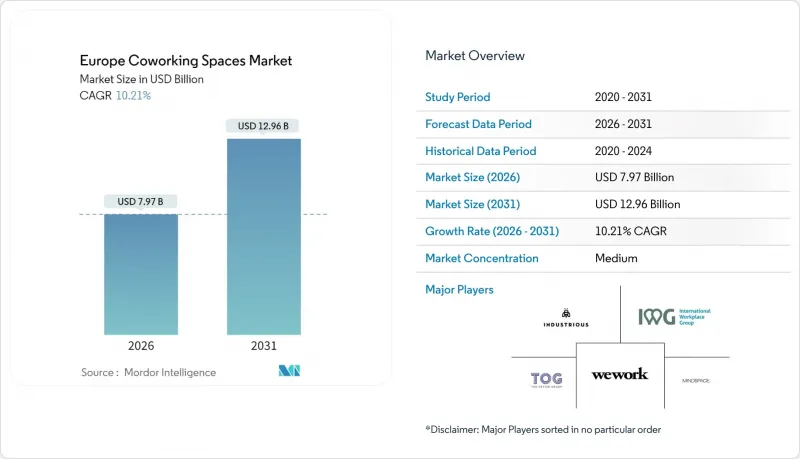
2025年欧洲共享办公空间市场价值为72.3亿美元,预计将从2026年的79.7亿美元成长到2031年的129.6亿美元。
预计在预测期(2026-2031 年)内,复合年增长率将达到 10.21%。
混合办公模式的兴起、企业优化房地产投资组合的压力日益增大,以及政府降低前期成本的激励措施,共同推动了对弹性办公空间解决方案的持续需求。企业正采用轻资产管理协议以节省资金,而中型办公空间则能满足营运商平衡使用率和服务品质所需的密度。大型办公空间的扩张速度最快,因为大型企业客户需要配备专用协作区域的整层办公空间。人工智慧驱动的运转率平台也透过提供支援动态定价的即时入住率数据,帮助营运商提高利润率。同时,主要城市过剩的閒置租赁物业以及老旧办公大楼ESG维修成本的不断上涨,限制了营运商近期的定价能力。将技术差异化与混合用途位置策略结合的营运商,将更有利于掌握欧洲共同工作空间市场下一阶段的成长机会。
欧洲共享办公空间市场趋势与洞察
利用灵活空间优化企业房地产投资组合
随着商业债务市场再融资风险的再次浮现,企业加速向弹性办公空间转型。轻资产交易如今占主导地位:IWG 2024 年的 624 个办公地点中,95% 都采用管理伙伴关係模式,为企业租户提供承包办公环境,同时将资本支出转移给业主。跨国公司正将弹性办公中心作为网路房地产策略的一部分,以减少固定租赁数量并重新部署员工。这使得房地产管理人员能够在符合法定人均面积要求的前提下,将座位密度降低 20%。空间预订 API 与企业人力资源系统集成,允许员工在办公日预订靠近企划团队的办公桌,使企业能够将人均占地面积比 2019 年的基准值降低 35%。这一趋势在伦敦和慕尼黑最为明显,金融机构估计,2025 年至 2027 年间,办公室相关资产将占 929 亿美元债务资金筹措的 44%。弹性办公空间在严峻的劳动市场中,既能减少租赁义务,又能维持关键的人才吸引指标。
加速欧盟劳动法中混合工作政策的实施
欧盟层级关于在家工作权利的指南在2024年至2025年间被纳入各国法律,明确规定了远距办公安排和使用符合人体工学的卫星办公室的权利。雇主现在必须在通勤范围内提供“合适的设施”,或提供补贴以支付使用共享办公空间的费用。这项义务将合规成本转移到了缺乏必要建筑认证追踪系统的公司身上,促使采购部门将整个职场外包给专业供应商。因此,到2025年,允许员工每天选择工作地点的多站点通行证(订阅模式)的企业合约数量比去年同期增加了32%。为了因应这项变化,营运商正在维修现有设施,使其符合ISO 45001健康与安全标准,并加装隔音装置和空气品质感测器以支援劳动审核。混合办公政策也推动了设计变革,例如团队办公区和以会议为导向的楼层布局,使公司能够在遵守密度限制的同时,调整「重点协作日」。
老旧办公大楼ESG维修成本不断上涨
欧洲2030年能源绩效法规要求商业占地面积达到EPC B级或同等标准,这导致老旧资产的资本支出激增。一栋建于1970年代的建筑,平均维修成本超过每平方英尺190美元,其中包括电机空调、LED照明和外墙隔热材料。签订管理协议而非租赁协议的共享办公空间业者可以避免直接资本支出,但仍需承担房东转嫁的更高服务费。受监管行业的租户在签署多年合约之前,越来越要求获得BREEAM「优秀」或LEED「金级」认证,这使得不符合标准的办公空间实际上无法出租。在次市场,依赖基于浮动利率基准的银行贷款的资本结构增加了资金筹措的难度。提前预测维修计划并协商绿色认证资本支出分摊条款的运营商可以获得成本优势,而那些拖延翻新的运营商则面临资产过时的风险,这可能会减缓欧洲联合办公空间市场的网络扩张。
细分市场分析
截至2025年,中型办公空间(20,000-40,000平方英尺)占据了欧洲共享办公空间市场52.80%的份额,这反映出它们能够在不影响社群互动的情况下,维持300-500个工位的网络。营运商正利用模组化隔间,在48小时内调整布局,以适应不断变化的企业需求。预计到2031年,大型办公空间将以11.74%的复合年增长率成长,这主要得益于企业倾向于租用整层楼,并对广播工作室和5G身临其境型室等高端设施的需求。营运商正透过采用人工智慧驱动的空间利用工具来抵消大型办公空间较高的固定成本,并缓解季节性收入波动,这些工具在活动日可将座位密度提高18%。小规模办公空间在通勤区域蓬勃发展,作为中心辐射式模式中的枢纽,确保会员可以在距离家20分钟车程内找到工位。
管理合约的显着增长(2024年IWG所有新分店的95%)表明,业主更倾向于伙伴关係模式,这种模式既能稳定现金流,又能满足租赁协议中的运转率要求。在规模较大的办公空间中,企业套房占总可出租面积的42%(两年前为26%),这印证了办公空间布局正从以自由工作者为中心转向以企业为中心。合约期限指标也反映了这项变化,2023年至2025年间,企业合约的平均期限从9个月增加到14个月。这些趋势证实了中大型办公空间在加速欧洲共享办公空间市场成长方面发挥核心作用。
其他福利:
- Excel格式的市场预测(ME)表
- 3个月的分析师支持
目录
第一章 引言
- 研究假设和市场定义
- 调查范围
第二章调查方法
第三章执行摘要
第四章 市场情势
- 市场概览
- 市场驱动因素
- 一个蓬勃发展的Start-Ups生态系统正在寻求经济高效且灵活的租赁方案
- 利用弹性空间优化企业房地产 (CRE) 投资组合
- 疫情后振兴中央商务区的国家与地方奖励
- 加速欧盟劳动法中混合工作政策的实施(2025年及以后)
- 为「居家办公」提供郊区创业投资创投
- 人工智慧驱动的空间利用平台提升营运商利润率
- 市场限制
- 过剩的閒置办公空间正在拉低主要城市的办公桌租金。
- 老旧办公大楼进行ESG维修的成本不断上升
- 利率波动限制了房地产投资信託基金的资金筹措机会
- 市政当局对历史街区分区变更的抵制
- 产业内的政府法规和政策
- 共享办公空间房地产市场的技术创新
- 对办公室房地产行业关键指标(供应量、租金、价格、运转率/空置率(%))的深入分析
- 远距办公如何影响空间需求
- 产业吸引力-波特五力分析
- 新进入者的威胁
- 买方和消费者的议价能力
- 供应商的议价能力
- 替代品的威胁
- 竞争对手之间的竞争
第五章 市场规模及成长预测(价值,单位:十亿美元)
- 按设施规模和量
- 小规模
- 中号
- 大规模
- 按行业
- 资讯科技(IT 和 ITES)
- 银行、金融服务和保险业 (BFSI)
- 商业咨询和专业服务
- 其他服务(零售、生命科学、能源、法律服务)
- 最终用户
- 自由工作者
- 公司
- Start-Ups及其他
- 按地区
- 德国
- 英国
- 法国
- 义大利
- 西班牙
- 其他欧洲地区
第六章 竞争情势
- 市场集中度
- 策略趋势
- 市占率分析
- 公司简介
- IWG(Regus & Spaces)
- WeWork
- The Office Group(TOG)
- Mindspace
- Industrious
- Second Home
- Tribes
- Impact Hub
- Fora Space
- Talent Garden
- Huckletree
- Betahaus
- Knotel Europe
- KAPTUR
- BounceSpace
- Mokrin House
- Paper Hub
- Mortimer House
- Sirius Facilities
第七章 市场机会与未来展望
The Europe Co-Working Spaces Market was valued at USD 7.23 billion in 2025 and estimated to grow from USD 7.97 billion in 2026 to reach USD 12.96 billion by 2031, at a CAGR of 10.21% during the forecast period (2026-2031).
Structural shifts toward hybrid work, mounting pressure to optimize corporate real-estate portfolios, and municipal incentives that lower set-up costs are driving sustained demand for flexible workspace solutions. Corporations are embracing asset-light managed agreements to conserve capital, while medium facilities provide the density operators need to balance utilization and service quality. Large sites are scaling fastest as enterprise clients ask for entire floors equipped with private collaboration zones, and AI-enabled utilization platforms are boosting operator margins by providing real-time occupancy data that supports dynamic pricing. At the same time, surplus grey-lease inventory in Tier-1 cities and rising ESG retrofitting costs on aging office stock temper near-term pricing power. Operators that combine technology differentiation with mixed-use location strategies are positioned to capitalize on the next growth phase of the Europe co-working spaces market.
Europe Coworking Spaces Market Trends and Insights
Corporate Real-Estate Portfolio Optimization via Flex Space
Enterprises accelerated their migration to flexible space once refinancing risk resurfaced in the commercial debt market. Asset-light deals now dominate: 95% of IWG's 624 openings in 2024 were structured as managed partnerships that shift cap-ex to landlords while delivering turnkey office ecosystems to corporate tenants. Multinationals treat flexible hubs as part of a networked real-estate stack that reallocates headcount across fewer fixed leases, helping real-estate directors hit 20% seat-density targets without breaching labor-code mandates on square footage per employee. Space-booking APIs integrate with company HR systems so staff reserve desks near project teams on in-office days, enabling firms to reduce square footage per employee by 35% relative to 2019 benchmarks. The most pronounced uptake is in London and Munich, where lenders estimate offices make up 44% of the USD 92.9 billion debt-funding gap due 2025-2027. Flexible space mitigates lease liabilities while sustaining talent-attraction metrics that matter in tight labor markets.
Acceleration of Hybrid Work Policies in EU Labor Codes
EU-level guidance on home-office rights filtered into national statutes during 2024-2025, codifying employee entitlements to remote scheduling and ergonomically safe satellite offices. Employers must now provide "suitable facilities" within commuting distance or grant allowances that cover co-working subscriptions. The mandate shifts compliance costs to companies ill-equipped to track building certifications, prompting procurement teams to outsource the entire workplace bundle to specialized operators. As a result, subscription models, multi-site passes that let staff choose locations daily, gained 32% more corporate seats during 2025 than the prior year. Operators respond by rehabbing legacy inventory to meet ISO 45001 health-and-safety standards, embedding acoustic dampening and air-quality sensors that satisfy labor-inspection audits. Hybrid policies also drive design changes such as team-based neighborhoods and meeting-heavy floorplates so firms can orchestrate anchor days that concentrate collaboration while respecting density caps.
Rising ESG Retrofitting Costs for Aging Office Stock
Europe's 2030 energy-performance mandate requires commercial floor space to achieve EPC B or equivalent, pushing capital expenditure on dated assets skyward. Average retrofit costs for 1970s-era buildings exceed USD 190 per square foot when factoring in electrified HVAC, LED lighting, and facade insulation. Co-working operators that hold management contracts rather than leases avoid direct cap-ex yet still confront service-charge increases passed through by landlords. Tenants from regulated industries now demand BREEAM Very Good or LEED Gold ratings before signing multi-year agreements, effectively rendering non-compliant space unlettable. Financing hurdles intensify in secondary markets where capital-stack structures rely on bank debt priced off floating-rate benchmarks. Operators that anticipate retrofit schedules and negotiate green-certification cap-ex sharing clauses secure a cost advantage, while laggards face stranded-asset risk that can stall network expansion within the Europe co-working spaces market.
Other drivers and restraints analyzed in the detailed report include:
- Booming Startup Ecosystem Seeking Cost-Efficient, Flexible Leases
- National & Municipal Incentives for Revitalizing Post-Pandemic CBDs
- Surplus Grey-Lease Inventory Depressing Desk Rates in Tier-1 Cities
For complete list of drivers and restraints, kindly check the Table Of Contents.
Segment Analysis
Medium facilities, 20,000 to 40,000 square feet, held 52.80% of Europe's co-working spaces market share in 2025, reflecting their ability to support 300-to-500 desk networks without diluting community engagement. Operators use modular partitions to pivot layouts within 48 hours, meeting fluctuating corporate requirements. Large facilities are projected to grow at an 11.74% CAGR through 2031 as enterprises commit to entire floors and demand premium amenities such as broadcast studios and 5G-enabled immersive rooms. Operators balance the higher fixed costs of large footprints by integrating AI-driven space-utilization tools that lift seat density by 18% on event days, smoothing revenue seasonality. Small facilities thrive in commuter belts, acting as spokes in hub-and-spoke models that guarantee members a seat within 20 minutes of home.
A surge in managed agreements, 95% of IWG openings in 2024, signals that landlords prefer partnership models that stabilize cash flows while enabling them to satisfy lender covenants on occupancy. In large facilities, corporate suites account for 42% of gross leased area versus 26% two years earlier, underscoring the shift from freelancer-centric to enterprise-oriented layouts. Duration metrics mirror this shift: the average enterprise contract length rose from nine to 14 months between 2023 and 2025. These dynamics solidify the central role of medium and large sites in accelerating the Europe co-working spaces market.
The Europe Co-Working Spaces Market Report is Segmented by Size & Scale of Facility (Small, Medium, Large), by Sector (Information Technology, BFSI, Business Consulting & Professional Service, Other Services), by End Use (Freelancers, Enterprises, Start Ups and Others), and by Geography (Germany, United Kingdom, France, Italy, Spain, Rest of Europe). The Market Forecasts are Provided in Terms of Value (USD).
List of Companies Covered in this Report:
- IWG (Regus & Spaces)
- WeWork
- The Office Group (TOG)
- Mindspace
- Industrious
- Second Home
- Tribes
- Impact Hub
- Fora Space
- Talent Garden
- Huckletree
- Betahaus
- Knotel Europe
- KAPTUR
- BounceSpace
- Mokrin House
- Paper Hub
- Mortimer House
- Sirius Facilities
Additional Benefits:
- The market estimate (ME) sheet in Excel format
- 3 months of analyst support
TABLE OF CONTENTS
1 Introduction
- 1.1 Study Assumptions & Market Definition
- 1.2 Scope of the Study
2 Research Methodology
3 Executive Summary
4 Market Landscape
- 4.1 Market Overview
- 4.2 Market Drivers
- 4.2.1 Booming startup ecosystem seeking cost-efficient, flexible leases
- 4.2.2 Corporate real-estate (CRE) portfolio optimisation via flex space
- 4.2.3 National & municipal incentives for revitalising post-pandemic CBDs
- 4.2.4 Acceleration of hybrid work policies in EU labour codes (2025+)
- 4.2.5 Venture-capital funding earmarked for "work-near-home" sub-urb hubs
- 4.2.6 AI-enabled space-utilisation platforms boosting operator margins
- 4.3 Market Restraints
- 4.3.1 Surplus grey-lease inventory depressing desk-rates in Tier-1 cities
- 4.3.2 Rising ESG retrofitting costs for ageing office stock
- 4.3.3 Interest-rate volatility constraining REIT financing windows
- 4.3.4 Municipal resistance to zoning conversion in heritage districts
- 4.4 Government Regulations and Initiatives in the Industry
- 4.5 Technological Innovations in the Co-Working Office Space Real Estate Market
- 4.6 Insights into the Key Office Real Estate Industry Metrics (Supply, Rentals, Prices, Occupancy/Vacancy (%))
- 4.7 Impact of Remote Working on Space Demand
- 4.8 Industry Attractiveness - Porter's Five Forces Analysis
- 4.8.1 Threat of New Entrants
- 4.8.2 Bargaining Power of Buyers/Consumers
- 4.8.3 Bargaining Power of Suppliers
- 4.8.4 Threat of Substitute Products
- 4.8.5 Intensity of Competitive Rivalry
5 Market Size & Growth Forecasts (Value, In USD Billion)
- 5.1 By Size & Scale of Facility
- 5.1.1 Small
- 5.1.2 Medium
- 5.1.3 Large
- 5.2 By Sector
- 5.2.1 Information Technology (IT and ITES)
- 5.2.2 BFSI (Banking, Financial Services and Insurance)
- 5.2.3 Business Consulting & Professional Service
- 5.2.4 Other Services (Retail, Lifesciences, Energy, Legal Services)
- 5.3 By End User
- 5.3.1 Freelancers
- 5.3.2 Enterprises
- 5.3.3 Start Ups and Others
- 5.4 By Geography
- 5.4.1 Germany
- 5.4.2 United Kingdom
- 5.4.3 France
- 5.4.4 Italy
- 5.4.5 Spain
- 5.4.6 Rest of Europe
6 Competitive Landscape
- 6.1 Market Concentration
- 6.2 Strategic Moves
- 6.3 Market Share Analysis
- 6.4 Company Profiles (includes Global level Overview, Market level overview, Core Segments, Financials as available, Strategic Information, Products & Services, and Recent Developments)
- 6.4.1 IWG (Regus & Spaces)
- 6.4.2 WeWork
- 6.4.3 The Office Group (TOG)
- 6.4.4 Mindspace
- 6.4.5 Industrious
- 6.4.6 Second Home
- 6.4.7 Tribes
- 6.4.8 Impact Hub
- 6.4.9 Fora Space
- 6.4.10 Talent Garden
- 6.4.11 Huckletree
- 6.4.12 Betahaus
- 6.4.13 Knotel Europe
- 6.4.14 KAPTUR
- 6.4.15 BounceSpace
- 6.4.16 Mokrin House
- 6.4.17 Paper Hub
- 6.4.18 Mortimer House
- 6.4.19 Sirius Facilities
7 Market Opportunities & Future Outlook
- 7.1 White-space & Unmet-Need Assessment

 2026年全球共享办公桌市场报告2026年全球共享办公空间市场报告2026年全球共享办公空间管理软体市场报告2026年全球办公空间市场报告
 专用弹性办公空间市场:全球产业分析(按规模、份额、成长和类型/应用划分)、区域洞察及2026-2034年预测
 日本共享办公空间市场规模、份额、趋势及预测(按类型、用途、最终用户和地区划分),2026-2034年
 共享办公空间市场-全球产业规模、份额、趋势、机会与预测:按设施、目标群体、附加价值服务、地区和竞争格局划分,2021-2031年
 共用办公空间:市场占有率分析、产业趋势与统计、成长预测(2026-2031)
 共享办公空间市场:2025-2032 年全球预测(按服务类型、会员类型、组织规模、营运模式和产业重点)共享办公设施市场-全球产业规模、份额、趋势、机会及预测,依空间类型、商业模式、应用、地区及竞争细分,2020-2030 年预测