


 |
市场调查报告书
商品编码
1940739
泰国资讯科技与安全:市场占有率分析、产业趋势与统计、成长预测(2026-2031)Thailand IT And Security - Market Share Analysis, Industry Trends & Statistics, Growth Forecasts (2026 - 2031) |
||||||

※ 本网页内容可能与最新版本有所差异。详细情况请与我们联繫。
2025年泰国IT和安全市场价值89.5亿美元,预计到2031年将达到204.4亿美元,高于2026年的102.7亿美元。
预测期(2026-2031 年)的复合年增长率预计为 14.78%。
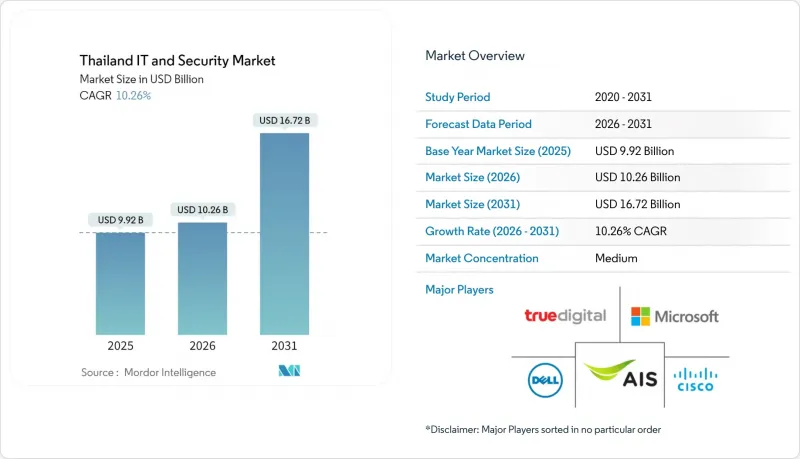
这一快速成长反映了泰国作为东协数位基础设施中心的地位、其以云端优先的公共部门政策以及持续涌入的超大规模资料中心(总投资已超过85亿美元)。覆盖95%人口的强大5G网路、15亿泰铢的国家人工智慧预算以及跨境电子商务的蓬勃发展,都在推动边缘到云端架构的普及。由于泰国网路安全专业人员短缺3万人,以及新的资料保护法规导致合规支出增加,企业买家越来越倾向于选择託管服务。来自DTAC日益激烈的竞争、与True Corporation合併后网路覆盖范围的重组,以及美国云端服务供应商竞相实现可用区本地化,都进一步加剧了竞争。预计这些因素将推动泰国IT和安全市场在未来十年保持两位数的成长。
泰国IT与安全市场趋势及洞察
云端优先政策加速公共部门的数位转型
数位政府发展局强制要求各机构采用云端技术,从而取消部门采购,并在安全、整合和分析服务方面实现规模经济。基于 ISO/IEC 27001 的集中式框架提高了新供应商的准入门槛,而国家网路安全局与Google云端的合作则为政府工作负载增加了人工智慧驱动的威胁侦测能力。本地云端区域解决了资料主权问题,并随着各机构将预算从硬体转向託管平台,增强了泰国的 IT 和安全市场。
5G基础设施将加速边缘运算的普及
Advanced Info Services 95% 的人口覆盖率支援工厂、医院和物流中心的低延迟应用。东部经济走廊的製造工厂将感测器数据传输到云端 AI 引擎,实现即时品管。同时,True Corporation 的「True Cyber Safe」每天为行动用户过滤 10 万个风险连结。这使得通讯业者能够从单纯的连接供应商转型为边缘平台营运商,进一步巩固其在泰国 IT 和安全市场的地位。
网路安全人才短缺限制了市场成长
目前,银行为聘请高级分析师支付180万泰铢(约5万美元)的年薪,确保获得稀缺的专业人才,但需求仍比供应多出3万人。中小企业无力应对薪资上涨,被迫延后计划或将业务外包给MSSP(资安管理服务提供者)。大学正努力扩充课程,而人才则纷纷涌向新加坡寻求更高薪的工作,这导致泰国IT和安全市场发展放缓。
细分市场分析
到2025年,服务收入将占总收入的41.64%,企业将倾向选择託管安全营运中心(SOC)、威胁狩猎和整合解决方案。在人才持续短缺的情况下,泰国IT和保全服务市场规模预计将以10.55%的复合年增长率成长。 True Corporation等通讯业者正在将安全和连接服务捆绑销售,以提升销售高收入服务。虽然由于资料中心和5G网路的资本支出,硬体收入稳定成长,但商品化正在抑製成长。软体,尤其是人工智慧辅助分析软体,预计将实现最快的成长速度,因为订阅模式将预算从资本支出转向营运成本。
这种构成比转变反映了泰国市场从以硬体为中心的架构向软体定义、服务导向的架构的演变。专业整合商将旧有系统与云端API连接起来,而供应商则提供自动化方案来弥补劳动力短缺。这种转变有助于泰国IT和安全市场在不断上涨的工资压力下保持高效运作。
2025年,云端运算将占泰国IT和安全市场份额的53.12%,复合年增长率将达到16.43%,显示云端运算在各垂直领域的应用日益广泛。超大规模资料中心业者在泰国的推出解决了资料居住问题,并增强了受监管银行迁移关键业务工作负载的信心。虽然本地部署仍将在国防和关键基础设施领域继续保留,但随着企业将本地控制与弹性运算结合,混合模式正日益受到青睐。
云端安全功能正日益超越传统防火墙,促使风险规避型负责人加快迁移计画。日益复杂的整合需求推动了託管安全服务提供者 (MSSP) 的需求,而 SD-WAN 正在取代 MPLS 以降低电路成本。随着通讯业者在工厂和医院部署边缘节点,混合部署预计将推动泰国 IT 和安全市场规模的扩大。
其他福利:
- Excel格式的市场预测(ME)表
- 分析师支持(3个月)
目录
第一章 引言
- 研究假设和市场定义
- 调查范围
第二章调查方法
第三章执行摘要
第四章 市场情势
- 市场概览
- 市场驱动因素
- 泰国公共部门云端优先政策
- 加速 5G 部署,以支援从边缘到云端的各种应用场景
- 电子商务的快速成长推动了超大规模资料中心的建设
- 董事会层级采纳 NIST CSF 和 ISO/IEC 27001 标准,以满足出口市场要求
- 日本和美国製造商「泰国+」近岸外包的兴起
- 金融科技监理沙盒推动开放API安全支出
- 市场限制
- 分散式中小企业的IT预算週期
- 网路安全专业人员短缺3万人
- 传统 MPLS 合约会减缓云端迁移速度
- 泰铢波动下,对进口半导体的高度依赖
- 价值/供应链分析
- 监管环境
- 技术展望
- 波特五力分析
- 新进入者的威胁
- 买方的议价能力
- 供应商的议价能力
- 替代品的威胁
- 竞争对手之间的竞争
- 定价分析
第五章 市场规模与成长预测
- 按组件
- 硬体和设备
- 软体
- 服务
- 透过部署模式
- 本地部署
- 云
- 杂交种
- 按组织规模
- 大公司
- 小型企业
- 按最终用户行业划分
- BFSI
- 政府/国防
- 製造业
- 卫生保健
- 零售与电子商务
- 能源与公共产业
第六章 竞争情势
- 市场集中度
- 策略趋势
- 市占率分析
- 公司简介
- Advanced Info Service Public Co. Ltd(AIS)
- True Digital Group Co. Ltd
- Dell Technologies Inc.
- Cisco Systems Inc.
- International Business Machines Corp.(IBM)
- Microsoft Corporation
- Hewlett Packard Enterprise Co.
- Fujitsu(Thailand)Co. Ltd
- Fortinet Inc.
- Palo Alto Networks Inc.
- Check Point Software Technologies Ltd
- Trend Micro Inc.
- Kaspersky Lab
- Samsung Electronics Co. Ltd
- Acer Inc.
- Lenovo Group Ltd
- G-Able Co. Ltd
- MFEC Public Co. Ltd
- Digital Government Development Agency(DGA)
- SIAMDATA Co. Ltd
第七章 市场机会与未来趋势
- 閒置频段与未满足需求评估
The Thailand IT and Security market was valued at USD 8.95 billion in 2025 and estimated to grow from USD 10.27 billion in 2026 to reach USD 20.44 billion by 2031, at a CAGR of 14.78% during the forecast period (2026-2031).
This surge reflects Thailand's positioning as ASEAN's digital-infrastructure hub, the public-sector cloud-first mandate, and sustained hyperscale data-center inflows that already top USD 8.5 billion. Robust 5G coverage of 95% of the population, a THB 1.5 billion national AI budget, and cross-border e-commerce flows energize adoption of edge-to-cloud architectures. Enterprise buyers increasingly favor managed services because the country lacks 30,000 cybersecurity professionals, while new data-protection rules elevate compliance spending. The DTAC heightens competitive intensity-True Corporation merger that reshapes network reach, and by U.S. cloud providers racing to localize availability zones. These forces converge to keep the Thailand IT and Security market on a double-digit growth path through the decade.
Thailand IT And Security Market Trends and Insights
Cloud-First Policy Accelerates Public-Sector Digital Transformation
The Digital Government Development Agency mandates cloud adoption across ministries, dissolving siloed procurement and creating scale for security, integration, and analytics services. Centralized frameworks anchored on ISO/IEC 27001 raise entry barriers for new vendors, while the National Cyber Security Agency's alliance with Google Cloud layers AI-driven threat detection onto government workloads. Local cloud regions address data-sovereignty concerns, bolstering the Thailand IT and Security market as agencies shift budget from hardware to managed platforms.
5G Infrastructure Enables Edge-Computing Proliferation
Advanced Info Service's 95% population coverage underpins low-latency applications in factories, hospitals, and logistics hubs. Manufacturing plants in the Eastern Economic Corridor now stream sensor data to cloud AI engines for real-time quality control, while True Corporation's "True CyberSafe" filters 100,000 risky links per day for mobile users. Telcos thus graduate from connectivity providers to edge-platform operators, deepening their stake in the Thailand IT and Security market.
Cyber-Security Talent Shortage Constrains Market Growth
Banks now pay senior analysts THB 1.8 million (USD 50,000) to secure scarce experts, yet demand still exceeds supply by 30,000 roles. SMEs cannot match wage inflation and therefore defer projects or outsource to MSSPs. Universities scramble to scale curricula, while talent migrates to higher-paying Singapore roles, subtracting momentum from the Thailand IT and Security market.
Other drivers and restraints analyzed in the detailed report include:
- E-Commerce Growth Drives Hyperscale Data-Center Demand
- Export Manufacturing Drives Enterprise Security Compliance
- SME Budget Fragmentation Delays Technology Adoption
For complete list of drivers and restraints, kindly check the Table Of Contents.
Segment Analysis
YServices contributed 41.64% of 2025 revenue as enterprises chose managed SOC, threat-hunting, and integration offerings. The Thailand IT and Security market size for services is projected to climb at a 10.55% CAGR as talent scarcity persists. Telecom operators such as True Corporation bundle security with connectivity to upsell higher-margin offerings. Hardware revenues rise steadily on data-center and 5G network capex, but commoditization caps growth. Software, especially AI-assisted analytics, records the fastest run-rate because subscription models shift budgets from capex to opex.
The mix signals Thailand's evolution from hardware-centric builds to software-defined, service-oriented architectures. Specialized integrators tie legacy systems to cloud APIs, while vendors deliver automated playbooks that offset human shortfalls. This pivot keeps the Thailand IT and Security market efficient even as wage pressure mounts.
Cloud controlled 53.12% of the Thailand IT and Security market share in 2025, and sustained a 16.43% CAGR, indicating deepening adoption across verticals. Hyperscalers neutralize data-residency concerns by launching Thai regions, giving regulated banks confidence to migrate core workloads. On-premises persists in defense and critical infrastructure, but hybrid models gain favor as enterprises pair local control with elastic compute.
Cloud security capabilities now often surpass legacy firewalls, prompting risk-averse buyers to accelerate lift-and-shift roadmaps. Integration complexity fuels MSSP demand, while SD-WAN replaces MPLS to cut circuit costs. The Thailand IT and Security market size attached to hybrid deployments will widen as telcos push edge nodes to factories and hospitals.
The Thailand IT and Security Market Report is Segmented by Component (Hardware and Devices, Software, Services), Deployment Mode (On-Premises, Cloud, Hybrid), Organization Size (Large Enterprises, Small and Medium Enterprises), End-User Industry (BFSI, Government and Defense, Manufacturing, Healthcare, Retail and E-Commerce, Energy and Utilities), and Geography. The Market Forecasts are Provided in Terms of Value (USD).
List of Companies Covered in this Report:
- Advanced Info Service Public Co. Ltd (AIS)
- True Digital Group Co. Ltd
- Dell Technologies Inc.
- Cisco Systems Inc.
- International Business Machines Corp. (IBM)
- Microsoft Corporation
- Hewlett Packard Enterprise Co.
- Fujitsu (Thailand) Co. Ltd
- Fortinet Inc.
- Palo Alto Networks Inc.
- Check Point Software Technologies Ltd
- Trend Micro Inc.
- Kaspersky Lab
- Samsung Electronics Co. Ltd
- Acer Inc.
- Lenovo Group Ltd
- G-Able Co. Ltd
- MFEC Public Co. Ltd
- Digital Government Development Agency (DGA)
- SIAMDATA Co. Ltd
Additional Benefits:
- The market estimate (ME) sheet in Excel format
- 3 months of analyst support
TABLE OF CONTENTS
1 INTRODUCTION
- 1.1 Study Assumptions and Market Definition
- 1.2 Scope of the Study
2 RESEARCH METHODOLOGY
3 EXECUTIVE SUMMARY
4 MARKET LANDSCAPE
- 4.1 Market Overview
- 4.2 Market Drivers
- 4.2.1 Cloud-first policy in Thai public sector
- 4.2.2 Acceleration of 5G rollout enabling edge-to-cloud use-cases
- 4.2.3 E-commerce boom driving hyperscale data-center build-outs
- 4.2.4 Board-level adoption of NIST CSF and ISO/IEC 27001 to meet export-market mandates
- 4.2.5 Rise of "Thailand PLUS" near-shoring by Japanese and US manufacturers
- 4.2.6 FinTech regulatory sandbox pushing open-API security spend
- 4.3 Market Restraints
- 4.3.1 Fragmented SME IT budget cycles
- 4.3.2 Shortage of 30,000 cyber-security professionals
- 4.3.3 Legacy MPLS contracts delaying cloud migration
- 4.3.4 High dependence on imported semiconductors amid Baht volatility
- 4.4 Value / Supply-Chain Analysis
- 4.5 Regulatory Landscape
- 4.6 Technological Outlook
- 4.7 Porter's Five Forces Analysis
- 4.7.1 Threat of New Entrants
- 4.7.2 Bargaining Power of Buyers
- 4.7.3 Bargaining Power of Suppliers
- 4.7.4 Threat of Substitutes
- 4.7.5 Intensity of Competitive Rivalry
- 4.8 Pricing Analysis
5 MARKET SIZE AND GROWTH FORECASTS (VALUE)
- 5.1 By Component
- 5.1.1 Hardware and Devices
- 5.1.2 Software
- 5.1.3 Services
- 5.2 By Deployment Mode
- 5.2.1 On-premises
- 5.2.2 Cloud
- 5.2.3 Hybrid
- 5.3 By Organization Size
- 5.3.1 Large Enterprises
- 5.3.2 Small and Medium Enterprises (SMEs)
- 5.4 By End-user Industry
- 5.4.1 BFSI
- 5.4.2 Government and Defense
- 5.4.3 Manufacturing
- 5.4.4 Healthcare
- 5.4.5 Retail and E-commerce
- 5.4.6 Energy and Utilities
6 COMPETITIVE LANDSCAPE
- 6.1 Market Concentration
- 6.2 Strategic Moves
- 6.3 Market Share Analysis
- 6.4 Company Profiles (includes Global-level overview, Market-level overview, Core segments, Financials as available, Strategic information, Market rank/share, Products and services, Recent developments)
- 6.4.1 Advanced Info Service Public Co. Ltd (AIS)
- 6.4.2 True Digital Group Co. Ltd
- 6.4.3 Dell Technologies Inc.
- 6.4.4 Cisco Systems Inc.
- 6.4.5 International Business Machines Corp. (IBM)
- 6.4.6 Microsoft Corporation
- 6.4.7 Hewlett Packard Enterprise Co.
- 6.4.8 Fujitsu (Thailand) Co. Ltd
- 6.4.9 Fortinet Inc.
- 6.4.10 Palo Alto Networks Inc.
- 6.4.11 Check Point Software Technologies Ltd
- 6.4.12 Trend Micro Inc.
- 6.4.13 Kaspersky Lab
- 6.4.14 Samsung Electronics Co. Ltd
- 6.4.15 Acer Inc.
- 6.4.16 Lenovo Group Ltd
- 6.4.17 G-Able Co. Ltd
- 6.4.18 MFEC Public Co. Ltd
- 6.4.19 Digital Government Development Agency (DGA)
- 6.4.20 SIAMDATA Co. Ltd
7 MARKET OPPORTUNITIES AND FUTURE TRENDS
- 7.1 White-space and Unmet-Need Assessment

 资料安全市场:按组件类型、部署模式、组织规模和产业划分 - 2026-2032年全球市场预测
 2026年全球IT安全咨询服务市场报告
 教育安全:市场占有率分析、产业趋势与统计、成长预测(2026-2031)
 全球IT安全咨询服务市场规模、份额、趋势和成长分析报告(2026-2034年)资料驱动型保全服务市场,依服务、部署模式、安全技术、组织规模及垂直产业划分,全球预测,2026-2032年软体开发安全咨询服务市场:按服务类型、部署类型、安全类型、组织规模和产业划分 - 全球预测(2026-2032 年)
 医疗保健IT安全市场预测至2032年:按组件、部署类型、组织规模、应用、最终用户和地区分類的全球分析Frost Radar:资料安全平台,2025全球资料安全平台市场:2025-2030年
 全球人工智慧资料安全市场