


 |
市场调查报告书
商品编码
1940855
教育安全:市场占有率分析、产业趋势与统计、成长预测(2026-2031)Education Security - Market Share Analysis, Industry Trends & Statistics, Growth Forecasts (2026 - 2031) |
||||||

※ 本网页内容可能与最新版本有所差异。详细情况请与我们联繫。
教育安全市场预计将从 2025 年的 9.8 亿美元成长到 2026 年的 11 亿美元,预计到 2031 年将达到 19.1 亿美元,2026 年至 2031 年的复合年增长率为 11.78%。
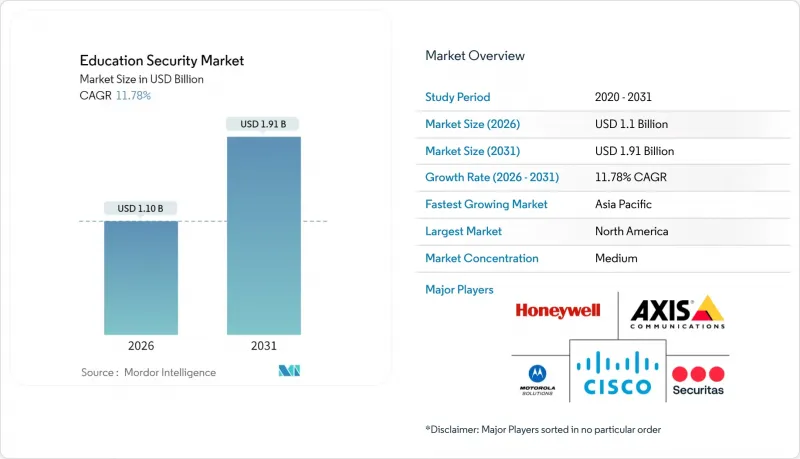
预算拨款的增加,例如联邦政府根据《K-12教育网路安全法案》津贴的2亿美元拨款,已将学校定位为关键基础设施。物理威胁和数位威胁的融合(2022年至2024年校园网路攻击激增156%)正在推动对整合防护解决方案的需求。人工智慧(AI)驱动的影像分析技术可在三到五秒内侦测到可疑活动,从而缩短事件回应时间,并加速其在各学区的普及应用。北美以37.31%的收入份额引领教育安全市场,而亚太地区则以13.8%的复合年增长率实现了最快增长,这主要得益于数十亿美元的智慧校园计划。全球企业集团和云端原生专家竞相调整其安全产品以适应严格的学生资料法规,因此市场竞争强度仍然适中。
全球教育安全市场趋势与洞察
用于早期威胁侦测的人工智慧行为侦测技术
先进的电脑视觉模型正在将安全防护从被动响应转变为主动预测。 2024年,Verkada在500个学区部署的系统显示,基于人工智慧的可疑人员警报回应时间缩短了67%,异常检测准确率高达94%。加州一个学区报告称,实施该系统后,事件发生率降低了43%,这表明该技术在减少校园霸凌和武器相关事件方面卓有成效。目前,为了减少误报,系统正在实施情境分析,将位置、时间以及过往风险记录等因素纳入考量。然而,演算法需要6到12个月的基线影像才能稳定运行,这需要大规模的边缘运算投资。将人工智慧与合规性仪錶板整合的供应商,透过促进FERPA合规性的实施,正在教育安全市场中占据优势。
政府安全津贴加速技术更新週期
自2024年以来,总额超过12亿美元的「制止校园暴力」津贴,使即使是规模小规模的学区也能绕过过时的模拟系统,采用云端原生平台。德克萨斯州已拨款3亿美元用于校园安全,佛罗里达州的「守护者」计画每年拨款1.5亿美元,从而形成同步更新周期,有利于采用承包解决方案。津贴指标要求可衡量的结果,因此供应商将事件分析仪表板作为标准配置。多年支援义务条款确保系统维护,同时稳定供应商收入。随着资金越来越与基于环境、社会和治理(ESG)的安全关键绩效指标(KPI)相一致,学区正在优先考虑能够将安全事件转化为审核的社会影响评分的平台。
初始采购成本和生命週期成本不断上升
全校范围的部署平均成本在 15 万至 50 万美元之间,年度服务费最高可达资本支出的 25%,这给预算有限的学区带来了巨大压力。专业安装会增加 30% 至 40% 的成本,而不断演变的威胁要求每三到五年进行大规模系统升级。津贴项目通常不包括软体许可和云端储存更新,迫使一些学区只能以备用模式运行高级系统。提供基于效能定价和模组化升级的供应商正在减少预算摩擦,并改善整个教育安全产业的整体拥有成本指标。
细分市场分析
到2025年,安保服务仍将占教育安保市场总收入的41.12%,儘管自动化技术发展迅速,安保服务仍将是教育安保市场的基础。保安人员满足监管要求,并能增强相关人员的安心。由人工智慧分析驱动的警报监控服务将以13.72%的复合年增长率超越所有其他服务。结合人工巡逻、无人机空影像和行动仪錶板的混合安保模式正在改变传统的津贴角色。越来越多的学区正在拨款建造即时指挥中心,从而推动了对系统整合和託管服务合约的需求。
在教育安全市场,随着教育机构整合供应商组合,系统整合服务预计将会成长。随着人员审查法规日益严格,入职前筛检正在復苏。咨询服务正向网路安全审核和以ESG(环境、社会和治理)为基础的安全报告方向发展。提供捆绑式服务套件的供应商透过简化采购流程,实现了高于市场平均的成长。
到2025年,硬体将占据教育安全市场52.15%的份额,这主要得益于摄影机和门禁控制设备的捆绑部署。然而,软体领域13.05%的复合年增长率凸显了向分析主导、云端管理架构的转变。边缘运算摄影机透过将人工智慧直接嵌入设备,模糊了组件之间的界限,从而减少了资料中心的面积。视讯管理平台的订阅定价模式将资本支出转化为可预测的营运支出。
服务收入约占总收入的四分之一,学区越来越多地将维护、韧体更新和威胁监控外包。随着供应商将功能从专用硬体转移到透过无线更新进行功能升级,教育安全市场的软体部分将持续成长。
区域分析
到2025年,北美将占教育安全市场收入的36.85%,美国联邦政府14亿美元的拨款将加速技术更新换代。加拿大各省政府也纷纷效仿,安大略省实施了一项1.8亿加元的项目,用于更新其视讯监控和门禁系统。墨西哥的现代化计画已拨款8,900万美元用于公立学校安全技术,扩大了区域供应商管道。
预计到2031年,亚太地区将以13.63%的复合年增长率实现最高成长。中国正将高达15%的780亿美元教育改革资金用于综合安防,加速大规模采购。印度的智慧校园投资超过120亿美元,东南亚各国的教育部门也将安全解决方案纳入其数位化学习计画。全球相机巨头的在地化生产提高了交付速度,满足了国内采购需求,进一步加剧了教育安防市场的竞争。
欧洲在应对GDPR方面稳步推进,德国已投资28亿欧元用于建造数位化学校,英国也投资6.5亿英镑用于采用隐私纳入设计技术的基础建设。中东和非洲地区总支出虽落后,但存在一些高成长领域。阿联酋的「智慧学校」计划和沙乌地阿拉伯的「2030愿景」教育支柱正在刺激对云端多语言安全套件的需求。能够应对不同资料居住规则的供应商更有可能在这些地区成功拓展业务。
其他福利:
- Excel格式的市场预测(ME)表
- 分析师支持(3个月)
目录
第一章 引言
- 研究假设和市场定义
- 调查范围
第二章调查方法
第三章执行摘要
第四章 市场情势
- 市场概览
- 市场驱动因素
- 校园即时影像分析需求快速成长
- 校园暴力和破坏行为事件日益增多
- 政府安全津贴加速技术更新週期
- 新兴经济体的基础建设现代化计划
- 利用人工智慧驱动的行为检测技术进行早期威胁识别
- ESG相关的安全关键绩效指标用于指导资金筹措决策
- 市场限制
- 高昂的初始采购成本和生命週期成本
- 持续存在的隐私和资料保护问题
- 实体和网路安全架构不统一
- 校园保全人员短缺
- 宏观经济因素的影响
- 产业价值链分析
- 监管环境
- 技术展望
- 波特五力分析
- 供应商的议价能力
- 买方的议价能力
- 新进入者的威胁
- 替代品的威胁
- 竞争对手之间的竞争
第五章 市场规模与成长预测
- 透过服务
- 安全
- 入职前筛选
- 安全咨询
- 系统整合与管理
- 警报监控服务
- 其他私人保全服务
- 按组件
- 硬体
- 软体
- 服务
- 透过安全解决方案
- 视讯监控系统
- 门禁系统
- 紧急通讯系统
- 网路安全解决方案
- 透过部署模式
- 本地部署
- 云
- 杂交种
- 按设施
- 小学和中学教育设施
- 高等教育设施
- 其他教育设施
- 按地区
- 北美洲
- 我们
- 加拿大
- 墨西哥
- 南美洲
- 巴西
- 阿根廷
- 南美洲其他地区
- 欧洲
- 德国
- 英国
- 法国
- 义大利
- 西班牙
- 其他欧洲地区
- 亚太地区
- 中国
- 日本
- 印度
- 韩国
- 东南亚
- 亚太其他地区
- 中东
- 沙乌地阿拉伯
- 阿拉伯聯合大公国
- 土耳其
- 其他中东地区
- 非洲
- 南非
- 奈及利亚
- 其他非洲地区
- 北美洲
第六章 竞争情势
- 市场集中度
- 策略趋势
- 市占率分析
- 公司简介
- Cisco Systems Inc.
- Honeywell International Inc.
- Motorola Solutions Inc.
- Securitas AB
- Axis Communications AB
- Genetec Inc.
- Verkada Inc.
- Hangzhou Hikvision Digital Technology Co. Ltd.
- Johnson Controls International plc
- Robert Bosch GmbH
- ADT Inc.
- Allied Universal Topco LLC
- Prosegur Compania de Seguridad SA
- Hanwha Vision Co., Ltd.
- Zhejiang Dahua Technology Co. Ltd.
- Gallagher Group Limited
- Silverseal Corporation
- SEICO Inc.
- Kisi Inc.
- AxxonSoft LLC
- Eagle Eye Networks Inc.
第七章 市场机会与未来展望
The education security market is expected to grow from USD 0.98 billion in 2025 to USD 1.1 billion in 2026 and is forecast to reach USD 1.91 billion by 2031 at 11.78% CAGR over 2026-2031.
Rising federal allocations, such as the USD 200 million K-12 Education Cybersecurity Act grant, have positioned schools as critical-infrastructure sites. Converging physical and digital threats, underscored by a 156% jump in campus cyberattacks between 2022 and 2024, sharpen demand for integrated protection. Artificial-intelligence video analytics now detect suspicious behavior within 3-5 seconds, shortening incident response times and bolstering adoption momentum across districts. North America leads the education security market with a 37.31% revenue share, while the Asia-Pacific region records the fastest growth at a 13.8% CAGR, driven by multi-billion-dollar smart campus programs. Competitive intensity remains moderate as global conglomerates and cloud-native specialists vie to align security offerings with strict student-data regulations.
Global Education Security Market Trends and Insights
AI-Enabled Behavioural Detection for Early Threat Identification
Advanced computer vision models are increasingly shifting security from a reactive to a predictive mode. Verkada rollouts across 500 districts in 2024 demonstrated 67% faster responses after AI person-of-interest alerts, achieving 94% accuracy in anomaly detection. Districts in California reported a 43% decline in incidents following the deployment, highlighting the technology's effectiveness in reducing bullying and weapons-related events. Contextual analytics now factor in location, time of day, and historical risk to curb false positives. However, campuses must capture 6-12 months of baseline footage before algorithms stabilize, requiring sizable edge-compute investments. Vendors that bundle AI with compliance dashboards gain an edge in the education security market by easing FERPA-aligned rollouts.
Government Safety Grants Accelerating Technology Refresh Cycles
Since 2024, STOP School Violence grants exceeding USD 1.2 billion have enabled smaller districts to bypass legacy analog systems and adopt cloud-native platforms. Texas earmarked USD 300 million for school security, and Florida's Guardian Program injects USD 150 million annually, creating synchronized refresh cycles that favor turnkey solutions. Grant metrics demand measurable outcomes, prompting vendors to ship incident analytics dashboards as standard. Mandatory multi-year support clauses stabilize provider revenue while ensuring system upkeep. As funds increasingly link to ESG-based safety KPIs, districts prioritize platforms that convert security events into auditable social-impact scores.
High Upfront Procurement and Lifecycle Costs
Complete campus installations average USD 150,000-500,000, with annual service fees consuming up to 25% of capital outlays, straining tight district budgets. Specialized installations raise costs by 30-40%, and major system refreshes are required every 3-5 years to counter evolving threats. Grant schemes rarely cover software licensing or cloud-storage renewals, prompting some districts to run sophisticated systems in fallback modes. Vendors offering outcome-based pricing and modular upgrades mitigate budget friction and improve total cost-of-ownership metrics across the education security industry.
Other drivers and restraints analyzed in the detailed report include:
- Heightened Incidence of School Violence and Vandalism
- Infrastructure Modernisation Programs in Emerging Economies
- Persistent Privacy and Data-Protection Concerns
For complete list of drivers and restraints, kindly check the Table Of Contents.
Segment Analysis
Guarding services generated 41.12% of 2025 revenue, anchoring the education security market despite the rapid advancement of automation. Visible officers fulfill regulatory mandates and boost stakeholder reassurance. Alarm-monitoring services, fueled by AI analytics, outpace all services at 13.72% CAGR. Hybrid guard models that combine human patrols with drone feeds and mobile dashboards are reshaping traditional roles. Districts allocating grant funds toward real-time command centers elevate demand for systems integration and managed service contracts.
The education security market size for systems integration services is set to expand as institutions consolidate their vendor portfolios. Pre-employment screening rebounds amid stricter personnel vetting rules. Consulting engagements evolve into cybersecurity audits and ESG-based safety reporting. Vendors offering bundled service suites achieve above-market growth by lowering procurement complexity.
Hardware accounted for 52.15% of the education security market share in 2025, driven by the rollout of bulk cameras and access controls. Yet software's 13.05% CAGR underscores the shift toward analytics-driven, cloud-managed architectures. Edge-enabled cameras blur component lines by embedding AI directly on devices, shrinking data-center footprints. Subscription pricing for video-management platforms converts capital expenditure into predictable operating outlays.
Services accounted for nearly one-quarter of total revenue as districts increasingly outsourced maintenance, firmware updates, and threat monitoring. The education security market size for software will continue expanding as vendors decouple functionality from proprietary hardware and push feature upgrades via over-the-air updates.
The Education Security Market Report is Segmented by Services (Guarding, Pre-Employment Screening, and More), Component (Hardware, Software, and Services), Security Solution (Video Surveillance Systems, Access Control Systems, and More), Deployment Mode (On-Premise, Cloud, and Hybrid), Facilities (Primary and Secondary Facilities, and More), and Geography. The Market Forecasts are Provided in Terms of Value (USD).
Geography Analysis
North America accounted for 36.85% of the education security market revenue in 2025, led by the United States' USD 1.4 billion in combined federal grants that catalyzed rapid technology refresh cycles. Canadian provinces echo this trend, with Ontario's CAD 180 million program upgrading video surveillance and access-control stacks. Mexico's modernization drive earmarks USD 89 million for public-school safety technology, broadening regional supplier pipelines.
Asia-Pacific posts the most aggressive 13.63% CAGR through 2031. China's USD 78 billion education overhaul allocates up to 15% for integrated security, fast-tracking large-scale procurements. India's smart-campus investments surpass USD 12 billion, and Southeast Asian ministries bundle safety solutions within digital-learning rollouts. Local manufacturing by global camera giants shortens delivery cycles and satisfies domestic-content mandates, heightening competitive churn within the education security market.
Europe advances steadily on GDPR context compliance. Germany commits EUR 2.8 billion to digital schools, and the United Kingdom channels GBP 650 million toward infrastructure fortified by privacy-by-design tools. The Middle East and Africa trail in aggregate spending yet exhibit pockets of high growth-UAE smart-school projects and Saudi Arabia's Vision 2030 education pillar stimulate demand for cloud-ready, multi-lingual security suites. Suppliers adept at navigating divergent data-residency rules are more likely to succeed in scaling across these regions.
- Cisco Systems Inc.
- Honeywell International Inc.
- Motorola Solutions Inc.
- Securitas AB
- Axis Communications AB
- Genetec Inc.
- Verkada Inc.
- Hangzhou Hikvision Digital Technology Co. Ltd.
- Johnson Controls International plc
- Robert Bosch GmbH
- ADT Inc.
- Allied Universal Topco LLC
- Prosegur Compania de Seguridad S.A.
- Hanwha Vision Co., Ltd.
- Zhejiang Dahua Technology Co. Ltd.
- Gallagher Group Limited
- Silverseal Corporation
- SEICO Inc.
- Kisi Inc.
- AxxonSoft LLC
- Eagle Eye Networks Inc.
Additional Benefits:
- The market estimate (ME) sheet in Excel format
- 3 months of analyst support
TABLE OF CONTENTS
1 INTRODUCTION
- 1.1 Study Assumptions and Market Definition
- 1.2 Scope of the Study
2 RESEARCH METHODOLOGY
3 EXECUTIVE SUMMARY
4 MARKET LANDSCAPE
- 4.1 Market Overview
- 4.2 Market Drivers
- 4.2.1 Surging demand for real-time video analytics on campuses
- 4.2.2 Heightened incidence of school violence and vandalism
- 4.2.3 Government safety grants accelerating technology refresh cycles
- 4.2.4 Infrastructure modernisation programs in emerging economies
- 4.2.5 AI-enabled behavioural detection for early threat identification
- 4.2.6 ESG-linked safety KPIs guiding funding decisions
- 4.3 Market Restraints
- 4.3.1 High upfront procurement and lifecycle costs
- 4.3.2 Persistent privacy and data-protection concerns
- 4.3.3 Disjointed physical-cybersecurity architectures
- 4.3.4 Shortage of skilled campus security personnel
- 4.4 Impact of Macroeconomic Factors
- 4.5 Industry Value Chain Analysis
- 4.6 Regulatory Landscape
- 4.7 Technological Outlook
- 4.8 Porter's Five Forces Analysis
- 4.8.1 Bargaining Power of Suppliers
- 4.8.2 Bargaining Power of Buyers
- 4.8.3 Threat of New Entrants
- 4.8.4 Threat of Substitutes
- 4.8.5 Intensity of Competitive Rivalry
5 MARKET SIZE AND GROWTH FORECASTS (VALUE)
- 5.1 By Services
- 5.1.1 Guarding
- 5.1.2 Pre-Employment Screening
- 5.1.3 Security Consulting
- 5.1.4 Systems Integration and Management
- 5.1.5 Alarm Monitoring Services
- 5.1.6 Other Private Security Services
- 5.2 By Component
- 5.2.1 Hardware
- 5.2.2 Software
- 5.2.3 Services
- 5.3 By Security Solution
- 5.3.1 Video Surveillance Systems
- 5.3.2 Access Control Systems
- 5.3.3 Emergency Communication Systems
- 5.3.4 Cybersecurity Solutions
- 5.4 By Deployment Mode
- 5.4.1 On-Premise
- 5.4.2 Cloud
- 5.4.3 Hybrid
- 5.5 By Facilities
- 5.5.1 Primary and Secondary Facilities
- 5.5.2 Higher Education Facilities
- 5.5.3 Other Educational Facilities
- 5.6 By Geography
- 5.6.1 North America
- 5.6.1.1 United States
- 5.6.1.2 Canada
- 5.6.1.3 Mexico
- 5.6.2 South America
- 5.6.2.1 Brazil
- 5.6.2.2 Argentina
- 5.6.2.3 Rest of South America
- 5.6.3 Europe
- 5.6.3.1 Germany
- 5.6.3.2 United Kingdom
- 5.6.3.3 France
- 5.6.3.4 Italy
- 5.6.3.5 Spain
- 5.6.3.6 Rest of Europe
- 5.6.4 Asia Pacific
- 5.6.4.1 China
- 5.6.4.2 Japan
- 5.6.4.3 India
- 5.6.4.4 South Korea
- 5.6.4.5 South-East Asia
- 5.6.4.6 Rest of Asia Pacific
- 5.6.5 Middle East
- 5.6.5.1 Saudi Arabia
- 5.6.5.2 United Arab Emirates
- 5.6.5.3 Turkey
- 5.6.5.4 Rest of Middle East
- 5.6.6 Africa
- 5.6.6.1 South Africa
- 5.6.6.2 Nigeria
- 5.6.6.3 Rest of Africa
- 5.6.1 North America
6 COMPETITIVE LANDSCAPE
- 6.1 Market Concentration
- 6.2 Strategic Moves
- 6.3 Market Share Analysis
- 6.4 Company Profiles (includes Global level Overview, Market level overview, Core Segments, Financials as available, Strategic Information, Market Rank/Share for key companies, Products and Services, and Recent Developments)
- 6.4.1 Cisco Systems Inc.
- 6.4.2 Honeywell International Inc.
- 6.4.3 Motorola Solutions Inc.
- 6.4.4 Securitas AB
- 6.4.5 Axis Communications AB
- 6.4.6 Genetec Inc.
- 6.4.7 Verkada Inc.
- 6.4.8 Hangzhou Hikvision Digital Technology Co. Ltd.
- 6.4.9 Johnson Controls International plc
- 6.4.10 Robert Bosch GmbH
- 6.4.11 ADT Inc.
- 6.4.12 Allied Universal Topco LLC
- 6.4.13 Prosegur Compania de Seguridad S.A.
- 6.4.14 Hanwha Vision Co., Ltd.
- 6.4.15 Zhejiang Dahua Technology Co. Ltd.
- 6.4.16 Gallagher Group Limited
- 6.4.17 Silverseal Corporation
- 6.4.18 SEICO Inc.
- 6.4.19 Kisi Inc.
- 6.4.20 AxxonSoft LLC
- 6.4.21 Eagle Eye Networks Inc.
7 MARKET OPPORTUNITIES AND FUTURE OUTLOOK
- 7.1 White-space and Unmet-need Assessment

 资料安全市场:按组件类型、部署模式、组织规模和产业划分 - 2026-2032年全球市场预测
 2026年全球IT安全咨询服务市场报告
 泰国资讯科技与安全:市场占有率分析、产业趋势与统计、成长预测(2026-2031)
 全球IT安全咨询服务市场规模、份额、趋势和成长分析报告(2026-2034年)资料驱动型保全服务市场,依服务、部署模式、安全技术、组织规模及垂直产业划分,全球预测,2026-2032年软体开发安全咨询服务市场:按服务类型、部署类型、安全类型、组织规模和产业划分 - 全球预测(2026-2032 年)
 医疗保健IT安全市场预测至2032年:按组件、部署类型、组织规模、应用、最终用户和地区分類的全球分析Frost Radar:资料安全平台,2025全球资料安全平台市场:2025-2030年
 全球人工智慧资料安全市场