


 |
市场调查报告书
商品编码
1940775
IT硬体:市场占有率分析、产业趋势与统计、成长预测(2026-2031年)IT Hardware - Market Share Analysis, Industry Trends & Statistics, Growth Forecasts (2026 - 2031) |
||||||

※ 本网页内容可能与最新版本有所差异。详细情况请与我们联繫。
2025年全球IT硬体市场价值为1,411.5亿美元,预计到2031年将达到2,213.4亿美元,而2026年为1,521.3亿美元。
预计在预测期(2026-2031 年)内,复合年增长率将达到 7.78%。
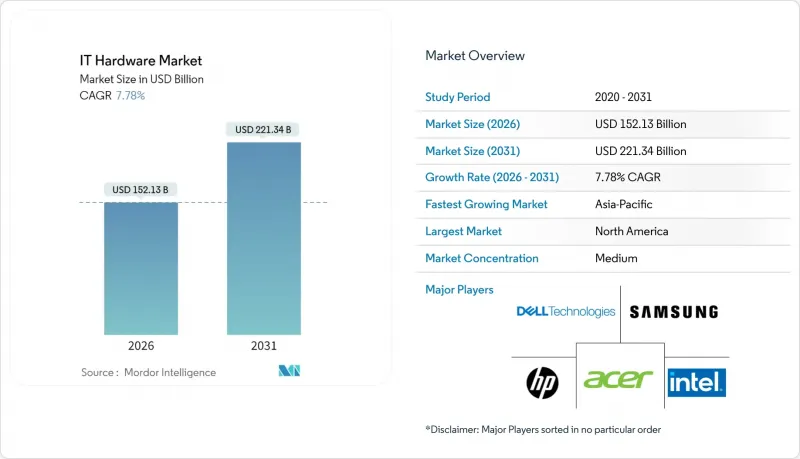
随着企业在Windows 10停止支援前更新PC、部署人工智慧伺服器以及遵守资料主权法规,市场需求正在加速成长。北美云端服务供应商持续扩展其超大规模园区,而亚太地区的製造商则正利用边缘运算实现生产现代化。半导体供应紧张和电子废弃物法规虽然抑制了短期成长势头,但并未危及长期成长前景。整合运算、储存和网路解决方案的供应商竞争日益激烈。儘管直接与OEM厂商交易仍是大型企业的主要采购方式,但快速成长的线上管道正使中小企业也能以经济实惠的价格获得企业级设备。
全球IT硬体市场趋势与洞察
疫情后PC更新换代週期,以及Windows 10停止支援前的这段时间。
企业面临一个严峻的最后期限:Windows 10 将于 2025 年 10 月停止支援。微软的扩展安全计画 (Extended Security Plan) 的费用在第三年已上涨至每台装置 427 美元,使得购买新硬体比打补丁更具成本效益。 2020-2021 年购买的远距办公设备正处于其四年的自然更换週期。美国凯撒医疗集团 (Kaiser Permanente) 等医疗系统已将其所有设备升级到基于 Windows 11 的电子健康记录 (EHR) 系统。各大银行也纷纷效仿,摩根大通计画在 2024 年累计21 亿美元,以增强其最新 PC 的终端安全性。这两种因素共同推动了受监管行业对合规笔记型电脑、桌上型电脑和专用工作站的需求。
人工智慧优化伺服器和GPU的普及
随着人工智慧工作负载从试点阶段过渡到生产阶段,对专用伺服器的需求激增。英伟达(NVIDIA)2024财年的资料中心收入飙升至475亿美元,因为企业普遍采用基于GPU的运算。戴尔科技集团报告称,其人工智慧伺服器累积订单在一个季度内从8亿美元跃升至29亿美元,凸显了人工智慧设备的紧迫性。西门子等製造商正在工厂车间部署这些系统以实现预测性维护,高盛于2024年投资12亿美元,以确保毫秒级风险分析能力。这种转变也加速了对高频宽网路和低延迟储存的投入,以确保人工智慧丛集能够满载运作。
电子废弃物法规和不断上涨的处置成本
欧盟的《废弃电子电气设备指令》要求在2027年实现85%的回收率,增加了製造商的重新设计和物流成本。加州的「维修权」法案要求供应商储备零件和手册长达七年,迫使他们重新思考产品蓝图。消费者将处置成本计入总拥有成本,延长了产品更新周期。微软将其个人电脑的使用寿命从四年延长至五年,以减少垃圾掩埋。采用模组化底盘的供应商正在获得优势,而计划报废策略的重要性正在降低。
细分市场分析
伺服器营收在IT硬体市场成长最快,年复合成长率高达8.95%,这主要得益于企业采用高密度GPU节点进行AI模型训练。戴尔在2024年第三季面向AI的伺服器配置中实现了42亿美元的营收。同时,PC仍保持51.02%的市场份额,但其更新周期有所延长。储存和网路设备正顺应伺服器需求,为AI丛集增加频宽和低延迟连结。液冷技术和垂直整合机架正在模糊传统的产品界线。 AMD收购ZT Systems带来了客製化设计能力,这与超大规模资料中心业者对客製化设备的偏好相符。周边设备对週边设备的需求稳定,而边缘网关则在工业环境中开闢了新的细分市场。
混合架构在伺服器机房中十分普遍。企业将x86 CPU与加速器结合使用,以平衡成本和吞吐量。不断上涨的电价使得能源效率成为首要采购标准。在人工智慧普及浪潮的推动下,伺服器IT硬体市场预计将持续成长至2031年。能够提供包含电源和冷却子系统的承包机架的供应商,相较于提供白盒产品的供应商,更能保障其利润率。
到2025年,企业支出将维持在47.25%的水平,而云端服务供应商将以17.05%的复合年增长率超越企业。光是AWS一家,在2024年第三季就在资料中心和人工智慧伺服器的资本支出上投入了127亿美元。政府机构正在扩大国内容量以符合主权法规。医疗保健产业正在转向远端医疗并保障病患记录安全,这需要加密储存阵列。银行、金融服务和保险(BFSI)公司正在对终端进行现代化改造,以满足网路安全弹性审核的要求。製造商正在部署边缘丛集以进行即时生产数据处理,媒体公司正在推出8K编辑套件。通讯业者正在将IT硬体整合到5G核心网路中,优先考虑融合运算设备。
云端巨头的资本支出将支撑对伺服器、交换器和储存设备的需求,从而保护供应商免受週期性低迷的影响。同时,企业将继续维护内部资产以处理受监管的工作负载,并采用混合IT架构。 IT硬体市场将受益于这两种趋势,并在未来十年内保持用户结构的平衡。
区域分析
到2025年,北美将贡献37.40%的收入,这主要得益于人工智慧的早期应用和超大规模的扩张。联邦政府的云端计画和私营部门的技术升级正在维持稳定的更新週期。企业正在拥抱混合IT,推动在个人电脑、伺服器和网路硬体之间进行均衡采购。永续设计也日益受到关注,供应商提案节能机架以满足碳排放目标。
亚太地区将引领成长,到2031年复合年增长率将达9.32%。日本计画投资354亿美元建设资料中心,将支援GPU伺服器和液冷系统的大量采购。印度的数位公共产品框架将推动国内处理需求,扩大本地伺服器容量。在中国,儘管贸易紧张局势加剧,但本土技术供应商的市场份额正在不断增长。新加坡等东南亚枢纽城市正吸引跨国公司在此建构云端平台。製造业现代化正在加速全部区域边缘节点的部署,并将需求扩展到主要大都市以外的地区。
在监管合规和永续性奖励的推动下,欧洲正经历温和的成长。维修权法案刺激了对模组化硬体的需求,而资料主权规则则鼓励本地组装。云端资料中心正因可再生能源的普及而位置北欧国家,同时银行业和公共服务领域的本地投资也持续成长。东欧正在迎头赶上,加大对个人电脑和网路升级的投资,从而带动了更成熟的西方市场的成长。
其他福利:
- Excel格式的市场预测(ME)表
- 3个月的分析师支持
目录
第一章 引言
- 研究假设和市场定义
- 调查范围
第二章调查方法
第三章执行摘要
第四章 市场洞察
- 市场概览
- 市场驱动因素
- 疫情后的PC更新换代週期领先Windows 10停止支援(EoS)发生。
- 人工智慧优化伺服器和GPU的普及
- 新兴市场超大规模资料中心建设扩张
- 智慧工厂边缘运算入门套件的成长
- 维修权和模组化升级条例
- 数位主权硬体激励措施(以 CHIPS 法案的形式)
- 市场限制
- 更严格的电子废弃物法规和不断上涨的处置成本
- 半导体地缘政治供应链中断
- 关税波动会增加原始设备製造商的搬迁成本。
- 云端迁移可降低本地硬体支出
- 价值链分析
- 监管环境
- 技术展望
- 波特五力模型
- 供应商的议价能力
- 买方的议价能力
- 新进入者的威胁
- 替代品的威胁
- 竞争对手之间的竞争
- 产业生态系分析
- 主要用例和案例研究
- 宏观经济趋势评估
- 投资分析
第五章 市场规模与成长预测
- 依产品类型
- PC客户端设备
- 伺服器
- 储存装置
- 网路装置
- 周边设备和配件
- 边缘和物联网网关
- 最终用户
- 企业
- 政府和公共部门
- BFSI
- 卫生保健
- 教育
- 媒体与娱乐
- 云端服务供应商
- 通讯业者
- 製造业和工业
- 透过安装环境
- 本地部署
- 云
- 透过分销管道
- 直接/OEM
- 系统整合商
- 增值转售商
- 线上零售
- 按地区
- 北美洲
- 我们
- 加拿大
- 墨西哥
- 南美洲
- 巴西
- 阿根廷
- 哥伦比亚
- 南美洲其他地区
- 欧洲
- 德国
- 英国
- 法国
- 义大利
- 西班牙
- 俄罗斯
- 荷兰
- 其他欧洲地区
- 亚太地区
- 中国
- 日本
- 韩国
- 印度
- 澳洲
- 新加坡
- 亚太其他地区
- 中东和非洲
- 中东
- 沙乌地阿拉伯
- 阿拉伯聯合大公国
- 其他中东地区
- 非洲
- 南非
- 埃及
- 其他非洲地区
- 中东
- 北美洲
第六章 竞争情势
- 市场集中度
- 策略趋势
- 市占率分析
- 公司简介
- Upwork Inc.
- Fiverr International Ltd.
- Freelancer Limited
- Toptal LLC
- Guru.com LLC
- PeoplePerHour.com Ltd.
- DesignCrowd Pty Ltd.
- Contently Inc.
- WorkGenius GmbH
- WorkMarket, Inc.
- Catalant Technologies, Inc.
- 99designs by Vista
- Behance(Adobe Inc.)
- TaskRabbit, Inc.
- Amazon Mechanical Turk(Amazon.com, Inc.)
- UpStack Technologies, Inc.
- Workana Inc.
- Gigster LLC
- Aquent LLC
- FlexJobs Corporation
第七章 市场机会与未来展望
The global IT hardware market was valued at USD 141.15 billion in 2025 and estimated to grow from USD 152.13 billion in 2026 to reach USD 221.34 billion by 2031, at a CAGR of 7.78% during the forecast period (2026-2031).
Demand accelerates as enterprises refresh PCs ahead of Windows 10 end-of-support, deploy AI-ready servers, and comply with data-sovereignty mandates. North American cloud providers continue to expand hyperscale campuses, while Asia-Pacific manufacturers modernize production with edge computing. Tight semiconductor supply and e-waste regulation temper short-term momentum but do not derail the long-range growth outlook. Vendor competition intensifies around integrated compute, storage, and networking solutions that shorten deployment time and improve energy efficiency. Direct OEM relationships still dominate large-enterprise procurement, yet fast-growing online channels now give smaller firms affordable access to enterprise-grade equipment.
Global IT Hardware Market Trends and Insights
Post-pandemic PC refresh cycle ahead of Windows 10 EoS
Enterprises face a hard Windows 10 support deadline in October 2025. Microsoft's extended security plan costs escalated to USD 427 per device in the third year, making new hardware cheaper than patching . Devices purchased for remote work in 2020-2021 now reach their natural four-year replacement window. U.S. hospital systems such as Kaiser Permanente have already upgraded entire fleets for Windows 11-based electronic health records. Banking majors mirror the trend; JPMorgan Chase earmarked USD 2.1 billion in 2024 for endpoint security upgrades tied to modern PCs. The dual catalyst lifts demand for compliant laptops, desktops, and specialist workstations across regulated sectors.
Proliferation of AI-optimized servers and GPUs
AI workloads move from pilots to production, sending specialized server demand sharply higher. NVIDIA data-center revenue jumped to USD 47.5 billion in fiscal 2024 as enterprises standardised on GPU-based compute. Dell Technologies reported an AI-server backlog swelling from USD 800 million to USD 2.9 billion within one quarter, underscoring urgency for AI-ready gear. Manufacturers such as Siemens embed these systems on shop floors to enable predictive maintenance, while Goldman Sachs invested USD 1.2 billion in 2024 to secure millisecond risk-analysis capability. The shift also accelerates spending on high-bandwidth networking and low-latency storage that keep AI clusters fully utilized.
Escalating e-waste regulation and disposal costs
The EU's Waste Electrical and Electronic Equipment Directive now mandates 85% recycling by 2027, raising redesign and logistics costs for producers. California's Right-to-Repair Act forces vendors to stock parts and manuals for seven years, reshaping product roadmaps. Customers factor disposal fees into the total cost of ownership, stretching refresh cycles. Microsoft extended its own PC life from four to five years to limit landfill volume. Vendors with modular chassis gain an edge, while planned obsolescence playbooks lose relevance.
Other drivers and restraints analyzed in the detailed report include:
- Hyperscale data-centre build-out in emerging markets
- Growth of edge-computing starter kits for smart factories
- Semiconductor geo-political supply-chain shocks
For complete list of drivers and restraints, kindly check the Table Of Contents.
Segment Analysis
Server revenue is growing at a 8.95% CAGR, the fastest in the IT hardware market, as enterprises adopt dense GPU nodes for AI model training. Dell logged USD 4.2 billion in Q3 2024 server sales on AI-centric builds. In contrast, PCs hold a 51.02% share but now experience elongated replacement cycles. Storage and networking follow server demand, adding bandwidth and low-latency links for AI clusters. Liquid cooling and vertically integrated racks blur traditional product boundaries. AMD's acquisition of ZT Systems gives it custom design capacity, aligning with hyperscaler preference for bespoke units. Peripherals see steady demand from hybrid work, while edge gateways seed new micro-segments in industrial settings.
Hybrid architecture dominates server rooms. Enterprises pair x86 CPUs with accelerators, balancing cost and throughput. Energy efficiency has become a front-line buying criterion as utility tariffs climb. The IT hardware market size for servers is poised to expand steadily alongside AI deployment waves through 2031. Vendors capable of supplying turnkey racks with power and cooling subsystems protect margins against white-box alternatives.
Enterprises retained 47.25% of 2025 spending, yet cloud providers are set to outpace at a 17.05% CAGR. AWS alone devoted USD 12.7 billion in Q3 2024 to data-center and AI server capital outlays. Government buyers raise on-shore capacity to comply with sovereignty rules. Healthcare pivots to telemedicine and secure patient records, needing encrypted storage arrays. BFSI firms refresh endpoints to satisfy cyber-resilience audits. Manufacturing installs edge clusters for real-time production data, and media firms deploy 8K editing suites. Telecom operators integrate IT hardware into 5G core networks, preferring converged compute appliances.
Cloud leaders' capex sets a high floor for server, switch, and storage demand, cushioning suppliers against cyclical dips. Enterprises, meanwhile, adopt hybrid IT, retaining in-house assets for regulated workloads. The IT hardware market benefits from both streams, yielding a balanced user-mix profile through the decade.
The IT Hardware Market Report is Segmented by Product Type (PC Client Devices, Servers, and More), End User (Enterprise, Government and Public Sector, BFSI, and More), Deployment Environment (On-Premise, and Cloud), Distribution Channel (Direct/OEM, System Integrators, Value-Added Resellers, and Online Retail), and Geography. The Market Forecasts are Provided in Terms of Value (USD).
Geography Analysis
North America contributed 37.40% revenue in 2025 thanks to early AI adoption and hyperscale expansion. Federal cloud programs and private-sector tech upgrades sustain steady refresh cycles. Enterprises embrace hybrid IT, driving balanced orders across PCs, servers, and network hardware. Sustainable design also gains traction, with vendors pitching energy-efficient racks to meet carbon targets.
Asia-Pacific leads growth at a 9.32% CAGR to 2031. Japan's planned USD 35.4 billion in data-center spend underpins bulk purchases of GPU servers and liquid-cooling systems. India advances digital-public-goods frameworks, forcing domestic processing that enlarges local server capacity . China's indigenous tech suppliers grab share amid trade tension, while Southeast Asian hubs like Singapore attract multi-national cloud builds. Manufacturing modernization multiplies edge-node deployment across the region, spreading demand beyond tier-one cities.
Europe posts moderate expansion anchored by regulatory compliance and sustainability incentives. Right-to-repair laws stimulate modular hardware demand, while data-sovereignty rules encourage regional assembly. Cloud data centers locate in Nordic countries for renewable energy, yet on-premise spend persists in banking and public services. Eastern Europe shows catch-up investment in PCs and network upgrades, adding a growth tail to the mature Western bloc.
- Upwork Inc.
- Fiverr International Ltd.
- Freelancer Limited
- Toptal LLC
- Guru.com LLC
- PeoplePerHour.com Ltd.
- DesignCrowd Pty Ltd.
- Contently Inc.
- WorkGenius GmbH
- WorkMarket, Inc.
- Catalant Technologies, Inc.
- 99designs by Vista
- Behance (Adobe Inc.)
- TaskRabbit, Inc.
- Amazon Mechanical Turk (Amazon.com, Inc.)
- UpStack Technologies, Inc.
- Workana Inc.
- Gigster LLC
- Aquent LLC
- FlexJobs Corporation
Additional Benefits:
- The market estimate (ME) sheet in Excel format
- 3 months of analyst support
TABLE OF CONTENTS
1 INTRODUCTION
- 1.1 Study Assumptions and Market Definition
- 1.2 Scope of the Study
2 RESEARCH METHODOLOGY
3 EXECUTIVE SUMMARY
4 MARKET INSIGHTS
- 4.1 Market Overview
- 4.2 Market Drivers
- 4.2.1 Post-pandemic PC refresh cycle ahead of Windows 10 EoS
- 4.2.2 Proliferation of AI-optimised servers and GPUs
- 4.2.3 Hyperscale data-centre build-out in emerging markets
- 4.2.4 Growth of edge-computing starter kits for smart factories
- 4.2.5 Right-to-repair and modular-upgrade regulations
- 4.2.6 Digital-sovereignty hardware incentives (CHIPS-style bills)
- 4.3 Market Restraints
- 4.3.1 Escalating e-waste regulation and disposal costs
- 4.3.2 Semiconductor geo-political supply-chain shocks
- 4.3.3 Tariff volatility driving OEM relocation expense
- 4.3.4 Cloud migration cannibalising on-prem hardware spend
- 4.4 Value Chain Analysis
- 4.5 Regulatory Landscape
- 4.6 Technological Outlook
- 4.7 Porter's Five Forces
- 4.7.1 Bargaining Power of Suppliers
- 4.7.2 Bargaining Power of Buyers
- 4.7.3 Threat of New Entrants
- 4.7.4 Threat of Substitutes
- 4.7.5 Competitive Rivalry
- 4.8 Industry Ecosystem Analysis
- 4.9 Key Use Cases and Case Studies
- 4.10 Assessment of Macroeconomic Trends
- 4.11 Investment Analysis
5 MARKET SIZE AND GROWTH FORECASTS (VALUE)
- 5.1 By Product Type
- 5.1.1 PC Client Devices
- 5.1.2 Servers
- 5.1.3 Storage Devices
- 5.1.4 Networking Hardware
- 5.1.5 Peripherals and Accessories
- 5.1.6 Edge and IoT Gateways
- 5.2 By End User
- 5.2.1 Enterprise
- 5.2.2 Government and Public Sector
- 5.2.3 BFSI
- 5.2.4 Healthcare
- 5.2.5 Education
- 5.2.6 Media and Entertainment
- 5.2.7 Cloud Service Providers
- 5.2.8 Telecom Operators
- 5.2.9 Manufacturing and Industrial
- 5.3 By Deployment Environment
- 5.3.1 On-Premise
- 5.3.2 Cloud
- 5.4 By Distribution Channel
- 5.4.1 Direct / OEM
- 5.4.2 System Integrators
- 5.4.3 Value-Added Resellers
- 5.4.4 Online Retail
- 5.5 By Geography
- 5.5.1 North America
- 5.5.1.1 United States
- 5.5.1.2 Canada
- 5.5.1.3 Mexico
- 5.5.2 South America
- 5.5.2.1 Brazil
- 5.5.2.2 Argentina
- 5.5.2.3 Colombia
- 5.5.2.4 Rest of South America
- 5.5.3 Europe
- 5.5.3.1 Germany
- 5.5.3.2 United Kingdom
- 5.5.3.3 France
- 5.5.3.4 Italy
- 5.5.3.5 Spain
- 5.5.3.6 Russia
- 5.5.3.7 Netherlands
- 5.5.3.8 Rest of Europe
- 5.5.4 Asia-Pacific
- 5.5.4.1 China
- 5.5.4.2 Japan
- 5.5.4.3 South Korea
- 5.5.4.4 India
- 5.5.4.5 Australia
- 5.5.4.6 Singapore
- 5.5.4.7 Rest of Asia-Pacific
- 5.5.5 Middle East and Africa
- 5.5.5.1 Middle East
- 5.5.5.1.1 Saudi Arabia
- 5.5.5.1.2 United Arab Emirates
- 5.5.5.1.3 Rest of Middle East
- 5.5.5.2 Africa
- 5.5.5.2.1 South Africa
- 5.5.5.2.2 Egypt
- 5.5.5.2.3 Rest of Africa
- 5.5.5.1 Middle East
- 5.5.1 North America
6 COMPETITIVE LANDSCAPE
- 6.1 Market Concentration
- 6.2 Strategic Moves
- 6.3 Market Share Analysis
- 6.4 Company Profiles (includes Global level Overview, Market level overview, Core Segments, Financials as available, Strategic Information, Market Rank/Share for key companies, Products and Services, and Recent Developments)
- 6.4.1 Upwork Inc.
- 6.4.2 Fiverr International Ltd.
- 6.4.3 Freelancer Limited
- 6.4.4 Toptal LLC
- 6.4.5 Guru.com LLC
- 6.4.6 PeoplePerHour.com Ltd.
- 6.4.7 DesignCrowd Pty Ltd.
- 6.4.8 Contently Inc.
- 6.4.9 WorkGenius GmbH
- 6.4.10 WorkMarket, Inc.
- 6.4.11 Catalant Technologies, Inc.
- 6.4.12 99designs by Vista
- 6.4.13 Behance (Adobe Inc.)
- 6.4.14 TaskRabbit, Inc.
- 6.4.15 Amazon Mechanical Turk (Amazon.com, Inc.)
- 6.4.16 UpStack Technologies, Inc.
- 6.4.17 Workana Inc.
- 6.4.18 Gigster LLC
- 6.4.19 Aquent LLC
- 6.4.20 FlexJobs Corporation
7 MARKET OPPORTUNITIES AND FUTURE OUTLOOK
- 7.1 White-space and Unmet-Need Assessment

 2026年全球硬体储存市场报告
 全球硬检验市场
 印度 IT 硬体:市场占有率分析、行业趋势和统计数据、成长预测(2025-2030 年)全球硬体储存市场
 硬体储存市场规模、份额、成长分析,按硬体储存解决方案类型、储存容量、使用环境、地区 - 产业预测,2025-2032