


 |
市场调查报告书
商品编码
1940778
亚太地区人力资本管理软体:市场占有率分析、产业趋势与统计、成长预测(2026-2031)Asia-Pacific Human Capital Management Software - Market Share Analysis, Industry Trends & Statistics, Growth Forecasts (2026 - 2031) |
||||||

※ 本网页内容可能与最新版本有所差异。详细情况请与我们联繫。
亚太地区人力资源管理软体市场预计将从 2025 年的 88.7 亿美元成长到 2026 年的 97.6 亿美元,预计到 2031 年将达到 157.4 亿美元,2026 年至 2031 年的复合年增长率为 10.04%。
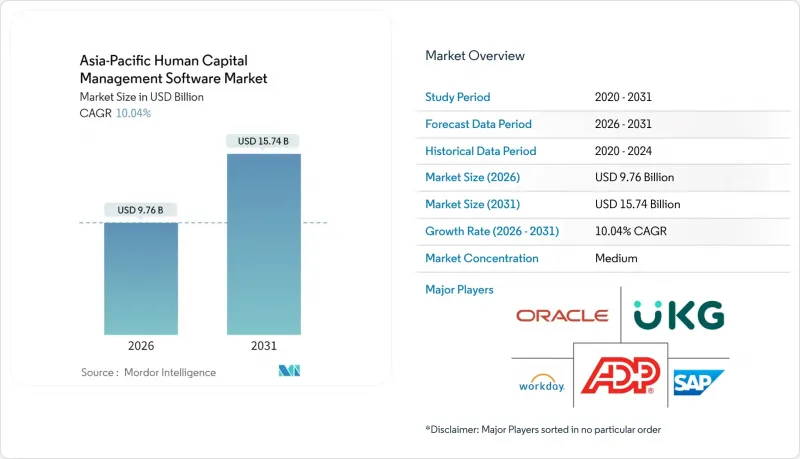
这一快速成长反映了当前该地区企业正以整合式云端原生平台取代传统、人工密集型人力资源工具的趋势,这些平台能够减少人工操作、降低合规风险,并满足行动优先型员工的需求。推动这项需求的动力来自人工智慧驱动的自动化技术的快速发展,该技术能够简化招募、分析和薪资核算流程,同时支援多种语言和监管规则。能够将深度在地化与扩充性的云端架构相结合的供应商正在获得优势,因为企业越来越将现代人力资本管理(HCM)视为核心系统而非外围附加元件。儘管市场竞争激烈,但转换成本和监管复杂性限制了激烈的价格战,使现有供应商能够资金筹措用于新产品发布和透过收购进行扩张。
亚太地区人力资本管理软体市场趋势与洞察
对行动HCM应用程式的需求不断增长
智慧型手机的普及导致许多员工不再登入桌面版人力资源入口网站,促使企业重新设计工作流程以适应更小的萤幕。原生行动应用程式鼓励自助服务,减少人力资源工单数量,并确保数据及时更新。自带装置办公室 (BYOD) 政策已成为主流,虽然需要进行安全更新,但提升了随时随地存取的便利性。能够将薪资单、请假核准和微学习内容推送至员工设备的供应商,由于能够有效提升员工参与度,因此续约率更高。这种转变在印度和印尼尤其明显,通讯业者和零售商正透过面向消费者的应用,逐步部署人力资本管理 (HCM) 功能。
加速亚太企业采用云端运算
预算负责人越来越认为本地部署的人力资源套件系统僵化、成本高昂,且升级週期往往落后于监管变化。迁移到基于订阅的云端平台可以将整体拥有成本降低一半,同时实现即时功能发布。 SAP 等全球公司已发布 2024 年更新,其中融入了技能推理人工智慧,展示了只有在云端环境中才能实现的功能。印度等市场强大的宽频环境、不断下降的储存价格以及对 SaaS 友善的监管环境正在缩小大中小型企业之间的能力差距。随着企业跨国扩张,集中式云端人力资源系统更容易协调跨多个司法管辖区的薪资核算和合规事宜。
隐私和安全问题
许多国家限制跨境资料流动,要求SaaS供应商部署本地资料中心并采取严格的加密措施。行动装置的普及催生了新的攻击途径,促使企业增加对装置管理和零信任存取的投入。没有专门安全团队的公司在接受安全控制审核期间,往往会面临计划延期。而通过ISO 27001认证并符合新加坡《个人资讯保护法》的供应商则更容易签订合约。
细分市场分析
截至2025年,基于云端的解决方案将占据亚太地区人力资本管理软体市场78.05%的份额,年复合成长率达10.98%。企业认为,更快的新功能交付速度和集中管理合规性更新是其主要优势。只有在监管机构要求本地伺服器的情况下,例如澳洲某些公共部门环境和日本金融公司,才会继续采用本地部署。成本模型显示,迁移五年后,硬体和维护成本将降低40%至60%。 Workday等供应商正在扩展区域资料中心,以解决客户对资料居住的担忧。
向可组合式人力资源架构的转变进一步加速了云端技术的采用。客户无需进行大规模升级即可引入学习管理和绩效评估等新模组。生态系统整合商透过预先打包税务、时间管理和协作应用程式的连接器来加快部署速度。因此,亚太地区的人力资本管理软体市场中,透过 SaaS 实现的新采用量超过了从本地部署迁移的量。
作为记录系统的核心人力资源管理系统(HRMS)预计到2025年将维持29.74%的成长势头,而绩效管理和人才管理则以11.68%的复合年增长率快速成长。人工智慧(AI)能够产生个人化目标、汇总360度回馈,并识别离职风险高的员工。薪资核算依然重要,尤其是在法定扣款按季度调整的情况下,但其差异化优势正从总薪酬转向实得工资计算,再到分析仪錶板。随着各行业纷纷采用混合办公模式,劳动力管理再次受到关注。
学习和招募模组受益于基于人工智慧的技能匹配。 Cornerstone 2025 版本利用生成式人工智慧将候选人履历与内部能力框架进行配对。管治、风险和合规 (GRC) 附加元件记录 ISO 和 SOC 报告所需的审核追踪。附加元件引擎考虑了区域薪酬结构,这对跨境团队至关重要。这些高级模组共同提高了每位客户的钱包份额,从而推动了亚太地区人才资本管理软体市场规模的成长,这主要归功于附加元件的销售。
其他福利:
- Excel格式的市场预测(ME)表
- 3个月的分析师支持
目录
第一章 引言
- 研究假设和市场定义
- 调查范围
第二章调查方法
第三章执行摘要
第四章 市场情势
- 市场概览
- 市场驱动因素
- 对行动HCM应用的需求不断增长
- 人才流动性需求日益增长
- 加速亚太企业采用云端运算
- 数字薪资核算合规性的监管要求
- 推出人工智慧驱动的多语言人力资源聊天机器人
- 整合跨境零工平台
- 市场限制
- 隐私和安全问题
- 与传统ERP系统整合的复杂性
- 亚太地区劳动法环境的碎片化
- 人力资源分析人才短缺
- 价值链分析
- 监管环境
- 技术展望
- PESTEL 分析
- 波特五力分析
- 新进入者的威胁
- 买方的议价能力
- 供应商的议价能力
- 替代品的威胁
- 竞争对手之间的竞争
- 宏观经济因素如何影响市场
第五章 市场规模与成长预测
- 透过部署
- 基于云端的
- 本地部署
- 透过使用
- 核心人力资源管理
- 薪资管理
- 薪资管理
- 劳动力管理
- 绩效与人才管理
- 数位学习和电子招聘
- 企业级 GRC(eGRC)
- 按组织规模
- 中小企业
- 大公司
- 报价
- 软体
- 核心平台
- 点解决方案/附加元件
- 服务
- 部署与集成
- 支援与维护
- 软体
- 按最终用户行业划分
- BFSI
- 资讯科技和电信
- 零售与电子商务
- 製造业
- 医疗保健和生命科学
- 政府/公共部门
- 其他终端用户产业
- 按国家/地区
- 中国
- 日本
- 印度
- 韩国
- 澳洲
- 新加坡
- 印尼
- 马来西亚
- 亚太其他地区
第六章 竞争情势
- 市场集中度
- 策略趋势
- 市占率分析
- 公司简介
- Workday Inc.
- SAP SE
- Oracle Corporation
- Automatic Data Processing, Inc.(ADP)
- UKG Inc.
- Cornerstone OnDemand, Inc.
- PeopleStrong Technologies Pvt. Ltd.
- Infor, Inc.
- Darwinbox Digital Solutions Pvt. Ltd.
- Ceridian HCM Holding Inc.(Dayforce)
- Ramco Systems Limited
- Zoho Corporation Pvt. Ltd.
- BambooHR LLC
- The Sage Group plc(Sage People)
- Beisen Cloud Computing Co., Ltd.
- SumTotal Systems LLC
- Paycom Software, Inc.
- HiBob Inc.
- WorkForce Software, LLC
- Rippling People Center Inc.
- Gusto, Inc.
- SmartHR, Inc.
第七章 市场机会与未来展望
The Asia-Pacific Human Capital Management Software market is expected to grow from USD 8.87 billion in 2025 to USD 9.76 billion in 2026 and is forecast to reach USD 15.74 billion by 2031 at 10.04% CAGR over 2026-2031.
This rapid climb reflects how enterprises across the region are replacing patchwork HR tools with unified, cloud-native platforms that cut manual effort, lower compliance risk, and meet mobile-first employee expectations. Demand is reinforced by a sharp pivot toward AI-enabled automation that streamlines recruiting, analytics, and payroll while supporting diverse languages and regulatory rules. Vendors able to pair deep localization with scalable cloud architecture are gaining ground as organizations view modern HCM as a core system, not a peripheral add-on. Competition is healthy, yet switching costs and regulatory complexity temper aggressive price wars, giving established providers room to fund new product releases and acquisition-driven expansion.
Asia-Pacific Human Capital Management Software Market Trends and Insights
Growing Demand for Mobile HCM Applications
Widespread smartphone use means many employees never log into a desktop HR portal, so companies are redesigning workflows for smaller screens. Native mobile apps lift self-service adoption, which slashes HR ticket volumes and keeps data current. Bring-your-own-device rules are now mainstream, compelling security updates but reinforcing the convenience of anytime access. Vendors that can push payslips, leave approvals, and micro-learning to handsets are earning higher renewal rates because employees stay engaged. India and Indonesia showcase this shift, as telecom operators and retailers routinely roll out HCM functions through consumer-grade apps.
Accelerated Cloud Adoption Across APAC Enterprises
Budget holders increasingly view on-premise HR suites as rigid and costly, with upgrade cycles that lag regulatory change. Moving to a subscription-based cloud can drop total ownership costs by up to half while adding real-time feature releases. Global players such as SAP released 2024 updates that embed skills-inference AI, illustrating functionality only practical in the cloud. Strong broadband, falling storage prices, and SaaS-friendly regulations in markets like India are shrinking the gap between enterprise and SME capabilities. As firms expand across borders, centralized cloud HR systems ease payroll and compliance alignment in multiple jurisdictions.
Privacy and Security Concerns
Many countries restrict cross-border data flows, so SaaS vendors must deploy in-region data centers and rigorous encryption. Mobile adoption introduces additional attack vectors, prompting higher spend on device management and zero-trust access. Firms without dedicated security teams often face project delays while controls are audited. Vendors that certify to ISO 27001 and align with Singapore's Personal Data Protection Act find it easier to close deals.
Other drivers and restraints analyzed in the detailed report include:
- Regulatory Mandates for Digital Payroll Compliance
- Increase in Demand for Talent Mobility
- Integration Complexity with Legacy ERP Stacks
For complete list of drivers and restraints, kindly check the Table Of Contents.
Segment Analysis
Cloud options captured 78.05% of the Asia-Pacific Human Capital Management Software market share in 2025 and are growing at an 10.98% CAGR. Organizations cite faster feature delivery and centralized compliance updates as top benefits. On-premise deployments persist only where regulators require local servers, such as certain public-sector environments in Australia and financial firms in Japan. Cost modeling shows a 40-60% reduction in hardware and maintenance spend over five years after migration. Providers like Workday extend regional data centers to reassure buyers about data residency.
A shift toward composable HR architecture further boosts the cloud. Customers can turn on new modules, such as learning or performance, without a major upgrade cycle. Ecosystem integrators pre-package connectors for tax, time clocks, and collaboration apps, speeding rollout. As a result, the Asia-Pacific Human Capital Management Software market registers more first-time buyers entering directly via SaaS than through on-premise conversions.
Core HR retained 29.74% revenue in 2025 as the anchor record system, yet performance and talent management are accelerating at 11.68% CAGR. AI generates personalized goals, collates 360-degree feedback, and flags flight-risk employees. Payroll remains mission-critical, especially as statutory deductions change quarterly, but differentiation now centers on analytics dashboards rather than gross-to-net calculations. Workforce management enjoys renewed attention in industries adopting hybrid shifts.
Learning and recruiting modules benefit from AI-based skill matching. Cornerstone's 2025 release employed generative AI to map candidate resumes to internal competency frameworks. Governance, risk, and compliance add-ons record audit trails for ISO and SOC reporting. Compensation engines factor location-based pay scales, vital for cross-border teams. Collectively, these advanced modules expand wallet share per customer, raising the Asia-Pacific Human Capital Management Software market size, attributed to add-on sales.
The Asia-Pacific Human Capital Management Software Market Report is Segmented by Deployment (Cloud-Based and On-Premise), Application (Core HR, Payroll Management, and More), Organization Size (Small and Medium-Sized Enterprises and Large Enterprises), Offering (Software and Services), End-User Industry (BFSI, IT and Telecom, and More), and Country. The Market Forecasts are Provided in Terms of Value (USD).
List of Companies Covered in this Report:
- Workday Inc.
- SAP SE
- Oracle Corporation
- Automatic Data Processing, Inc. (ADP)
- UKG Inc.
- Cornerstone OnDemand, Inc.
- PeopleStrong Technologies Pvt. Ltd.
- Infor, Inc.
- Darwinbox Digital Solutions Pvt. Ltd.
- Ceridian HCM Holding Inc. (Dayforce)
- Ramco Systems Limited
- Zoho Corporation Pvt. Ltd.
- BambooHR LLC
- The Sage Group plc (Sage People)
- Beisen Cloud Computing Co., Ltd.
- SumTotal Systems LLC
- Paycom Software, Inc.
- HiBob Inc.
- WorkForce Software, LLC
- Rippling People Center Inc.
- Gusto, Inc.
- SmartHR, Inc.
Additional Benefits:
- The market estimate (ME) sheet in Excel format
- 3 months of analyst support
TABLE OF CONTENTS
1 INTRODUCTION
- 1.1 Study Assumptions and Market Definition
- 1.2 Scope of the Study
2 RESEARCH METHODOLOGY
3 EXECUTIVE SUMMARY
4 MARKET LANDSCAPE
- 4.1 Market Overview
- 4.2 Market Drivers
- 4.2.1 Growing demand for mobile HCM applications
- 4.2.2 Increase in demand for talent mobility
- 4.2.3 Accelerated cloud adoption across APAC enterprises
- 4.2.4 Regulatory mandates for digital payroll compliance
- 4.2.5 AI-driven multilingual HR chatbots adoption
- 4.2.6 Integration of cross-border gig-workforce platforms
- 4.3 Market Restraints
- 4.3.1 Privacy and security concerns
- 4.3.2 Integration complexity with legacy ERP stacks
- 4.3.3 Fragmented APAC labour-law landscape
- 4.3.4 Scarcity of HR-analytics talent pool
- 4.4 Value Chain Analysis
- 4.5 Regulatory Landscape
- 4.6 Technological Outlook
- 4.7 PESTLE Analysis
- 4.8 Porter's Five Forces Analysis
- 4.8.1 Threat of New Entrants
- 4.8.2 Bargaining Power of Buyers
- 4.8.3 Bargaining Power of Suppliers
- 4.8.4 Threat of Substitutes
- 4.8.5 Intensity of Competitive Rivalry
- 4.9 Impact of Macroeconomic Factors on the Market
5 MARKET SIZE AND GROWTH FORECASTS (VALUES)
- 5.1 By Deployment
- 5.1.1 Cloud-based
- 5.1.2 On-premise
- 5.2 By Application
- 5.2.1 Core HR
- 5.2.2 Payroll Management
- 5.2.3 Compensation Management
- 5.2.4 Workforce Management
- 5.2.5 Performance and Talent Management
- 5.2.6 E-learning and E-recruiting
- 5.2.7 Enterprise GRC (eGRC)
- 5.3 By Organization Size
- 5.3.1 Small and Medium-sized Enterprises (SMEs)
- 5.3.2 Large Enterprises
- 5.4 By Offering
- 5.4.1 Software
- 5.4.1.1 Core Platforms
- 5.4.1.2 Point Solutions/Add-ons
- 5.4.2 Services
- 5.4.2.1 Implementation and Integration
- 5.4.2.2 Support and Maintenance
- 5.4.1 Software
- 5.5 By End-user Industry
- 5.5.1 BFSI
- 5.5.2 IT and Telecom
- 5.5.3 Retail and E-commerce
- 5.5.4 Manufacturing
- 5.5.5 Healthcare and Life-Sciences
- 5.5.6 Government and Public Sector
- 5.5.7 Other End-user Industries
- 5.6 By Country
- 5.6.1 China
- 5.6.2 Japan
- 5.6.3 India
- 5.6.4 South Korea
- 5.6.5 Australia
- 5.6.6 Singapore
- 5.6.7 Indonesia
- 5.6.8 Malaysia
- 5.6.9 Rest of Asia-Pacific
6 COMPETITIVE LANDSCAPE
- 6.1 Market Concentration
- 6.2 Strategic Moves
- 6.3 Market Share Analysis
- 6.4 Company Profiles (includes Global level Overview, Market level overview, Core Segments, Financials as available, Strategic Information, Market Rank/Share for key companies, Products and Services, and Recent Developments)
- 6.4.1 Workday Inc.
- 6.4.2 SAP SE
- 6.4.3 Oracle Corporation
- 6.4.4 Automatic Data Processing, Inc. (ADP)
- 6.4.5 UKG Inc.
- 6.4.6 Cornerstone OnDemand, Inc.
- 6.4.7 PeopleStrong Technologies Pvt. Ltd.
- 6.4.8 Infor, Inc.
- 6.4.9 Darwinbox Digital Solutions Pvt. Ltd.
- 6.4.10 Ceridian HCM Holding Inc. (Dayforce)
- 6.4.11 Ramco Systems Limited
- 6.4.12 Zoho Corporation Pvt. Ltd.
- 6.4.13 BambooHR LLC
- 6.4.14 The Sage Group plc (Sage People)
- 6.4.15 Beisen Cloud Computing Co., Ltd.
- 6.4.16 SumTotal Systems LLC
- 6.4.17 Paycom Software, Inc.
- 6.4.18 HiBob Inc.
- 6.4.19 WorkForce Software, LLC
- 6.4.20 Rippling People Center Inc.
- 6.4.21 Gusto, Inc.
- 6.4.22 SmartHR, Inc.
7 MARKET OPPORTUNITIES AND FUTURE OUTLOOK
- 7.1 White-space and Unmet-Need Assessment

 2026年全球人力资本管理软体市场报告2026年全球人才管理软体市场报告2026年全球目标与关键成果(OKR)软体市场报告
 2026-2030年全球人力资源管理软体市场
 人力资源管理软体市场分析及预测(至2035年):依类型、产品类型、服务、技术、组件、应用、部署类型、最终用户、模组及功能划分
 全球人力资源管理软体市场规模、份额、趋势和成长分析报告(2026-2034年)人才管理软体市场规模、占有率、成长及全球产业分析:依类型、应用和地区划分的洞察与预测(2026-2034)
 人力资本管理软体市场报告:按组件、部署类型、最终用户、垂直行业和地区划分,2026-2034 年
 人力资本管理软体市场-全球产业规模、份额、趋势、机会和预测:按部署模式、组织规模、产业、服务、软体、地区和竞争对手划分,2021-2031年日本人才管理软体市场报告(按组件、部署类型、企业规模、垂直产业和地区划分,2026-2034 年)