


 |
市场调查报告书
商品编码
1940815
越南容器玻璃:市场占有率分析、产业趋势与统计、成长预测(2026-2031)Vietnam Container Glass - Market Share Analysis, Industry Trends & Statistics, Growth Forecasts (2026 - 2031) |
||||||

※ 本网页内容可能与最新版本有所差异。详细情况请与我们联繫。
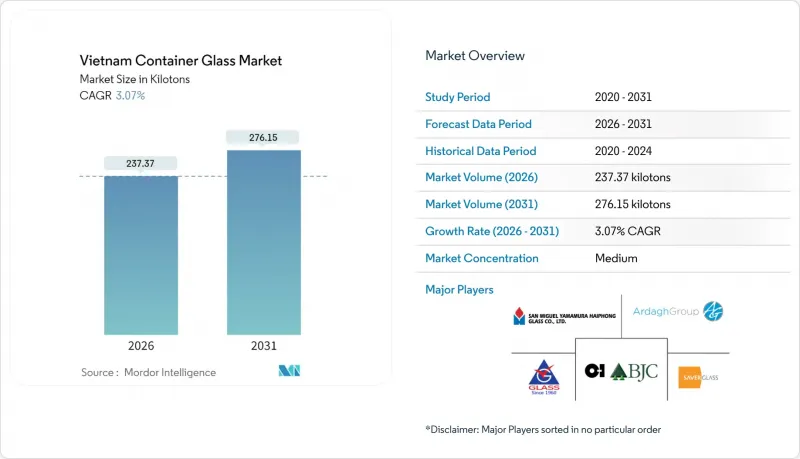
2025年越南容器玻璃市场价值为230.30千吨,预计2031年将达到276.15千吨,高于2026年的237.37千吨。
预计在预测期(2026-2031 年)内,复合年增长率将达到 3.07%。
人口稳定成长、可支配收入增加以及越南作为区域出口枢纽的地位支撑了市场需求,而对永续包装的监管支持则增强了长期前景。预计到2024年,製造业的外国直接投资(FDI)将达到255.8亿美元,这将推动熔炉升级以提高效率和产能。饮料、化妆品和製药业的优质化趋势促使品牌所有者更倾向于使用玻璃而非塑料,因为他们追求更优异的阻隔性能和更高端的货架形象。儘管电价上涨和再生宝特瓶(rPET)的替代正在减缓市场成长势头,但越南修订后的《药品管理法》(将于2025年7月生效)中包含的优惠政策正在推动对琥珀色和I型药用玻璃的特殊需求。建立覆盖全国的废玻璃回收网路对于脱碳和成本控制仍然至关重要,对回收基础设施的投资已被列为战略重点。
越南玻璃容器市场趋势与洞察
ESG主导的出口包装转变
国际买家,主要来自欧洲和北美,对高端食品和饮料进口包装的可回收要求日益增长,迫使越南出口商从塑胶包装转向玻璃包装。咖啡、茶叶和特色食品生产商表示,采用玻璃包装可获得15-20%的价格溢价,推动了越南玻璃容器市场的发展。玻璃包装也有助于提升原产地品牌形象,并降低与环境标准相关的贸易政策风险。从越南采购的跨国公司正在供应商合约中加入严格的永续性条款,从而确保越南国内玻璃製造商的稳定销售。这种转变在主要出口港口附近尤其明显。中期来看,预期环境、社会和治理(ESG)合规将推动出口导向需求以0.8%的复合年增长率成长。
外商直接主导的炉窑升级与产能扩张
2024年,将有255.8亿美元的製造业外商直接投资流入越南,透过合资企业促进技术向越南玻璃容器市场的转移。引进的富氧燃烧炉与传统设备相比,可减少约18%的二氧化碳排放。位于平阳省和海防省的新生产线将降低燃料消耗,提高着色柔软性,使生产商能够在不影响生产线效率的前提下,扩大高利润琥珀色玻璃的生产。这项多年投资计划,加上越南工业园区的扩建,将确保玻璃级碱灰和耐火材料的进口需求稳定。从长远来看,现代化生产能力的扩张将提高国内供应的韧性,并降低对进口药品瓶灌装的依赖。
电力成本上涨和电网不稳定
2024年10月,越南平均零售电费达到每度电2103.11越南盾,尖峰时段3,640越南盾。能源成本约占玻璃生产成本的23%,因此价格上涨会挤压利润空间,并抑制熔炉维修。停电会促使企业投资柴油发电设施,但也会因批次温度降低而导致更高的废品率。政府计划将2025年360亿美元基础设施预算的80%以上用于发电和输电项目,以稳定电力供应。然而,短期波动预计将使预期复合年增长率下降0.6个百分点。
细分市场分析
预计到2025年,饮料业将以60.74%的市场份额引领越南玻璃容器市场,并在2031年之前保持销量主导地位,这主要得益于国内啤酒产量的扩大和出口型烈酒装瓶商数量的增加。玻璃瓶仍然是高端拉格啤酒和精酿啤酒品牌的首选,这得益于成熟的可回收瓶系统,该系统降低了单位填充成本。化妆品和个人护理品行业虽然销售小规模,但预计将成为成长最快的品类,复合年增长率达3.52%,这反映了消费者可支配收入的增加和电子商务的日益普及。高所得消费者将玻璃容器与产品纯度连结起来,这使得中端本土品牌能够在不牺牲利润率的情况下提升包装等级。药品玻璃的需求受益于修订后的《药品法》推动的国内灌装和包装生产线的建立,从而确保了对ISO认证管瓶的稳定需求。调味品和蜂蜜等食品应用领域也呈现稳定成长,这主要得益于对日本和韩国的出口需求。同时,儘管产量不高,但作为最高端的细分市场,香水的单位盈利最高。
从绝对数量来看,预计2026年至2031年间,饮料业将成为越南玻璃容器市场吨位成长最大的产业。同时,由于增值装饰加工、小批量生产以及高端护肤品所需的厚壁规格,化妆品行业的利润率预计将有所提高。医药玻璃受到严格的监管标准约束,这些标准构成了准入壁垒,限制了竞争,从而支撑了其特殊的溢价。因此,均衡的终端使用者结构将增强生产商的抗风险能力,并减轻因大宗商品价格波动和饮料季节性週期造成的收入波动。
越南玻璃容器市场报告按最终用户(饮料[含酒精饮料(啤酒、葡萄酒、烈酒、其他酒精饮料)、非酒精饮料(碳酸饮料、乳製品饮料等)]、食品[果酱和果冻、调味品和酱料等]、化妆品和个人护理等)和颜色(无色、琥珀色、绿色等)进行细分。市场预测以千吨为单位。
其他福利:
- Excel格式的市场预测(ME)表
- 3个月的分析师支持
目录
第一章 引言
- 研究假设和市场定义
- 调查范围
第二章调查方法
第三章执行摘要
第四章 市场情势
- 市场概览
- 市场驱动因素
- 出口包装的ESG主导转型
- 外商主导的炉窑升级与产能扩张
- 扩大製药生产
- 快速成长的化妆品和个人护理行业
- 政府针对一次性塑胶製品的倡议
- 酒精饮料产量迅速成长
- 市场限制
- 电力成本上涨和电网不稳定
- 替代压力用于rPET瓶
- 玻璃屑收集基础设施的漏洞
- 物流和损失挑战
- PESTEL 分析
- 产业供应链分析
- 越南容器玻璃熔炉的生产能力和位置
- 工厂选址及投产
- 生产能力
- 炉型
- 所产玻璃的颜色
- 货柜玻璃进出口资料 - 主要进出口目的地
- 进口量及进口额(2021-2024 年)
- 出口量和出口额(2021-2024 年)
- 波特五力分析
- 新进入者的威胁
- 供应商的议价能力
- 买方的议价能力
- 替代品的威胁
- 竞争对手之间的竞争
- 原料分析
- 玻璃包装的回收趋势
- 玻璃包装需求与供给分析
第五章 市场规模与成长预测
- 最终用户
- 饮料
- 酒精饮料
- 啤酒
- 葡萄酒
- 烈酒
- 其他酒精饮料(苹果酒和其他发酵饮料)
- 非酒精性
- 果汁
- 碳酸软性饮料(CSD)
- 乳製品饮料
- 其他非酒精饮料
- 酒精饮料
- 食品(果酱、果冻、橘子酱、蜂蜜、香肠和调味品、食用油、腌菜)
- 化妆品和个人护理
- 药品(不含管瓶和安瓿瓶)
- 香水
- 饮料
- 按颜色
- 绿色的
- 琥珀色
- 无色透明
- 其他颜色
第六章 竞争情势
- 市场集中度
- 策略趋势与发展
- 公司市占率分析(基于当前产能)
- 公司简介
- OI BJC Vietnam Glass Company Limited
- San Miguel Yamamura Hai Phong Glass Co., Ltd.
- Thuduc Glass Bottle Joint Stock Company
- Bao Minh Glass Joint Stock Company
- San Miguel Yamamura Phu Tho Packaging Co., Ltd.
- Saverglass SAS
- Verallia Packaging SAS
- Ardagh Group SA
- Go Vap Glass
- Bormioli Rocco
第七章 市场机会与未来展望
The Vietnam container glass market was valued at 230.30 kilotons in 2025 and estimated to grow from 237.37 kilotons in 2026 to reach 276.15 kilotons by 2031, at a CAGR of 3.07% during the forecast period (2026-2031).
Steady population growth, rising disposable incomes, and Vietnam's position as a regional export base underpin demand, while regulatory support for sustainable packaging reinforces long-term prospects. Foreign direct investment (FDI) into manufacturing, worth USD 25.58 billion in 2024, is catalyzing furnace upgrades that improve efficiency and capacity. Premiumization trends in beverages, cosmetics, and pharmaceuticals favor glass over plastic as brand owners seek superior barrier properties and a premium shelf image. Electricity price escalation and rPET substitution temper momentum, yet incentives embedded in Vietnam's amended Law on Pharmacy, effective July 2025, expand specialized demand for amber and Type I pharmaceutical glass. Building a nationwide cullet collection network remains vital for decarbonization and cost control, positioning recycling infrastructure investment as a strategic priority.
Vietnam Container Glass Market Trends and Insights
ESG-Driven Export Packaging Shift
International buyers, especially in Europe and North America, increasingly require recyclable packaging for premium food and beverage imports, prompting Vietnam's exporters to switch from plastic to glass. Coffee, tea, and specialty food producers report 15-20% price premiums when adopting glass, bolstering the Vietnam container glass market. Glass also supports origin branding efforts and mitigates trade-policy risks related to environmental standards. Multinational corporations sourcing from Vietnam embed strict sustainability clauses in supplier contracts, ensuring a stable offtake for domestic glass producers. This shift intensifies near major ports where export consolidation occurs. Over the medium term, ESG compliance is expected to lift export-oriented demand by an incremental 0.8% of the forecast CAGR.
FDI-Driven Furnace Upgrades and Capacity Additions
USD 25.58 billion in manufacturing FDI in 2024 channels technology transfer into the Vietnam container glass market through joint ventures that deploy oxy-combustion furnaces able to trim CO2 emissions by about 18% versus legacy units. New lines in Binh Duong and Hai Phong cut fuel consumption and widen color flexibility, letting producers chase higher-margin amber batches without compromising line efficiency. Multi-year investment schedules align with Vietnam's industrial-park expansion, guaranteeing steady glass-grade soda ash imports and furnace-refractory demand. Over the long term, modern capacity raises domestic supply resilience and limits import reliance on bottles for pharmaceutical filling operations.
Electricity Cost Inflation and Grid Instability
Average retail electricity tariffs hit VND 2,103.11 per kWh in October 2024, with peak-hour rates soaring to VND 3,640 per kWh. Energy accounts for roughly 23% of glass production cost, so spikes compress margins and deter furnace rebuilds. Grid outages drive investment in diesel backup and elevate scrap rates when batch temperatures fall. The government plans to allocate over 80% of a USD 36 billion 2025 infrastructure budget to power generation and transmission, aiming to stabilize supply. Still, near-term volatility subtracts 0.6 percentage points from expected CAGR.
Other drivers and restraints analyzed in the detailed report include:
- Pharmaceutical Manufacturing Expansion
- Booming Cosmetics and Personal Care Sector
- rPET Bottle Substitution Pressure
For complete list of drivers and restraints, kindly check the Table Of Contents.
Segment Analysis
The beverages segment dominated the Vietnam container glass market with 60.74% market share in 2025 and is expected to maintain volume leadership through 2031 as domestic beer output scales and export-oriented spirits bottlers expand. Glass bottles remain preferred for premium lager and craft beer branding, supported by established returnable bottle systems that reduce per-fill cost. Cosmetics and personal care, though smaller in tonnage, are projected as the fastest-growing category at a 3.52% CAGR, reflecting rising disposable incomes and e-commerce penetration. High-spend consumers link glass with product purity, enabling mid-sized local brands to trade up packaging without sacrificing margin. Pharmaceutical glass demand benefits from new domestic fill-finish lines encouraged by the amended pharmacy law, ensuring consistent offtake for ISO-certified vials. Food applications such as condiments and honey experience stable growth, powered by export demand to Japan and South Korea, while perfumery, the most premium niche, commands the highest unit revenue despite modest volumes.
In absolute terms, beverages are forecast to add the largest incremental tonnage to the Vietnam container glass market size over 2026-2031. Cosmetics, however, deliver margin upside through value-added decoration, smaller batch runs, and thicker-wall specifications favored by luxury skincare. Pharmaceutical glass's stringent regulatory standards set a high barrier to entry, limiting competition and supporting specialized price premiums. A balanced end-user portfolio, therefore, enhances producer resilience, smoothing revenue against commodity price swings and seasonal beverage cycles.
The Vietnam Container Glass Market Report is Segmented by End-User (Beverages [Alcoholic {Beer, Wine, Spirits, Other Alcoholic Beverages}, and Non-Alcoholic {Carbonated Drinks (CSDs), Dairy Product Based Drinks, and More}], Food [Jam and Jelly, Condiments and Sauces, and More], Cosmetics and Personal Care, and More), Color (Flint, Amber, Green, and More). The Market Forecasts are Provided in Terms of Volume (Kilotons).
List of Companies Covered in this Report:
- O-I BJC Vietnam Glass Company Limited
- San Miguel Yamamura Hai Phong Glass Co., Ltd.
- Thuduc Glass Bottle Joint Stock Company
- Bao Minh Glass Joint Stock Company
- San Miguel Yamamura Phu Tho Packaging Co., Ltd.
- Saverglass SAS
- Verallia Packaging SAS
- Ardagh Group S.A.
- Go Vap Glass
- Bormioli Rocco
Additional Benefits:
- The market estimate (ME) sheet in Excel format
- 3 months of analyst support
TABLE OF CONTENTS
1 INTRODUCTION
- 1.1 Study Assumptions and Market Definition
- 1.2 Scope of the Study
2 RESEARCH METHODOLOGY
3 EXECUTIVE SUMMARY
4 MARKET LANDSCAPE
- 4.1 Market Overview
- 4.2 Market Drivers
- 4.2.1 ESG-Driven Export Packaging Shift
- 4.2.2 FDI-Driven Furnace Upgrades and Capacity Additions
- 4.2.3 Pharmaceutical Manufacturing Expansion
- 4.2.4 Booming Cosmetics and Personal Care Sector
- 4.2.5 Government Push Against Single-Use Plastics
- 4.2.6 Surging Alcoholic Beverage Output
- 4.3 Market Restraints
- 4.3.1 Electricity Cost Inflation and Grid Instability
- 4.3.2 rPET Bottle Substitution Pressure
- 4.3.3 Weak Cullet Collection Infrastructure
- 4.3.4 Logistics and Breakage Challenges
- 4.4 PESTEL Analysis
- 4.5 Industry Supply-Chain Analysis
- 4.6 Container Glass Furnace Capacity and Locations in Vietnam
- 4.6.1 Plant Locations and Year of Commencement
- 4.6.2 Production Capacities
- 4.6.3 Types of Furnaces
- 4.6.4 Color of Glass Produced
- 4.7 Export-Import Data of Container Glass - Covering Key Import and Export Destinations
- 4.7.1 Import Volume and Value, 2021-2024
- 4.7.2 Export Volume and Value, 2021-2024
- 4.8 Porter's Five Forces Analysis
- 4.8.1 Threat of New Entrants
- 4.8.2 Bargaining Power of Suppliers
- 4.8.3 Bargaining Power of Buyers
- 4.8.4 Threat of Substitutes
- 4.8.5 Competitive Rivalry
- 4.9 Raw Material Analysis
- 4.10 Recycling Trends for Glass Packaging
- 4.11 Demand vs Supply Analysis for Glass Packaging
5 MARKET SIZE AND GROWTH FORECASTS (VOLUME)
- 5.1 By End-user
- 5.1.1 Beverages
- 5.1.1.1 Alcoholic
- 5.1.1.1.1 Beer
- 5.1.1.1.2 Wine
- 5.1.1.1.3 Spirits
- 5.1.1.1.4 Other Alcoholic Beverages (Cider and Other Fermented Drinks)
- 5.1.1.2 Non-Alcoholic
- 5.1.1.2.1 Juices
- 5.1.1.2.2 Carbonated Drinks (CSDs)
- 5.1.1.2.3 Dairy Product Based Drinks
- 5.1.1.2.4 Other Non-Alcoholic Beverages
- 5.1.1.1 Alcoholic
- 5.1.2 Food (Jam, Jelly, Marmalades, Honey, Sausages and Condiments, Oil, Pickles)
- 5.1.3 Cosmetics and Personal Care
- 5.1.4 Pharmaceuticals (excluding Vials and Ampoules)
- 5.1.5 Perfumery
- 5.1.1 Beverages
- 5.2 By Color
- 5.2.1 Green
- 5.2.2 Amber
- 5.2.3 Flint
- 5.2.4 Other Colors
6 COMPETITIVE LANDSCAPE
- 6.1 Market Concentration
- 6.2 Strategic Moves and Developments
- 6.3 Company Market Share Analysis, (Based on Latest Production Capacity)
- 6.4 Company Profiles (includes Global level Overview, Market level overview, Core Segments, Financials as available, Strategic Information, Market Rank/Share for key companies, Products and Services, and Recent Developments)
- 6.4.1 O-I BJC Vietnam Glass Company Limited
- 6.4.2 San Miguel Yamamura Hai Phong Glass Co., Ltd.
- 6.4.3 Thuduc Glass Bottle Joint Stock Company
- 6.4.4 Bao Minh Glass Joint Stock Company
- 6.4.5 San Miguel Yamamura Phu Tho Packaging Co., Ltd.
- 6.4.6 Saverglass SAS
- 6.4.7 Verallia Packaging SAS
- 6.4.8 Ardagh Group S.A.
- 6.4.9 Go Vap Glass
- 6.4.10 Bormioli Rocco
7 MARKET OPPORTUNITIES AND FUTURE OUTLOOK
- 7.1 White-space and Unmet-Need Assessment

 玻璃器皿容器市场:2026-2032年全球市场预测(依产品类型、材料、製造流程、容量范围、容器形状和最终用途划分)玻璃瓶市场:依材质、颜色、容量、应用及通路划分-2026-2032年全球市场预测
 酒精饮料瓶市场规模、份额和成长分析:按形状、容量、材质、应用和地区划分-2026-2033年产业预测
 全球保温瓶市场规模、份额、成长率、按类型和应用分類的全球产业分析、区域趋势以及 2026-2034 年预测。
 德国容器玻璃:市场占有率分析、产业趋势与统计、成长预测(2026-2031)2026-2034年全球容器玻璃市场规模、份额、趋势和成长分析报告
 日本玻璃容器市场规模、份额、趋势和预测:按产品、最终用途行业和地区划分,2026-2034年
 2026年全球容器玻璃市场报告2026年全球运动水壶市场报告
 容器玻璃市场 - 全球产业规模、份额、趋势、机会及预测(按玻璃类型、容器类型、成型方法、终端用户产业、地区和竞争格局划分,2021-2031年)