


 |
市场调查报告书
商品编码
1940834
控释肥料(CRF):市占率分析、产业趋势与统计、成长预测(2026-2031)Controlled Release Fertilizers - Market Share Analysis, Industry Trends & Statistics, Growth Forecasts (2026 - 2031) |
||||||

※ 本网页内容可能与最新版本有所差异。详细情况请与我们联繫。
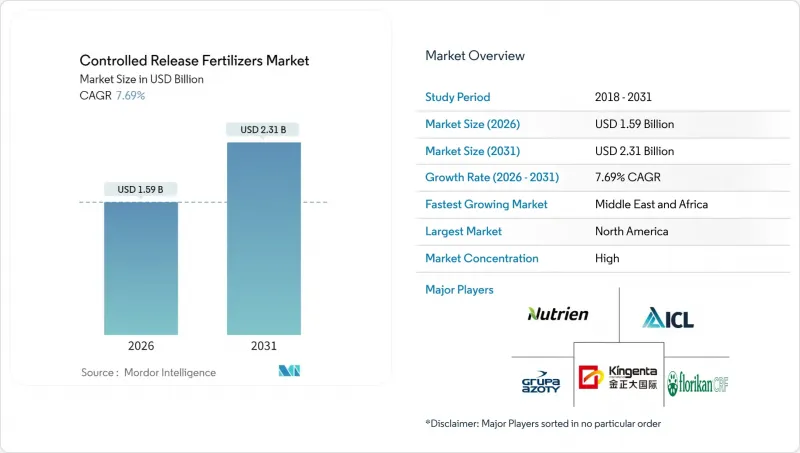
预计到 2026 年,控释肥料(CRF) 市场价值将达到 15.9 亿美元,从 2025 年的 14.8 亿美元成长到 2031 年的 23.1 亿美元。
预计2026年至2031年年复合成长率(CAGR)为7.69%。
精准养分管理策略的推广应用,旨在提高产量、减少养分流失并满足日益严格的环境法规要求。聚合物涂层技术正在引领技术发展趋势,而数位农业平台则透过将即时土壤数据与客製化的养分释放方案相结合,创造新的价值。区域性水资源短缺促使农民转向更有效率的养分利用产品,而政府奖励措施则加速了大规模农地种植者对这些产品的采用。目前市场竞争程度适中,这为开发可生物降解涂层和数据驱动决策工具的创新者留下了发展空间。
全球控释肥料(CRF)市场趋势及洞察
与精密农业技术的融合
可变施肥装置将控释肥料与即时土壤养分图同步,使农民能够根据田间微环境调整肥料包膜厚度和释放曲线。这种整合减少了过度施肥和施肥不足的情况,提高了养分利用效率,并延长了产品的使用寿命。设备製造商将农艺建议与地理空间分析相结合,使控释肥料市场参与企业融入更广泛的数位生态系统。大型农场可以透过节省劳动力和遵守环保法规来获得积分,从而形成良性循环,稳步扩大基本客群。
环境法规和永续性要求正在重塑标准。
欧洲「从农场到餐桌」策略已将控释肥料列为优先投入品,以实现超过80%的氮肥利用率。 2024年生物降解条款催生了一个价值2亿美元的利基市场,该市场专注于可在12-18个月内安全分解的涂层肥料。这一趋势目前也影响着北美和新兴亚洲地区的标籤检视。监管合规奖励,例如放宽缓衝区要求,降低了控释肥料的总拥有成本,使其低于传统肥料。因此,控释肥料(CRF)市场与评估可衡量永续性成果的政策架构日益契合。
高昂的生产成本和价格溢价是广泛采用的障碍。
聚合物包膜性肥料的售价通常是传统肥料的两到三倍,而包膜树脂的价格与波动剧烈的石油原料价格密切相关,预计2024年石油原料价格将波动15%至25%。利润微薄的小规模农户往往不愿采用化肥,即使化肥承诺能带来终身成本节约。生产商正在建立社区混合化肥厂以降低物流成本,并引入「按英亩收费」的服务模式以降低前期成本。随着规模经济的成熟,这些措施或许有助于消除使用障碍。
细分市场分析
截至2025年,聚合物包膜产品将占据控释肥料( CRF)市场75.92%的份额,成为市场规模成长的主要驱动力,并将在2031年之前以7.84%的复合年增长率持续成长。其受欢迎程度源自于其精准的养分释放动态,能够与变数施肥设备无缝衔接。持续的研究已成功实现了在不影响耐久性的前提下降低包膜厚度,从而提高了成本效益和田间作业效果。可在18个月内分解的生物降解型产品现已符合欧盟标准,为此前因担心聚合物残留而犹豫不决的新客户群打开了市场。
聚合物-硫混合物在一些对硫养分持续供应尤为重要的特定领域中发挥作用,尤其是在面临土壤硫流失的油籽产区。这种混合物能够同步输送主要和次要养分,从而减少施肥频率。蜡和树脂包覆在註重性价比的管道中持续得到应用,在这些管道中,预算限制比精准施肥更为重要。这些产品类别共同丰富了产品组合,帮助供应商应对不同地区的农业实际情况。
控释肥料(CRF)市场报告按包膜类型(聚合物包膜、聚合物硫包膜及其他)、作物类型(田间作物、园艺作物、草坪及观赏植物)和地区(亚太地区、欧洲、中东和非洲、北美、南美)进行细分。市场预测以价值(美元)和数量(公吨)为单位。
区域分析
2025年,北美将占据控释肥料(CRF)市场40.86%的份额,这得益于先进的精密农业基础设施和监管成本分摊计划,这些计划对高效利用养分的投入品进行补贴。在美国,生产商受益于美国环保署(EPA)的流域指南,该指南将控释产品归类为最佳管理实务(BMP),符合合规积分的条件。在加拿大,永续农业倡议(SAI)已承诺投入1.5亿加元(约1.11亿美元)用于促进传统农地的转型,加速草原谷物带和园艺产业丛集地区的推广应用。
受水资源短缺导致低径流产品需求增加的推动,中东和非洲市场预计将以7.97%的复合年增长率快速成长至2031年。然而,价格高度敏感和缺乏咨询网络对即时销售扩张构成挑战。在拉丁美洲,大规模甘蔗和柑橘种植园正在创造新的机会,区域经销商正透过增加控释肥料(CRF)产品线来拓展产品系列。
亚太地区正经历显着成长,这主要得益于中国23亿美元的精密农业奖励策略以及印度为提升粮食安全而对养分利用效率的重视。该地区各国政府的措施包括设备融资方案、对农业工程师的支持、控释肥料(CRF)折扣以及示范田的建设,以鼓励推广应用。欧洲控释肥料(CRF)市场更着重与欧洲绿色交易保持一致,而非追求销售扩张。通用农业政策(CAP)的生态计画支付机制可报销高达70%的额外成本,用于减少经证实有效的养分流失,从而有效抵消了许多耕地农场的溢价。
其他福利:
- Excel格式的市场预测(ME)表
- 3个月的分析师支持
目录
第一章 引言
- 研究假设和市场定义
- 调查范围
- 调查方法
第二章 报告
第三章执行摘要和主要发现
第四章:主要产业趋势
- 主要农作物种植面积
- 田间作物
- 园艺作物
- 平均施肥量
- 宏量营养素
- 田间作物
- 园艺作物
- 宏量营养素
- 法律规范
- 价值炼和通路分析
- 市场驱动因素
- 与精密农业技术的融合
- 环境法规与永续性义务
- 水资源短缺与灌溉效率
- 降低人力成本并简化申请流程
- 气候变迁调适与作物抗逆性
- 粮食安全与生产力优化
- 市场限制
- 高生产成本和价格溢价
- 农民缺乏意识和技术差距
- 由于担心涂层颗粒剥落,正在游说要求实现涂层可追溯性。
- 通货膨胀导致聚合物成本飙升,对缓释肥生产商的利润率带来压力。
第五章 市场规模及成长预测(价值及数量)
- 涂层类型
- 聚合物涂层
- 聚合物和硫涂层
- 其他的
- 作物类型
- 田间作物
- 园艺作物
- 草坪和观赏植物
- 地区
- 亚太地区
- 澳洲
- 孟加拉
- 中国
- 印度
- 印尼
- 日本
- 巴基斯坦
- 菲律宾
- 泰国
- 越南
- 亚太其他地区
- 欧洲
- 法国
- 德国
- 义大利
- 荷兰
- 俄罗斯
- 西班牙
- 乌克兰
- 英国
- 其他欧洲地区
- 中东和非洲
- 奈及利亚
- 沙乌地阿拉伯
- 南非
- 土耳其
- 其他中东和非洲地区
- 北美洲
- 加拿大
- 墨西哥
- 我们
- 北美其他地区
- 南美洲
- 阿根廷
- 巴西
- 南美洲其他地区
- 亚太地区
第六章 竞争情势
- 关键策略倡议
- 市占率分析
- 公司概况
- 公司简介。
- Ekompany International BV(DeltaChem)
- Grupa Azoty SA(Compo Expert)
- Haifa Group
- ICL Group Ltd
- Mivena BV
- Nutrien Ltd.
- Kingenta Ecological Engineering Group Co., Ltd.
- New Mountain Capital(Florikan)
第七章:CEO们需要思考的关键策略问题
The controlled release fertilizers market size in 2026 is estimated at USD 1.59 billion, growing from 2025 value of USD 1.48 billion with 2031 projections showing USD 2.31 billion, growing at 7.69% CAGR over 2026-2031.
Adoption rides on precision nutrient management strategies that improve yield, curb nutrient loss, and align with tightening environmental regulations. Polymer-based coatings shape the technology landscape, while digital farming platforms create new value by linking real-time soil data with customized nutrient release schedules. Regional water scarcity pushes growers toward nutrient-efficient products, and government incentives accelerate uptake among large field-crop operations. Competitive intensity remains moderate, leaving room for innovators developing biodegradable coatings and data-driven decision tools.
Global Controlled Release Fertilizers Market Trends and Insights
Precision Agriculture Technology Integration
Variable-rate applicators now synchronize controlled release fertilizers with real-time soil nutrient maps, allowing growers to match coating thickness and release curves to micro-field conditions. Such orchestration reduces over- or under-fertilization events, boosts nutrient use efficiency, and extends product life cycles. Equipment makers bundle agronomic advisory and geospatial analytics, positioning controlled release fertilizers market participants in a broader digital ecosystem. Larger farms capture labor savings and environmental compliance credits, creating a reinforcing adoption loop that steadily expands the customer base.
Environmental Regulations and Sustainability Mandates Reshape Standards
Europe's Farm to Fork Strategy classifies controlled release products as preferred inputs for achieving nitrogen use-efficiency benchmarks above 80%. The 2024 biodegradability clause spurred a USD 200 million niche for coatings that safely decompose within 12-18 months, a trend now influencing labels in North America and emerging Asia. Compliance incentives, such as reduced buffer-zone requirements, lower the total cost of ownership relative to conventional fertilizers. Consequently, the controlled release fertilizers market is increasingly entwined with policy frameworks that reward measurable sustainability outcomes.
High Production Costs and Price Premium Barriers Constrain Penetration
Polymer-coated fertilizers typically sell at two to three times the price of conventional products, and coating resins track volatile petroleum input costs that swung 15-25% in 2024. Smallholders operating on tight margins hesitate to adopt even when lifetime savings appear favorable. Producers respond with localized blending plants to cut logistics costs and with pay-per-acre service models to alleviate upfront expenditure. These moves could soften the restraint once economies of scale mature.
Other drivers and restraints analyzed in the detailed report include:
- Water Scarcity and Irrigation Efficiency Requirements Accelerate Adoption
- Labor Cost Reduction and Application Convenience Transform Farm Operations
- Limited Farmer Awareness and Technical Knowledge Gaps Impede Adoption
For complete list of drivers and restraints, kindly check the Table Of Contents.
Segment Analysis
Polymer-coated products held 75.92% of the controlled release fertilizer market share in 2025 and contributed the bulk of the controlled release fertilizer market size growth, progressing at a 7.84% CAGR through 2031. Their popularity stems from precise nutrient-release kinetics that integrate seamlessly with variable-rate applicators. Continuous research is lowering coating thickness without compromising durability, improving cost ratios, and field performance. Biodegradable variants that decompose within 18 months now meet European Union standards, bringing new customer segments that formerly resisted polymer accumulation concerns.
Polymer-sulfur hybrids play a niche role where extended sulfur nutrition is critical, particularly in oilseed belts facing soil sulfur depletion. The combination lowers input counts by co-delivering macro- and secondary nutrients over synchronized timelines. Wax and resin coatings remain in value-oriented channels where tight budgets override the need for high-precision release. These categories together provide portfolio breadth that helps suppliers address diverse regional agronomic realities.
The Controlled Release Fertilizers Market Report is Segmented by Coating Type (Polymer Coated, Polymer-Sulfur Coated, and Others), Crop Type (Field Crops, Horticultural Crops, and Turf and Ornamental), and Geography (Asia-Pacific, Europe, The Middle East and Africa, North America, and South America). The Market Forecasts are Provided in Terms of Value (USD) and Volume (Metric Tons).
Geography Analysis
North America accounted for a 40.86% share of the controlled release fertilizers market in 2025, supported by advanced precision agriculture infrastructure and regulatory cost-share programs that subsidize nutrient-efficient inputs. In the United States, growers benefit from Environmental Protection Agency (EPA) watershed guidelines, which classify controlled release products as best-management practices eligible for compliance credits. In Canada, the Sustainable Agriculture Initiative allocated CAD 150 million (USD 111 million) to facilitate the conversion of conventional acres, accelerating adoption in prairie grain belts and horticultural clusters.
The Middle East and Africa markets are projected to grow at a fastest CAGR of 7.97% through 2031, driven by water scarcity, which increases interest in low-leach products. However, price sensitivity and limited advisory networks pose challenges to immediate volume growth. Latin America's large sugarcane and citrus holdings present emerging opportunities as regional distributors expand their portfolios by adding controlled release fertilizers lines.
The Asia-Pacific region is experiencing significant growth, driven by China's USD 2.3 billion precision agriculture stimulus and India's focus on nutrient-use efficiency to enhance national food security. Government initiatives in the region include bundling equipment loans, agronomist support, and discounts on controlled release fertilizers, which create demonstration plots to accelerate adoption. Europe's controlled release fertilizers market emphasizes compliance with the European Green Deal rather than volumetric expansion. Eco-scheme payments under the Common Agricultural Policy now reimburse up to 70% of incremental costs for proven nutrient-loss reductions, effectively offsetting the price premium for many arable farms.
- Ekompany International BV (DeltaChem)
- Grupa Azoty S.A. (Compo Expert)
- Haifa Group
- ICL Group Ltd
- Mivena BV
- Nutrien Ltd.
- Kingenta Ecological Engineering Group Co., Ltd.
- New Mountain Capital (Florikan)
Additional Benefits:
- The market estimate (ME) sheet in Excel format
- 3 months of analyst support
TABLE OF CONTENTS
1 INTRODUCTION
- 1.1 Study Assumptions & Market Definition
- 1.2 Scope of the Study
- 1.3 Research Methodology
2 REPORT OFFERS
3 EXECUTIVE SUMMARY AND KEY FINDINGS
4 KEY INDUSTRY TRENDS
- 4.1 Acreage Of Major Crop Types
- 4.1.1 Field Crops
- 4.1.2 Horticultural Crops
- 4.2 Average Nutrient Application Rates
- 4.2.1 Primary Nutrients
- 4.2.1.1 Field Crops
- 4.2.1.2 Horticultural Crops
- 4.2.1 Primary Nutrients
- 4.3 Regulatory Framework
- 4.4 Value Chain & Distribution Channel Analysis
- 4.5 Market Drivers
- 4.5.1 Precision agriculture technology integration
- 4.5.2 Environmental regulations and sustainability mandates
- 4.5.3 Water scarcity and irrigation efficiency
- 4.5.4 Labor cost reduction and application convenience
- 4.5.5 Climate change adaptation and crop resilience
- 4.5.6 Food security and productivity optimization
- 4.6 Market Restraints
- 4.6.1 High production costs and price premium
- 4.6.2 Limited farmer awareness and technical gaps
- 4.6.3 Microparticle-shedding concerns triggering lobbying for coating traceability
- 4.6.4 Inflation-driven polymer cost spikes squeezing CRF producer margins
5 MARKET SIZE AND GROWTH FORECASTS (VALUE AND VOLUME)
- 5.1 Coating Type
- 5.1.1 Polymer Coated
- 5.1.2 Polymer-Sulfur Coated
- 5.1.3 Others
- 5.2 Crop Type
- 5.2.1 Field Crops
- 5.2.2 Horticultural Crops
- 5.2.3 Turf & Ornamental
- 5.3 Region
- 5.3.1 Asia-Pacific
- 5.3.1.1 Australia
- 5.3.1.2 Bangladesh
- 5.3.1.3 China
- 5.3.1.4 India
- 5.3.1.5 Indonesia
- 5.3.1.6 Japan
- 5.3.1.7 Pakistan
- 5.3.1.8 Philippines
- 5.3.1.9 Thailand
- 5.3.1.10 Vietnam
- 5.3.1.11 Rest of Asia-Pacific
- 5.3.2 Europe
- 5.3.2.1 France
- 5.3.2.2 Germany
- 5.3.2.3 Italy
- 5.3.2.4 Netherlands
- 5.3.2.5 Russia
- 5.3.2.6 Spain
- 5.3.2.7 Ukraine
- 5.3.2.8 United Kingdom
- 5.3.2.9 Rest of Europe
- 5.3.3 Middle East & Africa
- 5.3.3.1 Nigeria
- 5.3.3.2 Saudi Arabia
- 5.3.3.3 South Africa
- 5.3.3.4 Turkey
- 5.3.3.5 Rest of Middle East & Africa
- 5.3.4 North America
- 5.3.4.1 Canada
- 5.3.4.2 Mexico
- 5.3.4.3 United States
- 5.3.4.4 Rest of North America
- 5.3.5 South America
- 5.3.5.1 Argentina
- 5.3.5.2 Brazil
- 5.3.5.3 Rest of South America
- 5.3.1 Asia-Pacific
6 COMPETITIVE LANDSCAPE
- 6.1 Key Strategic Moves
- 6.2 Market Share Analysis
- 6.3 Company Landscape
- 6.4 Company Profiles (Includes Global Level Overview, Market Level Overview, Core Business Segments, Financials, Headcount, Key Information, Market Rank, Market Share, Products and Services, and Analysis of Recent Developments).
- 6.4.1 Ekompany International BV (DeltaChem)
- 6.4.2 Grupa Azoty S.A. (Compo Expert)
- 6.4.3 Haifa Group
- 6.4.4 ICL Group Ltd
- 6.4.5 Mivena BV
- 6.4.6 Nutrien Ltd.
- 6.4.7 Kingenta Ecological Engineering Group Co., Ltd.
- 6.4.8 New Mountain Capital (Florikan)
7 KEY STRATEGIC QUESTIONS FOR FERTILIZER CEOS

 全球种子与肥料处理市场(2025-2032 年)
 2026年全球缓释肥料市场报告控释肥料市场-2026-2031年预测
 非农业用控制释放肥料颗粒市场(依配方类型、养分机制、成分、应用、最终用户和通路划分),全球预测(2026-2032年)
 缓释性肥料市场规模、份额及成长分析(按类型、应用方法、最终用途及地区划分)-2026-2033年产业预测
 控释肥料市场-全球产业规模、份额、趋势、机会和预测,按类型、最终用途、应用方式、地区和竞争格局划分,2020-2030年预测
 全球控释肥料(CRF)市场按类型、功能、产品等级、应用方法、最终用途和地区划分-预测至2030年包衣肥料市场-全球产业规模、份额、趋势、机会和预测(按类型、作物类型、地区和竞争情况划分,2020-2030 年)控制释放液态氮市场按产品类型、包衣类型、形态、释放机制、施用方法、作物类型、最终用户和分销管道划分 - 全球预测 2025-2030
 全球硝化抑制剂及尿素酶抑制剂市场分析及预测(至2032年):依产品类型、营养类型、作物类型、施用方法、通路、最终用户及地区划分