


 |
市场调查报告书
商品编码
1940856
亚太地区混凝土外加剂:市场占有率分析、产业趋势与统计、成长预测(2026-2031)Asia-Pacific Concrete Admixtures - Market Share Analysis, Industry Trends & Statistics, Growth Forecasts (2026 - 2031) |
||||||

※ 本网页内容可能与最新版本有所差异。详细情况请与我们联繫。
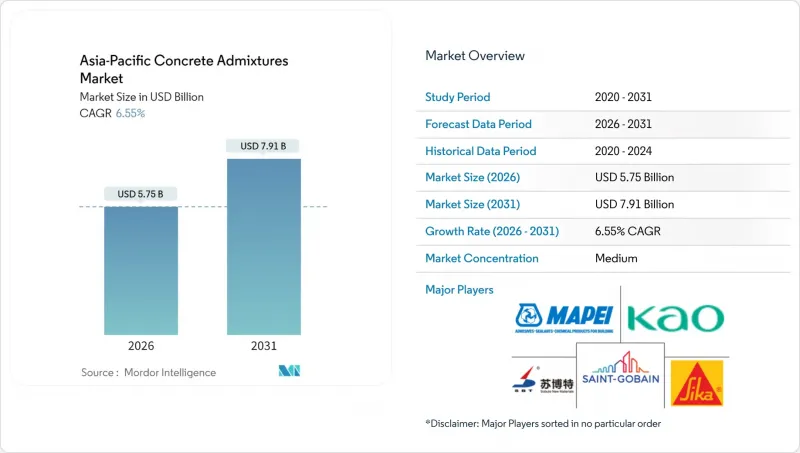
亚太地区混凝土外加剂市场预计将从 2025 年的 54 亿美元成长到 2026 年的 57.5 亿美元,预计到 2031 年将达到 79.1 亿美元,2026 年至 2031 年的复合年增长率为 6.55%。
政府在交通、能源和城市改造领域的持续投入,预拌混凝土和预製系统的快速普及,以及地震带和沿海地区耐久性标准的提高,目前都在支撑市场需求。承包商正在指定能够减少用水量、加快强度发展并能承受高水泥基材料(SCM)用量的混凝土配比,从而帮助客户缩短计划週期并降低碳排放强度。儘管全球供应商透过收购进行整合的趋势仍在继续,但区域专业供应商正利用位置优势,使竞争保持适度。供应侧风险,例如波动较大的聚羧酸醚(PCE)原料成本和承包商通路分散,限制了近期的成长。然而,亚太地区的混凝土外加剂市场将继续受益于资料中心、电池超级工厂和大型住宅专案的快速应用。
亚太地区混凝土外加剂市场趋势及洞察
政府主导的大型企划计划
在中国、印度和印尼,价值数十亿美元的交通走廊、机场和产业丛集正在采用掺加外加剂的混凝土,以满足紧迫的工期和50年的使用寿命目标。混凝土生产商正在引入聚羧酸醚类高效减水剂和收缩控制添加剂,以实现混凝土快速强度发展和无裂缝的大量浇筑。马来西亚作为区域数位基础设施中心的地位正在加速超大规模建设,这需要低渗透性和优异施工性能的高性能混凝土混合料。这些公私合作的大型企划专案推动了亚太地区混凝土外加剂市场的强劲成长,性能导向规范也越来越多地被纳入采购框架中。
快速采用预拌混凝土及预製混凝土搅拌站
新型预拌混凝土和预製构件工厂中标准化配料和自动化称重平台的出现,推动了对稳定、客製化外加剂解决方案的需求。越南和泰国的混凝土外加剂应用正处于临界点,集中式搅拌站的品质和产能均已超越现场搅拌方式,从而持续推高了对减水剂和速凝剂的需求。新加坡先进的预製构件产业生态系统进一步展现了富含外加剂的自密实混凝土在成本和速度方面的优势,并巩固了这一模式,其他东南亚市场也渴望效仿。
聚羧酸醚原料价格波动
丙烯酸衍生物是高效减水剂的合成原料,其价格随原油供应趋势波动,挤压生产商的利润空间,并使固定价格合约的执行变得更加复杂。东南亚地区对国内石化产能的限制对中国的出口政策产生了日益显着的影响,导致亚太地区混凝土外加剂市场安全库存增加,并出现週期性附加费。
细分市场分析
到2025年,减水剂将占亚太地区混凝土外加剂市场36.95%的份额,这反映了其在包括大型住宅、路面铺设和结构框架等广泛应用领域的多功能性。承包商欣赏其在不改变水灰比的情况下可实现5-10兆帕的稳定强度提升,从而减少水泥用量并降低接合材料成本。
预计到2031年,超塑化剂将以7.02%的复合年增长率快速成长,成为市场上成长最快的产品。资料中心地下室和超级工厂的地面需要低渗透性混合料,且坍落度需保持在150毫米以上并维持两小时以上。马贝(MAPEI)、西卡(Sika)和圣戈班(Saint-Gobain)等公司推出了独特的聚羧酸系产品,兼具早期强度高和收缩率低的优点,进一步扩大了其竞争优势。
在中国北方和日本,冻融循环对路面完整性构成重大威胁,因此加气剂仍然至关重要。在混凝土大批量浇筑和水下浇筑中,减缩剂和黏度调节剂的需求分别增加。儘管这些配方应用范围较小,但它们透过解决气候和应用方面的特定挑战,为亚太地区的混凝土外加剂市场增添了价值。
其他福利:
- Excel格式的市场预测(ME)表
- 3个月的分析师支持
目录
第一章 引言
- 研究假设和市场定义
- 调查范围
第二章调查方法
第三章执行摘要
第四章 市场情势
- 市场概览
- 市场驱动因素
- 政府主导的大型计划计划
- 快速采用预拌混凝土及预製混凝土搅拌站
- 向低碳转型/向富含SCM(水泥基外加剂)的混凝土混合料转型
- 更严格的抗震和沿海建筑标准耐久性要求
- 资料中心与电池超级工厂建设热潮
- 市场限制
- 聚羧酸醚(PCE)原料价格波动
- 分散的承包商通路会延误外加剂规格的製定
- 依赖进口的供应链容易受到地缘政治风险的影响。
- 价值链分析
- 监管环境
- 波特五力模型
- 新进入者的威胁
- 供应商的议价能力
- 买方的议价能力
- 替代品的威胁
- 竞争对手之间的竞争
- 终端用户产业趋势
第五章 市场规模与成长预测
- 按混合物类型
- 加速器
- 加气剂
- 高效减水剂(超塑化剂)
- 减水剂
- 缓速器
- 收缩抑制剂
- 黏度调节剂
- 其他(腐蚀抑制剂、防水剂等)
- 应用领域
- 商业的
- 工业和公共设施
- 基础设施
- 住宅
- 按地区
- 澳洲
- 中国
- 印度
- 印尼
- 日本
- 马来西亚
- 韩国
- 泰国
- 越南
- 亚太其他地区
第六章 竞争情势
- 市场集中度
- 策略趋势
- 市占率(%)/排名分析
- 公司简介
- Cementaid International
- CICO Technologies
- Guangdong Redwall New Materials Co.,Ltd
- Jiangsu Subote New Materials Co., Ltd.
- Kao Corporation
- MAPEI SpA
- Master Builders Solutions Holdings GmbH
- MC-Bauchemie
- PT Penta-Chemicals Indonesia
- Pidilite Industries Ltd.
- RPM International
- Saint-Gobain
- Sika AG
- Xypex Chemical Corporation
第七章 市场机会与未来展望
第八章:执行长面临的关键策略问题
The Asia-Pacific Concrete Admixtures Market is expected to grow from USD 5.40 billion in 2025 to USD 5.75 billion in 2026 and is forecast to reach USD 7.91 billion by 2031 at 6.55% CAGR over 2026-2031.
Sustained government spending on transport, energy, and urban renewal, fast-rising adoption of ready-mix and precast systems, and tightened durability norms in seismic and coastal zones together anchor current demand. Contractors specify engineered mixes that lower water demand, accelerate strength gain, and accommodate high supplementary cementitious material (SCM) loads, helping owners cut project cycle times and carbon intensity. Competitive intensity remains moderate as global suppliers consolidate through acquisitions, while local specialists capitalize on proximity advantages. Supply-side risks, linked to polycarboxylate ether (PCE) feedstock cost swings and fragmented contractor channels, temper near-term growth. However, the Asia-Pacific concrete admixtures market continues to benefit from the rapid uptake in data-center, battery-gigafactory, and large-scale housing programs.
Asia-Pacific Concrete Admixtures Market Trends and Insights
Government Megaproject Pipeline
Multi-billion-dollar transport corridors, airports, and industrial clusters across China, India, and Indonesia rely on admixture-enhanced concrete to meet tight schedules and 50-year service-life targets. Concrete producers deploy polycarboxylate-ether superplasticizers and shrinkage-reducing additives to achieve rapid strength gain and crack-free mass pours. Malaysia's designation as a regional digital-infrastructure hub accelerates hyperscale build-outs that mandate high-performance mixes with low permeability and superior workability. This convergence of public and private megaprojects keeps the Asia-Pacific concrete admixtures market on a robust growth trajectory, with procurement frameworks increasingly embedding performance-based specifications.
Rapid Penetration of Ready-Mix and Precast Concrete Plants
Standardized batching and automated dosing platforms at new ready-mix and precast facilities heighten demand for consistent, tailor-made admixture solutions. Vietnam and Thailand are now reaching adoption inflection points, where centralized plants outperform site-mixed alternatives in terms of quality and throughput, drawing in continuous volumes of water reducers and accelerators. Singapore's advanced precast ecosystem further showcases the cost and speed dividends of admixture-rich self-compacting concrete, reinforcing a template other Southeast Asian markets seek to replicate.
Volatility in Polycarboxylate Ether Feedstock Prices
Prices for acrylic-acid derivatives that underpin superplasticizer synthesis fluctuate with crude-oil supply dynamics, compressing producer margins and complicating fixed-price contracting. Limited domestic petrochemical capacity across Southeast Asia amplifies exposure to Chinese export policies, prompting higher safety stocks and periodic surcharges in the Asia-Pacific concrete admixtures market.
Other drivers and restraints analyzed in the detailed report include:
- Shift Toward Low-Carbon/SCM-Rich Concrete Blends
- Stricter Durability Specs in Seismic and Coastal Building Codes
- Fragmented Contractor Channel Slows Admixture Specification
For complete list of drivers and restraints, kindly check the Table Of Contents.
Segment Analysis
Water reducers captured 36.95% of the Asia-Pacific concrete admixtures market in 2025, reflecting universal applicability across mass housing, pavements, and structural frames. Contractors value their predictable 5-10 MPa strength uplift at unchanged water-to-cement ratios, enabling leaner cement content and savings on overall binder cost.
Superplasticizers are projected to post the swiftest 7.02% CAGR to 2031, as data-center basements and giga-factory floors require low-permeability mixes with 150-mm slump retention over two hours. MAPEI, Sika, and Saint-Gobain introduce proprietary polycarboxylate grades that combine high early strength with reduced shrinkage, further extending their competitive lead.
Air-entraining agents remain vital in northern China and Japan, where freeze-thaw cycles pose a significant threat to pavement integrity. Shrinkage-reducing and viscosity-modifying additives gain traction in large-volume pours and underwater placements, respectively. Although niche, these formulations lengthen the value ladder within the Asia-Pacific concrete admixtures market by solving climate- and application-specific challenges.
The Asia-Pacific Concrete Admixtures Market Report is Segmented by Admixture Type (Accelerators, Air-Entraining, High-Range Water Reducers, Water Reducers, Retarders, Shrinkage-Reducing, Viscosity-Modifying, and Others), End-Use Sector (Commercial, Industrial and Institutional, Infrastructure, and Residential), and Geography (Australia, China, India, Indonesia, and More). The Market Forecasts are Provided in Terms of Value (USD).
List of Companies Covered in this Report:
- Cementaid International
- CICO Technologies
- Guangdong Redwall New Materials Co.,Ltd
- Jiangsu Subote New Materials Co., Ltd.
- Kao Corporation
- MAPEI S.p.A.
- Master Builders Solutions Holdings GmbH
- MC-Bauchemie
- P.T. Penta-Chemicals Indonesia
- Pidilite Industries Ltd.
- RPM International
- Saint-Gobain
- Sika AG
- Xypex Chemical Corporation
Additional Benefits:
- The market estimate (ME) sheet in Excel format
- 3 months of analyst support
TABLE OF CONTENTS
1 Introduction
- 1.1 Study Assumptions and Market Definition
- 1.2 Scope of the Study
2 Research Methodology
3 Executive Summary
4 Market Landscape
- 4.1 Market Overview
- 4.2 Market Drivers
- 4.2.1 Government megaproject pipeline
- 4.2.2 Rapid penetration of ready-mix and precast concrete plants
- 4.2.3 Shift toward low-carbon/SCM-rich concrete blends
- 4.2.4 Stricter durability specs in seismic and coastal building codes
- 4.2.5 Data-center and battery-gigafactory construction boom
- 4.3 Market Restraints
- 4.3.1 Volatility in polycarboxylate ether (PCE) feedstock prices
- 4.3.2 Fragmented contractor channel slows admixture specification
- 4.3.3 Import-based supply chains vulnerable to geopolitical risk
- 4.4 Value Chain Analysis
- 4.5 Regulatory Landscape
- 4.6 Porter's Five Forces
- 4.6.1 Threat of New Entrants
- 4.6.2 Bargaining Power of Suppliers
- 4.6.3 Bargaining Power of Buyers
- 4.6.4 Threat of Substitutes
- 4.6.5 Competitive Rivalry
- 4.7 End-use Sector Trends
5 Market Size and Growth Forecasts (Value)
- 5.1 By Admixture Type
- 5.1.1 Accelerators
- 5.1.2 Air-Entraining
- 5.1.3 High-Range Water Reducers (Superplasticizers)
- 5.1.4 Water Reducers
- 5.1.5 Retarders
- 5.1.6 Shrinkage-Reducing
- 5.1.7 Viscosity-Modifying
- 5.1.8 Others (Corrosion-inhibiting, Waterproofing, etc.)
- 5.2 By End-Use Sector
- 5.2.1 Commercial
- 5.2.2 Industrial and Institutional
- 5.2.3 Infrastructure
- 5.2.4 Residential
- 5.3 By Geography
- 5.3.1 Australia
- 5.3.2 China
- 5.3.3 India
- 5.3.4 Indonesia
- 5.3.5 Japan
- 5.3.6 Malaysia
- 5.3.7 South Korea
- 5.3.8 Thailand
- 5.3.9 Vietnam
- 5.3.10 Rest of Asia-Pacific
6 Competitive Landscape
- 6.1 Market Concentration
- 6.2 Strategic Moves
- 6.3 Market Share(%)/Ranking Analysis
- 6.4 Company Profiles (includes Global level Overview, Market level overview, Core Segments, Financials as available, Strategic Information, Market Rank/Share for key companies, Products and Services, and Recent Developments)
- 6.4.1 Cementaid International
- 6.4.2 CICO Technologies
- 6.4.3 Guangdong Redwall New Materials Co.,Ltd
- 6.4.4 Jiangsu Subote New Materials Co., Ltd.
- 6.4.5 Kao Corporation
- 6.4.6 MAPEI S.p.A.
- 6.4.7 Master Builders Solutions Holdings GmbH
- 6.4.8 MC-Bauchemie
- 6.4.9 P.T. Penta-Chemicals Indonesia
- 6.4.10 Pidilite Industries Ltd.
- 6.4.11 RPM International
- 6.4.12 Saint-Gobain
- 6.4.13 Sika AG
- 6.4.14 Xypex Chemical Corporation
7 Market Opportunities and Future Outlook
- 7.1 White-space and Unmet-Need Assessment
8 Key Strategic Questions for CEOS

 混凝土外加剂市场:按类型、原料、形态、应用和最终用户划分-2026-2032年全球市场预测
 2026年全球减缩剂市场报告2026年全球混凝土外加剂市场报告
 混凝土外加剂:市场占有率分析、产业趋势与统计、成长预测(2026-2031)
 全球混凝土外加剂市场规模、份额、趋势和成长分析报告(2026-2034年)2026年全球多羧酸减水剂市场报告
 混凝土外加剂市场规模、份额和趋势分析报告:按类型、地区和细分市场预测(2026-2033 年)生物基混凝土外加剂市场:按类型、原料来源、通路和应用划分,全球预测(2026-2032年)全球水泥粉煤灰市场:市场规模、占有率、成长率、产业分析、类型、应用及区域分析,未来预测(2026-2034)
 生物基混凝土外加剂市场规模、份额及成长分析(依产品类型、原料、应用及地区划分)-2026-2033年产业预测