


 |
市场调查报告书
商品编码
1894901
红外线感测应用市场与品牌策略(2026 年)2026 Infrared Sensing Application Market and Branding Strategies |
||||||

多种因素正在推动红外线感测市场的扩张。基于消费性电子、DMS/OMS、汽车和工业自动化应用(例如雷射雷达),用于红外线感测的红外线LED、VCSEL和EEL的市场规模预计到2030年将达到22.14亿美元。
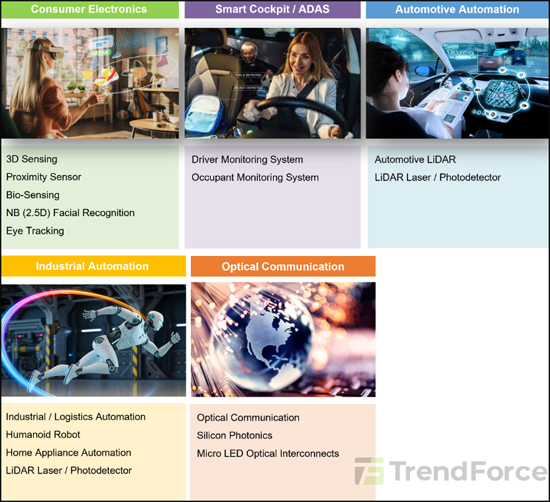
主题1:消费性电子
主题2:智慧座舱/ADAS - 驾驶/乘员监控系统 (DMS/OMS)
欧盟通用安全法规将要求自2026年7月7日起,所有新乘用车、卡车和巴士必须安装ADDW系统。此外,豪华车辆现在必须配备驾驶监控系统,以防止事故和其他操作失误,以及ADAS/自动驾驶L2及以上系统。 汽车製造商对这项法规的回应无疑地推动了市场对驾驶员/乘员监控系统的需求。然而,由于汽车市场竞争激烈,红外线LED市场的价格压力依然强劲。
主题3:汽车自动化 - 自动驾驶
面对市场竞争,汽车製造商正积极推广配备先进技术的高附加价值产品(例如,ADB头灯、全宽/迷你LED尾灯)。他们也在推广将雷射雷达应用于ADAS/L3级自动驾驶系统(例如,高速公路驾驶辅助系统),以提高驾驶安全性并增强自动紧急煞车(AEB)性能。主要厂商包括沃尔沃、通用汽车、奥迪、福斯、宝马、现代、红旗、长安、理想汽车、爱拓、蔚来、丰田和日产。汽车光达也被应用于L4-L5级自动驾驶的自动驾驶公车、无人驾驶计程车和卡车,主要用于短程和点对点运输。 这有助于缓解劳动力短缺,降低劳动力和运输成本。
主题 4:工业自动化与人形机器人
工业光达正被应用于机器人、工业製造流程、物流和安全防护领域。电子商务产业的快速发展增加了工厂内部的配送和运输量,而消费者对快速且便利的配送服务的需求也不断成长。这使得速度成为物流公司成功的关键因素,同时也增加了最后一公里配送的难度。电子商务和物流公司越来越需要配送机器人来降低最后一公里配送成本并提高效率。
因此,2026 年将标誌着机器人产业进入一个新阶段,其特点是人工智慧驱动的人形机器人将专注于实际应用。人形机器人依靠各种感测器与周围环境互动。 虽然具体感测器会因设计要求而异,但这些感测器可以进行定制,以模拟人类的感官功能。
主题 5:光通讯
随着生成式人工智慧的兴起,资料中心对传输速度的需求显着增长。据 TrendForce 称,400Gbps 及以下的资料传输速度已被云端服务供应商 (CSP) 资料中心广泛采用。同时,预计 800Gbps 和 1.6Tbps 将成为 2025 年至 2026 年市场需求的重要成长驱动力。
本报告探讨并分析了红外线感测应用市场,并提供了对该市场商业和行销策略的全面见解。
目录
第一章:红外线感测市场规模分析
- 2026年红外线感测应用市场 - 产品分析概述
- 红外线感测市场规模分析 - 红外线LED/VCSEL/EEL(2026-2030)
- 红外线感测公司收入 - 红外线LED/VCSEL/EEL(2023-2025)
- 消费性电子3D感测 - 模组与VCSEL(2026-2030)
- 消费性电子3D感测 - VCSEL与VCSEL晶片(2026-2030)
- 汽车/工业光达市场 - 光达与光达雷射(2026-2030)
- 红外线LED市场规模分析 - 安防监控(2026-2030)
第二章:消费性电子产品
- 消费性电子产品 - 红外线感测技术概述
- 消费性电子产品品牌策略路线图(2024-2030)
第二章:1. 3D感测
- 3D感测技术概述
- 飞行时间(ToF)技术分析
- iPhone 17中的结构光 - 产品、成本与供应链
- iPhone 17 Pro中的雷射雷达扫描器 - 产品、成本和供应链
- iPhone Pro(2026) - 预计萤幕下3D感测技术规格
- 消费性电子产品3D感测技术的机会市场
- 3D感测产品规格及供应链(2022-2025)
- 模组市场规模 - 消费性电子3D感测(2026-2030)
- VCSEL市场规模 - 消费性电子3D感测(2026-2030)
- VCSEL晶片市场规模 - 消费性电子3D感测(2026-2030)
- VCSEL技术路线图
- 3D感测应用创新推动VCSEL/EEL技术发展
- VCSEL晶片价格趋势(2018-2030)
第二章:接近感测器
- 接近感测器规格及价格趋势分析(2026)
- 接近感测器市场规模分析(2026-2030)
第二章 3. 生物感测
- 生理参数测量与疾病分析
- 心率与血氧浓度 - 光学感测原理
- 血压与体液平衡 - 光学感测原理
- 生物感测测量位置概述
- Apple Watch Series 11 - PPG 产品、成本与供应链
- Apple AirPods Pro 3 - 皮肤侦测感应器产品、成本与供应链
- Samsung Galaxy Watch 8 - PPG 产品、成本与供应链
- Samsung Galaxy Buds 4 Pro - 皮肤侦测感应器产品、成本和供应链
- 智慧戒指生物感测趋势
- 生物感测系统市场趋势
- 生物感测市场规模分析 - 模组(2026-2030)
- 生物感测市场规模分析 - 分离式 LED(2026-2030)
- 生物感测市场潜力
- 短波红外线 (SWIR)
- SWIR LED 规格分析
- SWIR LED/InGaAs 光电二极体定价分析(2022-2025)
第二章、第四章:NB 人脸辨识
- 2.5D 人脸辨识的优势
- NB (2.5D) 脸部辨识 - 红外线 LED 规格与供应链
- NB (2.5D) 人脸辨识会采用 VSCEL 技术吗?
- 红外线LED市场规模分析 - NB (2.5D) 人脸辨识 (2026-2030)
第二章、第五章:眼动追踪
- AR/VR/MR - 光学感测与显示技术
- 眼动追踪优势分析
- 眼动追踪应用市场
- 眼动追踪品牌与产品规格
- AR/VR/MR 产业 - 资本投资、併购、策略联盟与供应链合作
- 眼动追踪技术演进与品牌专利策略
- AR/VR/MR 市场出货量分析 (2026-2030)
- 红外线LED市场规模分析 - 眼动追踪 (2026-2030)
第三章:驾驶/乘客监控系统
- 驾驶分析
- 智慧型驾驶舱 - 从现在到未来
- 主动/被动感测分析
- 驾驶员监控系统 - 法规与政策
- 驾驶/乘员监控系统 - 功能分析
- 驾驶/乘员监控系统 - 2.5D 规格分析
- 驾驶/乘员监控系统 - 3D 感测规格分析
- 驾驶/乘员监控系统 - 感测器融合分析
- OEM 策略与供应链
- DMS/OMS - 汽车出货量与渗透率 (2026-2030)
- 红外线 LED/VCSEL 市场规模分析 - DMS/OMS (2026-2030)
- 红外线 LED/VCSEL 需求市场与公司收入分析 - DMS/OMS
- 红外线 LED 产品规格分析 - ams 欧司朗
- VCSEL 产品规格分析 - ams 欧司朗
- 红外线LED/VCSEL 产品规格分析 - Stanley
- 驾驶/乘员监控系统市场概况分析
第四章 汽车/工业自动化
- 光达应用市场定义
- 汽车/工业光达市场规模分析(2026-2030)
- 光达成像技术概述
- 光达产品规格与定价分析
- 雷射雷达市场概况分析
第四章,第一部分:汽车自动化
- ADAS/自动驾驶 - OEM 策略联盟分析
- ADAS/自动驾驶路线图与供应链(2021-2026)
- L4-L5 级自动驾驶市场概况分析
- 汽车感测分析 - 光达、雷达和摄影机
- 光达产品需求 - 驾驶场景分析
第四章 2. 工业自动化
- 工业光达应用市场
- 人形机器人市场展望(2026)
- 人形机器人 - 红外线感测解决方案
- 配送光达
- 消费性电子光达(扫地机器人/呼叫中心)(Panion Robot)
第四章,第三部分:光达雷射与光电侦测器
- 雷射雷达雷射市场规模 - 应用分析(2026-2030)
- 雷射雷达雷射市场规模 - 产品分析(2026-2030)
- 光达光电侦测器市场规模 - 产品分析(2026-2030)
- 雷射雷达雷射 - EEL/VCSEL 综合分析
- 汽车雷射雷达雷射 (EEL) 分析
- 汽车雷射雷达雷射 (VCSEL) 分析
- 工业光达雷射分析
- 雷射雷达雷射公司 - 主要客户列表
- 光达光电探测器分析
- 光达雷射/光电侦测器公司列表
第五章 光通讯产品趋势与供应链分析
- 资料中心升级刺激光通讯市场需求
- 光通讯市场发展(2025-2026)
- CSP 资料中心路线图 - NVIDIA、Google、Amazon
- CSP 资料中心路线图 - Microsoft、Meta、Oracle
- 800Gbps 与 1.6Tbps 收发器产品趋势
- 收发器与 SiPh CPO 的比较
- SiPh CPO 技术挑战分析
- 光通讯 - 收发器 vs. SiPh CPO vs. Micro LED CPO
- 光通讯 - Micro LED/VCSEL/CW LD (SiPh CPO)/EML
- Micro LED 光互连的机会与挑战
- ML、CW LD 和 InGaAs 光电二极体价格调查(2025)
- 光通讯市场分析景观
According to the report "TrendForce 2026 Infrared Sensing Application Market and Branding Strategies," driven by brands' strategic planning, five key themes are projected to unfold steadily between 2026 and 2030.
- (1) consumer electronics, including under-display 3D sensing, under-display proximity sensors, and bio-sensing
- (2) smart cockpit / ADAS- driver / occupant monitoring systems (DMS/OMS)
- (3) automotive automation- autonomous driving
- (4) industrial automation and humanoid robots
- (5) optical communication
Various factors are helping to expand the market scale of infrared sensing applications. Based on consumer electronics, DMS/OMS, automotive and industrial automation applications such as LiDAR, TrendForce forecasts that the IR LED, VCSEL, and EEL market scale for infrared sensing applications will climb to USD 2.214 billion by 2030.
Topic One: Consumer Electronics
Under-Display 3D Sensing: Apple is expected to adopt Dual-Junction VCSELs, and introduce under-display 3D sensing in the 2026 model of iPhone Pro using mature processes. Moreover, brands like Apple and Meta are planning to launch AR glasses between 2028 and 2030, leveraging 3D sensing to enable real-time interaction between virtual and real environments, thereby opening up significant business opportunities.
Under-Display Proximity Sensors: By adopting LTPO panels and adjusting timings to avoid the refresh rate of OLED screens (144Hz), smartphone brands can reduce white spot artifacts. This factor also led Apple to cancel the development of its 1,130nm SWIR VCSEL under-display proximity sensor. Meanwhile, in order to improve screen-to-body ratio, the 2026 iPhone Pro will not only use under-display 3D sensing but may also place 1D/2D ToF sensors under the screen. Other brands mostly use 940nm VCSEL under-display proximity sensors, such as Samsung, OPPO, vivo, Transsion, Xiaomi, ZTE, Huawei, Honor, and Motorola.
Bio-Sensing: Apple Watch Series 11 have been incorporated with the new feature of blood pressure detection in 2025 through improvement of algorithms under the existing hardware, while AirPods Pro 3 is now included with skin-detect sensor and heart rate monitoring. Samsung's Galaxy Watch 8 and Galaxy Buds 4 Pro, under optimization on software and hardware, are maintaining the bio-sensing features from previous generations. For the long term, next-gen bio-sensing features, including body hydration, blood lipids, and blood alcohol concentration (BAC), could potentially be incorporated into smart watches of Apple and Samsung in between 2029 and 2030.
Eye Tracking: The advantages of eye tracking include intuitive visual experience, eye-triggered interactive interfaces, automatic interpupillary distance (IPD) adjustment, identity verification, and mobile payment are also expected to be integrated with Micro LED displays in AR glasses. Brands such as Apple, Meta, Samsung, Amazon, and Google are likely to adopt these technologies.
Topic Two: Smart Cockpit / ADAS- Driver / Occupant Monitoring Systems (DMS/OMS)
The EU General Safety Regulation stipulates that new passenger cars, trucks, and buses must be equipped with ADDW systems starting from July 7, 2026. Additionally, ADAS / autonomous driving Level 2 and above must be installed in high-end vehicles along with driver monitoring systems to prevent misuse that could lead to accidents and disputes. Carmakers' response to the policy has indeed driven the demand for driver/occupant monitoring systems in the market. However, due to the intense competition in the automotive market, the price pressure in the IR LED market has not eased.
Topic Three: Automotive Automation - Autonomous Driving
Automakers, facing market competition, are actively marketing high value-added products engineered with advanced technologies, such as ADB headlights, and full-width / Mini LED taillights. They have also been applying LiDAR to ADAS / autonomous driving Level 3 (e.g., Highway Pilot), aiming to enhance driving safety and autonomous emergency braking (AEB) performance. Leading players include Volvo, General Motors, Audi, Volkswagen, BMW, Hyundai, Hongqi, Changan, Li Auto, AITO, NIO, Toyota, and Nissan. Automotive LiDAR is also applied in autonomous buses, robo-taxis, and autonomous trucks with autonomous driving Level 4-5 mainly for shuttling and point-to-point transportation. This helps address labor shortages and save personnel and transportation costs.
Topic Four: Industrial Automation and Humanoid Robots
Industrial LiDAR is applied in robots, industrial manufacturing processes, logistics, and safety protection. With the rapid growth of the e-commerce industry, distribution and transportation within factories have increased, while consumer demand for fast and convenient delivery services continues to rise. This has made speed a crucial factor in determining success for logistics companies in e-commerce, while also making last-mile delivery more challenging. E-commerce and logistics companies, aiming to reduce last-mile delivery costs and improve efficiency, are increasingly demanding more delivery robots.
The year 2026 will therefore mark a new phase in the robotics industry, characterized by humanoid robots that are driven by AI and focused on practical applications. Humanoid robots rely on various sensors to interact with their surrounding environment. The specific sensors vary according to design requirements. These sensors can be aligned with the simulation of human sensory functions.
Topic Five: Optical Communications
In response to the rise of generative AI, data centers are facing a significant increase in transmission rate demands. According to TrendForce, data transmission rates of less than or equal to 400 Gbps have already been widely adopted in the data centers of Cloud Service Providers (CSPs). Meanwhile, 800 Gbps and 1.6 Tbps will be the main drivers of market demand growth from 2025 onwards and continue into 2026. NVIDIA's goals for SiPh CPO products include: 1. Low cost (< USD 0.1 / Gbps); 2. Low power consumption (< 1.5 pJ/bit); Long distance (> 1 km); Small form factor (>0.5 Tbps/mm2); High reliability (< 10 FIT). Among these, Micro LED CPO is expected to align with SiPh CPO goals in terms of low cost, low power consumption, small form factor, and high reliability.
TrendForce analyzes the market scale, opportunities and challenges, and product specifications and pricing for infrared sensing applications. These analyses are based on brand manufacturers' strategies and the latest developments across supply chains. The report aims to provide readers with a comprehensive insight into business and marketing strategies in the infrared sensing application market.
Table of Contents
Chapter 1. Infrared Sensing Market Scale Analysis
- 2026 Infrared Sensing Application Market- Product Analysis Overview
- 2026-2030 Infrared Sensing Market Scale Analysis- IR LED / VCSEL / EEL
- 2023-2025(E) Infrared Sensing Player Revenue- IR LED / VCSEL / EEL
- 2026-2030 Consumer Electronics 3D Sensing- Module vs. VCSEL
- 2026-2030 Consumer Electronics 3D Sensing- VCSEL vs. VCSEL Chip
- 2026-2030 Automotive / Industrial LiDAR Market- LiDAR vs. LiDAR Laser
- 2026-2030 IR LED Market Scale Analysis- Security Surveillance
Chapter 2. Consumer Electronics
- Consumer Electronics- Infrared Sensing Technology Overview
- 2024-2030 Consumer Electronics Brand Strategy Roadmap
2.1 3D Sensing
- 3D Sensing Technology Overview
- Time of Flight Technology Analysis
- iPhone 17 Structured Light- Product, Cost, and Supply Chain
- iPhone 17 Pro LiDAR Scanner- Product, Cost, and Supply Chain
- iPhone Pro (2026)- Under-Display 3D Sensing Specification Estimates
- Consumer Electronics 3D Sensing Market Opportunities
- 2022-2025 3D Sensing Product Specification and Supply Chain
- 2026-2030 Module Market Scale- Consumer Electronics 3D Sensing
- 2026-2030 VCSEL Market Scale- Consumer Electronics 3D Sensing
- 2026-2030 VCSEL Chip Market Scale- Consumer Electronics 3D Sensing
- VCSEL Technology Roadmap
- 3D Sensing Application Innovation Drives VCSEL / EEL Technologies
- 2018-2030 VCSEL Chip Price Trend
2.2 Proximity Sensor
- 2026(E) Proximity Sensor Specifications and Price Trend Analysis
- 2026-2030 Proximity Sensor Market Scale Analysis
2.3 Bio-Sensing
- Physiological Parameter Measurement and Disease Analysis
- Heart Rate vs. Blood Oxygen- Optical Sensing Principle
- Blood Pressure vs. Body Hydration- Optical Sensing Principle
- Bio-Sensing Measurement Location Overview
- Apple Watch Series 11- PPG Product, Cost, and Supply Chain
- Apple AirPods Pro 3- Skin-Detect Sensor Product, Cost, and Supply Chain
- Samsung Galaxy Watch 8- PPG Product, Cost, and Supply Chain
- Samsung Galaxy Buds 4 Pro- Skin-Detect Sensor Product, Cost, Supply Chain
- Smart Ring Bio-Sensing Trend
- Bio-Sensing System Market Landscape
- 2026-2030 Bio-Sensing Market Scale Analysis- Module
- 2026-2030 Bio-Sensing Market Scale Analysis- Discrete LED
- Bio-Sensing Market Potential
- Short Wave Infrared (SWIR)
- SWIR LED Specification Analysis
- 2022-2025 SWIR LED / InGaAs Photodiode Price Analysis
2.4 NB Facial Recognition
- 2.5D Face ID Advantages
- NB (2.5D) Facial Recognition- IR LED Specification and Supply Chain
- Will NB (2.5D) Facial Recognition Come with VSCEL Technology?
- 2026-2030 IR LED Market Scale Analysis- NB (2.5D) Facial Recognition
2.5 Eye Tracking
- AR/VR/MR- Optical Sensing and Display Technologies
- Eye Tracking Advantage Analysis
- Eye Tracking Application Markets
- Eye Tracking Brands and Product Specifications
- AR/VR/MR Industry- Capital Investment, M&A, Strategic Alliance, Supply Chain Cooperation
- Eye Tracking Technology Evolution and Brand Patent Strategies
- 2026-2030 AR/VR/MR Market Shipment Analysis
- 2026-2030 IR LED Market Scale Analysis- Eye Tracking
Chapter 3. Driver / Occupant Monitoring System
- Key Factor Analysis
- Smart Cockpit- From Today to the Future
- Active / Passive Sensing Analysis
- Driver Monitoring System- Regulations and Policies
- Driver / Occupant Monitoring System- Feature Analysis
- Driver / Occupant Monitoring System- 2.5D Specification Analysis
- Driver / Occupant Monitoring System- 3D Sensing Specification Analysis
- Driver / Occupant Monitoring System- Sensor Fusion Analysis
- OEM Strategies and Supply Chain
- 2026-2030 DMS/OMS- Car Shipment vs. Penetration Rate
- 2026-2030 IR LED / VCSEL Market Scale Analysis- DMS/OMS
- IR LED / VCSEL Demand Market vs. Player Revenue Analysis- DMS/OMS
- IR LED Product Specification Analysis- ams OSRAM
- VCSEL Product Specification Analysis- ams OSRAM
- IR LED / VCSEL Product Specification Analysis- Stanley
- Driver / Occupant Monitoring System Market Landscape Analysis
Chapter 4. Automotive / Industrial Automation
- Definitions of LiDAR Application Markets
- 2026-2030 Automotive / Industrial LiDAR Market Scale Analysis
- LiDAR Imaging Technology Overview
- LiDAR Product Specification and Price Analysis
- LiDAR Market Landscape Analysis
4.1 Automotive Automation
- ADAS / Autonomous Driving- OEM's Strategic Alliance Analysis
- 2021-2026 ADAS / Autonomous Driving Roadmap and Supply Chain
- Autonomous Driving Level 4-5 Market Landscape Analysis
- Automotive Sensing Analysis- LiDAR, Radar and Camera
- LiDAR Product Requirement- Driving Scenario Analysis
4.2 Industrial Automation
- Industrial LiDAR Application Market
- 2026 Humanoid Robot Market Outlook
- Humanoid Robot - Infrared Sensing Solution
- Delivery LiDAR
- Home Appliance LiDAR (Robot Vacuums / Companion Robots)
4.3 LiDAR Laser and Photodetector
- 2026-2030 LiDAR Laser Market Scale- Application Analysis
- 2026-2030 LiDAR Laser Market Scale- Product Analysis
- 2026-2030 LiDAR Photodetector Market Scale- Product Analysis
- LiDAR Laser- EEL / VCSEL Comprehensive Analysis
- Automotive LiDAR Laser (EEL) Analysis
- Automotive LiDAR Laser (VCSEL) Analysis
- Industrial LiDAR Laser Analysis
- LiDAR Laser Player- Major Customer List
- LiDAR Photodetector Analysis
- LiDAR Laser / Photodetector Player List
Chapter 5. Optical Communications Product Trend and Supply Chain Analysis
- Data Center Upgrades Stimulate Optical Communications Market Demand
- 2025-2026 Optical Communications Market Development
- CSP's Data Center Roadmap- NVIDIA, Google, Amazon
- CSP's Data Center Roadmap- Microsoft, Meta, Oracle
- 800Gbps vs. 1.6Tbps Transceiver Product Trend
- Transceiver vs. SiPh CPO
- SiPh CPO Technology Challenges Analysis
- Optical Communications- Transceiver vs. SiPh CPO vs. Micro LED CPO
- Optical Communications- Micro LED / VCSEL / CW LD (SiPh CPO) / EML
- Micro LED Optical Interconnects Opportunities and Challenges
- 2025 EML, CW LD, and InGaAs Photodiode Price Survey
- Optical Communications Market Landscape Analysis

 2026年全球红外线资料通讯市场报告2026年全球红外线防护系统市场报告
 红外线阵列感测器-2026年至2032年全球市占率及排名、总收入及需求预测
 中波红外线模拟器市场:依产品、技术、部署、通路、应用、最终用户划分,全球预测(2026-2032年)InGaAs红外线检测器单元素市场按应用、终端用户产业、工作模式和波长范围划分,全球预测,2026-2032年PbX红外线检测器单元素市场按应用、技术、波长、分销管道和部署方式划分,全球预测(2026-2032年)按技术、应用、波长和元件类型分類的冷却式红外线检测器阵列市场,全球预测,2026-2032年按技术、最终用户、应用、冷却机制和波长分類的冷却式红外线检测器单元素市场,全球预测,2026-2032年非製冷红外线检测器单元素市场(按应用、探测器材料、频谱波段、技术类型、解析度、最终用户和销售管道),全球预测,2026-2032年非製冷红外线检测器阵列市场(按材料类型、应用、终端用户产业和检测器解析度划分),全球预测,2026-2032年