


 |
市场调查报告书
商品编码
1993235
汽车软体开发与安全解决方案Automotive Software Development & Security Solutions |
||||||

随着供应商不断推进能够实现联网汽车、电气化、高级自动化和软体定义汽车的新平台和功能,汽车产业正经历着一波关注、投资和创新的浪潮。
本报告对汽车软体、开发和部署工具以及网路安全解决方案市场进行了定义和评估,并从定量和定性两个方面深入分析了推动市场变革的因素。报告中还检验了近期趋势、不断变化的工程需求以及正在再形成这一快速发展市场格局的供应商策略。
发表该报告
- Aeris
- Airbiquity / Karma Automotive
- Amazon / AWS
- Aptiv / Wind River
- Arm
- AUMOVIO /Elektrobit / PlaxidityX
- Aurora Labs
- AVL
- Block Harbor
- Broadcom / VMware
- BTC
- Cadence
- Canonical
- Cetitec (a Porsche company)
- Clearlake Capital
- COVESA / GENIVI
- Cybellum
- Dassault Systemes
- Deloitte
- dSPACE
- Eclipse Foundation
- Edge Impulse
- emlix
- ETAS (Bosch subsidiary)
- eSOL
- Excelfore
- Flexera
- Ford
- Foretellix
- GAIO Technology
- General Motors
- Green Hills Software
- HARMAN
- HPE
- Hyundai Mobis
- IBM / Red Hat
- Infineon Technologies
- INTEGRITY Security Services
- Intel
- Inverted AI
- Jama Software
- Jfrog
- Karamba Security
- Kaspersky
- LG Electronics
- Lynx Software Technologies
- MathWorks
- Mend.io
- Mercedes-Benz
- Microsoft / Azure
- Nissan Motor Co.
- NVIDIA
- NXP Semiconductors/ TTTech Auto
- Parallel Domain
- Perforce
- PTC
- Qualcomm
- QNX (division of BlackBerry Limited)
- Renesas Electronics
- Sibros
- Siemens / Altair
- Sonatus
- Sonotype
- Stellantis
- STMicroelectronics
- SUSE
- Synk
- Synopsys / Ansys
- Texas Instruments
- Thales
- Tier IV
- Tata Elxsi
- Triumph Group
- Upstream Security
- Vector Informatik
- VicOne
- Volkswagen / CARIAD
- Voxel51
- Wind River
执行摘要
汽车产业正经历一场由技术进步驱动的重大变革,其中包括软体定义汽车、电气化、半自动驾驶汽车、联网汽车平台和下一代通讯系统的兴起。这些变革推动了对专用软体和开发工具的需求,以建构、管理、维护和保护日益复杂的车辆架构。随着硬体整合不断推进,竞争对手纷纷转向透过功能和服务实现差异化,软体开发已成为原始设备製造商 (OEM) 的首要任务。随着软体定义汽车 (SDV) 时代的到来,汽车製造商和一级供应商都在迅速扩展其软体能力和开发人才,以满足下一代出行的需求。
汽车产业正从攻击面有限的硬体定义车辆 (HWD) 向支援空中下载 (OTA) 更新的软体定义车辆 (SDV) 转型,后者面临有线和无线安全风险。为了应对这些新的安全漏洞,汽车製造商及其供应商生态系统正在部署一系列符合 OEM 内部标准、政府法规和行业最佳实践的网路安全解决方案,以确保车辆的安全可靠。
本报告涵盖了物联网和嵌入式作业系统、容器、虚拟机器管理程式、自动化软体安全测试 (ASST)、基于模型的系统工程 (MBSE) 工具、需求管理 (RM) 工具、软体配置分析 (SCA)、网路安全、边缘人工智慧、DevSecOps/OTA、虚拟 ECU 和自动驾驶汽车检验等领域的软体、开发和安全解决方案。
目录
本报告内容
本报告探讨的问题
本报告的目标受众
本报告涵盖的供应商
执行摘要
- 主要发现
世界市场概览
依解决方案类型进行预测
- 嵌入式作业系统
- 容器和虚拟机器管理程式解决方案
- 自动化软体和系统测试工具
- 基于模型的系统工程
- 需求管理
- 软体配置分析和安全测试工具
- 自主系统检验解决方案
- OTA/DevSecOps
- 边缘人工智慧开发工具
- 虚拟ECU检验、原型製作和硬体在环(HiL)解决方案
- 汽车网路安全
- 网路安全在软体定义汽车中的作用
- 促进汽车产业采用网路安全技术的法规
- V2X 连接
- 车内支付
- 车辆充电
- 应用程式和 API
- 人工智慧在汽车网路安全中的作用
- 后量子安全
近期市场趋势
- 软体定义汽车正在重塑汽车架构和风险。
- OEM厂商和供应商的软体精简揭露了SDV发展过程中遇到的难题。
- 收购、合作和市场策略转变
- Synopsys 收购 Ansys 有望打造一个从晶片到系统的平台。
- 西门子以106亿美元收购Altair Engineering
- QNX 和 Vector 透过安全性和云端整合来推进其基础 SDV 平台的发展。
- 其他合作关係
- 其他收购和剥离
- 促进软体开发工具和安全解决方案普及的法规。
竞争格局
供应商简介
- AUMOVIO/Elektrobit/PlaxidityX
- HARMAN
- ETAS
- Foretellix
- Green Hills
- INTEGRITY Security Services.
- Kaspersky
- MathWorks
- QNX
- Red Hat
- Siemens
- Synopsys
- Vector Informatik
- Wind River
工程方面的考虑
- Start-Ups在SDV生态系中扮演的角色日益重要
- 现有技术公司和系统整合商的影响力正在下降。
- 下一波汽车创新浪潮
- 嵌入式安全软体、硬体与FOTA实现
- 工程计划延误原因分析
- 远端应用程式的采用率持续成长
关于作者
Inside this Report
The automotive industry is experiencing a wave of interest, investment, and innovation as vendors advance new platforms and capabilities to enable connected, electrified, increasingly automated, and software-defined vehicles. This report defines and evaluates the market for automotive software, development/deployment tools, and cybersecurity solutions, delivering both quantitative and qualitative insights into the forces driving change. It examines recent industry developments, shifting engineering requirements, and vendor strategies that are reshaping this rapidly evolving landscape.
What Questions are Addressed?
- As cybersecurity becomes a bigger concern and new standards are adopted in the automotive industry, how will vendors adapt?
- Which areas of software development will experience the most growth?
- Who are the leading suppliers in the industry, and what initiatives are they taking to ensure their future in the industry?
- What features and functions are consolidating in modern software development tools & platforms?
- Why are automotive software partnerships evolving to long-term strategic collaborations?
- Which technologies are OEMs investing in to secure the future of software-defined, autonomous, connected, and electrified vehicles?
Who Should Read this Report?
- CEO or other C-level executives
- Corporate development and M&A teams
- Marketing executives
- Business development and sales leaders
- Product development and product strategy leaders
- Channel management and channel strategy leaders
Organizations Listed in this Report
- Aeris
- Airbiquity / Karma Automotive
- Amazon / AWS
- Aptiv / Wind River
- Arm
- AUMOVIO /Elektrobit / PlaxidityX
- Aurora Labs
- AVL
- Block Harbor
- Broadcom / VMware
- BTC
- Cadence
- Canonical
- Cetitec (a Porsche company)
- Clearlake Capital
- COVESA / GENIVI
- Cybellum
- Dassault Systemes
- Deloitte
- dSPACE
- Eclipse Foundation
- Edge Impulse
- emlix
- ETAS (Bosch subsidiary)
- eSOL
- Excelfore
- Flexera
- Ford
- Foretellix
- GAIO Technology
- General Motors
- Green Hills Software
- HARMAN
- HPE
- Hyundai Mobis
- IBM / Red Hat
- Infineon Technologies
- INTEGRITY Security Services
- Intel
- Inverted AI
- Jama Software
- Jfrog
- Karamba Security
- Kaspersky
- LG Electronics
- Lynx Software Technologies
- MathWorks
- Mend.io
- Mercedes-Benz
- Microsoft / Azure
- Nissan Motor Co.
- NVIDIA
- NXP Semiconductors/ TTTech Auto
- Parallel Domain
- Perforce
- PTC
- Qualcomm
- QNX (division of BlackBerry Limited)
- Renesas Electronics
- Sibros
- Siemens / Altair
- Sonatus
- Sonotype
- Stellantis
- STMicroelectronics
- SUSE
- Synk
- Synopsys / Ansys
- Texas Instruments
- Thales
- Tier IV
- Tata Elxsi
- Triumph Group
- Upstream Security
- Vector Informatik
- VicOne
- Volkswagen / CARIAD
- Voxel51
- Wind River
Executive Summary
The automotive industry is undergoing a major transformation as advances in technology drive the rise of software-defined, electrified, semi-autonomous vehicles, connected car platforms, and next-generation communication systems. These changes are fueling demand for specialized software and development tools to build, manage, maintain, and secure increasingly complex vehicle architectures. As hardware consolidates and competition shifts toward differentiation through features and services, software development has become a central priority for OEMs. The era of the software-defined vehicle is now underway, with both automakers and Tier 1 suppliers rapidly expanding their software capabilities and scaling developer talent to meet the needs of next-generation mobility.
The automotive industry is transitioning from hardware-defined vehicles with limited attack surfaces to software-defined vehicles (SDVs) that support over-the-air (OTA) updates and include both wired and wireless security exposure. To address these new vulnerabilities, automakers and their supplier ecosystems are deploying a range of cybersecurity solutions that align with internal OEM standards, government regulations, and industry best practices to ensure safe and secure vehicles.
The report covers software, development and security solutions across IoT & embedded operating systems (OSs), containers, hypervisors, automated software & security testing (ASST), Model-based systems engineering tools (MBSE), requirements management tools (RM), software composition analysis (SCA), cybersecurity, Edge AI, DevSecOps/OTA, virtual ECUs, and autonomous vehicle verification.
Key Findings
- The rise of advanced driver-assistance systems (ADAS), software-defined vehicles (SDVs), and over-the-air (OTA) updates is accelerating the automotive software market, as OEMs strive to deliver rapid feature enhancements today while advancing toward autonomous and connected mobility.
- OEMs face a range of challenges in developing vehicle features, including macroeconomic pressures and shifting consumer demand, increasing system complexity, and high development costs.
- According to VDC's Voice of the Engineer survey, respondents indicated that the complexity of applications and technology is the leading factor for delays to automotive projects.
- The expansion of product portfolios through both internally developed solutions as well as collaborative partnerships will drive vendor differentiation within the SDV market, as engineers seek to consolidate toolsets and look for ease of integration.
- The growing use of AI in automotive software development and cybersecurity solutions will be essential not only for expediting SDV innovation and ensuring safety, but also for strengthening defenses against emerging AI-powered cybersecurity attacks.
- Regional and country-specific standards require OEMs and suppliers to integrate safety validation, threat modeling, secure coding, over-the-air update controls, and lifecycle risk management into their software development workflows.
Report Excerpt
The Next Wave of Automotive Innovation
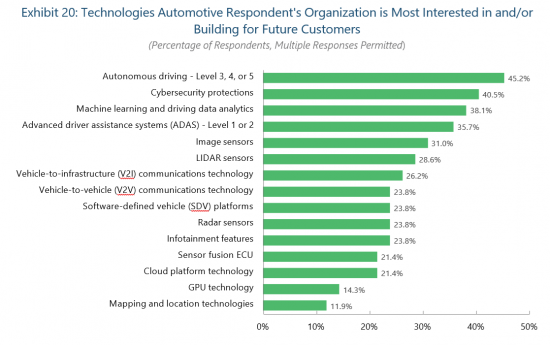
Understanding evolving automotive market trends is critical to guiding the development of next-generation software architectures and cybersecurity solutions.As the complexity of SAE Level 3 and Level 4 systems expands within high-dependability environments, the implementation of an integrated and automated software toolchain becomes essential to ensure functional safety, system integrity, and regulatory compliance. Such a toolchain must enable model-based development, high-fidelity simulation, continuous integration and deployment (CI/CD), and comprehensive validation and cybersecurity assurance throughout the vehicle's. To help alleviate this growing complexity, software tool vendors should deliver interoperable platforms and open solutions that integrate with other vendors and tier suppliers across the automotive supply chain, fostering greater collaboration, efficiency, and system-level optimization.
Furthermore, interest in ADAS and AD sensing technologies remains strong, with 31% of respondents highlighting image sensors, 28.6% citing LiDAR sensors, and 23.8% identifying radar sensors as key areas of interest. To enable multi-sensor systems, 21.4% of respondents pointed to sensor fusion ECUs as an important supporting technology. The integration of these sensing modalities, coupled with advanced fusion algorithms, is critical for delivering the high-resolution, real-time environmental perception required for both ADAS and higher-level autonomous driving functions. As vehicles adopt increasingly complex sensor suites, robust hardware security architectures, testing, and verification processes can play a critical role in ensuring seamless system and software interoperability, consistent performance, and the reliability needed to meet safety-critical regulatory demands.
Although Vehicle-to-Everything (V2X) technology has yet to achieve mainstream adoption, surveyed automotive engineers identified Vehicle-to-Infrastructure (V2I) at 26.2% and Vehicle-to-Vehicle (V2V) at 23.8% as key areas of focus [see Exhibit 20]. V2I, V2V, and broader V2X capabilities enhance vehicle safety and situational awareness by enabling data exchange beyond the line of sight and range limitations of onboard sensors.
To address the security implications of this connectivity, cybersecurity vendors must develop protection layers specifically designed to safeguard V2X safety communications. As semi-autonomous and fully autonomous vehicles continue to mature, these vendors should prioritize automotive-specific protection mechanisms that preserve safety-critical operations even during cyberattacks or system malfunctions, unlike traditional IT security measures that may simply isolate or shut down affected systems.
OEMs, aiming to control costs and comply with varying regional regulations, are likely to concentrate on developing fundamental in-house protections while relying on specialized vendors for advanced or system-level defenses. This evolution underscores the need for cybersecurity providers to tailor their offerings to emerging SDV architectures, the unique vulnerabilities these systems introduce while ensuring compliance with diverse regulatory frameworks.
As cybersecurity becomes more deeply integrated into the SDV software lifecycle, collaboration between OEMs, Tier 1 suppliers, and software vendors will be essential to maintain compliance, streamline development, and ensure continuous protection throughout the vehicle's operational lifespan. Effective coordination across the supply chain, supported by standardized frameworks, shared threat intelligence, and interoperable toolchains, will be critical to managing risk and enabling secure innovation at scale.
Table of Contents
Inside this Report
What Questions are Addressed?
Who Should Read this Report?
Organizations Listed in this Report
Executive Summary
- Key Findings
Global Market Overview
Forecast by Solution Type
- Embedded Operating Systems
- Container & Hypervisor Solutions
- Automated Software and System Testing Tools
- Model-Based Systems Engineering
- Requirements Management
- Software Composition Analysis & Security Test Tools
- Autonomous Systems Verification Solutions
- OTA/DevSecOps
- Edge AI Development Tools
- Virtual ECU Validation, Prototyping & HiL Solutions
- Automotive Cybersecurity
- Cybersecurity's Role in the Software-Defined Vehicle
- Regulations Driving Automotive Cybersecurity Adoption
- V2X Connectivity
- In-Car Payments
- Vehicle Charging
- Apps & APIs
- The Role of Artificial Intelligence in Automotive Cybersecurity
- Post-Quantum Security
Recent Market Developments
- Software-Defined Vehicles Reshape Automotive Architecture and Risk
- Software Cuts at OEMs and Suppliers Expose SDV Growing Pains
- Acquisitions, Partnerships and Market Pivots
- Synopsys Ansys Acquisition to Create a Silicon-to-Systems Platform
- Siemens' $10.6B Move for Altair Engineering
- QNX and Vector Advance Foundational SDV Platform with Safety and Cloud Integration
- Other Partnerships & Collaborations
- Other Acquisitions & Divestitures
- Regulations Driving Software Development Tool and Security Solutions Adoption
Competitive Landscape
Vendor Profiles
- AUMOVIO/Elektrobit/PlaxidityX
- HARMAN
- ETAS
- Foretellix
- Green Hills
- INTEGRITY Security Services.
- Kaspersky
- MathWorks
- QNX
- Red Hat
- Siemens
- Synopsys
- Vector Informatik
- Wind River
Engineering Insights
- The Expanding Role of Startups in the SDV Ecosystem
- Diminishing Influence of Established Tech and System Integrators
- The Next Wave of Automotive Innovation
- Implementation of Embedded Security Software, Hardware, and FOTA
- Attributions of Delays in Engineering Projects
- Sustained Increases in Remote Application Deployments
About the Authors
List of Exhibits
- Exhibit 1:Global Revenue of Automotive Software Development & Security Solutions, by Type
- Exhibit 2:Global Portion of Automotive Software Development & Security Solutions, by Type Market
- Exhibit 3:Global Revenue of Automotive IoT & Embedded OS
- Exhibit 4:Current & Expected Primary OS in Automotive Projects, by OS Source
- Exhibit 5:Global Revenue of Automotive Hypervisor & Container Solutions
- Exhibit 6:Global Revenue for Automotive Automated Software & System Testing Tools
- Exhibit 7:Global Revenue for Automotive Model Based Systems Engineering Tools
- Exhibit 8:Global Revenue for Automotive Requirements Management Solutions
- Exhibit 9:Global Revenue for Automotive Software Composition Analysis & Security Test Tools
- Exhibit 10:Global Revenue for Automotive Autonomous System Verification Solutions
- Exhibit 11:Global Revenue for Automotive OTA & DevSecOps Solutions
- Exhibit 12:Global Revenue for Automotive Edge AI Development Tools
- Exhibit 13:Global Revenue for Virtual ECU Validation, Prototyping & HiL Solutions
- Exhibit 14:Global Revenue of Automotive Cybersecurity Solutions & Services
- Exhibit 15:Global Share of Automotive Software & Security Solutions by Leading Vendors, 2024 & 2025
- Exhibit 16:Global Share of Automotive OS, Containers & Hypervisors by Leading Vendors, by Vertical, 2024 & 2025
- Exhibit 17:Global Share of Automotive ASST, MBSE, & SCA Solutions by Leading Vendors, by Vertical, 2024 & 2025
- Exhibit 18:Global Share of Automotive Autonomous System Verification, OTA/DevSecOps, Edge AI, & vECU Solutions by Leading Vendors, by Vertical, 2024 & 2025
- Exhibit 19:Current Major Competition in the Software-Defined Space
- Exhibit 20:Technologies Automotive Respondent's Organization is Most Interested in and/or Building for Future Customers
- Exhibit 21:Use of Embedded Security Software, Hardware, & Firmware-Over-the-Air Updating in Current Automotive Projects vs. Overall IoT Projects
- Exhibit 22:Attributions of Delays to Automotive Projects
- Exhibit 23:Current Use of Remote Deployment & Management by Vertical Market

 2026年全球汽车网路安全市场报告
 互联行动安全解决方案市场预测至2034年:按产品类型、连接类型、技术、应用、最终用户和地区分類的全球分析2026年全球外部云端汽车保全服务市场报告
 汽车网路安全市场(至 2040 年):依组件、形式、安全类型、车辆类型、应用、地区和主要参与者划分的行业趋势和全球预测
 联网汽车安全市场机会、成长要素、产业趋势分析及2026年至2035年预测
 汽车网路安全市场分析及预测(至2035年):按类型、产品类型、服务、技术、组件、应用、部署类型、最终用户和解决方案划分
 2026-2034年全球汽车网路安全市场规模、份额、趋势和成长分析报告人工智慧在汽车网路安全领域的市场机会、成长驱动因素、产业趋势分析及预测(2026-2035年)
 乘用车网路安全市场-全球产业规模、份额、趋势、机会、预测:按安全类型、应用类型、地区和竞争格局划分,2021-2031年商用车网路安全市场-全球产业规模、份额、趋势、机会、预测:按安全类型、应用、地区和竞争格局划分,2021-2031年