


 |
市场调查报告书
商品编码
1984236
医用及相关水凝胶:市场与技术(2026-2046)Medical and Allied Hydrogels: Markets, Technologies 2026-2046 |
||||||

摘要
预计到2046年,医疗保健相关水凝胶市场将成长五倍,达到1,580亿美元。其中,医疗领域的销售额预计将从36%成长至43%,占市场毛利的大部分。
本报告重点在于用于医疗用途的水凝胶,例如帮助盲人恢復视力、使瘫痪患者能够行走、器官移植以及对抗癌症,而非尿布或化妆品。本报告撰写于2026年,并持续更新,以确保不会因该快速发展领域中的过时资讯而受到误导。
为寻求商机的公司提供清晰的指导
这份以商业为导向的报告包含2026年至2046年的25 项预测、63 家重点公司、32 张全新资讯图表、17 项关键结论、6个章节以及 6 项 SWOT 分析。博士级的分析对快速的技术进步进行了详细考察,尤其是在2025年至2026年期间,重点关注了有毒材料和性能不足等挑战,同时也揭示了这些挑战为企业带来的商机。
对于任何希望在医疗及相关水凝胶领域所需的材料、硬体和服务这一庞大且利润日益丰厚的市场中获利的人来说,这份报告都是必读之作。
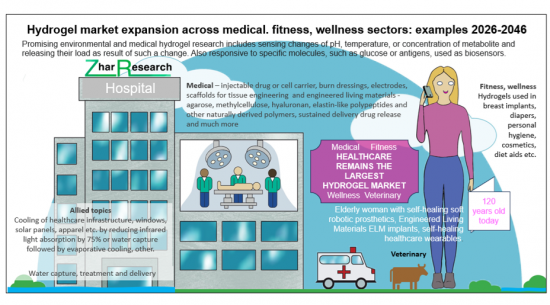
标题:医疗、健身和健康领域水凝胶市场的扩张(案例研究2026-2046)来源:Zhar Research 报告《Medical and Allied Hydrogels: Markets, Technologies 2026-2046》
目录目录
第1章 执行摘要与结论
- 本报告的目标和结构
- 研究方法
- 资讯图表:水凝胶市场在医疗、健身和健康领域的扩张
- 水凝胶的定义与生医用途
- 应用、背景和改进路径
- 2025-2026年调查受欢迎程度排名(16 水凝胶配方系列)
- 17个主要结论
- 水凝胶中的毒素为何既是问题也是机会
- 水凝胶技术选择、趋势与竞争分析(与替代技术的比较)
- 6 项关于水凝胶的SWOT 分析
- 水凝胶路线图:依行业划分
- 市场预测
- 全球医疗保健水凝胶市场:依类别划分
- 医用水凝胶市场:涵盖 12个类别,市场规模达数十亿美元
- 医疗保健水凝胶市场规模(%):以 4个地区划分
- 医疗保健水凝胶市场规模:合成水凝胶、天然水凝胶和混合水凝胶
- 医疗保健水凝胶技术:依功能划分,分为 5个类别
- 全球冷却模组市场(以 7 种技术划分)
第2章 引言
- 背景
- 定义、发展历程与实例
- 诸多优势
- 市场驱动因素
- 根据用途选择水凝胶设计的有效方法
- 仿生法
- 医疗保健领域仿生防污和抗菌水凝胶
- 关于该术语的注意事项 "凝胶"
- 局限性
- 天然材料与合成材料
- 自癒合水凝胶的重要性
- 水凝胶毒素及其中间体为何构成问题
- 水凝胶前驱物和製造技术的演变,包括 3D 和 4D 列印
- 水凝胶竞争格局的演变:离子凝胶、硅胶和超分子凝胶
- 硅酮和聚氨酯如何与水凝胶竞争和结合
第3章 医疗保健水凝胶工具包:概述
- 概述:工具包需要快速扩展以满足日益多样化的需求
- 资讯图表:医疗、健身与健康领域的水凝胶市场扩张
- 水凝胶分子工具包及其发展趋势
- 详细的水凝胶技术选项,包括具体范例和趋势
- 六大新兴水凝胶化学与功能家族
- 七大类基础水凝胶技术
- 医用水凝胶的改良:仿生、复合材料与化学方法
- 用于肾臟透析等的水凝胶膜
- 水凝胶SWOT分析:现况评估
第4章 医疗保健水凝胶工具包:非生物材料与新型功能
- 医用水凝胶所需性能的扩展
- 水凝胶在实现所需性能方面的竞争格局
- 满足多样化性能要求的关键化学选择
- 蒸发冷却
- 生物相容性与生物降解性实例:胜肽水凝胶
- 回应pH值的药物递送等
- 客製化机械特性
- 水凝胶研究进展:依性能的医疗应用
- 生物相容性
- 生物降解性
- 药物递送
- 弹性体水凝胶系统(EHS)
- 柔韧性
- 注射剂和润滑剂
- 药物监测
- pH回应性
- 可列印性
- 支架材料
- 自黏性
- 自癒合功能(包括材料分析和SWOT分析)
- 治疗性自生成功能
- 感测功能(含SWOT分析)
- 形状记忆
- 刺激回应性
- 可拉伸性
- 高强度、高韧性、高硬度
- 透明度
第5章 ELM(工程生命材料)
- 概述
- ELM:SWOT 评估
- 资讯图表:与医学相关的ELM 及相关医学主题
- 资讯图表:ELM 的结构与功能
- 科技与材料机会
- 2026年的自癒合 ELM:19个生物水凝胶实例
- ELM 创建和部署的四个阶段
- 2026年工程生物疗法的水凝胶平台
- 2026年用于肿瘤学和其他医学应用的DNA 水凝胶
- 2026年生物材料在人类癒合和免疫工程的应用
- 2025-2026年其他相关的ELM 研究
- 挑战与未来展望
第6章 医学的未来应用水凝胶
- 概述
- 疾病特异性水凝胶疗法的主要进展:2025-2026
- 预防失明:角膜保护与再生、视网膜修復
- 骨再生和其他生物医学植入物
- 脑损伤治疗、脑肿瘤、神经植入物、脑机接口
- 乳癌治疗
- 烧伤癒合
- 心臟手术
- 隐形眼镜
- 克隆氏症
- 糖尿病併发症
- 残障人士支持
- 口腔炎症
- 神经调控
- 缓解骨关节炎
- 再生医学
- 疤痕修復
- 皮肤再生疗法
- 用于瘫痪治疗的脊椎植入物
- 组织工程:细胞移植、器官替代、皮肤、牙周组织、黏合剂
- 伤口癒合:未来敷料、注射剂及其他
Summary
The healthcare hydrogel market increases fivefold to $158 billion in 2046. Its medical sector is surging from 36% to 43% of value sales and becoming the majority of market gross margin. Time for a report that concentrates less on diapers and cosmetics and more on hydrogels making the blind see, the paralysed walk, organs replaced and cancers overcome. See the Zhar Research report, "Medical and Allied Hydrogels: Markets, Technologies 2026-2046". Written in 2026, it is constantly updated so you are not misled by old information in this fast-moving field.
Clarity for companies seeking business
Commercially-oriented, this 270-page report has forecasts 2026-2046 in 25 lines, 63 companies mentioned, 32 new infograms, 17 key conclusions, six chapters, six SWOT appraisals. The PhD level analysis, mostly of the flood of advances in 2025 and 2026, reveals challenges such as toxic materials and inadequate aspects of performance that are your opportunities.
Quick read
The Executive Summary and Conclusions (33 pages) is for those in a hurry, giving definitions, scope, new infograms, materials analysis pie charts, the key conclusions, six SWOT appraisals, the roadmaps and all forecasts 2026-2046 with explanations.
Context
The Introduction (26 pages) gives definitions, context such as benefits, market drivers, biomimetics and useful approaches for hydrogel design-to-purpose. In a balanced approach, there are cautions too, such as care needed with terms such as gel, and some ongoing inadequacy in life and robustness in some applications. In every chapter, see identification and assessment of leading materials and hardware mostly in 2025-6 research advances referenced and discussed. Learn evolving precursors and production technologies for hydrogels including 3D and 4D printing. Understand evolving hydrogel competition with polyurethanes and silicones both being constituents of some hydrogels but also sometimes their competition.
Unbiassed analysis of the latest advances
Chapter 3. Hydrogel Toolkit for Healthcare: General Situation (27 pages) gives the big picture mainly in new infograms. Learn how it will rapidly widen to serve increasingly diverse needs and see a landscape of hydrogel market expansion across medical. fitness, wellness sectors 2026-2046. A box diagram gives hydrogel technology choices in detail with examples and trends with future winners identified. Infograms of ten families of emerging medical hydrogel chemistry and functionality show functional and other families with many research papers from 2025 and 2026 showing progress. Enabling technologies, routes to improvement and competition for membranes and other structures are introduced then comes a dense two-page hydrogel SWOT appraisal. Throughout the report, the key compounds are highlighted in red and the key points in green so you can easily identify your materials and applicational opportunities.
Chapter 4. Hydrogel Toolkit for Healthcare: Inanimate Materials, Emerging Functions 2026-2046 (71 pages) delves much deeper into this, the largest commercial opportunity. A large number of appropriate research advances from 2025-6 are explained with references. See two SWOT appraisals. A pie chart of 368 latest advances by material reveals how hydrogels lead healthcare self-healing materials research. 20 functions are found to be particularly in demand, usually in groups and there are subsections on all of them. An infogram clarifies Elastomer Hydrogel Systems. Understand injectable hydrogels and others advancing in 2026. See multifunctional hydrogel interfaces: transforming flexible electronics and also the latest elastomer-crosslinked hybrid hydrogels with co-constructed hydrophobic-hydrophilic networks for electronic skin. Understand advances in neural tissue engineering and progress with a supramolecularly biolubricant hydrogel coating for effectively enhancing biotribological performance and also self-healing via cyclodextrin-based host-guest interaction. What happened at the 19th World Drug Delivery Summit, took place on January 29-30, 2026? How are hydrogel nanoparticles newly improved for drug delivery?
Living hydrogels
Living hydrogels? Engineered Living Materials ELM with hydrogel scaffolds? Definitions vary but most would agree that are organs are mostly living and the ultimate is to replace and repair them with living material that can grow, heal and strengthen in a similar manner. Chapter 5. Engineered Living Materials ELM describes these and allied options such as DNA hydrogels for oncology and hydrogel-aided structures grown to purpose but dead when then used. Its 38 pages have a SWOT, several explanatory infograms and much research analysed particularly from 2026 and 2025. One conclusion is that ELM will have serious impact in the later part of the 2026-2046 timeframe.
Heroic achievements arriving
By now, it will be abundantly clear to the reader that it is the medical part of the healthcare hydrogel market that will become dominant in gross margin 2026-2046 powered by the lion's share of research advances and industrial initiatives. The report therefore closes with Chapter 6. Future Medical Hydrogels in Action (55 pages) - a powerful tour of advances arriving with hydrogels. They include blindness prevention, bone regeneration, biomedical implants, many forms of treatment for brain injury, breast tumors, burns, cardiac surgery, contact lenses, Crohn's disease, diabetic complications, disability support, oral inflammation and much more even including spinal cord implants treating paralysis, tissue engineering for organ replacement, periodontal, skin regeneration and other purposes.
The report, "Medical and Allied Hydrogels: Markets, Technologies 2026-2046" is your essential reading if you are to enjoy part of the large, and increasingly high-margin market for the materials, hardware and services required.
CAPTION: Hydrogel market expansion across medical, fitness and wellness sectors: examples 2026-2046. Source: Zhar Research report, "Medical and Allied Hydrogels: Markets, Technologies 2026-2046".
Table of Contents
1. Executive summary and conclusions
- 1.1 Purpose and layout of this report
- 1.2 Methodology
- 1.3 Infogram: hydrogel market expansion across medical. fitness, wellness sectors 2025-2045
- 1.4 Hydrogel definition and biomedical usefulness with two infograms
- 1.5 Usefulness, context, routes to improvement
- 1.6 Research popularity 2025-6 of 16 hydrogel formulation families
- 1.7 Seventeen primary conclusions
- 1.8 How hydrogel toxigens are an issue and an opportunity
- 1.9 Hydrogel technology choices, trends and competition analysis vs alternatives
- 1.10 Six hydrogel SWOT appraisals
- 1.11 Hydrogel roadmaps 2026-2046 by industry sector
- 1.12 Market forecasts 2026-2046 in 26 lines
- 1.12.1 Healthcare hydrogel global market in seven categories $ billion: table, graph, explanation 2025-2046
- 1.12.2 Medical hydrogel market 2026 and 2046 $ billion in 12 categories
- 1.12.3 Healthcare hydrogel value market % by four regions 2025-2046
- 1.12.4 Healthcare hydrogel value market: synthetic vs natural vs hybrid % 2025-2046
- 1.12.5 Healthcare hydrogel technology added by 5 functional categories $ billion 2025-2046
- 1.12.6 Cooling module global market by seven technologies $ billion 2025-2046
2. Introduction
- 2.1 Background
- 2.1.1 Definition, evolution and examples
- 2.1.2 Many benefits
- 2.1.3 Market drivers
- 2.2 Useful approaches for hydrogel design to purpose
- 2.2.1 Biomimetic approach
- 2.2.2 Bioinspired antifouling and antibacterial hydrogels for healthcare
- 2.3 Beware of the term gel
- 2.4 Limitations
- 2.5 Natural vs synthetic
- 2.6 Importance of hydrogels that heal themselves
- 2.7 How hydrogel toxigens and toxigen intermediaries are an issue
- 2.8 Evolving precursors and production technologies for hydrogels including 3D and 4D printing
- 2.8.1 Overview
- 2.8.2 Examples of hydrogel precursors left, natural hydrogels right and hydrogel properties bottom
- 2.8.3 3D, 4D and bio-ink printing of hydrogels
- 2.8.4 Fabrication of a tough, long-lasting adhesive hydrogel patch
- 2.9 Evolving hydrogel competition: ionogels, silica gel, supramolecular gels
- 2.10 How silicones and polyurethanes will both compete with and combine with hydrogels
3. Hydrogel toolkit for healthcare: general situation
- 3.1 Overview: toolkit must rapidly widen to serve increasingly diverse needs
- 3.2 Infogram: hydrogel market expansion across medical. fitness, wellness sectors 2026-2046
- 3.3 Hydrogel molecular toolkit and trends
- 3.4 Hydrogel technology choices in detail with examples and trends
- 3.5 Six families of emerging hydrogel chemistry and functionality
- 3.6 Hydrogel enabling technology by seven categories
- 3.7 Biomimetic, composite and chemistry routes to medical hydrogel improvement
- 3.8 Hydrogel membranes for kidney dialysis and other purposes
- 3.9 Hydrogel SWOT appraisal - where we are now
4. Hydrogel toolkit for healthcare: inanimate materials, emerging functions 2026-2046
- 4.1 Increasing range of properties needed from medical hydrogels
- 4.2 Hydrogel competition in achieving desired parameters
- 4.3 Popular chemical choices achieving some of the various parameters
- 4.3.1 Evaporative cooling.
- 4.3.2 Biocompatibility and biodegradable example: peptide hydrogels
- 4.3.3 pH and other responsive delivery
- 4.3.4 Tailored mechanical properties
- 4.4 Important hydrogel research advances by medically-useful parameter 2025 and 2026
- 4.4.1 Biocompatible
- 4.4.2 Biodegradable
- 4.4.3 Drug delivery
- 4.4.4 Elastomer Hydrogel Systems EHS
- 4.4.5 Flexible
- 4.4.6 Injectable and lubricant
- 4.4.7 Medication monitoring
- 4.4.8 pH-responsive
- 4.4.9 Printable
- 4.4.10 Scaffold
- 4.4.11 Self-adhesive
- 4.4.12 Self-healing with materials analysis and SWOT
- 4.4.13 Self-powered for therapy
- 4.4.14 Sensing with SWOT appraisal
- 4.4.15 Shape memory
- 4.4.16 Stimuli responsive
- 4.4.17 Stretchable
- 4.4.18 Strong, tough or hard
- 4.4.19 Transparent
5. Engineered Living Materials ELM
- 5.1 Overview
- 5.2 ELM SWOT appraisal
- 5.3 Infogram: Healthcare-relevant ELM and some allied medical topics
- 5.4 Infograms: Structures and functions of engineered living materials
- 5.5 Technologies and materials opportunities
- 5.5.1 Advanced disciplines brought to bear
- 5.5.2 Learning from nature and importance of fungal cells
- 5.5.3 Hybrid ELM materials with latest research success analysis
- 5.6 Self-healing ELM in 2026 with 19 examples of living hydrogels
- 5.7 Four stages of ELM creation and deployment
- 5.8 Hydrogel platforms for engineered live biotherapeutics in 2026
- 5.9 DNA hydrogels for oncology and other healthcare applications in 2026
- 5.10 Assisting human healing and immune engineering with biological materials in 2026
- 5.11 Other relevant ELM research in 2025-6
- 5.12 Obstacles and the way forward
6. Future medical hydrogels in action
- 6.1 Overview
- 6.2 Major advances in hydrogel treatments by condition primarily in 2025-6
- 6.2.1 Blindness prevention: corneal protection and restoration, retinal repair
- 6.2.2 Bone regeneration and other biomedical implants
- 6.2.3 Brain injury treatment, brain tumors, neural implants, brain-computer interface
- 6.2.4 Breast tumor treatment
- 6.2.5 Burn recovery
- 6.2.6 Cardiac surgery
- 6.2.7 Contact lenses
- 6.2.8 Crohn's disease
- 6.2.9 Diabetic complications
- 6.2.10 Disability support
- 6.2.11 Inflammation oral
- 6.2.12 Neuromodulation
- 6.2.13 Osteoarthritis mitigation
- 6.2.14 Regenerative medicine
- 6.2.15 Scar repair
- 6.2.16 Skin rejuvenation
- 6.2.17 Spinal cord implants for treating paralysis
- 6.2.18 Tissue engineering: cell transplantation, organ replacement, skin, periodontal, adhesives
- 6.2.19 Wound healing: future dressings, injectables, other

 水凝胶敷料市场规模、份额、趋势和预测:按产品、材料、应用、最终用户和地区划分,2026-2034年
 水凝胶敷料市场:2026-2032年全球市场预测(按应用、产品类型、最终用户和分销管道划分)
 全球医用导电水凝胶市场规模、製造商、供应链、销售管道与客户:2026-2032年
 2026年全球土壤耕作市场报告水凝胶市场:依产品类型、形态、应用和分销管道划分-2026-2032年全球市场预测
 全球水凝胶敷料市场:市场规模、占有率、成长率、产业分析、依类型、应用和地区划分的考察及预测(2026-2034年)
 水凝胶:市场占有率分析、产业趋势与统计、成长预测(2026-2031)全球水凝胶市场:市场规模、占有率、成长率、产业分析、按类型、应用和地区划分的考量因素以及未来预测(2026-2034)
 水凝胶市场规模、份额和成长分析(按原料类型、成分、形态、应用和地区划分)-2026-2033年产业预测
 水硬陶瓷市场规模、份额及成长分析(按应用、最终用户及地区划分)-2026-2033年产业预测