


 |
市场调查报告书
商品编码
1876787
相变材料市场机会、成长驱动因素、产业趋势分析及预测(2025-2034年)Phase Change Materials Market Opportunity, Growth Drivers, Industry Trend Analysis, and Forecast 2025 - 2034 |
||||||

2024年全球相变材料市场价值为26亿美元,预计2034年将以11.4%的复合年增长率成长至79亿美元。
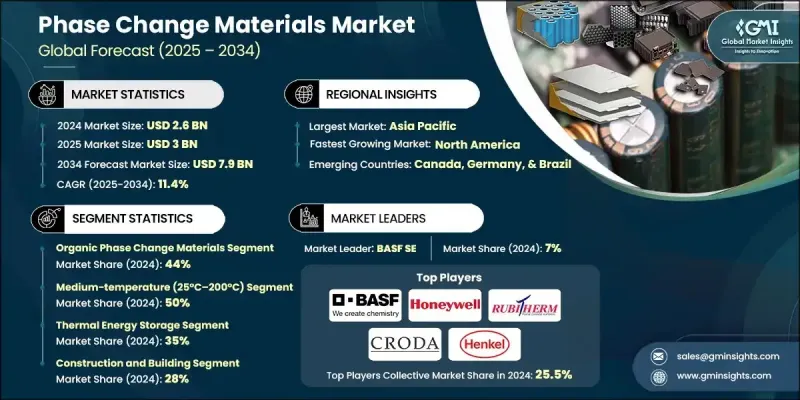
市场成长归功于对节能产品日益增长的需求、不断完善的能源法规以及向再生能源和永续技术的加速转型。相变材料正成为热能储存应用不可或缺的一部分,它们有助于降低能源高峰、提升性能并优化建筑、电子、汽车和工业领域的资源利用。中温相变材料(温度范围为25°C至200°C)约占总需求的55%,主要得益于其在建筑、电子设备和电动车电池热管理系统中的广泛应用。同时,低温相变材料在冷冻冷链物流领域发展迅速,而高温相变材料则在工业余热回收和聚光太阳能发电专案中日益受到重视。随着全球对永续性和温控物流的日益关注,相变材料在冷链系统中的应用也日益广泛,以维持温度稳定性、提高产品安全性并符合监管标准。电子商务、疫苗分发和易腐品物流的激增也推动了封装和製剂技术的创新,使相变材料成为现代供应链中不可或缺的一部分。
| 市场范围 | |
|---|---|
| 起始年份 | 2024 |
| 预测年份 | 2025-2034 |
| 起始值 | 26亿美元 |
| 预测值 | 79亿美元 |
| 复合年增长率 | 11.4% |
复合和混合相变材料市场预计到2034年将以17.9%的复合年增长率成长。这些先进材料对于管理电子产品、电动车、纺织品以及新兴航太应用中的热负荷至关重要。形状稳定相变材料(PSM)因其卓越的可靠性和与复杂热环境的兼容性而日益普及。它们能够在保持结构完整性的同时提供稳定的储能性能,使其在高效能和安全关键型应用中特别有用。
预计到2034年,冷链产业规模将达到7.16亿美元,相变材料(PCM)为运输和储存过程中的精确温度控制提供了一种环保、可重复使用且无毒的解决方案。 PCM在製药、食品和医疗保健行业的日益普及,确保了更高的品质保证并减少了产品变质。此外,在工业领域,PCM越来越多地被整合到流程优化、能量回收和设备保护系统中,显着提高了效率和永续性。
2024年北美相变材料市场规模达6.89亿美元,预计2034年将以10.5%的复合年增长率成长。美国在北美市场占据主导地位,这主要得益于其对永续建筑实践、节能建筑材料和电动车热管理的高度重视。此外,再生能源基础设施的快速发展也为基于相变材料的储能係统创造了机会。生物基相变材料配方和封装技术的进步是影响北美市场产品差异化的关键因素。
全球相变材料市场的主要企业包括:Sunamp Ltd.、汉高股份及两合公司 (Henkel AG & Co. KGaA)、巴斯夫股份公司 (BASF SE)、Microtek Laboratories Inc.、Outlast Technologies LLC、Rubitherm Technologies GmbH、Sasol Limited、Climator Sweden AB、Croda International Plc、Themoory Gm. Solutions、Entropy Solutions Inc.、PCM Energy Pvt. Ltd.、Pluss Advanced Technologies Pvt. Ltd.、va-Q-tec AG、Vikram Solar Ltd. 和 Zeon Corporation。相变材料市场的关键参与者正在采取多种策略来加强其全球影响力。这些策略包括投资研发,以开发具有更高导热性和长期稳定性的生物基和可回收相变材料配方。各公司也透过面向汽车、能源和建筑行业的复合和混合相变材料技术来扩展其产品组合。此外,他们还利用与暖通空调、再生能源和冷链企业的策略合作伙伴关係和合作来增强应用整合。此外,市场领导者正在优化生产效率并扩大地理范围,以抓住亚太和北美地区的新兴机会。
目录
第一章:方法论与范围
第二章:执行概要
第三章:行业洞察
- 产业生态系分析
- 供应商格局
- 利润率
- 每个阶段的价值增加
- 影响价值链的因素
- 中断
- 产业影响因素
- 成长驱动因素
- 产业陷阱与挑战
- 市场机会
- 成长潜力分析
- 监管环境
- 北美洲
- 欧洲
- 亚太地区
- 拉丁美洲
- 中东和非洲 (MEA)
- 波特的分析
- PESTEL 分析
- 价格趋势
- 按地区
- 依材料类型
- 未来市场趋势
- 技术与创新格局
- 当前技术趋势
- 新兴技术
- 专利格局
- 贸易统计(HS编码)(註:仅提供重点国家的贸易统计资料)
- 主要进口国
- 主要出口国
- 永续性和环境方面
- 永续实践
- 减少废弃物策略
- 生产中的能源效率
- 环保倡议
- 碳足迹考量
第四章:竞争格局
- 介绍
- 公司市占率分析
- 按地区
- 北美洲
- 欧洲
- 亚太地区
- 拉丁美洲
- MEA
- 按地区
- 公司矩阵分析
- 主要市场参与者的竞争分析
- 竞争定位矩阵
- 关键进展
- 併购
- 合作伙伴关係与合作
- 新产品发布
- 扩张计划
第五章:市场估算与预测:依材料类型划分,2021-2034年
- 主要趋势
- 有机相变材料
- 石蜡
- 脂肪酸
- 脂肪酸衍生物
- 无机相变材料
- 盐水合物
- 硝酸盐
- 氟化物盐
- 氢氧化物盐
- 复合/混合相变材料
- 聚合物复合材料
- 微胶囊化
- 形状稳定
第六章:市场估算与预测:依温度范围划分,2021-2034年
- 主要趋势
- 低温(-50°C 至 25°C)
- 中等温度(25°C 至 200°C)
- 高温(200℃至1500℃)
第七章:市场估计与预测:依应用领域划分,2021-2034年
- 主要趋势
- 热能储存
- 建筑储能
- 工业製程储存
- 电网级储能
- 热调节与控制
- 电子热学
- 电池热
- 过程温度控制
- 舒适与调节
- 建筑气候控制
- 汽车座舱舒适性
- 纺织品温度
- 冷链与保藏
- 食品饮料冷链
- 药品冷链
- 医疗器材
- 工业製程应用
- 废热回收
- 製程加热/冷却
- 装置保护
第八章:市场估算与预测:依最终用途划分,2021-2034年
- 主要趋势
- 建筑与建筑物
- 电子与半导体
- 汽车与运输
- 纺织品和服装
- 能源与公用事业
- 医疗保健与製药
- 餐饮
- 工业製造
- 航太与国防
第九章:市场估计与预测:依地区划分,2021-2034年
- 主要趋势
- 北美洲
- 我们
- 加拿大
- 欧洲
- 德国
- 英国
- 法国
- 西班牙
- 义大利
- 欧洲其他地区
- 亚太地区
- 中国
- 印度
- 日本
- 澳洲
- 韩国
- 亚太其他地区
- 拉丁美洲
- 巴西
- 墨西哥
- 阿根廷
- 拉丁美洲其他地区
- 中东和非洲
- 沙乌地阿拉伯
- 南非
- 阿联酋
- 中东和非洲其他地区
第十章:公司简介
- BASF SE
- Climator Sweden AB
- Croda International Plc
- Entropy Solutions Inc.
- Henkel AG & Co. KGaA
- Honeywell International Inc.
- Microtek Laboratories Inc.
- Outlast Technologies LLC
- PCM Energy Pvt. Ltd.
- Phase Change Energy Solutions
- Pluss Advanced Technologies Pvt. Ltd.
- Rubitherm Technologies GmbH
- Sasol Limited
- Sunamp Ltd.
- Thermory AS
- va-Q-tec AG
- Vikram Solar Ltd.
- Zeon Corporation
The Global Phase Change Materials Market was valued at USD 2.6 billion in 2024 and is estimated to grow at a CAGR of 11.4% to reach USD 7.9 billion by 2034.
The market's growth is attributed to increasing demand for energy-efficient products, evolving energy regulations, and the accelerating transition toward renewable and sustainable technologies. Phase change materials are becoming integral to thermal energy storage applications, where they help reduce energy peaks, enhance performance, and optimize resource utilization across buildings, electronics, automotive, and industrial sectors. Medium-temperature PCMs, ranging from 25°C to 200°C, account for around 55% of total demand due to their widespread use in thermal management systems for buildings, electronic devices, and electric vehicle batteries. Meanwhile, low-temperature PCMs are advancing rapidly in refrigeration and cold-chain logistics, while high-temperature variants are gaining prominence in industrial waste-heat recovery and concentrated solar power projects. With growing global attention on sustainability and temperature-sensitive logistics, PCMs are increasingly deployed in cold chain systems to maintain temperature stability, improve product safety, and comply with regulatory standards. The surge in e-commerce, vaccine distribution, and perishable goods logistics is also propelling innovation in encapsulation and formulation technologies, making PCMs an indispensable part of modern supply chains.
| Market Scope | |
|---|---|
| Start Year | 2024 |
| Forecast Year | 2025-2034 |
| Start Value | $2.6 Billion |
| Forecast Value | $7.9 Billion |
| CAGR | 11.4% |
The composite and hybrid phase change materials segment will grow at a CAGR of 17.9% through 2034. These advanced materials are essential in managing thermal loads in electronics, electric vehicles, textiles, and emerging aerospace applications. Shape-stabilized PCMs are also experiencing growing adoption due to their superior reliability and compatibility with complex thermal environments. Their ability to retain structural integrity while delivering consistent energy storage performance has made them particularly useful in high-performance and safety-critical applications.
The cold chain industry is expected to reach USD 716 million by 2034, with PCMs offering an eco-friendly, reusable, and non-toxic solution for maintaining precise temperature control during transportation and storage. Their growing adoption across pharmaceuticals, food, and healthcare industries ensures better quality assurance and reduced spoilage. Moreover, in industrial settings, PCMs are increasingly integrated into systems for process optimization, energy recovery, and machinery protection, resulting in significant improvements in efficiency and sustainability.
North America Phase Change Materials Market generated USD 689 million in 2024 and is expected to grow at a CAGR of 10.5% through 2034. The United States dominates the regional market, driven by a strong focus on sustainable construction practices, energy-efficient building materials, and electric vehicle thermal management. Additionally, the rapid expansion of renewable energy infrastructure is creating opportunities for PCM-based energy storage systems. Advances in bio-based PCM formulations and encapsulation technologies are key factors shaping product differentiation across the North American market.
Leading companies operating in the Global Phase Change Materials Market include Sunamp Ltd., Henkel AG & Co. KGaA, BASF SE, Microtek Laboratories Inc., Outlast Technologies LLC, Rubitherm Technologies GmbH, Sasol Limited, Climator Sweden AB, Croda International Plc, Thermory AS, Honeywell International Inc., Phase Change Energy Solutions, Entropy Solutions Inc., PCM Energy Pvt. Ltd., Pluss Advanced Technologies Pvt. Ltd., va-Q-tec AG, Vikram Solar Ltd., and Zeon Corporation. Key players in the phase change materials market are adopting several strategies to strengthen their global presence. These include investing in R&D to develop bio-based and recyclable PCM formulations with improved thermal conductivity and long-term stability. Companies are also expanding their product portfolios through composite and hybrid PCM technologies aimed at the automotive, energy, and construction sectors. Strategic partnerships and collaborations with HVAC, renewable energy, and cold chain firms are being leveraged to enhance application integration. Furthermore, market leaders are optimizing manufacturing efficiency and expanding geographically to capture emerging opportunities in Asia-Pacific and North America.
Table of Contents
Chapter 1 Methodology & Scope
- 1.1 Market scope and definition
- 1.2 Research design
- 1.2.1 Research approach
- 1.2.2 Data collection methods
- 1.3 Data mining sources
- 1.3.1 Global
- 1.3.2 Regional/Country
- 1.4 Base estimates and calculations
- 1.4.1 Base year calculation
- 1.4.2 Key trends for market estimation
- 1.5 Primary research and validation
- 1.5.1 Primary sources
- 1.6 Forecast model
- 1.7 Research assumptions and limitations
Chapter 2 Executive Summary
- 2.1 Industry 360° synopsis
- 2.2 Key market trends
- 2.2.1 Regional
- 2.2.2 Material type
- 2.2.3 Temperature range
- 2.2.4 Application
- 2.2.5 End Use
- 2.3 TAM Analysis, 2025-2034
- 2.4 CXO perspectives: Strategic imperatives
- 2.4.1 Executive decision points
- 2.4.2 Critical success factors
- 2.5 Future Outlook and Strategic Recommendations
Chapter 3 Industry Insights
- 3.1 Industry ecosystem analysis
- 3.1.1 Supplier landscape
- 3.1.2 Profit margin
- 3.1.3 Value addition at each stage
- 3.1.4 Factor affecting the value chain
- 3.1.5 Disruptions
- 3.2 Industry impact forces
- 3.2.1 Growth drivers
- 3.2.2 Industry pitfalls and challenges
- 3.2.3 Market opportunities
- 3.3 Growth potential analysis
- 3.4 Regulatory landscape
- 3.4.1 North America
- 3.4.2 Europe
- 3.4.3 Asia Pacific
- 3.4.4 Latin America
- 3.4.5 Middle East & Africa (MEA)
- 3.5 Porter's analysis
- 3.6 PESTEL analysis
- 3.7 Price trends
- 3.7.1 By region
- 3.7.2 By material type
- 3.8 Future market trends
- 3.9 Technology and innovation landscape
- 3.9.1 Current technological trends
- 3.9.2 Emerging technologies
- 3.10 Patent landscape
- 3.11 Trade statistics (HS code) ( Note: the trade statistics will be provided for key countries only
- 3.11.1 Major importing countries
- 3.11.2 Major exporting countries
- 3.12 Sustainability and environmental aspects
- 3.12.1 Sustainable practices
- 3.12.2 Waste reduction strategies
- 3.12.3 Energy efficiency in production
- 3.12.4 Eco-friendly initiatives
- 3.13 Carbon footprint consideration
Chapter 4 Competitive Landscape, 2024
- 4.1 Introduction
- 4.2 Company market share analysis
- 4.2.1 By region
- 4.2.1.1 North America
- 4.2.1.2 Europe
- 4.2.1.3 Asia Pacific
- 4.2.1.4 LATAM
- 4.2.1.5 MEA
- 4.2.1 By region
- 4.3 Company matrix analysis
- 4.4 Competitive analysis of major market players
- 4.5 Competitive positioning matrix
- 4.6 Key developments
- 4.6.1 Mergers & acquisitions
- 4.6.2 Partnerships & collaborations
- 4.6.3 New Product Launches
- 4.6.4 Expansion Plans
Chapter 5 Market Estimates and Forecast, By Material Type, 2021-2034 (USD Billion & Tons)
- 5.1 Key trends
- 5.2 Organic PCMs
- 5.2.1 Paraffins
- 5.2.2 Fatty acids
- 5.2.3 Fatty acid derivatives
- 5.3 Inorganic PCMs
- 5.3.1 Salt hydrates
- 5.3.2 Nitrate salts
- 5.3.3 Fluoride salts
- 5.3.4 Hydroxide salts
- 5.4 Composite/hybrid PCMs
- 5.4.1 Polymer composites
- 5.4.2 Microencapsulated
- 5.4.3 Shape-stabilized
Chapter 6 Market Estimates and Forecast, By Temperature Range, 2021-2034 (USD Billion & Tons)
- 6.1 Key trends
- 6.2 Low temperature (-50°c to 25°c)
- 6.3 Medium temperature (25°c to 200°c)
- 6.4 High temperature (200°c to 1500°c)
Chapter 7 Market Estimates and Forecast, By Application, 2021-2034 (USD Billion & Tons)
- 7.1 Key trends
- 7.2 Thermal energy storage
- 7.2.1 Building energy storage
- 7.2.2 Industrial process storage
- 7.2.3 Grid-scale energy storage
- 7.3 Thermal regulation & control
- 7.3.1 Electronics thermal
- 7.3.2 Battery thermal
- 7.3.3 Process temperature control
- 7.4 Comfort & conditioning
- 7.4.1 Building climate control
- 7.4.2 Automotive cabin comfort
- 7.4.3 Textile temperature
- 7.5 Cold chain & preservation
- 7.5.1 Food & beverage cold chain
- 7.5.2 Pharmaceutical cold chain
- 7.5.3 Medical device
- 7.6 Industrial process applications
- 7.6.1 Waste heat recovery
- 7.6.2 Process heating/cooling
- 7.6.3 Equipment protection
Chapter 8 Market Estimates and Forecast, By End Use, 2021-2034 (USD Billion & Tons)
- 8.1 Key trends
- 8.2 Construction & buildings
- 8.3 Electronics & semiconductors
- 8.4 Automotive & transportation
- 8.5 Textiles & apparel
- 8.6 Energy & utilities
- 8.7 Healthcare & pharmaceuticals
- 8.8 Food & beverage
- 8.9 Industrial manufacturing
- 8.10 Aerospace & defense
Chapter 9 Market Estimates and Forecast, By Region, 2021-2034 (USD Billion & Tons)
- 9.1 Key trends
- 9.2 North America
- 9.2.1 U.S.
- 9.2.2 Canada
- 9.3 Europe
- 9.3.1 Germany
- 9.3.2 UK
- 9.3.3 France
- 9.3.4 Spain
- 9.3.5 Italy
- 9.3.6 Rest of Europe
- 9.4 Asia Pacific
- 9.4.1 China
- 9.4.2 India
- 9.4.3 Japan
- 9.4.4 Australia
- 9.4.5 South Korea
- 9.4.6 Rest of Asia Pacific
- 9.5 Latin America
- 9.5.1 Brazil
- 9.5.2 Mexico
- 9.5.3 Argentina
- 9.5.4 Rest of Latin America
- 9.6 Middle East and Africa
- 9.6.1 Saudi Arabia
- 9.6.2 South Africa
- 9.6.3 UAE
- 9.6.4 Rest of Middle East and Africa
Chapter 10 Company Profiles
- 10.1 BASF SE
- 10.2 Climator Sweden AB
- 10.3 Croda International Plc
- 10.4 Entropy Solutions Inc.
- 10.5 Henkel AG & Co. KGaA
- 10.6 Honeywell International Inc.
- 10.7 Microtek Laboratories Inc.
- 10.8 Outlast Technologies LLC
- 10.9 PCM Energy Pvt. Ltd.
- 10.10 Phase Change Energy Solutions
- 10.11 Pluss Advanced Technologies Pvt. Ltd.
- 10.12 Rubitherm Technologies GmbH
- 10.13 Sasol Limited
- 10.14 Sunamp Ltd.
- 10.15 Thermory AS
- 10.16 va-Q-tec AG
- 10.17 Vikram Solar Ltd.
- 10.18 Zeon Corporation

 相变材料市场:类型、形态、应用与最终用途-2026-2032年全球市场预测无机相变材料市场:按类型、形态、分销管道、应用和最终用途行业划分-全球预测,2026-2032年有机相变材料市场:按类型、形态、应用、终端用户产业和分销管道划分-2026-2032年全球预测
 生物基相变材料市场规模、份额和成长分析:按产品类型、应用、最终用户和地区划分-2026-2033年产业预测
 2026年全球相变材料市场报告
 相变材料市场-全球产业规模、份额、趋势、机会、预测:按产品、应用、地区和竞争对手划分,2021-2031年家用电器相变材料市场(按产品类型、技术、电源、分销管道和最终用户划分)—2026-2032年全球预测相变润滑脂市场依产品类型、应用、终端用户产业及通路划分-2026年至2032年全球预测
 相变材料(PCM)市场规模、份额和成长分析(按类型、应用、终端用户产业、类型和地区划分)-2026-2033年产业预测
 全球相变材料市场按类型、应用和地区划分-预测至2030年