


 |
市场调查报告书
商品编码
1885785
精神益生菌成分市场机会、成长驱动因素、产业趋势分析及预测(2025-2034年)Psychobiotic Ingredients Market Opportunity, Growth Drivers, Industry Trend Analysis, and Forecast 2025 - 2034 |
||||||

2024 年全球精神益生菌成分市场价值为 3.051 亿美元,预计到 2034 年将以 11.4% 的复合年增长率增长至 9.368 亿美元。
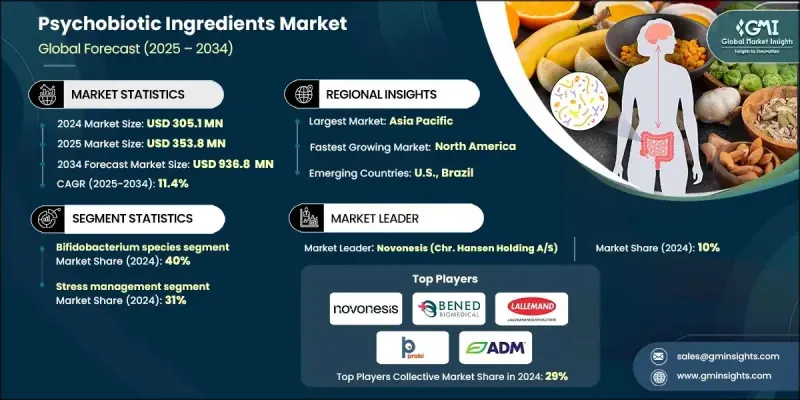
益生菌成分由特定的益生菌菌株组成,它们透过影响肠脑轴内的路径来支持情绪健康。这些微生物来自一些以影响神经活动、神经传导物质讯号传导和整体心理平衡而闻名的细菌群。它们透过多种生物学作用发挥作用,包括形成神经活性分子、调节下丘脑-垂体-肾上腺轴(HPA轴)、缓解发炎反应、增强肠道屏障以及刺激肠脑之间的神经通讯。它们的成分与消化细胞和免疫细胞相互作用,发出可能影响情绪和认知过程的信号。研究结果表明,当人们持续使用这些成分时,压力指标、荷尔蒙平衡、焦虑指标和认知能力均有显着改善。随着人们对微生物组和心理健康的兴趣持续增长,益生菌正从早期科学探索阶段过渡到成熟的商业解决方案,并得到菌株特异性临床证据的支持。大众对心理健康的认识不断提高,以及对天然和科学支持的健康产品的兴趣日益浓厚,正在推动益生菌获得更广泛的市场认可。
| 市场范围 | |
|---|---|
| 起始年份 | 2024 |
| 预测年份 | 2025-2034 |
| 起始值 | 3.051亿美元 |
| 预测值 | 9.368亿美元 |
| 复合年增长率 | 11.4% |
双歧桿菌属在 2024 年占据了 40% 的市场份额,预计到 2034 年将以 15.1% 的复合年增长率增长。这些菌种之所以引领市场,是因为它们对肠脑通讯的影响已被充分证实,并且有大量研究支持它们能够影响神经传导物质路径、压力反应系统和发炎标记。
2024年,压力管理细分市场占31%的市场份额,预计到2034年将以10%的复合年增长率成长。此细分市场持续扩张,是因为消费者寻求可靠的解决方案,这些解决方案需有科学证据支持,能够降低与压力相关的生物标记并提高整体韧性。
2024年,北美益生菌成分市占率达到10.8%,并持续稳定成长。该地区受益于成熟的微生物组研究科学体系、日益增强的肠脑轴认知以及强大的膳食补充剂产业。此外,公众意识的提升、职场健康计划以及对经临床验证的天然产品的需求,都进一步推动了该地区的成长。
活跃于益生菌原料市场的主要公司包括:菲仕兰坎皮纳原料公司 (FrieslandCampina Ingredients)、Seed Health、帝斯曼-菲美意公司 (DSM-Firmenich)、ADM、拉勒曼健康解决方案公司 (Lallemand Health Solutions)、Winclove Probiotics BV、Unique Biotech Limited、Novone 控股公司(Hlcia) AB、Bened Biomedical Co., Ltd.、AB-Biotics(KANEKA 子公司)以及乐斯福旗下的 Gnosis。这些公司采用多种策略方法来巩固其竞争优势。许多公司投资于先进的菌株开发和临床研究,以建立强有力的科学基础来证明其对心理健康的益处。与膳食补充剂品牌、食品製造商和研究机构建立合作关係有助于扩大商业覆盖范围并加速创新。此外,各公司也专注于与监管法规的协调一致,以支持其关于压力、情绪和认知健康的声明。产品多元化,包括针对特定消费群体量身定制的配方,增强了产品组合的吸引力。
目录
第一章:方法论与范围
第二章:执行概要
第三章:行业洞察
- 产业生态系分析
- 供应商格局
- 利润率
- 每个阶段的价值增加
- 影响价值链的因素
- 中断
- 产业影响因素
- 成长驱动因素
- 产业陷阱与挑战
- 市场机会
- 成长潜力分析
- 监管环境
- 北美洲
- 欧洲
- 亚太地区
- 拉丁美洲
- 中东和非洲
- 波特的分析
- PESTEL 分析
- 价格趋势
- 按地区
- 按细菌菌株类型
- 未来市场趋势
- 技术与创新格局
- 当前技术趋势
- 新兴技术
- 专利格局
- 贸易统计(HS编码)(註:仅提供重点国家的贸易统计资料)
- 主要进口国
- 主要出口国
- 永续性和环境方面
- 永续实践
- 减少废弃物策略
- 生产中的能源效率
- 环保倡议
- 碳足迹考量
第四章:竞争格局
- 介绍
- 公司市占率分析
- 按地区
- 北美洲
- 欧洲
- 亚太地区
- 拉丁美洲
- MEA
- 按地区
- 公司矩阵分析
- 主要市场参与者的竞争分析
- 竞争定位矩阵
- 关键进展
- 併购
- 合作伙伴关係与合作
- 新产品发布
- 扩张计划
第五章:市场估算与预测:依细菌菌株类型划分,2021-2034年
- 主要趋势
- 乳桿菌属
- 植物乳桿菌
- 鼠李糖乳桿菌
- 瑞士乳香
- 嗜酸乳桿菌
- 干酪乳桿菌
- 罗伊氏乳桿菌
- 双歧桿菌属
- 短双歧桿菌
- 长双歧桿菌
- 婴儿双歧桿菌
- 乳酸双歧桿菌
- 双歧桿菌
- 动物双歧桿菌
- 芽孢桿菌属
- 凝结芽孢桿菌
- 枯草桿菌
- 其他有益物种
第六章:市场估算与预测:依应用领域划分,2021-2034年
- 主要趋势
- 压力管理
- 企业用户
- 学生
- 医护人员
- 缓解焦虑
- 广泛性焦虑症的应用
- 社交焦虑症应用
- 忧郁症治疗
- 轻度至中度忧郁症
- 抗忧郁药物的辅助治疗
- 认知功能增强
- 记忆增强
- 学习能力提升
- 执行功能支持
- 预防老化和失智症
- 情绪与幸福感提升
- 整体健康状况
- 临床情绪应用
- 神经系统和行为障碍
- 自闭症谱系障碍(ASD)
- 注意力不足过动症(ADHD)
- 其他神经发育障碍
第七章:市场估计与预测:依地区划分,2021-2034年
- 主要趋势
- 北美洲
- 我们
- 加拿大
- 欧洲
- 德国
- 英国
- 法国
- 西班牙
- 义大利
- 欧洲其他地区
- 亚太地区
- 中国
- 印度
- 日本
- 澳洲
- 韩国
- 亚太其他地区
- 拉丁美洲
- 巴西
- 墨西哥
- 阿根廷
- 拉丁美洲其他地区
- 中东和非洲
- 沙乌地阿拉伯
- 南非
- 阿联酋
- 中东和非洲其他地区
第八章:公司简介
- Novonesis (Chr. Hansen Holding A/S)
- Bened Biomedical Co., Ltd.
- Lallemand Health Solutions
- Probi AB
- ADM (Archer Daniels Midland)
- AB-Biotics (KANEKA subsidiary)
- Seed Health
- BioGaia AB
- Kerry Group plc
- FrieslandCampina Ingredients
- Gnosis by Lesaffre
- Winclove Probiotics BV
- DSM-Firmenich
- Unique Biotech Limited
The Global Psychobiotic Ingredients Market was valued at USD 305.1 million in 2024 and is estimated to grow at a CAGR of 11.4% to reach USD 936.8 million by 2034.
Psychobiotic ingredients consist of targeted probiotic strains that support emotional well-being by influencing pathways within the gut-brain connection. These microorganisms come from bacterial groups known for their ability to affect neurological activity, neurotransmitter signaling, and overall psychological balance. They operate through diverse biological actions, including the formation of neuroactive molecules, regulation of the HPA axis, moderation of inflammatory responses, strengthening of the intestinal barrier, and stimulation of neural communication between the gut and the brain. Their components interact with digestive and immune cells to send signals that may influence mood and cognitive processes. Research findings have shown measurable improvements in stress markers, hormonal balance, anxiety indicators, and cognitive performance when individuals use these ingredients consistently. As interest in the microbiome and mental wellness continues to rise, psychobiotics are transitioning from early scientific exploration to established commercial solutions supported by strain-specific clinical evidence. Greater public understanding of mental health, combined with growing interest in natural and science-backed wellness products, is driving broader market acceptance.
| Market Scope | |
|---|---|
| Start Year | 2024 |
| Forecast Year | 2025-2034 |
| Start Value | $305.1 Million |
| Forecast Value | $936.8 Million |
| CAGR | 11.4% |
The bifidobacterium species segment held 40% share in 2024 and is expected to grow at a CAGR of 15.1% through 2034. These species lead the market due to their well-documented effects on gut-brain communication, supported by strong research that highlights their ability to influence neurotransmitter pathways, stress response systems, and inflammatory markers.
The stress management segment accounted for 31% share in 2024 and is projected to grow at a CAGR of 10% through 2034. This segment continues to expand because consumers seek reliable solutions supported by scientific evidence showing reductions in stress-related biomarkers and improved overall resilience.
North America Psychobiotic Ingredients Market held a 10.8% share in 2024 and continues to show steady advancement. The region benefits from an established scientific community focused on microbiome research, growing awareness of the gut-brain connection, and a strong supplement industry. Awareness initiatives, workplace wellness programs, and demand for clinically supported natural products further reinforce regional growth.
Major companies active in the Psychobiotic Ingredients Market include FrieslandCampina Ingredients, Seed Health, DSM-Firmenich, ADM, Lallemand Health Solutions, Winclove Probiotics B.V., Unique Biotech Limited, Novonesis (Chr. Hansen Holding A/S), Probi AB, Kerry Group plc, BioGaia AB, Bened Biomedical Co., Ltd., AB-Biotics (KANEKA subsidiary), and Gnosis by Lesaffre. Companies in the Psychobiotic Ingredients Market use several strategic approaches to reinforce their competitive standing. Many invest in advanced strain development and clinical research to build strong scientific validation for mental wellness benefits. Partnerships with supplement brands, food manufacturers, and research institutions help expand commercial reach and accelerate innovation. Firms also emphasize regulatory alignment to support claims related to stress, mood, and cognitive health. Product diversification, including formulations tailored for specific consumer groups, strengthens portfolio appeal.
Table of Contents
Chapter 1 Methodology & Scope
- 1.1 Market scope and definition
- 1.2 Research design
- 1.2.1 Research approach
- 1.2.2 Data collection methods
- 1.3 Data mining sources
- 1.3.1 Global
- 1.3.2 Regional/Country
- 1.4 Base estimates and calculations
- 1.4.1 Base year calculation
- 1.4.2 Key trends for market estimation
- 1.5 Primary research and validation
- 1.5.1 Primary sources
- 1.6 Forecast model
- 1.7 Research assumptions and limitations
Chapter 2 Executive Summary
- 2.1 Industry 360° synopsis
- 2.2 Key market trends
- 2.2.1 Regional
- 2.2.2 Bacterial strain type
- 2.2.3 Application
- 2.2.4 Region
- 2.3 TAM Analysis, 2025-2034
- 2.4 CXO perspectives: Strategic imperatives
- 2.4.1 Executive decision points
- 2.4.2 Critical success factors
- 2.5 Future Outlook and Strategic Recommendations
Chapter 3 Industry Insights
- 3.1 Industry ecosystem analysis
- 3.1.1 Supplier landscape
- 3.1.2 Profit margin
- 3.1.3 Value addition at each stage
- 3.1.4 Factor affecting the value chain
- 3.1.5 Disruptions
- 3.2 Industry impact forces
- 3.2.1 Growth drivers
- 3.2.2 Industry pitfalls and challenges
- 3.2.3 Market opportunities
- 3.3 Growth potential analysis
- 3.4 Regulatory landscape
- 3.4.1 North America
- 3.4.2 Europe
- 3.4.3 Asia Pacific
- 3.4.4 Latin America
- 3.4.5 Middle East & Africa
- 3.5 Porter's analysis
- 3.6 PESTEL analysis
- 3.7 Price trends
- 3.7.1 By region
- 3.7.2 By bacterial strain type
- 3.8 Future market trends
- 3.9 Technology and Innovation landscape
- 3.9.1 Current technological trends
- 3.9.2 Emerging technologies
- 3.10 Patent Landscape
- 3.11 Trade statistics (HS code) ( Note: the trade statistics will be provided for key countries only)
- 3.11.1 Major importing countries
- 3.11.2 Major exporting countries
- 3.12 Sustainability and environmental aspects
- 3.12.1 Sustainable practices
- 3.12.2 Waste reduction strategies
- 3.12.3 Energy efficiency in production
- 3.12.4 Eco-friendly initiatives
- 3.13 Carbon footprint consideration
Chapter 4 Competitive Landscape, 2024
- 4.1 Introduction
- 4.2 Company market share analysis
- 4.2.1 By region
- 4.2.1.1 North America
- 4.2.1.2 Europe
- 4.2.1.3 Asia Pacific
- 4.2.1.4 LATAM
- 4.2.1.5 MEA
- 4.2.1 By region
- 4.3 Company matrix analysis
- 4.4 Competitive analysis of major market players
- 4.5 Competitive positioning matrix
- 4.6 Key developments
- 4.6.1 Mergers & acquisitions
- 4.6.2 Partnerships & collaborations
- 4.6.3 New Product Launches
- 4.6.4 Expansion Plans
Chapter 5 Market Estimates and Forecast, By Bacterial Strain Type, 2021-2034 (USD Billion) (Kilo Tons)
- 5.1 Key trends
- 5.2 Lactobacillus species
- 5.2.1 L. plantarum
- 5.2.2 L. rhamnosus
- 5.2.3 L. helveticus
- 5.2.4 L. acidophilus
- 5.2.5 L. casei
- 5.2.6 L. reuteri
- 5.3 Bifidobacterium species
- 5.3.1 B. breve
- 5.3.2 B. longum
- 5.3.3 B. infantis
- 5.3.4 B. lactis
- 5.3.5 B. bifidum
- 5.3.6 B. animalis
- 5.4 Bacillus species
- 5.4.1 B. coagulans
- 5.4.2 B. subtilis
- 5.5 Other beneficial species
Chapter 6 Market Estimates and Forecast, By Application, 2021-2034 (USD Billion) (Kilo Tons)
- 6.1 Key trends
- 6.2 Stress management
- 6.2.1 Corporate users
- 6.2.2 Students
- 6.2.3 Healthcare workers
- 6.3 Anxiety reduction
- 6.3.1 Generalized anxiety applications
- 6.3.2 Social anxiety applications
- 6.4 Depression treatment
- 6.4.1 Mild-to-moderate depression
- 6.4.2 Adjunct therapy to antidepressants
- 6.5 Cognitive function enhancement
- 6.5.1 Memory enhancement
- 6.5.2 Learning improvement
- 6.5.3 Executive function support
- 6.5.4 Aging & dementia prevention
- 6.6 Mood & well-being enhancement
- 6.6.1 General wellness
- 6.6.2 Clinical mood applications
- 6.7 Neurological & behavioral disorders
- 6.7.1 Autism spectrum disorder (ASD)
- 6.7.2 Attention deficit hyperactivity disorder (ADHD)
- 6.7.3 Other neurodevelopmental conditions
Chapter 7 Market Estimates and Forecast, By Region, 2021-2034 (USD Billion) (Kilo Tons)
- 7.1 Key trends
- 7.2 North America
- 7.2.1 U.S.
- 7.2.2 Canada
- 7.3 Europe
- 7.3.1 Germany
- 7.3.2 UK
- 7.3.3 France
- 7.3.4 Spain
- 7.3.5 Italy
- 7.3.6 Rest of Europe
- 7.4 Asia Pacific
- 7.4.1 China
- 7.4.2 India
- 7.4.3 Japan
- 7.4.4 Australia
- 7.4.5 South Korea
- 7.4.6 Rest of Asia Pacific
- 7.5 Latin America
- 7.5.1 Brazil
- 7.5.2 Mexico
- 7.5.3 Argentina
- 7.5.4 Rest of Latin America
- 7.6 Middle East and Africa
- 7.6.1 Saudi Arabia
- 7.6.2 South Africa
- 7.6.3 UAE
- 7.6.4 Rest of Middle East and Africa
Chapter 8 Company Profiles
- 8.1 Novonesis (Chr. Hansen Holding A/S)
- 8.2 Bened Biomedical Co., Ltd.
- 8.3 Lallemand Health Solutions
- 8.4 Probi AB
- 8.5 ADM (Archer Daniels Midland)
- 8.6 AB-Biotics (KANEKA subsidiary)
- 8.7 Seed Health
- 8.8 BioGaia AB
- 8.9 Kerry Group plc
- 8.10 FrieslandCampina Ingredients
- 8.11 Gnosis by Lesaffre
- 8.12 Winclove Probiotics B.V.
- 8.13 DSM-Firmenich
- 8.14 Unique Biotech Limited


