


 |
市场调查报告书
商品编码
1885882
太阳能树市场机会、成长驱动因素、产业趋势分析及预测(2025-2034年)Solar Tree Market Opportunity, Growth Drivers, Industry Trend Analysis, and Forecast 2025 - 2034 |
||||||

2024 年全球太阳能树市场价值为 2.903 亿美元,预计到 2034 年将以 7% 的复合年增长率增长至 5.715 亿美元。
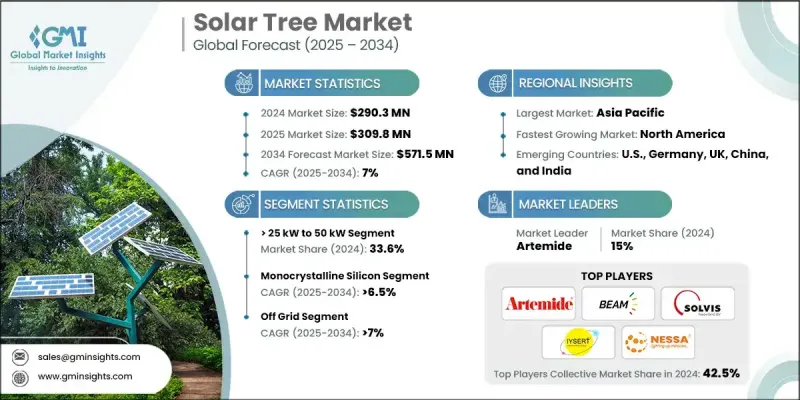
随着模组化、使用者友善设计以及对城市环境适应性的提升,太阳能树在公共空间的部署迎来新的机会,市场正蓬勃发展。智慧照明系统与节能城市规划的融合,进一步强化了太阳能树在永续基础设施中的作用。太阳能树是一种在树枝上安装光伏板的结构,用于捕获太阳能并将其转化为电能。其设计旨在优化空间利用,同时为城市或公共区域提供美观的再生能源解决方案。人们对美观性和实用性能源发电的双重需求,正使太阳能树成为城市建筑计画的首选。轻质耐腐蚀材料和高性能光电技术的进步,提升了太阳能树在各种气候条件下的耐久性。物联网监控系统与即时能源分析的结合,提高了运作效率和预测性维护能力。在太阳能树安装的同时,电动车充电设施的扩展,也为向清洁出行解决方案的转型提供了支持。
| 市场范围 | |
|---|---|
| 起始年份 | 2024 |
| 预测年份 | 2025-2034 |
| 起始值 | 2.903亿美元 |
| 预测值 | 5.715亿美元 |
| 复合年增长率 | 7% |
2024年,额定功率大于25千瓦至50千瓦的太阳能树状系统市占率达33.6%,预计到2034年将以超过6.5%的复合年增长率成长。高效能太阳能组件和坚固的结构设计使该细分市场成为大规模商业应用的理想选择。与先进的储能係统和智慧能源管理平台集成,可提高关键基础设施应用的可靠性。
预计到2034年,多晶硅太阳能树市场规模将达8,000万美元。成本效益高的多晶硅面板结合简化的製造方法,提高了太阳能树专案的经济性。耐用材料与多晶硅技术的结合,增强了太阳能树在恶劣户外环境下的稳定性。
2024年,美国太阳能树市场规模预计将达4,250万美元。太阳能树设计的创新以及与电动车充电站的整合,正在推动城市清洁旅行计画的实施。智慧电网连接的发展与再生能源政策的实施一致,为太阳能树的大规模部署创造了有利条件。
全球太阳能树市场的主要参与者包括SmartFlower、Solar Forma、SolarLogix、Kondaas Solar Energy、LEADSUN、Spotlight Solar、RS Power Systems、EV Energy、Solvis、URJA SAUR ELECTRONICS、Imagine Powertree、SolarBotanic Tree、AGNI SOLAR SYSTEMS、Artemide、Inject Tree、SolarBotanic Tree、AGNI Energy ERACS SYSTEMS、Artemide、Inivity Solar、Yelson EnergyG、Eelom Energy、AxjDA、Artem Energy、ImERTer、Got Energy”这些公司正透过加强研发投入来提升面板效率、结构耐久性和模组化程度,巩固其市场地位。与城市规划者、再生能源公司和电动车充电基础设施供应商的策略合作有助于拓展部署机会。此外,各公司也致力于智慧能源整合、物联网监控系统和预测性维护解决方案,以提升营运效率。地理扩张、收购新兴新创企业以及轻量化、低成本材料的创新,都有助于提升其市场竞争力。
目录
第一章:方法论与范围
第二章:执行概要
第三章:行业洞察
- 产业生态系分析
- 原物料供应及采购分析
- 製造能力评估
- 供应链韧性与风险因素
- 配电网路分析
- 监管环境
- 产业影响因素
- 成长驱动因素
- 产业陷阱与挑战
- 成长潜力分析
- 波特的分析
- PESTEL 分析
- 太阳能树的成本结构分析
- 新兴机会与趋势
- 数位化和物联网集成
- 投资分析及未来展望
第四章:竞争格局
- 介绍
- 按地区分類的公司市占率分析
- 北美洲
- 欧洲
- 亚太地区
- 中东和非洲
- 拉丁美洲
- 战略仪錶板
- Key partnerships & collaborations
- Major M&A activities
- Product innovations & launches
- Market expansion strategies
- 策略倡议
- 竞争性标竿分析
- 创新与技术格局
第五章:市场规模及预测:依产能划分,2021-2034年
- 主要趋势
- ≤ 10 千瓦
- 10千瓦至25千瓦
- 25千瓦至50千瓦
- 大于 50 千瓦
第六章:市场规模及预测:依技术划分,2021-2034年
- 主要趋势
- 单晶硅
- 多晶硅
- 薄膜
第七章:市场规模及预测:以连结方式划分,2021-2034年
- 主要趋势
- 离网
- 电网
第八章:市场规模及预测:依组件划分,2021-2034年
- 主要趋势
- 电池
- 太阳能光电模组
- 逆变器
- 电缆和连接器
第九章:市场规模及预测:依应用领域划分,2021-2034年
- 主要趋势
- 住宅
- 商业和工业
- 公用事业
第十章:市场规模及预测:依地区划分,2021-2034年
- 主要趋势
- 北美洲
- 我们
- 加拿大
- 墨西哥
- 欧洲
- 德国
- 英国
- 奥地利
- 挪威
- 义大利
- 西班牙
- 法国
- 荷兰
- 亚太地区
- 中国
- 日本
- 印度
- 韩国
- 澳洲
- 新加坡
- 中东和非洲
- 沙乌地阿拉伯
- 阿联酋
- 南非
- 拉丁美洲
- 巴西
- 阿根廷
第十一章:公司简介
- AGNI SOLAR SYSTEMS
- Artemide
- Beam Global
- EVT Energy
- Imagine Powertree
- Infinity Solar Energy
- IYSERT ENERGY
- Kondaas Solar Energy
- Kotson Solar
- LEADSUN
- NESSA
- RS Power Systems
- SmartFlower
- Solar Forma
- Solar Tree
- SolarBotanic Tree
- SolarLogix
- Solvis
- Spotlight Solar
- URJA SAUR ELECTRONICS
The Global Solar Tree Market was valued at USD 290.3 million in 2024 and is estimated to grow at a CAGR of 7% to reach USD 571.5 million by 2034.
The market is gaining momentum as modular, user-friendly designs and improved adaptability for urban environments create new opportunities for deployment in public spaces. Integration of smart lighting systems alongside energy-efficient city planning is reinforcing the role of solar trees in sustainable infrastructure. Solar trees are structures that feature photovoltaic panels mounted on branches to capture solar energy and convert it into electricity. They are designed to optimize space while offering a visually appealing renewable energy solution for urban or public areas. Growing demand for both aesthetic appeal and functional energy generation is positioning solar trees as a preferred choice for urban architectural projects. Advances in lightweight, corrosion-resistant materials and high-performance photovoltaic technology are improving durability in diverse climates. The adoption of IoT-enabled monitoring systems combined with real-time energy analytics enhances operational efficiency and predictive maintenance. Expanding electric vehicle charging capabilities alongside solar tree installations is supporting the transition to clean mobility solutions.
| Market Scope | |
|---|---|
| Start Year | 2024 |
| Forecast Year | 2025-2034 |
| Start Value | $290.3 Million |
| Forecast Value | $571.5 Million |
| CAGR | 7% |
The >25 kW to 50 kW rated solar tree segment accounted for 33.6% share in 2024 and is expected to grow at a CAGR of over 6.5% through 2034. High-efficiency solar modules and robust structural designs are making this segment ideal for large-scale commercial use. Integration with advanced energy storage systems and smart energy management platforms enhances reliability for critical infrastructure applications.
The polycrystalline silicon solar tree segment is projected to reach USD 80 million by 2034. Cost-effective polycrystalline panels combined with simplified manufacturing methods are improving affordability for solar tree projects. Durable materials paired with polycrystalline technology are increasing resilience for installations in harsh outdoor environments.
U.S. Solar Tree Market generated USD 42.5 million in 2024. Innovation in solar tree designs and integration with EV charging stations is driving clean mobility initiatives across urban landscapes. Development of smart grid connectivity in alignment with renewable energy mandates is fostering favorable conditions for large-scale solar tree deployment.
Key players operating in the Global Solar Tree Market include SmartFlower, Solar Forma, SolarLogix, Kondaas Solar Energy, LEADSUN, Spotlight Solar, RS Power Systems, EV Energy, Solvis, URJA SAUR ELECTRONICS, Imagine Powertree, SolarBotanic Tree, AGNI SOLAR SYSTEMS, Artemide, Infinity Solar Energy, EVT Energy, Kotson Solar, NESSA, and IYSERT ENERGY. Companies in the Global Solar Tree Market are strengthening their presence by investing in research and development to enhance panel efficiency, structural durability, and modularity. Strategic collaborations with urban planners, renewable energy firms, and EV charging infrastructure providers help expand deployment opportunities. Firms are also focusing on smart energy integration, IoT-enabled monitoring systems, and predictive maintenance solutions to improve operational performance. Geographic expansion, acquisition of emerging startups, and innovation in lightweight, cost-effective materials support competitive positioning.
Table of Contents
Chapter 1 Methodology & Scope
- 1.1 Research design
- 1.1.1 Research approach
- 1.1.2 Data collection methods
- 1.2 Base estimates and calculations
- 1.2.1 Base year calculation
- 1.2.2 Market estimates & forecast parameters
- 1.3 Forecast
- 1.3.1 Key trends for market estimates
- 1.3.2 Quantified market impact analysis
- 1.3.2.1 Mathematical impact of growth parameters on forecast
- 1.3.3 Scenario analysis framework
- 1.4 Primary research and validation
- 1.4.1 Some of the primary sources (but not limited to)
- 1.5 Data mining sources
- 1.5.1 Paid Sources
- 1.5.2 Sources, by region
- 1.6 Research trail & scoring components
- 1.6.1 Research trail components
- 1.6.2 Scoring components
- 1.7 Research transparency addendum
- 1.7.1 Source attribution framework
- 1.7.2 Quality assurance metrics
- 1.7.3 Our commitment to trust
- 1.8 Market definitions
Chapter 2 Executive Summary
- 2.1 Industry 360° synopsis, 2021 - 2034
- 2.2 Business trends
- 2.3 Capacity trends
- 2.4 Technology trends
- 2.5 Connectivity trends
- 2.6 Component trends
- 2.7 Application trends
- 2.8 Regional trends
Chapter 3 Industry Insights
- 3.1 Industry ecosystem analysis
- 3.1.1 Raw material availability & sourcing analysis
- 3.1.2 Manufacturing capacity assessment
- 3.1.3 Supply chain resilience & risk factors
- 3.1.4 Distribution network analysis
- 3.2 Regulatory landscape
- 3.3 Industry impact forces
- 3.3.1 Growth drivers
- 3.3.2 Industry pitfalls & challenges
- 3.4 Growth potential analysis
- 3.5 Porter's analysis
- 3.5.1 Bargaining power of suppliers
- 3.5.2 Bargaining power of buyers
- 3.5.3 Threat of new entrants
- 3.5.4 Threat of substitutes
- 3.6 PESTEL analysis
- 3.6.1 Political factors
- 3.6.2 Economic factors
- 3.6.3 Social factors
- 3.6.4 Technological factors
- 3.6.5 Legal factors
- 3.6.6 Environmental factors
- 3.7 Cost structure analysis of solar tree
- 3.8 Emerging opportunities & trends
- 3.9 Digitalization and IoT integration
- 3.10 Investment analysis & future outlook
Chapter 4 Competitive Landscape, 2025
- 4.1 Introduction
- 4.2 Company market share analysis, by region, 2024
- 4.2.1 North America
- 4.2.2 Europe
- 4.2.3 Asia Pacific
- 4.2.4 Middle East & Africa
- 4.2.5 Latin America
- 4.3 Strategic dashboard
- 4.3.1 Key partnerships & collaborations
- 4.3.2 Major M&A activities
- 4.3.3 Product innovations & launches
- 4.3.4 Market expansion strategies
- 4.4 Strategic initiatives
- 4.5 Competitive benchmarking
- 4.6 Innovation & technology landscape
Chapter 5 Market Size and Forecast, By Capacity, 2021 - 2034 (USD Million)
- 5.1 Key trends
- 5.2 ≤ 10 kW
- 5.3 > 10 kW to 25 kW
- 5.4 > 25 kW to 50 kW
- 5.5 > 50 kW
Chapter 6 Market Size and Forecast, By Technology, 2021 - 2034 (USD Million)
- 6.1 Key trends
- 6.2 Monocrystalline silicon
- 6.3 Polycrystalline silicon
- 6.4 Thin-film
Chapter 7 Market Size and Forecast, By Connectivity, 2021 - 2034 (USD Million)
- 7.1 Key trends
- 7.2 Off grid
- 7.3 On grid
Chapter 8 Market Size and Forecast, By Component, 2021 - 2034 (USD Million)
- 8.1 Key trends
- 8.2 Battery
- 8.3 Solar PV modules
- 8.4 Inverter
- 8.5 Cables and connectors
Chapter 9 Market Size and Forecast, By Application, 2021 - 2034 (USD Million)
- 9.1 Key trends
- 9.2 Residential
- 9.3 Commercial & industrial
- 9.4 Utility
Chapter 10 Market Size and Forecast, By Region, 2021 - 2034 (USD Million)
- 10.1 Key trends
- 10.2 North America
- 10.2.1 U.S.
- 10.2.2 Canada
- 10.2.3 Mexico
- 10.3 Europe
- 10.3.1 Germany
- 10.3.2 UK
- 10.3.3 Austria
- 10.3.4 Norway
- 10.3.5 Italy
- 10.3.6 Spain
- 10.3.7 France
- 10.3.8 Netherlands
- 10.4 Asia Pacific
- 10.4.1 China
- 10.4.2 Japan
- 10.4.3 India
- 10.4.4 South Korea
- 10.4.5 Australia
- 10.4.6 Singapore
- 10.5 Middle East & Africa
- 10.5.1 Saudi Arabia
- 10.5.2 UAE
- 10.5.3 South Africa
- 10.6 Latin America
- 10.6.1 Brazil
- 10.6.2 Argentina
Chapter 11 Company Profiles
- 11.1 AGNI SOLAR SYSTEMS
- 11.2 Artemide
- 11.3 Beam Global
- 11.4 EVT Energy
- 11.5 Imagine Powertree
- 11.6 Infinity Solar Energy
- 11.7 IYSERT ENERGY
- 11.8 Kondaas Solar Energy
- 11.9 Kotson Solar
- 11.10 LEADSUN
- 11.11 NESSA
- 11.12 RS Power Systems
- 11.13 SmartFlower
- 11.14 Solar Forma
- 11.15 Solar Tree
- 11.16 SolarBotanic Tree
- 11.17 SolarLogix
- 11.18 Solvis
- 11.19 Spotlight Solar
- 11.20 URJA SAUR ELECTRONICS

 光伏(PV)市场规模、份额、趋势和预测(按类型、併网类型、部署类型、最终用户和地区划分),2026-2034年
 2026年全球太阳能板製造市场报告2026年全球薄膜太阳能模组市场报告
 太阳能隔音屏障市场 - 全球产业规模、份额、趋势、机会及预测(按应用、安装、光学模组、地区和竞争格局划分,2021-2031年)钝化发射极背接触电池市场 - 全球产业规模、份额、趋势、机会及预测(按组件、类型、应用、地区和竞争格局划分,2021-2031年)
 全球黏度测量服务市场(按服务、黏度计类型、技术、终端用户产业划分)预测(2026-2032年)
 光伏材料市场规模、份额和成长分析(按组件、产品、材料、电池类型、安装类型、应用和地区划分)—产业预测(2026-2033 年)
 太阳能市场机会、成长要素、产业趋势分析及2026年至2035年预测2025年全球现场太阳能电动车充电市场报告现场太阳能电子燃料市场机会、成长驱动因素、产业趋势分析及预测(2025-2034年)