


 |
市场调查报告书
商品编码
1892815
炭黑市场机会、成长驱动因素、产业趋势分析及预测(2026-2035年)Carbon Black Market Opportunity, Growth Drivers, Industry Trend Analysis, and Forecast 2026 - 2035 |
||||||

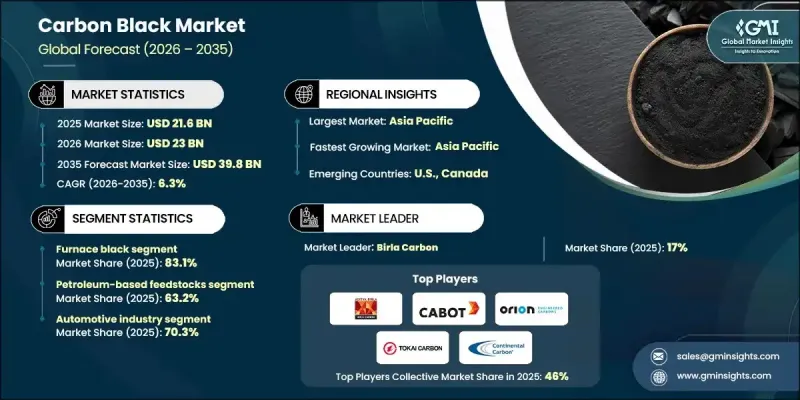
2025年全球炭黑市场价值为216亿美元,预计到2035年将以6.3%的复合年增长率成长至398亿美元。
市场成长主要受多个行业需求的推动。炭黑作为一种细小的碳颗粒,在橡胶製品(尤其是轮胎)中发挥着至关重要的增强作用,能够显着提升轮胎的强度、耐久性和耐磨性。汽车产量的激增,尤其是在发展中地区,是轮胎相关应用的关键驱动因素。此外,炭黑也广泛用作油漆、涂料和油墨的颜料,可提供深邃的黑色和优异的抗紫外线性能。随着电动车和再生能源的发展,炭黑在电子、导电材料、电池和电磁屏蔽等领域的新兴应用也日益增加。目前,针对特定工业用途的特种炭黑也在不断研发中。同时,由于传统製程会产生颗粒物排放和污染物,该产业正面临采用环境永续生产方式的压力。
| 市场范围 | |
|---|---|
| 起始年份 | 2025 |
| 预测年份 | 2026-2035 |
| 起始值 | 216亿美元 |
| 预测值 | 398亿美元 |
| 复合年增长率 | 6.3% |
2025年,炉法炭黑市占率达到83.1%,预计到2035年将以6.3%的复合年增长率成长。其成本效益和大规模生产能力使其成为应用最广泛的炭黑形式。橡胶、塑胶、涂料和油墨产业是其主要消费产业,这主要受对耐用、高性能产品的需求所驱动。
2025年,石油基原料市占率达到63.2%,预计2026年至2035年将以6.4%的复合年增长率成长。石油因其储量丰富且经济可行,仍是主要的原料。先进的炼製和加工技术正在被应用,以提高效率并减少排放。
预计到2025年,北美炭黑市占率将达到14.8%。汽车、橡胶和包装产业的成长,以及永续生产技术的应用,是推动市场成长的主要动力。美国和加拿大对绿色技术的投资以及严格的环境法规,促使製造商在保持高性能的同时,生产更清洁、生物基的炭黑。
目录
第一章:方法论与范围
第二章:执行概要
第三章:行业洞察
- 产业生态系分析
- 供应商格局
- 利润率
- 每个阶段的价值增加
- 影响价值链的因素
- 中断
- 产业影响因素
- 成长驱动因素
- 产业陷阱与挑战
- 市场机会
- 成长潜力分析
- 监管环境
- 北美洲
- 欧洲
- 亚太地区
- 拉丁美洲
- 中东和非洲
- 波特的分析
- PESTEL 分析
- 价格趋势
- 按地区
- 按原料
- 未来市场趋势
- 技术与创新格局
- 当前技术趋势
- 新兴技术
- 专利格局
- 贸易统计(HS编码)(註:仅提供重点国家的贸易统计资料)
- 主要进口国
- 主要出口国
- 永续性和环境方面
- 永续实践
- 减少废弃物策略
- 生产中的能源效率
- 环保倡议
- 碳足迹考量
第四章:竞争格局
- 介绍
- 公司市占率分析
- 按地区
- 北美洲
- 欧洲
- 亚太地区
- 拉丁美洲
- MEA
- 按地区
- 公司矩阵分析
- 主要市场参与者的竞争分析
- 竞争定位矩阵
- 关键进展
- 併购
- 合作伙伴关係与合作
- 新产品发布
- 扩张计划
第五章:市场估算与预测:依製造流程划分,2022-2035年
- 炉黑
- 热黑
- 乙炔黑
- 灯黑
- 频道骇
第六章:市场估算与预测:依原料划分,2022-2035年
- 石油基原料
- 煤基原料
- 天然气
- 生物基和可再生原料
第七章:市场估算与预测:依最终用途产业划分,2022-2035年
- 汽车产业
- 轮胎製造
- 非轮胎汽车橡胶
- 汽车塑料
- 汽车涂料
- 建筑业
- 屋顶材料
- 密封剂和黏合剂
- 土工膜防水材料
- 电缆和导管
- 工业製造
- 传送带
- 工业软管和垫圈
- 机械橡胶製品
- 工业涂料
- 电学
- 电池製造
- 半导体
- 电线电缆绝缘
- 导电聚合物及复合材料
- 包装产业
- 塑胶包装
- 食品接触材料
- 阻隔膜
- 印刷出版
- 印刷油墨
- 碳粉和喷墨墨水
- 纺织业
- 纺织品印染
- 纤维改性
- 特种布料
- 其他行业
第八章:市场估算与预测:依地区划分,2022-2035年
- 北美洲
- 我们
- 加拿大
- 欧洲
- 德国
- 英国
- 法国
- 西班牙
- 义大利
- 欧洲其他地区
- 亚太地区
- 中国
- 印度
- 日本
- 澳洲
- 韩国
- 亚太其他地区
- 拉丁美洲
- 巴西
- 墨西哥
- 阿根廷
- 拉丁美洲其他地区
- 中东和非洲
- 沙乌地阿拉伯
- 南非
- 阿联酋
- 中东和非洲其他地区
第九章:公司简介
- Asahi Carbon Co., Ltd.
- Birla Carbon India Private Limited
- Black Bear Carbon BV
- Cabot Corporation
- China Synthetic Rubber Corporation
- Continental Carbon
- Jinneng Science and Technology Company Limited
- Longxing Chemical Stock Co., Ltd.
- Mitsubishi Chemical Corporation
- Monolith Materials, Inc.
- OCI Company Ltd
- Omsk Carbon Group OOO
- Orion Engineered Carbons SA
- Phillips Carbon Black Limited
- Qingzhou Boao Carbon Black Co., Ltd.
- Shandong Huadong Rubber Materials Co., Ltd.
- Tokai Carbon Co., Ltd.
The Global Carbon Black Market was valued at USD 21.6 billion in 2025 and is estimated to grow at a CAGR of 6.3% to reach USD 39.8 billion by 2035.
The market is propelled by the expanding demand across multiple industries. Carbon black, as a finely divided form of carbon, plays a vital role as a reinforcing agent in rubber products, particularly tires, where it enhances strength, durability, and wear resistance. The surge in automotive production, especially in developing regions, is a key driver for tire-related applications. Additionally, carbon black is extensively used as a pigment in paints, coatings, and inks, offering deep black coloration and UV resistance. Emerging applications in electronics, conductive materials, batteries, and electromagnetic shielding align with the growth of electric vehicles and renewable energy. Specialty carbon blacks are also being developed for tailored industrial uses. At the same time, the industry is experiencing pressure to adopt environmentally sustainable manufacturing practices due to the particulate emissions and pollutants from conventional processes.
| Market Scope | |
|---|---|
| Start Year | 2025 |
| Forecast Year | 2026-2035 |
| Start Value | $21.6 Billion |
| Forecast Value | $39.8 Billion |
| CAGR | 6.3% |
The furnace black segment held an 83.1% share in 2025 and is projected to grow at a CAGR of 6.3% through 2035. Its cost-effectiveness and large-scale manufacturability make it the most widely used form of carbon black. The rubber, plastics, coatings, and ink industries are the primary consumers, driven by demand for durable, high-performance products.
The petroleum-based feedstocks segment held a 63.2% share in 2025 and is expected to grow at a CAGR of 6.4% from 2026 to 2035. Petroleum remains the dominant raw material due to its availability and economic feasibility. Advanced refining and processing technologies are being implemented to enhance efficiency and reduce emissions.
North America Carbon Black Market accounted for a 14.8% share in 2025. Growth is fueled by the automotive, rubber, and packaging industries, coupled with the adoption of sustainable production technologies. Investments in green technologies and strict environmental regulations in the U.S. and Canada are motivating manufacturers to produce cleaner, bio-based carbon blacks while maintaining high performance.
Major players in the Global Carbon Black Market include Continental Carbon, Black Bear Carbon BV, Mitsubishi Chemical Corporation, Birla Carbon India Private Limited, OCI Company Ltd, Asahi Carbon Co., Ltd., Jinneng Science and Technology Company Limited, Tokai Carbon Co., Ltd., Orion Engineered Carbons S.A., Phillips Carbon Black Limited, China Synthetic Rubber Corporation, Omsk Carbon Group OOO, Longxing Chemical Stock Co., Ltd., Shandong Huadong Rubber Materials Co., Ltd., and Monolith Materials, Inc. Companies in the Carbon Black Market are strengthening their market positions by investing in R&D to develop high-performance and specialty carbon blacks tailored for automotive, electronics, and industrial applications. Firms are focusing on sustainable production methods, including bio-based feedstocks and cleaner manufacturing technologies, to comply with environmental regulations and appeal to eco-conscious customers. Strategic partnerships with raw material suppliers and manufacturers enable secure supply chains and cost efficiency.
Table of Contents
Chapter 1 Methodology & Scope
- 1.1 Market scope and definition
- 1.2 Research design
- 1.2.1 Research approach
- 1.2.2 Data collection methods
- 1.3 Data mining sources
- 1.3.1 Global
- 1.3.2 Regional/Country
- 1.4 Base estimates and calculations
- 1.4.1 Base year calculation
- 1.4.2 Key trends for market estimation
- 1.5 Primary research and validation
- 1.5.1 Primary sources
- 1.6 Forecast model
- 1.7 Research assumptions and limitations
Chapter 2 Executive Summary
- 2.1 Industry 3600 synopsis
- 2.2 Key market trends
- 2.2.1 Regional
- 2.2.2 Manufacturing process
- 2.2.3 Feedstock
- 2.2.4 End use industry
- 2.3 TAM Analysis, 2026-2035
- 2.4 CXO perspectives: Strategic imperatives
- 2.4.1 Executive decision points
- 2.4.2 Critical success factors
- 2.5 Future Outlook and Strategic Recommendations
Chapter 3 Industry Insights
- 3.1 Industry ecosystem analysis
- 3.1.1 Supplier landscape
- 3.1.2 Profit margin
- 3.1.3 Value addition at each stage
- 3.1.4 Factor affecting the value chain
- 3.1.5 Disruptions
- 3.2 Industry impact forces
- 3.2.1 Growth drivers
- 3.2.2 Industry pitfalls and challenges
- 3.2.3 Market opportunities
- 3.3 Growth potential analysis
- 3.4 Regulatory landscape
- 3.4.1 North America
- 3.4.2 Europe
- 3.4.3 Asia Pacific
- 3.4.4 Latin America
- 3.4.5 Middle East & Africa
- 3.5 Porter's analysis
- 3.6 PESTEL analysis
- 3.7 Price trends
- 3.7.1 By region
- 3.7.2 By feedstock
- 3.8 Future market trends
- 3.9 Technology and Innovation landscape
- 3.9.1 Current technological trends
- 3.9.2 Emerging technologies
- 3.10 Patent Landscape
- 3.11 Trade statistics (HS code) ( Note: the trade statistics will be provided for key countries only)
- 3.11.1 Major importing countries
- 3.11.2 Major exporting countries
- 3.12 Sustainability and environmental aspects
- 3.12.1 Sustainable practices
- 3.12.2 Waste reduction strategies
- 3.12.3 Energy efficiency in production
- 3.12.4 Eco-friendly initiatives
- 3.13 Carbon footprint consideration
Chapter 4 Competitive Landscape, 2025
- 4.1 Introduction
- 4.2 Company market share analysis
- 4.2.1 By region
- 4.2.1.1 North America
- 4.2.1.2 Europe
- 4.2.1.3 Asia Pacific
- 4.2.1.4 LATAM
- 4.2.1.5 MEA
- 4.2.1 By region
- 4.3 Company matrix analysis
- 4.4 Competitive analysis of major market players
- 4.5 Competitive positioning matrix
- 4.6 Key developments
- 4.6.1 Mergers & acquisitions
- 4.6.2 Partnerships & collaborations
- 4.6.3 New Product Launches
- 4.6.4 Expansion Plans
Chapter 5 Market Estimates and Forecast, By Manufacturing Process, 2022-2035 (USD Billion) (Kilo Tons)
- 5.1 Key trends
- 5.2 Furnace black
- 5.3 Thermal black
- 5.4 Acetylene black
- 5.5 Lamp black
- 5.6 Channel black
Chapter 6 Market Estimates and Forecast, By Feedstock, 2022-2035 (USD Billion) (Kilo Tons)
- 6.1 Key trends
- 6.2 Petroleum-based feedstocks
- 6.3 Coal-based feedstocks
- 6.4 Natural gas
- 6.5 Bio-based & renewable feedstocks
Chapter 7 Market Estimates and Forecast, By End Use Industry, 2022-2035 (USD Billion) (Kilo Tons)
- 7.1 Key trends
- 7.2 Automotive industry
- 7.2.1 Tire manufacturing
- 7.2.2 Non-tire automotive rubber
- 7.2.3 Automotive plastics
- 7.2.4 Automotive coatings
- 7.3 Construction industry
- 7.3.1 Roofing materials
- 7.3.2 Sealants & adhesives
- 7.3.3 Geomembranes & waterproofing
- 7.3.4 Cables & conduits
- 7.4 Industrial manufacturing
- 7.4.1 Conveyor belts
- 7.4.2 Industrial hoses & gaskets
- 7.4.3 Mechanical rubber goods
- 7.4.4 Industrial coatings
- 7.5 Electronics & electrical
- 7.5.1 Battery manufacturing
- 7.5.2 Semiconductors
- 7.5.3 Wire & cable insulation
- 7.5.4 Conductive polymers & composites
- 7.6 Packaging industry
- 7.6.1 Plastics packaging
- 7.6.2 Food-contact materials
- 7.6.3 Barrier films
- 7.7 Printing & publishing
- 7.7.1 Printing inks
- 7.7.2 Toners & inkjet inks
- 7.8 Textile industry
- 7.8.1 Textile printing & dyeing
- 7.8.2 Fiber modification
- 7.8.3 Specialty fabrics
- 7.9 Other industries
Chapter 8 Market Estimates and Forecast, By Region, 2022-2035 (USD Billion) (Kilo Tons)
- 8.1 Key trends
- 8.2 North America
- 8.2.1 U.S.
- 8.2.2 Canada
- 8.3 Europe
- 8.3.1 Germany
- 8.3.2 UK
- 8.3.3 France
- 8.3.4 Spain
- 8.3.5 Italy
- 8.3.6 Rest of Europe
- 8.4 Asia Pacific
- 8.4.1 China
- 8.4.2 India
- 8.4.3 Japan
- 8.4.4 Australia
- 8.4.5 South Korea
- 8.4.6 Rest of Asia Pacific
- 8.5 Latin America
- 8.5.1 Brazil
- 8.5.2 Mexico
- 8.5.3 Argentina
- 8.5.4 Rest of Latin America
- 8.6 Middle East and Africa
- 8.6.1 Saudi Arabia
- 8.6.2 South Africa
- 8.6.3 UAE
- 8.6.4 Rest of Middle East and Africa
Chapter 9 Company Profiles
- 9.1 Asahi Carbon Co., Ltd.
- 9.2 Birla Carbon India Private Limited
- 9.3 Black Bear Carbon BV
- 9.4 Cabot Corporation
- 9.5 China Synthetic Rubber Corporation
- 9.6 Continental Carbon
- 9.7 Jinneng Science and Technology Company Limited
- 9.8 Longxing Chemical Stock Co., Ltd.
- 9.9 Mitsubishi Chemical Corporation
- 9.10 Monolith Materials, Inc.
- 9.11 OCI Company Ltd
- 9.12 Omsk Carbon Group OOO
- 9.13 Orion Engineered Carbons S.A.
- 9.14 Phillips Carbon Black Limited
- 9.15 Qingzhou Boao Carbon Black Co., Ltd.
- 9.16 Shandong Huadong Rubber Materials Co., Ltd.
- 9.17 Tokai Carbon Co., Ltd.

 2026年全球黑火药市场报告
 特种奈米碳管管粉末市场:依纯度、类型、生产方法、功能、最终用途和应用划分-全球预测,2026-2032年
 全球炭黑市场(2026-2036)
 炭黑:市场占有率分析、产业趋势与统计、成长预测(2026-2031)全球炭黑市场规模、份额、趋势和成长分析报告(2026-2034年)2026年全球炭黑市场报告2026年全球石墨化炭黑(GCB)市场报告
 炭黑市场-全球产业规模、份额、趋势、机会、预测:按类型、应用、地区和竞争格局划分,2021-2031年炭黑填充母粒市场按类型、等级、产品形式、加工技术、应用和分销管道划分,全球预测(2026-2032年)全球炭黑市场:市场规模、份额、成长率、产业分析、按类型、应用和地区划分的分析、未来预测(2026-2034)