


 |
市场调查报告书
商品编码
1913315
乘用车ADAS市场机会、成长要素、产业趋势分析及2026年至2035年预测Passenger Vehicle ADAS Market Opportunity, Growth Drivers, Industry Trend Analysis, and Forecast 2026 - 2035 |
||||||

全球乘用车ADAS市场预计2025年将达322亿美元,2035年将达1,603亿美元,年复合成长率为17.8%。
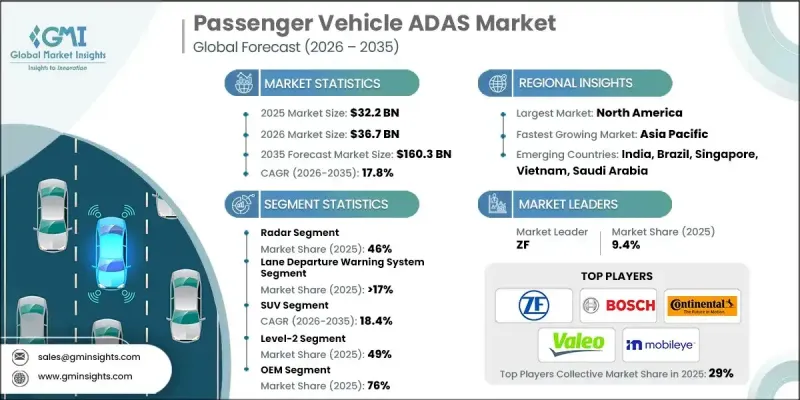
这一成长主要得益于政府日益严格的安全政策和不断发展的车辆评估标准,这些因素促使汽车製造商整合高级驾驶辅助系统 (ADAS) 以满足合规要求并增强自身竞争力。消费者越来越重视安全保障、驾驶便利性和减少疲劳驾驶,这推动了智慧辅助技术在乘用车领域的广泛应用。晶片製造效率的提高、大规模生产以及供应商之间日益激烈的竞争正在降低系统成本,使 ADAS 的应用范围从高端车型扩展到其他车型,而不会显着影响车辆价格。汽车製造商正积极利用 ADAS 功能集作为策略工具,以强化品牌形象、支持定价策略并建立长期的客户忠诚度。消费者对驾驶辅助技术的日益了解进一步增强了市场需求,ADAS 已稳固确立其作为现代乘用车设计核心要素的地位。
| 市场覆盖范围 | |
|---|---|
| 开始年份 | 2025 |
| 预测年份 | 2026-2035 |
| 起始值 | 322亿美元 |
| 预测金额 | 1603亿美元 |
| 复合年增长率 | 17.8% |
预计到2025年,雷达市占率将达到46%。雷达系统凭藉其稳定的性能和可靠性,被定位为ADAS架构的基础感测技术;而影像感测器则因其能够提供支援系统精确判读的精细视觉输入而备受重视。感测器解析度和处理能力的提升正在提高系统的整体精度和稳健性,从而强化多感测器整合在下一代ADAS部署中的作用。
车道偏离预警系统预计在2025年占据17%的市场份额,市场规模约为55亿美元。此细分市场受益于驾驶辅助解决方案日益增长的需求,这些解决方案有助于减轻驾驶员的疲劳,并提高长途驾驶的舒适度。该系统能够帮助维持车辆稳定,从而增强使用者的信心和持续的警觉性,这些因素推动了乘用车车主越来越多地采用此类系统。
预计到2025年,美国乘用车ADAS市场规模将达107亿美元。推动ADAS市场普及的因素包括:消费者对高阶辅助功能日益增长的兴趣、製造商主导的功能差异化以及智慧驾驶功能的日益普及。以软体为中心的汽车平臺和远端更新能力正在加速功能增强,并为所有车型类别催生新的收入模式。此外,监管也朝着透过结构化部署框架,在受控条件下逐步支援更高水准的自动化发展。
目录
第一章调查方法
第二章执行摘要
第三章业界考察
- 生态系分析
- 供应商情况
- 利润率分析
- 成本结构
- 每个阶段的附加价值
- 影响价值链的因素
- 中断
- 产业影响因素
- 司机
- 监理安全要求
- 消费者偏好安全车辆
- 技术成本降低
- OEM差异化策略
- 电动车的发展
- 产业潜在风险与挑战
- 高系统整合复杂性
- 高度自动化带来的监管不确定性
- 市场机会
- 扩展 2 级以上及 3 级系统
- 感测器融合和人工智慧的进展
- 售后市场和改装潜力
- 数据货币化和软体服务
- 成长潜力分析
- 监管环境
- 北美洲
- 美国- 联邦机动车辆安全标准 (FMVSS)
- 加拿大 - 机动车辆安全法规
- 欧洲
- 英国- 道路车辆(构造和使用)条例
- 德国——自动驾驶法
- 法国 - 流动导向法 (LOM)
- 义大利 - 道路交通法规 (Codice della Strada)
- 西班牙 - 一般交通法规
- 亚太地区
- 中国——智慧网联网汽车法规
- 日本 -道路运输车辆法
- 印度 - 中央机动车规则
- 拉丁美洲
- 巴西 - 国家交通法规
- 墨西哥 - 墨西哥官方车辆安全标准 (NOM)
- 阿根廷 - 国家交通法
- 中东和非洲
- 阿联酋 - 联邦交通法
- 南非 - 国家道路交通法
- 沙乌地阿拉伯 - 交通法规
- 北美洲
- 波特五力分析
- PESTEL 分析
- 科技与创新趋势
- 当前技术趋势
- 新兴技术
- 生产统计
- 生产基地
- 消费中心
- 出口和进口
- 成本細項分析
- 开发成本结构
- 研发成本分析
- 行销和销售成本
- 专利分析
- 永续性和环境方面
- 永续实践
- 减少废弃物策略
- 生产中的能源效率
- 环保倡议
- 对ADAS标准、检验和安全评估的影响
- Euro NCAP、Global NCAP 和 IIHS 评级如何影响 ADAS 的采用
- 联合国欧洲经济委员会法规(R79、R152、R157)及原始设备製造商合规流程
- 按自动化等级分類的认证、检验和测试要求
- 安全评级如何影响OEM功能包装和定价
- ADAS软体和运算架构概述
- 集中式、领域特定型及区域型ADAS架构
- SoC 与 ECU 的演进(ADAS ECU → 集中式计算)
- 中介软体、作业系统和即时性约束
- OTA 更新支援状态及其对软体生命週期的影响
- ADAS成本及支付意愿
- ADAS 资料、网路安全和功能安全(ISO 26262/SOTIF)
- OEM ADAS蓝图与功能迁移分析
第四章 竞争情势
- 介绍
- 公司市占率分析
- 北美洲
- 欧洲
- 亚太地区
- 拉丁美洲
- 中东和非洲
- 主要市场公司的竞争分析
- 竞争定位矩阵
- 战略展望矩阵
- 重大进展
- 併购
- 伙伴关係与合作
- 新产品发布
- 企业扩张计画和资金筹措
第五章 2022-2035年各系统市场估算与预测
- 主动式车距维持定速系统
- 盲点侦测系统
- 车道偏离预警系统
- 自动紧急煞车(AEB)
- 前方碰撞警报
- 夜视系统
- 驾驶员监控
- 轮胎压力监测系统
- 抬头显示器
- 停车辅助系统
- 其他的
第六章 按感测器分類的市场估算与预测,2022-2035年
- 雷达
- 骑士
- 超音波
- 相机
- 其他的
第七章 依车辆类型分類的市场估计与预测,2022-2035年
- 轿车
- SUV
- 掀背车
第八章 2022-2035年各层级市场估算与预测
- 一级
- 二级
- 3级
- 4级
- 5级
9. 2022-2035年按推进方式分類的市场估计与预测
- 内燃机(ICE)
- 电动车(EV)
- 电池式电动车(BEV)
- 混合动力电动车(HCEV)
- 燃料电池汽车(FCEV)
- 杂交种
第十章 按分销管道分類的市场估算与预测,2022-2035年
- OEM
- 售后市场
第十一章 2022-2035年各地区市场估计与预测
- 北美洲
- 美国
- 加拿大
- 欧洲
- 德国
- 英国
- 法国
- 义大利
- 西班牙
- 俄罗斯
- 北欧国家
- 葡萄牙
- 克罗埃西亚
- 比荷卢经济联盟
- 亚太地区
- 中国
- 印度
- 日本
- 澳洲
- 韩国
- 新加坡
- 泰国
- 印尼
- 越南
- 拉丁美洲
- 巴西
- 墨西哥
- 阿根廷
- 哥伦比亚
- 中东和非洲
- 南非
- 沙乌地阿拉伯
- 阿拉伯聯合大公国
- 土耳其
第十二章:公司简介
- 世界公司
- Aisin
- Aptiv
- Autoliv
- Bosch
- Continental
- Denso
- Harman
- Hella Forvia
- Magna International
- Mobileye
- Renesas Electronics
- Texas Instruments
- Valeo
- ZF Friedrichshafen
- 区域玩家
- Ambarella
- Clarion
- Ficosa
- Gentex
- Siemens
- Emerging/Disruptor Players
- Black Sesame Technologies
- Horizon Robotics
- Innoviz Technologies
- Luminar Technologies
- Mobileye Vision Technologies(China)
- Spark Minda
- Uhnder
The Global Passenger Vehicle ADAS Market was valued at USD 32.2 billion in 2025 and is estimated to grow at a CAGR of 17.8% to reach USD 160.3 billion by 2035.
Growth is attributed to stricter government safety policies and evolving vehicle assessment standards that encourage automakers to integrate advanced driver assistance capabilities to meet compliance targets and enhance competitiveness. Buyers are increasingly prioritizing protection, driving ease, and reduced fatigue, which is supporting higher adoption of intelligent assistance technologies across passenger vehicles. Improvements in chip manufacturing efficiency, large-scale production, and intensified supplier competition have lowered system costs, allowing ADAS penetration to expand beyond premium models without significantly impacting vehicle pricing. Manufacturers are actively leveraging ADAS feature sets as a strategic tool to strengthen brand perception, support pricing strategies, and build long-term customer loyalty. Increased consumer familiarity with driver assistance technologies continues to reinforce demand, positioning ADAS as a core component of modern passenger vehicle design.
| Market Scope | |
|---|---|
| Start Year | 2025 |
| Forecast Year | 2026-2035 |
| Start Value | $32.2 Billion |
| Forecast Value | $160.3 Billion |
| CAGR | 17.8% |
The radar segment held 46% share in 2025. Radar systems are positioned as a foundational sensing technology within ADAS architectures due to their consistent performance and reliability. At the same time, image sensors are recognized for delivering detailed visual inputs that support accurate system interpretation. Advancements in sensor resolution and processing capability have improved overall system accuracy and robustness, reinforcing the role of multi-sensor integration in next-generation ADAS deployments.
The lane departure warning system segment held 17% share in 2025, with a valuation of approximately USD 5.5 billion. This segment benefits from the growing demand for driving assistance solutions that help reduce driver workload and improve comfort during extended vehicle operation. The system's ability to support stable vehicle positioning contributes to higher user confidence and sustained attention, factors that are driving its increasing acceptance among passenger vehicle owners.
U.S. Passenger Vehicle ADAS Market was valued at USD 10.7 billion in 2025. Adoption is supported by rising interest in advanced assistance capabilities, manufacturer-led feature differentiation, and broader availability of intelligent driving functions. Software-centric vehicle platforms and remote update capabilities are accelerating feature enhancements and enabling new revenue models across vehicle categories. Regulatory developments are also gradually supporting more advanced automation levels under controlled conditions through structured deployment frameworks.
Key companies active in the Global Passenger Vehicle ADAS Market include Bosch, Mobileye, Continental, Valeo, Aptiv, ZF, Magna International, Denso, Autoliv, Harman, Siemens, and Clarion. Companies operating in the Global Passenger Vehicle ADAS Market are reinforcing their market position through continuous innovation, strategic partnerships, and scalable product development. Leading players are investing heavily in sensor fusion, software intelligence, and system integration to deliver reliable and cost-effective solutions. Collaboration with automakers is helping suppliers align technologies with evolving vehicle platforms and regulatory expectations. Firms are also focusing on modular architectures that allow flexible deployment across different vehicle segments. Expansion of global production capacity and long-term supply agreements are being used to improve cost efficiency and market reach.
Table of Contents
Chapter 1 Methodology
- 1.1 Market scope and definition
- 1.2 Research design
- 1.2.1 Research approach
- 1.2.2 Data collection methods
- 1.3 Data mining sources
- 1.3.1 Global
- 1.3.2 Regional/Country
- 1.4 Base estimates and calculations
- 1.4.1 Base year calculation
- 1.4.2 Key trends for market estimation
- 1.5 Primary research and validation
- 1.5.1 Primary sources
- 1.6 Forecast
- 1.7 Research assumptions and limitations
Chapter 2 Executive Summary
- 2.1 Industry 3600 synopsis, 2022 - 2035
- 2.2 Key market trends
- 2.2.1 Regional
- 2.2.2 System
- 2.2.3 Sensor
- 2.2.4 Vehicle
- 2.2.5 Level
- 2.2.6 Propulsion
- 2.2.7 Distribution Channel
- 2.3 TAM Analysis, 2026-2035
- 2.4 CXO perspectives: Strategic imperatives
- 2.4.1 Executive decision points
- 2.4.2 Critical success factors
- 2.5 Future outlook & strategic recommendations
Chapter 3 Industry Insights
- 3.1 Industry ecosystem analysis
- 3.1.1 Supplier landscape
- 3.1.2 Profit margin analysis
- 3.1.3 Cost structure
- 3.1.4 Value addition at each stage
- 3.1.5 Factor affecting the value chain
- 3.1.6 Disruptions
- 3.2 Industry impact forces
- 3.2.1.1 Growth drivers
- 3.2.1.2 Regulatory safety mandates
- 3.2.1.3 Consumer preference for safer vehicles
- 3.2.1.4 Technology cost reduction
- 3.2.1.5 OEM differentiation strategies
- 3.2.1.6 Growth of electric vehicles
- 3.2.2 Industry pitfalls and challenges
- 3.2.2.1 High system integration complexity
- 3.2.2.2 Regulatory uncertainty for higher automation
- 3.2.3 Market opportunities
- 3.2.3.1 Expansion of Level 2+ and Level 3 systems
- 3.2.3.2 Advancement in sensor fusion and AI
- 3.2.3.3 Aftermarket and retrofit potential
- 3.2.3.4 Data monetization and software services
- 3.3 Growth potential analysis
- 3.4 Regulatory landscape
- 3.4.1 North America
- 3.4.1.1 U.S. - Federal Motor Vehicle Safety Standards (FMVSS)
- 3.4.1.2 Canada - Motor Vehicle Safety Regulations
- 3.4.2 Europe
- 3.4.2.1 UK - Road Vehicles (Construction and Use) Regulations
- 3.4.2.2 Germany - Autonomous Driving Act
- 3.4.2.3 France - Mobility Orientation Law (LOM)
- 3.4.2.4 Italy - Highway Code (Codice della Strada)
- 3.4.2.5 Spain - General Traffic Regulation
- 3.4.3 Asia Pacific
- 3.4.3.1 China - Intelligent Connected Vehicle Regulations
- 3.4.3.2 Japan - Road Transport Vehicle Act
- 3.4.3.3 India - Central Motor Vehicle Rules
- 3.4.4 Latin America
- 3.4.4.1 Brazil - National Traffic Code
- 3.4.4.2 Mexico - Official Mexican Vehicle Safety Standards (NOM)
- 3.4.4.3 Argentina - National Traffic Law
- 3.4.5 Middle East & Africa
- 3.4.5.1 UAE - Federal Traffic Law
- 3.4.5.2 South Africa - National Road Traffic Act
- 3.4.5.3 Saudi Arabia - Traffic Law
- 3.4.1 North America
- 3.5 Porter's analysis
- 3.6 PESTEL analysis
- 3.7 Technology and innovation landscape
- 3.7.1 Current technological trends
- 3.7.2 Emerging technologies
- 3.8 Production statistics
- 3.8.1 Production hubs
- 3.8.2 Consumption hubs
- 3.8.3 Export and import
- 3.9 Cost breakdown analysis
- 3.9.1 Development cost structure
- 3.9.2 R&D cost analysis
- 3.9.3 Marketing & sales costs
- 3.10 Patent analysis
- 3.11 Sustainability and environmental aspects
- 3.11.1 Sustainable practices
- 3.11.2 Waste reduction strategies
- 3.11.3 Energy efficiency in production
- 3.11.4 Eco-friendly Initiatives
- 3.12 ADAS standards, validation & safety ratings impact
- 3.12.1 Euro NCAP, Global NCAP & IIHS rating impact on ADAS adoption
- 3.12.2 UNECE regulations (R79, R152, R157) and OEM compliance pathways
- 3.12.3 Homologation, validation & testing requirements by automation level
- 3.12.4 Impact of safety ratings on OEM feature packaging & pricing
- 3.13 ADAS software & compute architecture landscape
- 3.13.1 Centralized vs domain vs zonal ADAS architectures
- 3.13.2 SoC and ECU evolution (ADAS ECUs → centralized compute)
- 3.13.3 Middleware, operating systems & real-time constraints
- 3.13.4 OTA update readiness & software lifecycle implications
- 3.14 ADAS Cost vs Willingness-to-Pay
- 3.15 ADAS Data, Cybersecurity & Functional Safety (ISO 26262 / SOTIF)
- 3.16 OEM ADAS Roadmap & Feature Migration Analysis
Chapter 4 Competitive Landscape, 2025
- 4.1 Introduction
- 4.2 Company market share analysis
- 4.2.1 North America
- 4.2.2 Europe
- 4.2.3 Asia Pacific
- 4.2.4 LATAM
- 4.2.5 MEA
- 4.3 Competitive analysis of major market players
- 4.4 Competitive positioning matrix
- 4.5 Strategic outlook matrix
- 4.6 Key developments
- 4.6.1 Mergers & acquisitions
- 4.6.2 Partnerships & collaborations
- 4.6.3 New Product Launches
- 4.6.4 Expansion Plans and funding
Chapter 5 Market Estimates & Forecast, By System, 2022 - 2035 ($Bn)
- 5.1 Key trends
- 5.2 Adaptive cruise control
- 5.3 Blind spot detection
- 5.4 Lane departure warning system
- 5.5 Automatic emergency braking (AEB)
- 5.6 Forward collision warning
- 5.7 Night vision system
- 5.8 Driver monitoring
- 5.9 Tire pressure monitoring system
- 5.10 Head-up display
- 5.11 Park assist system
- 5.12 Others
Chapter 6 Market Estimates & Forecast, By Sensor, 2022 - 2035 ($Bn, Units)
- 6.1 Key trends
- 6.2 Radar
- 6.3 Lidar
- 6.4 Ultrasonic
- 6.5 Camera
- 6.6 Others
Chapter 7 Market Estimates & Forecast, By Vehicle, 2022 - 2035 ($Bn, Units)
- 7.1 Key trends
- 7.2 Sedan
- 7.3 SUV
- 7.4 Hatchback
Chapter 8 Market Estimates & Forecast, By Level, 2022-2035 ($Bn, Units)
- 8.1 Key trends
- 8.2 Level-1
- 8.3 Level-2
- 8.4 Level-3
- 8.5 Level-4
- 8.6 Level-5
Chapter 9 Market Estimates & Forecast, By Propulsion, 2022 - 2035 ($Bn, Units)
- 9.1 Key trends
- 9.2 ICE
- 9.3 EV
- 9.3.1 BEV
- 9.3.2 HCEV
- 9.3.3 FCEV
- 9.4 Hybrid
Chapter 10 Market Estimates & Forecast, By Distribution Channel, 2022 - 2035 ($Bn, Units)
- 10.1 Key trends
- 10.2 OEM
- 10.3 Aftermarket
Chapter 11 Market Estimates & Forecast, By Region, 2022 - 2035 ($Bn, Units)
- 11.1 Key trends
- 11.2 North America
- 11.2.1 US
- 11.2.2 Canada
- 11.3 Europe
- 11.3.1 Germany
- 11.3.2 UK
- 11.3.3 France
- 11.3.4 Italy
- 11.3.5 Spain
- 11.3.6 Russia
- 11.3.7 Nordics
- 11.3.8 Portugal
- 11.3.9 Croatia
- 11.3.10 Benelux
- 11.4 Asia Pacific
- 11.4.1 China
- 11.4.2 India
- 11.4.3 Japan
- 11.4.4 Australia
- 11.4.5 South Korea
- 11.4.6 Singapore
- 11.4.7 Thailand
- 11.4.8 Indonesia
- 11.4.9 Vietnam
- 11.5 Latin America
- 11.5.1 Brazil
- 11.5.2 Mexico
- 11.5.3 Argentina
- 11.5.4 Colombia
- 11.6 MEA
- 11.6.1 South Africa
- 11.6.2 Saudi Arabia
- 11.6.3 UAE
- 11.6.4 Turkey
Chapter 12 Company Profiles
- 12.1 Global Players
- 12.1.1 Aisin
- 12.1.2 Aptiv
- 12.1.3 Autoliv
- 12.1.4 Bosch
- 12.1.5 Continental
- 12.1.6 Denso
- 12.1.7 Harman
- 12.1.8 Hella Forvia
- 12.1.9 Magna International
- 12.1.10 Mobileye
- 12.1.11 Renesas Electronics
- 12.1.12 Texas Instruments
- 12.1.13 Valeo
- 12.1.14 ZF Friedrichshafen
- 12.2 Regional Players
- 12.2.1 Ambarella
- 12.2.2 Clarion
- 12.2.3 Ficosa
- 12.2.4 Gentex
- 12.2.5 Siemens
- 12.3 Emerging / Disruptor Players
- 12.3.1 Black Sesame Technologies
- 12.3.2 Horizon Robotics
- 12.3.3 Innoviz Technologies
- 12.3.4 Luminar Technologies
- 12.3.5 Mobileye Vision Technologies (China)
- 12.3.6 Spark Minda
- 12.3.7 Uhnder

 汽车ADAS标定工具市场(按车辆类型、部署模式、标定类型、系统类型、标定方法、最终用户和销售管道),全球预测,2026-2032年汽车ADAS校准设备市场(按设备类型、校准方法、车辆类型和分销管道划分),全球预测(2026-2032年)
 ADAS模拟市场机会、成长要素、产业趋势分析及2026年至2035年预测
 自主半导体维护无人机市场分析及预测(至2035年):按类型、产品类型、服务、技术、组件、应用、最终用户、功能、安装类型、解决方案划分ADAS订阅市场机会、成长要素、产业趋势分析及2026年至2035年预测
 ADAS(进阶驾驶辅助系统)市场报告:按解决方案类型、组件类型、车辆类型和地区划分,2026-2034 年日本驾驶辅助系统市场规模、份额、趋势及预测(按类型、技术、车辆类型和地区划分,2026-2034年)
 ADAS市场-全球产业规模、份额、趋势、机会及预测(按车辆类型、感测器类型、自动驾驶等级、功能、地区和竞争格局划分,2021-2031年)汽车同步器市场 - 全球产业规模、份额、趋势、机会及预测(按车辆类型、需求类别、材料、地区和竞争格局划分,2021-2031年)汽车轻型商用车ADAS市场-全球产业规模、份额、趋势、机会及预测(按感测器类型、自动驾驶等级、功能、地区和竞争格局划分,2021-2031年)