


 |
市场调查报告书
商品编码
1913394
家用清洁工具及用品市场机会、成长要素、产业趋势分析及2026年至2035年预测Household Cleaning Tools and Supplies Market Opportunity, Growth Drivers, Industry Trend Analysis, and Forecast 2026 - 2035 |
||||||

全球家用清洁工具和用品市场预计到 2025 年将达到 343 亿美元,到 2035 年将达到 579 亿美元,年复合成长率为 5.4%。
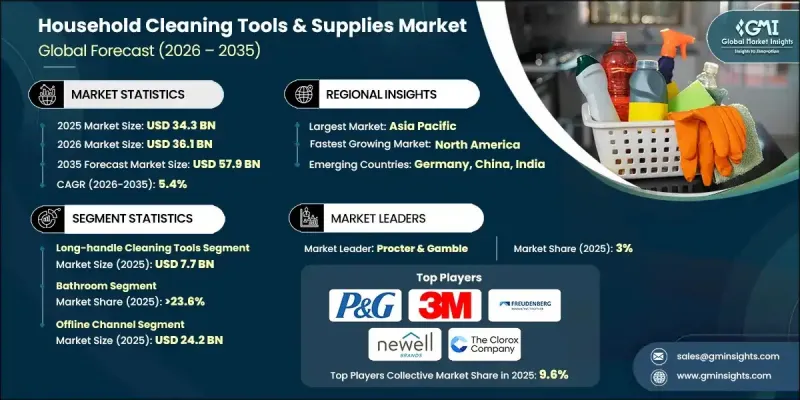
这一增长主要受以下因素驱动:卫生意识的提高、住宅和商业环境日益严格的清洁要求以及消费行为的改变。家庭对卫生和表面维护的日益重视,推动了对清洁工具和用品的稳定需求。各行业职场清洁标准的不断提高也进一步促进了产品的普及。消费者越来越重视清洁,将其视为日常生活的一部分,这持续影响他们的购买决策。此外,市场也在不断发展,消费者需要符合现代生活方式的现代化、高效且美观的清洁解决方案。永续性考量正在重塑产品开发,製造商致力于减少材料使用并提高环境性能。材料和设计的创新正在改变家庭清洁方式,使清洁更加高效,资源消耗更少。这些因素共同推动了市场扩张,同时促进了产品差异化和增值。
| 市场覆盖范围 | |
|---|---|
| 开始年份 | 2025 |
| 预测年份 | 2026-2035 |
| 起始值 | 343亿美元 |
| 预测金额 | 579亿美元 |
| 复合年增长率 | 5.4% |
预计到2025年,长柄清洁工具市场规模将达到77亿美元,2026年至2035年的复合年增长率(CAGR)为5.5%。由于消费者对符合人体工学、能减轻清洁工作中身体疲劳的产品需求不断增长,因此该细分市场占据了最大的市场份额。随着消费者寻求实用且高效的居家清洁解决方案,他们对能够提供更大清洁范围、更舒适便捷使用体验的工具的需求也日益增长。
预计到2025年,浴室应用领域将占据23.6%的市场份额,并在2035年之前以5.8%的复合年增长率成长。由于浴室区域湿度高且对卫生要求较高,因此需要定期清洁,从而持续推动对专业清洁工具和用品的需求。许多家庭表示浴室清洁频率较高,进一步巩固了该领域的市场主导地位。
预计到2025年,美国家用清洁工具和用品市占率将达到73.7%。市场成长主要受家庭数量增加、可支配收入水准提高以及对创新永续清洁解决方案的强劲需求所驱动。持续的产品研发和环保措施也持续推动该地区的市场需求。
目录
第一章调查方法和范围
第二章执行摘要
第三章业界考察
- 生态系分析
- 供应商情况
- 利润率
- 每个阶段的附加价值
- 影响价值链的因素
- 产业影响因素
- 司机
- 人们卫生和清洁意识的提高
- 清洁设备的技术进步
- 电子商务和订阅模式的成长
- 产业潜在风险与挑战
- 扩大专业清洁服务的使用
- 客户维繫和产品差异化不足
- 机会
- 对永续性的需求日益增长
- 整合智慧自动化清洁解决方案
- 司机
- 成长潜力分析
- 未来市场趋势
- 科技与创新趋势
- 当前技术趋势
- 新兴技术
- 价格趋势
- 按地区
- 副产品
- 监管环境
- 标准和合规要求
- 区域法规结构
- 认证标准
- 风险评估与缓解
- 差距分析
- 贸易统计(HS编码 - 9603;820551)
- 主要进口国
- 主要出口国
- 波特五力分析
- PESTEL 分析
- 消费行为分析
- 购买模式
- 偏好分析
- 消费行为的区域差异
- 电子商务如何影响购买决策
第四章 竞争情势
- 介绍
- 公司市占率分析
- 按地区
- 企业矩阵分析
- 主要市场公司的竞争分析
- 竞争定位矩阵
- 重大进展
- 併购
- 伙伴关係与合作
- 新产品发布
- 扩张计划
第五章 2022-2035年按产品分類的市场估算与预测
- 长柄清洁工具
- 拖把
- 扫帚
- 刷子
- 簸箕
- 旋转拖把
- 清扫机式拖把
- 除尘器
- 手持式清洁液
- 海绵
- 百洁布
- 清洁刷
- 刮水器
- 马桶刷和马桶搋子
- 清洁布/毛巾
- 其他的
- 清洁手套
- 一次性清洁手套
- 可重复使用的清洁手套
- 其他的
- 超细纤维产品
- 毛巾/抹布
- 超细纤维拖把
- 旋转拖把
- 拖把
- 除尘器
- 其他的
- 清洁系统
- 拖把/水桶系统
- 清洁推车和手推车
- 商用清洁系统
- 黏毛滚筒
- 收纳和整理用品
- 其他的
- 户外清洁工具
- 窗户清洁工具
- 排水沟清洁工具
- 其他的
- 多功能清洁工具
- 二合一多功能清洁工具
- 三合一多功能清洁工具
- 多功能清洁工具套装
- 其他的
- 商用清洁工具
- 商用清洁工具
- 商用清洁系统
- 商用清洁工具
- 其他的
- 电动/电池驱动清洁工具及配件
- 电子/电池供电清洁工具
- 短柄
- 长柄
- 电动/电池驱动清洁工具组及配件
- 其他的
- 电子/电池供电清洁工具
- 其他的
第六章 按应用领域分類的市场估算与预测,2022-2035年
- 地下室
- 浴室
- 卧室
- 车库
- 厨房
- 洗衣房
- 客厅
- 洗手间
- 其他的
7. 依最终用途分類的市场估计与预测,2022-2035 年
- DIY/住宅
- 清洁专业人员
第八章 按分销管道分類的市场估算与预测,2022-2035年
- 在线的
- 电子商务网站
- 公司经营的网站
- 离线
- 家居建材商店
- 大卖场/超级市场
- 大型零售商店
- 俱乐部频道
- 其他的
第九章 2022-2035年各地区市场估算与预测
- 北美洲
- 美国
- 加拿大
- 欧洲
- 德国
- 法国
- 英国
- 义大利
- 西班牙
- 亚太地区
- 中国
- 印度
- 日本
- 韩国
- 澳洲
- 拉丁美洲
- 巴西
- 墨西哥
- 阿根廷
- 中东和非洲
- 南非
- 沙乌地阿拉伯
- 阿拉伯聯合大公国
第十章:公司简介
- 3M
- Bissell
- Casabella
- Clorox
- Dyson
- Electrolux
- Freudenberg
- Karcher
- Libman
- Makita
- Newell
- Norwex
- Procter and Gamble
- Techtronic Industries
- Unger
The Global Household Cleaning Tools & Supplies Market was valued at USD 34.3 billion in 2025 and is estimated to grow at a CAGR of 5.4% to reach USD 57.9 billion by 2035.
Growth is supported by rising hygiene awareness, stricter cleanliness requirements across residential and commercial environments, and evolving consumer behavior. Households have become more attentive to sanitation and surface maintenance, reinforcing consistent demand for cleaning tools and supplies. Workplace cleanliness standards across multiple sectors have further contributed to product adoption. Consumers increasingly prioritize cleanliness as part of their daily routines, which continues to influence purchasing decisions. The market is also evolving through demand for modern, efficient, and visually appealing cleaning solutions that align with contemporary lifestyles. Sustainability considerations are reshaping product development, with manufacturers reducing material usage and improving environmental performance. Innovation in materials and design is transforming household cleaning practices, enabling more effective cleaning with lower resource consumption. These combined factors continue to strengthen market expansion while encouraging differentiation and value-added product offerings.
| Market Scope | |
|---|---|
| Start Year | 2025 |
| Forecast Year | 2026-2035 |
| Start Value | $34.3 Billion |
| Forecast Value | $57.9 Billion |
| CAGR | 5.4% |
In 2025, the long-handle cleaning tools segment generated USD 7.7 billion and is expected to grow at a CAGR of 5.5% during 2026-2035. This segment holds the largest share due to growing preference for ergonomically designed products that reduce physical strain during cleaning activities. Demand for tools that improve reach, comfort, and ease of use has increased as consumers seek practical and efficient household solutions.
The bathroom application segment held 23.6% share in 2025 and is projected to grow at a CAGR of 5.8% through 2035. Higher moisture exposure and hygiene sensitivity make this area a priority for regular cleaning, driving sustained demand for specialized cleaning tools and supplies. A significant share of households report frequent bathroom cleaning, reinforcing the segment's dominant position.
U.S. Household Cleaning Tools & Supplies Market held 73.7% share in 2025. Market growth is supported by rising household numbers, increasing disposable income levels, and strong demand for innovative and sustainable cleaning solutions. Continuous product development and environmentally focused initiatives continue to stimulate regional demand.
Key companies operating in the Global Household Cleaning Tools & Supplies Market include Procter and Gamble, Dyson, 3M, Electrolux, Bissell, Freudenberg, Karcher, Libman, Newell, Techtronic Industries, Makita, Unger, Casabella, Norwex, and Clorox. These companies compete through innovation, brand recognition, and extensive distribution networks. Companies in the Global Household Cleaning Tools & Supplies Market are strengthening their competitive position by focusing on product innovation, sustainability, and consumer-centric design. Manufacturers are investing in ergonomics and advanced materials to improve usability and cleaning efficiency. Environmental responsibility is a key strategy, with firms reducing material usage and enhancing product recyclability. Brand differentiation through design, performance, and durability is helping companies capture consumer loyalty. Expansion of e-commerce and direct-to-consumer channels is improving market reach and accessibility.
Table of Contents
Chapter 1 Methodology & Scope
- 1.1 Market scope and definition
- 1.2 Research design
- 1.2.1 Research approach
- 1.2.2 Data collection methods
- 1.3 Data mining sources
- 1.3.1 Global
- 1.3.2 Region/country
- 1.4 Base estimates and calculations
- 1.4.1 Base year calculation
- 1.4.2 Key trends for market estimation
- 1.5 Primary research and validation
- 1.5.1 Primary sources
- 1.6 Forecast model
- 1.7 Research assumptions and limitations
Chapter 2 Executive Summary
- 2.1 Industry 360° synopsis
- 2.2 Key market trends
- 2.2.1 Regional
- 2.2.2 Product
- 2.2.3 Application
- 2.2.4 End Use
- 2.2.5 Distribution channel
- 2.3 CXO perspectives: Strategic imperatives
- 2.3.1 Key decision points for industry executives
- 2.3.2 Critical success factors for market players
- 2.4 Future outlook and strategic recommendations
Chapter 3 Industry Insights
- 3.1 Industry ecosystem analysis
- 3.1.1 Supplier landscape
- 3.1.2 Profit margin
- 3.1.3 Value addition at each stage
- 3.1.4 Factor affecting the value chain
- 3.2 Industry impact forces
- 3.2.1 Growth drivers
- 3.2.1.1 Increasing awareness of hygiene and cleanliness
- 3.2.1.2 Technological advancements in cleaning equipment
- 3.2.1.3 E-commerce expansion and subscription models
- 3.2.2 Industry pitfalls & challenges
- 3.2.2.1 Rising adoption of professional cleaning services
- 3.2.2.2 Lack of consumer retention and product differentiation
- 3.2.3 Opportunities
- 3.2.3.1 Rising demand for sustainability
- 3.2.3.2 Integration of smart and automated cleaning solutions
- 3.2.1 Growth drivers
- 3.3 Growth potential analysis
- 3.4 Future market trends
- 3.5 Technology and innovation landscape
- 3.5.1 Current technological trends
- 3.5.2 Emerging technologies
- 3.6 Price trends
- 3.6.1 By region
- 3.6.2 By product
- 3.7 Regulatory landscape
- 3.7.1 Standards and compliance requirements
- 3.7.2 Regional regulatory frameworks
- 3.7.3 Certification standards
- 3.8 Risk assessment and mitigation
- 3.9 Gap analysis
- 3.10 Trade statistics (HS code- 9603; 820551)
- 3.10.1 Major importing countries
- 3.10.2 Major exporting countries
- 3.11 Porter's analysis
- 3.12 PESTEL analysis
- 3.13 Consumer behaviour analysis
- 3.13.1 Purchasing patterns
- 3.13.2 Preference analysis
- 3.13.3 Regional variations in consumer behaviour
- 3.13.4 Impact of e-commerce on buying decisions
Chapter 4 Competitive Landscape, 2025
- 4.1 Introduction
- 4.2 Company market share analysis
- 4.2.1 By region
- 4.2.1.1 North America
- 4.2.1.2 Europe
- 4.2.1.3 Asia Pacific
- 4.2.1.4 Latin America
- 4.2.1.5 Middle East and Africa
- 4.2.1 By region
- 4.3 Company matrix analysis
- 4.4 Competitive analysis of major market players
- 4.5 Competitive positioning matrix
- 4.6 Key developments
- 4.6.1 Mergers & acquisitions
- 4.6.2 Partnerships & collaborations
- 4.6.3 New product launches
- 4.6.4 Expansion plans
Chapter 5 Market Estimates & Forecast, By Product, 2022 - 2035, (USD Billion) (Thousand Units)
- 5.1 Key trends
- 5.2 Long handle cleaning tools
- 5.2.1 Mops
- 5.2.2 Brooms
- 5.2.3 Brushes
- 5.2.4 Dustpans
- 5.2.5 Spin Mops
- 5.2.6 Sweeper floor mop
- 5.2.7 Dusters
- 5.3 Handheld cleaning solutions
- 5.3.1 Sponges
- 5.3.2 Scour pads
- 5.3.3 Cleaning brushes
- 5.3.4 Squeegees
- 5.3.5 Toilet brushes and plungers
- 5.3.6 Cleaning cloths/towels
- 5.3.7 Others
- 5.4 Cleaning gloves
- 5.4.1 Disposable cleaning gloves
- 5.4.2 Reusable cleaning gloves
- 5.4.3 Others
- 5.5 Microfiber products
- 5.5.1 Towels/cloth
- 5.5.2 Microfiber mops
- 5.5.3 Spin mops
- 5.5.4 Mops
- 5.5.5 Dusters
- 5.5.6 Others
- 5.6 Cleaning systems
- 5.6.1 Mop/bucket systems
- 5.6.2 Cleaning carts and caddies
- 5.6.3 Professional cleaning systems
- 5.6.4 Lint rollers
- 5.6.5 Cleaning storage and organization
- 5.6.6 Others
- 5.7 Outdoor cleaning tools
- 5.7.1 Window cleaning tools
- 5.7.2 Gutter cleaning tools
- 5.7.3 Others
- 5.8 Multi-function cleaning tools
- 5.8.1 2 in 1 multi-function cleaning tools
- 5.8.2 3 in 1 multi-function cleaning tools
- 5.8.3 Multi-function cleaning tool kits
- 5.8.4 Other
- 5.9 Professional cleaning tools
- 5.9.1 Professional cleaning tools
- 5.9.2 Professional cleaning systems
- 5.9.3 Professional cleaning accessories
- 5.9.4 Other
- 5.10 Electric/battery powered cleaning tools and accessories
- 5.10.1 Electronic/battery power cleaning tools
- 5.10.1.1 Short handle
- 5.10.1.2 Long handle
- 5.10.2 Electric/battery power cleaning tool kits & accessories
- 5.10.3 Others
- 5.10.1 Electronic/battery power cleaning tools
- 5.11 Others
Chapter 6 Market Estimates & Forecast, By Application, 2022 - 2035, (USD Billion) (Thousand Units)
- 6.1 Key trends
- 6.2 Basement
- 6.3 Bathroom
- 6.4 Bedroom
- 6.5 Garage
- 6.6 Kitchen
- 6.7 Laundry room
- 6.8 Living room
- 6.9 Toilet
- 6.10 Others
Chapter 7 Market Estimates & Forecast, By End Use, 2022 - 2035, (USD Billion) (Thousand Units)
- 7.1 Key trends
- 7.2 DIY/homeowners
- 7.3 Cleaning professionals
Chapter 8 Market Estimates & Forecast, By Distribution Channel, 2022 - 2035, (USD Billion) (Thousand Units)
- 8.1 Key trends
- 8.2 Online
- 8.2.1 E-commerce websites
- 8.2.2 Company owned websites
- 8.3 Offline
- 8.3.1 Home centers
- 8.3.2 Hypermarkets/supermarkets
- 8.3.3 Big box retailers
- 8.3.4 Club channel
- 8.3.5 Others
Chapter 9 Market Estimates & Forecast, By Region, 2022 - 2035, (USD Billion) (Thousand Units)
- 9.1 Key trends
- 9.1.1 North America
- 9.1.1.1 U.S.
- 9.1.1.2 Canada
- 9.1.2 Europe
- 9.1.2.1 Germany
- 9.1.2.2 France
- 9.1.2.3 UK
- 9.1.2.4 Italy
- 9.1.2.5 Spain
- 9.1.3 Asia Pacific
- 9.1.3.1 China
- 9.1.3.2 India
- 9.1.3.3 Japan
- 9.1.3.4 South Korea
- 9.1.3.5 Australia
- 9.1.4 Latin America
- 9.1.4.1 Brazil
- 9.1.4.2 Mexico
- 9.1.4.3 Argentina
- 9.1.5 MEA
- 9.1.5.1 South Africa
- 9.1.5.2 Saudi Arabia
- 9.1.5.3 UAE
- 9.1.1 North America
Chapter 10 Company Profiles
- 10.1 3M
- 10.2 Bissell
- 10.3 Casabella
- 10.4 Clorox
- 10.5 Dyson
- 10.6 Electrolux
- 10.7 Freudenberg
- 10.8 Karcher
- 10.9 Libman
- 10.10 Makita
- 10.11 Newell
- 10.12 Norwex
- 10.13 Procter and Gamble
- 10.14 Techtronic Industries
- 10.15 Unger

 清洁产品市场分析及预测(至2035年):依类型、产品、应用、技术、最终用户、形态、材料类型、销售形式、功能及解决方案划分
 全球无线吸尘器市场规模、份额、趋势和成长分析报告(2026-2034)
 日本扫帚和拖把市场规模、份额、趋势和预测:按产品类型、分销管道和地区划分,2026-2034年
 环保型多用途清洁产品市场-全球产业规模、份额、趋势、机会及预测:按类型、应用、分销管道、地区和竞争格局划分,2021-2031年硬表面清洁布市场 - 全球产业规模、份额、趋势、机会、预测:按类型、应用、分销管道、地区和竞争格局划分,2021-2031年蒸汽拖把市场 - 全球产业规模、份额、趋势、机会、预测:按类型、电源、分销管道、地区和竞争格局划分,2021-2031年
 游泳后清洁产品市场按产品类型、活性成分、产品形式、通路和应用划分-2026-2032年全球预测
 永续和环保清洁化学品市场预测至2032年:按产品类型、成分类型、分销管道、应用和地区分類的全球分析2032年生物降解清洁剂市场预测:按产品类型、成分、包装、分销管道、应用、最终用户和地区分類的全球分析环保清洁剂市场预测至2032年:按产品类型、剂型、成分、价格分布、分销管道、应用、最终用户和地区分類的全球分析