


 |
市场调查报告书
商品编码
1928894
穿戴式驱蚊剂市场机会、成长要素、产业趋势分析及预测(2026-2035)Body Worn Insect Repellent Market Opportunity, Growth Drivers, Industry Trend Analysis, and Forecast 2026 - 2035 |
||||||

全球穿戴式驱蚊剂市场预计到 2025 年将达到 7.919 亿美元,预计到 2035 年将达到 16.3 亿美元,年复合成长率为 7.8%。
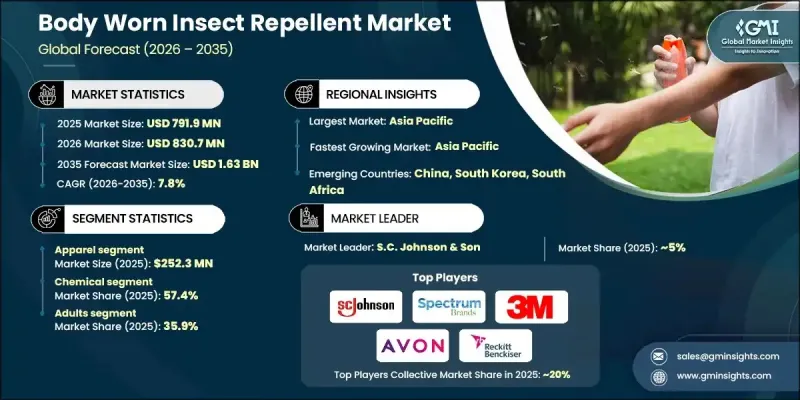
健行、露营和探险运动等户外活动的日益普及,以及全球旅游业的快速发展,正在推动个人驱虫产品的需求。消费者越来越倾向于选择既能有效抵御有害昆虫,又能融入自身生活方式和个人美学的产品。人们对虫媒疾病的认识不断提高,尤其是在热带和亚热带地区,进一步激发了人们对穿戴式驱虫产品的兴趣。疟疾、登革热、兹卡和莱姆病等虫媒疾病的流行,尤其是在亚太和非洲等高发生地区,正在推动此类产品的普及。公共卫生宣传活动促进了预防措施的推广,同时也推动了市场扩张;此外,便利性、功能性和生活方式的融合性也促使游客、探险爱好者和高风险环境下的专业人士将其作为日常用品。
| 市场覆盖范围 | |
|---|---|
| 开始年份 | 2025 |
| 预测年份 | 2026-2035 |
| 起始值 | 7.919亿美元 |
| 预测金额 | 16.3亿美元 |
| 复合年增长率 | 7.8% |
预计到2025年,服饰类驱虫剂市场规模将达到2.523亿美元,并在2035年之前以7.6%的复合年增长率成长。经处理的服装因其无需重复涂抹即可提供持久防护而备受欢迎。这种兼具实用防护和便利性的产品深受户外运动爱好者、旅客以及在高风险地区工作的人员的青睐。此外,经处理的服装时尚前卫的定位及其在疾病高风险地区的广泛应用,进一步提升了其市场吸引力。
2025年,化学驱蚊剂市占率占比达57.4%,预计2026年至2035年将以7.6%的复合年增长率成长。这些产品含有避蚊胺(DEET)、派卡瑞丁和IR3535等活性成分,因其对多种昆虫的显着驱避效果和持久防护作用而备受青睐。在虫媒疾病高发地区,卫生部门通常建议使用这类产品,消费者也对其信赖有加,使其成为流行地区旅客和专业人士的首选。
美国穿戴式驱蚊产品市场预计到2025年将达到1.983亿美元,到2035年将以8.1%的复合年增长率成长。消费者意识的提高、可支配收入的增加以及积极的户外生活方式支撑着市场的稳定需求。零售分销网路的扩张和电子商务的便利性进一步推动了市场渗透。人们对西尼罗河病毒等蚊媒疾病的担忧也促进了穿戴式驱蚊产品的全国普及。
目录
第一章调查方法和范围
第二章执行摘要
第三章业界考察
- 生态系分析
- 供应商情况
- 利润率
- 每个阶段的附加价值
- 影响价值链的因素
- 产业影响因素
- 司机
- 户外生活方式和旅游业蓬勃发展
- 媒介感染疾病发生率上升
- 对环保和天然产品的需求日益增长
- 挑战与困难
- 监理合规性和安全性问题
- 价格敏感度
- 机会
- 智慧型穿戴装置集成
- 在高风险地区拓展业务
- 司机
- 成长潜力分析
- 未来市场趋势
- 科技与创新趋势
- 当前技术趋势
- 新兴技术
- 价格趋势
- 按地区
- 副产品
- 监管环境
- 北美洲
- 美国:消费品安全委员会(CPSC)联邦法规(CFR)第16篇第1512部分
- 加拿大:国际标准化组织(ISO)4210
- 欧洲
- 德国:德国标准化协会 (DIN) 欧洲标准 (EN) ISO 4210
- 英国:欧洲标准 (EN) ISO 4210 /英国合格评定 (UKCA)
- 法国:欧洲标准 (EN) ISO 4210
- 亚太地区
- 中国:国家标准(GB)3565
- 印度:印度标准 (IS) 10613
- 日本:日本工业标准(JIS)D 9110
- 拉丁美洲
- 巴西:巴西技术标准协会 (ABNT) 巴西标准 (NBR) ISO 4210
- 墨西哥:国际标准化组织(ISO)4210
- 中东和非洲
- 南非:南非国家标准 (SANS) 311
- 沙乌地阿拉伯:沙乌地阿拉伯标准、计量和品质组织 (SASO) 海湾标准组织 (GSO) ISO 4210
- 北美洲
- 贸易统计(HS编码-3307.20)
- 主要进口国
- 主要出口国
- 波特分析
- PESTEL 分析
第四章 竞争情势
- 介绍
- 公司市占率分析
- 按地区
- 北美洲
- 欧洲
- 亚太地区
- 拉丁美洲
- 中东和非洲
- 按地区
- 企业矩阵分析
- 主要市场公司的竞争分析
- 竞争定位矩阵
- 重大进展
- 併购
- 伙伴关係与合作
- 新产品发布
- 扩张计划
第五章 依产品类型分類的市场估算与预测,2022-2035年
- 服饰
- 喷
- 精油和乳霜
- 贴纸和布贴
- 滚珠式
- 擦拭巾和纸巾
- 穿戴式装置
- 其他的
第六章 依原料分類的市场估算与预测,2022-2035年
- 自然的
- 化学
第七章 市场估计与预测:依价格区间划分,2022-2035年
- 低价位
- 中价位
- 高价位范围
第八章 依最终用户分類的市场估算与预测,2022-2035年
- 成人
- 孩子们
- 游客
- 军事相关人员
- 医疗/工业用户
第九章 按应用领域分類的市场估算与预测,2022-2035年
- 蚊子
- 打钩
- 跳蚤
- 户外活动(露营、健行、运动)
- 旅游
- 家用
- 商业/工业
第十章 按分销管道分類的市场估算与预测,2022-2035年
- 在线的
- 电子商务
- 公司网站
- 离线
- 超级市场/大卖场
- 专卖店
- 其他(药局等)
第十一章 2022-2035年各地区市场估计与预测
- 北美洲
- 我们
- 加拿大
- 欧洲
- 德国
- 英国
- 法国
- 义大利
- 西班牙
- 亚太地区
- 中国
- 印度
- 日本
- 韩国
- 澳洲
- 拉丁美洲
- 巴西
- 墨西哥
- 阿根廷
- 中东和非洲
- 沙乌地阿拉伯
- 阿拉伯聯合大公国
- 南非
第十二章:公司简介
- 3M Company
- Avon Products Inc.
- Burt's Bees
- Cascadia Essentials
- Coleman
- Ecolab
- ExOfficio
- Insect Shield
- Mosquito Squad
- Para'Kito
- Reckitt Benckiser
- SC Johnson &Son
- Sawyer Products
- Spectrum Brands
- ThermaCELL
The Global Body Worn Insect Repellent Market was valued at USD 791.9 million in 2025 and is estimated to grow at a CAGR of 7.8% to reach USD 1.63 billion by 2035.
The rising popularity of outdoor activities such as hiking, camping, and adventure sports, combined with rapid growth in global tourism, has fueled demand for personal insect protection solutions. Consumers increasingly seek products that provide reliable protection against harmful insects while complementing their lifestyle and personal aesthetics. The growing awareness of insect-borne illnesses, particularly in tropical and subtropical regions, has further amplified interest in body-worn repellents. Vector-borne diseases like malaria, dengue, Zika, and Lyme disease are driving adoption, especially in regions of Asia-Pacific and Africa where prevalence is high. Public health campaigns promoting preventive measures are supporting market expansion, while the combination of convenience, functionality, and lifestyle integration is encouraging regular usage among tourists, adventure enthusiasts, and professionals in high-risk environments.
| Market Scope | |
|---|---|
| Start Year | 2025 |
| Forecast Year | 2026-2035 |
| Start Value | $791.9 Million |
| Forecast Value | $1.63 Billion |
| CAGR | 7.8% |
The apparel-based insect repellents segment accounted for USD 252.3 million in 2025 and is expected to grow at a CAGR of 7.6% through 2035. Treated clothing remains popular because it offers extended protection without repeated applications. This segment attracts outdoor enthusiasts, travelers, and individuals working in high-risk areas, as it merges practical protection with convenience. The fashion-forward positioning of treated apparel and adoption in disease-prone regions strengthen its market appeal.
The chemical repellents segment held a 57.4% share in 2025 and is projected to grow at a CAGR of 7.6% from 2026 to 2035. These products, containing active ingredients such as DEET, picaridin, and IR3535, are preferred due to their proven effectiveness and durable protection against diverse insects. They are often recommended by health authorities and trusted by consumers in regions with high vector-borne disease transmission, making them the primary choice for travelers and professionals in endemic zones.
United States Body Worn Insect Repellent Market reached USD 198.3 million in 2025 and is expected to grow at a CAGR of 8.1% through 2035. High consumer awareness, disposable income, and a strong outdoor lifestyle contribute to consistent demand. Widespread retail distribution and e-commerce accessibility further enhance market penetration. Concerns about mosquito-borne illnesses such as the West Nile virus also reinforce the adoption of body-worn insect repellents across the country.
Leading companies in the Global Body Worn Insect Repellent Market include Burt's Bees, S.C. Johnson & Son, Coleman, ThermaCELL, 3M Company, Insect Shield, Avon Products Inc., Ecolab, Sawyer Products, Mosquito Squad, Para'Kito, Cascadia Essentials, ExOfficio, Spectrum Brands, and Reckitt Benckiser. Market leaders are strengthening their foothold by investing in innovative, long-lasting, and safe formulations that appeal to both casual consumers and professionals. Companies focus on expanding their apparel-based and chemical repellent offerings to address different lifestyle needs and climatic conditions. Collaborations with tourism and outdoor activity brands, combined with targeted marketing campaigns, increase visibility and adoption. Additionally, firms emphasize compliance with regulatory standards, sustainability initiatives, and product certifications to boost consumer trust.
Table of Contents
Chapter 1 Methodology & Scope
- 1.1 Market scope & definitions
- 1.2 Research design
- 1.2.1 Research approach
- 1.2.2 Data collection methods
- 1.3 Base estimates and calculations
- 1.3.1 Base year calculation
- 1.3.2 Market estimates & forecasts parameters
- 1.4 Forecast Model
- 1.4.1 Key trends for market estimates
- 1.4.2 Quantified market impact analysis
- 1.4.2.1 Mathematical impact of growth parameters on forecast
- 1.4.3 Scenario analysis framework
- 1.5 Primary research and validation
- 1.5.1 Some of the primary sources (but not limited to)
- 1.6 Data mining sources
- 1.6.1 Paid Sources
- 1.7 Primary research and validation
- 1.7.1 Primary sources
- 1.8 Research Trail & confidence scoring
- 1.8.1 Research trail components
- 1.8.2 Scoring components
- 1.9 Research transparency addendum
- 1.9.1 Source attribution framework
- 1.9.2 Quality assurance metrics
- 1.9.3 Our commitment to trust
- 1.10 Market Definitions
Chapter 2 Executive Summary
- 2.1 Industry 360° synopsis
- 2.2 Key market trends
- 2.2.1 Regional
- 2.2.2 Product type
- 2.2.3 Ingredient
- 2.2.4 Price Range
- 2.2.5 Application
- 2.2.6 End User
- 2.2.7 Distribution channels
- 2.3 CXO perspectives: Strategic imperatives
- 2.3.1 Key decision points for industry executives
- 2.3.2 Critical success factors for market players
- 2.4 Future outlook and strategic recommendations
Chapter 3 Industry Insights
- 3.1 Industry ecosystem analysis
- 3.1.1 Supplier landscape
- 3.1.2 Profit margin
- 3.1.3 Value addition at each stage
- 3.1.4 Factor affecting the value chain
- 3.2 Industry impact forces
- 3.2.1 Growth drivers
- 3.2.1.1 Outdoor lifestyle & travel boom
- 3.2.1.2 Rising incidence of vector-borne diseases
- 3.2.1.3 Preference for eco-friendly & natural products
- 3.2.2 Pitfalls & Challenges
- 3.2.2.1 Regulatory compliance & safety concerns
- 3.2.2.2 Price sensitivity
- 3.2.3 Opportunities
- 3.2.3.1 Smart wearable integration
- 3.2.3.2 Expansion in high-risk regions
- 3.2.1 Growth drivers
- 3.3 Growth potential analysis
- 3.4 Future market trends
- 3.5 Technology and innovation landscape
- 3.5.1 Current technological trends
- 3.5.2 Emerging technologies
- 3.6 Price trends
- 3.6.1 By region
- 3.6.2 By product
- 3.7 Regulatory landscape
- 3.7.1 North America
- 3.7.1.1 US: Consumer Product Safety Commission (CPSC) 16 Code of Federal Regulations (CFR) part 1512
- 3.7.1.2 Canada: International Organization for Standardization (ISO) 4210
- 3.7.2 Europe
- 3.7.2.1 Germany: Deutsches Institut fur Normung (DIN) European Norm (EN) ISO 4210
- 3.7.2.2 UK: European Norm (EN) ISO 4210 / United Kingdom Conformity Assessed (UKCA)
- 3.7.2.3 France: European Norm (EN) ISO 4210
- 3.7.3 Asia Pacific
- 3.7.3.1 China: Guobiao (GB) 3565
- 3.7.3.2 India: Indian Standard (IS) 10613
- 3.7.3.3 Japan: Japanese Industrial Standard (JIS) D 9110
- 3.7.4 Latin America
- 3.7.4.1 Brazil: Associacao Brasileira de Normas Tecnicas (ABNT) Norma Brasileira (NBR) ISO 4210
- 3.7.4.2 Mexico: International Organization for Standardization (ISO) 4210
- 3.7.5 Middle East & Africa
- 3.7.5.1 South Africa: South African National Standard (SANS) 311
- 3.7.5.2 Saudi Arabia: Saudi Standards, Metrology and Quality Organization (SASO) Gulf Standardization Organization (GSO) ISO 4210
- 3.7.1 North America
- 3.8 Trade statistics (HS Code - 3307.20)
- 3.8.1 Major importing countries
- 3.8.2 Major exporting countries
- 3.9 Porter';s analysis
- 3.10 PESTEL analysis
Chapter 4 Competitive Landscape, 2025
- 4.1 Introduction
- 4.2 Company market share analysis
- 4.2.1 By Region
- 4.2.1.1 North America
- 4.2.1.2 Europe
- 4.2.1.3 Asia Pacific
- 4.2.1.4 Latin America
- 4.2.1.5 Middle East & Africa
- 4.2.1 By Region
- 4.3 Company matrix analysis
- 4.4 Competitive analysis of major market players
- 4.5 Competitive positioning matrix
- 4.6 Key developments
- 4.6.1 Mergers & acquisitions
- 4.6.2 Partnerships & collaborations
- 4.6.3 New product launches
- 4.6.4 Expansion plans
Chapter 5 Market Estimates & Forecast, By Product Type, 2022 - 2035, (USD Million) (Thousand Units)
- 5.1 Key trends
- 5.2 Apparel
- 5.3 Sprays
- 5.4 Oils & creams
- 5.5 Stickers & patches
- 5.6 Roll ons
- 5.7 Wipes & towelettes
- 5.8 Wearable devices
- 5.9 Others
Chapter 6 Market Estimates & Forecast, By Ingredient, 2022 - 2035, (USD Million) (Thousand Units)
- 6.1 Key trends
- 6.2 Natural
- 6.3 Chemical
Chapter 7 Market Estimates & Forecast, By Price Range, 2022 - 2035, (USD Million) (Thousand Units)
- 7.1 Key trends
- 7.2 Low
- 7.3 Medium
- 7.4 High
Chapter 8 Market Estimates & Forecast, By End User, 2022 - 2035, (USD Million) (Thousand Units)
- 8.1 Key trends
- 8.2 Adults
- 8.3 Children
- 8.4 Travelers
- 8.5 Military personnel
- 8.6 Healthcare/industrial users
Chapter 9 Market Estimates & Forecast, By Application, 2022 - 2035, (USD Million) (Thousand Units)
- 9.1 Key trends
- 9.2 Mosquitoes
- 9.3 Ticks
- 9.4 Fleas
- 9.5 Outdoor activities (camping, hiking, sports)
- 9.6 Travel & tourism
- 9.7 Home use
- 9.8 Commercial/industrial
Chapter 10 Market Estimates & Forecast, By Distribution Channel, 2022 - 2035, (USD Million) (Thousand Units)
- 10.1 Key trends
- 10.2 Online
- 10.2.1 E-commerce
- 10.2.2 Company websites
- 10.3 Offline
- 10.3.1 Supermarkets/hypermarkets
- 10.3.2 Specialty stores
- 10.3.3 Others (pharmacies, etc.)
Chapter 11 Market Estimates & Forecast, By Region, 2022 - 2035, (USD Million) (Thousand Units)
- 11.1 Key trends
- 11.2 North America
- 11.2.1 U.S.
- 11.2.2 Canada
- 11.3 Europe
- 11.3.1 Germany
- 11.3.2 UK
- 11.3.3 France
- 11.3.4 Italy
- 11.3.5 Spain
- 11.4 Asia Pacific
- 11.4.1 China
- 11.4.2 India
- 11.4.3 Japan
- 11.4.4 South Korea
- 11.4.5 Australia
- 11.5 Latin America
- 11.5.1 Brazil
- 11.5.2 Mexico
- 11.5.3 Argentina
- 11.6 MEA
- 11.6.1 Saudi Arabia
- 11.6.2 UAE
- 11.6.3 South Africa
Chapter 12 Company Profiles
- 12.1 3M Company
- 12.2 Avon Products Inc.
- 12.3 Burt’s Bees
- 12.4 Cascadia Essentials
- 12.5 Coleman
- 12.6 Ecolab
- 12.7 ExOfficio
- 12.8 Insect Shield
- 12.9 Mosquito Squad
- 12.10 Para'Kito
- 12.11 Reckitt Benckiser
- 12.12 S.C. Johnson & Son
- 12.13 Sawyer Products
- 12.14 Spectrum Brands
- 12.15 ThermaCELL


