


 |
市场调查报告书
商品编码
1928903
动物饲料替代蛋白市场机会、成长要素、产业趋势分析及预测(2026年至2035年)Animal Feed Alternative Protein Market Opportunity, Growth Drivers, Industry Trend Analysis, and Forecast 2026 - 2035 |
||||||

全球动物饲料替代蛋白市场预计到 2025 年将达到 49 亿美元,到 2035 年将达到 97 亿美元,年复合成长率为 7%。
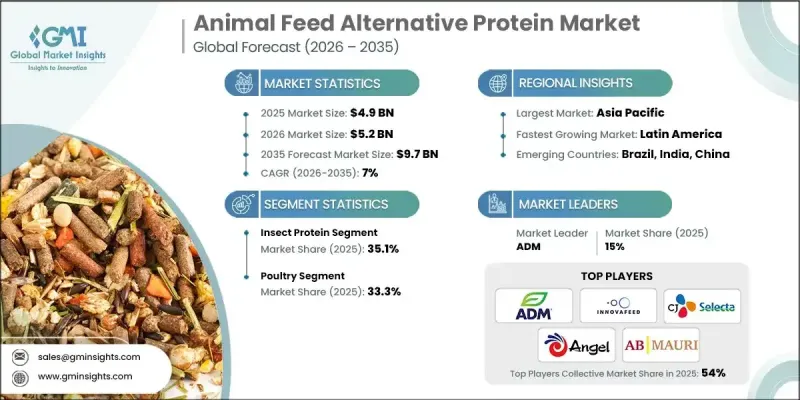
市场成长的驱动力在于永续性需求,这些需求重塑了整个饲料供应链的蛋白质筹资策略。与传统畜牧生产相关的排放和土地利用所带来的环境压力,已被认为是促使一体化企业、製造商和零售商重新评估蛋白质投入来源的关键因素。替代饲料蛋白因其依赖特定产品资源、每公顷蛋白质产量高以及能够支持长期供应稳定性等特点,被视为低影响解决方案。讨论强调,在此期间,永续性目标、监管力度和创新共同加速了饲料蛋白的多元化转型,使其摆脱对传统饲料蛋白的依赖,并为在全球多种动物生产系统中更广泛地商业性化应用奠定了基础。
| 市场覆盖范围 | |
|---|---|
| 开始年份 | 2025 |
| 预测年份 | 2026-2035 |
| 起始值 | 49亿美元 |
| 预测金额 | 97亿美元 |
| 复合年增长率 | 7% |
市场接受度的进一步解释体现在粮食安全和成本波动。 2021年至2023年,供应中断和地缘政治不确定性推高了饲料成本,增加了生产者管理风险的压力。替代蛋白被视为稳定的来源,可在关键畜牧业领域进行试验。昆虫饲料、发酵植物蛋白和微生物衍生成分的表现结果与传统进口蛋白饲料相当,同时降低了对外部供应链的依赖。针对消化功能、肠道功能和减少抗生素依赖性的研究进一步增强了人们对替代饲料蛋白能够促进动物健康、改善动物福利并提升高级产品定位的信心。
预计到2025年,昆虫蛋白市占率将达到35.1%,并在2026年至2035年间以6.8%的复合年增长率成长。市场趋势表明,企业正逐渐摆脱对单一蛋白质来源的依赖,转向多元化的原料组合。大型饲料生产商正将昆虫来源的原料与微生物、藻类、真菌、酵母来源的蛋白质以及加工大豆蛋白混合使用。这种组合方式旨在平衡成本控制、永续性、营养稳定性、胺基酸优化以及其他与肠道健康和饲料转换率相关的益处。
预计到2025年,家禽市场将占33.3%的市场份额,到2035年将以6.8%的复合年增长率成长。策略投资正集中于高利润的畜牧业领域,因为高价值的饲料配方能够抵销更高的原料成本。生产者和饲料配方生产商之间的合作日益普及,以此来开发富含替代蛋白的均衡饲料,从而支持永续性等概念,减少对传统海洋蛋白的依赖,并在动物营养和宠物市场引入新型饲料成分。
预计到2024年,北美动物饲料替代蛋白市场规模将达11.9亿美元。该地区的成长主要由寻求供应安全和环境考虑的垂直整合生产商推动。家禽饲料、特殊饲料和宠物营养领域的强劲需求持续推动着发酵蛋白、酵母衍生蛋白和单细胞蛋白的应用。美国凭藉先进的发酵基础设施、零售商主导的永续性倡议以及对不含抗生素、定位高端且部分替代传统豆粕的饲料解决方案的稳定需求,成为领先的国内市场。
竞争格局包括ADM、Calysta、Angel Yeast、Inova Feed、CJ Selecta、Hamlet Protein A/S、Titan Biotech、CHS、杜邦公司、AgriProtein、DeepBranch Biotechnology、AB Maury和Crescent Biotech等公司,它们都在积极开发和商业化饲料蛋白解决方案,并在全球市场推广应用。动物饲料替代蛋白市场的企业正透过产能扩张、技术投资和策略联盟来巩固自身地位。许多企业正致力于扩大发酵和昆虫生产系统的规模,以提高成本竞争力和供应可靠性。随着企业整合多种蛋白质形式以满足不同的营养和监管要求,产品组合多元化变得日益重要。
目录
第一章调查方法和范围
第二章执行摘要
第三章业界考察
- 生态系分析
- 供应商情况
- 利润率
- 每个阶段的附加价值
- 影响价值链的因素
- 中断
- 产业影响因素
- 司机
- 豆粕价格波动和供应中断
- 亚洲对肉类和水产养殖的需求不断增长
- 对永续性、森林砍伐和排放的担忧
- 产业潜在风险与挑战
- 高成本且大规模供应有限
- 监理核准和安全认知问题
- 市场机会
- 农产品对饲料蛋白的增值回收
- 优质、无抗生素、功能性肉品标籤
- 司机
- 成长潜力分析
- 监管环境
- 北美洲
- 欧洲
- 亚太地区
- 拉丁美洲
- 中东和非洲
- 波特分析
- PESTEL 分析
- 价格趋势
- 按地区
- 依产品类型
- 未来市场趋势
- 科技与创新趋势
- 当前技术趋势
- 新兴技术
- 专利状态
- 贸易统计(HS编码)
- 主要进口国
- 主要出口国
- 永续性和环境方面
- 永续努力
- 减少废弃物策略
- 生产中的能源效率
- 环保倡议
- 考虑到碳足迹
第四章 竞争情势
- 介绍
- 公司市占率分析
- 按地区
- 北美洲
- 欧洲
- 亚太地区
- 拉丁美洲
- 中东和非洲
- 按地区
- 企业矩阵分析
- 主要市场公司的竞争分析
- 竞争定位矩阵
- 重大进展
- 併购
- 伙伴关係与合作
- 新产品发布
- 业务拓展计划
第五章 2022-2035年按产品分類的市场估算与预测
- 昆虫来源的蛋白质
- 大豆分离蛋白
- 大豆蛋白浓缩物
- 发酵大豆蛋白
- 水绵蛋白
- 单细胞蛋白
- 藻类蛋白
- 谷物蛋白
- 真菌蛋白
- 酵母蛋白
- 哈姆雷特蛋白
第六章 2022-2035年各畜种市场估算与预测
- 家禽
- 肉鸡
- 产蛋母鸡
- 土耳其
- 其他的
- 猪
- 起动机
- 用于训练
- 母猪
- 牛
- 牛
- 牛
- 其他的
- 水产养殖
- 鲑鱼
- 鳟鱼
- 虾
- 鲤鱼
- 其他的
- 宠物食品
- 马
第七章 2022-2035年各地区市场估算与预测
- 北美洲
- 我们
- 加拿大
- 欧洲
- 德国
- 英国
- 法国
- 西班牙
- 义大利
- 其他欧洲地区
- 亚太地区
- 中国
- 印度
- 日本
- 澳洲
- 韩国
- 亚太其他地区
- 拉丁美洲
- 巴西
- 墨西哥
- 阿根廷
- 其他拉丁美洲地区
- 中东和非洲
- 沙乌地阿拉伯
- 南非
- 阿拉伯聯合大公国
- 其他中东和非洲地区
第八章 公司简介
- ADM
- CJ Selecta
- Calysta Inc
- CHS Inc
- Hamlet Protein A/S
- Titan Biotech Ltd
- EI Du Pont De Nemours And Company
- Deep Branch Biotechnology
- Agriprotein GmbH
- Innova Feed
- Angel Yeast
- AB Mauri
- Crescent Biotech
The Global Animal Feed Alternative Protein Market was valued at USD 4.9 billion in 2025 and is estimated to grow at a CAGR of 7% to reach USD 9.7 billion by 2035.
Market growth is driven by sustainability demands that reshaped protein sourcing strategies across feed supply chains. Environmental pressures related to emissions and land utilization associated with traditional livestock production are acknowledged as major drivers encouraging integrators, manufacturers, and retailers to reassess protein inputs. Alternative feed proteins are positioned as lower-impact solutions because they rely on side-stream resources and deliver higher protein yields per hectare, while supporting long-term supply resilience. The discussion emphasizes that sustainability goals, regulatory momentum, and innovation collectively accelerated diversification away from conventional feed proteins during this timeframe, laying the foundation for broader commercial adoption across multiple animal production systems worldwide.
| Market Scope | |
|---|---|
| Start Year | 2025 |
| Forecast Year | 2026-2035 |
| Start Value | $4.9 Billion |
| Forecast Value | $9.7 Billion |
| CAGR | 7% |
Market adoption is further explained through the lens of food security and cost volatility. Rising feed expenses between 2021 and 2023, driven by supply disruptions and geopolitical uncertainty, increased pressure on producers to manage risk. Alternative proteins are portrayed as stabilizing inputs that enabled trials across major animal production categories. Performance outcomes from insect-derived meals, fermented plant proteins, and microbial-based ingredients are described as comparable to traditional imported protein meals, while also reducing dependency on external supply chains. Scientific research focused on digestion, gut functionality, and reduced antibiotic reliance strengthened confidence that alternative feed proteins can support animal health, welfare outcomes, and premium product positioning.
The insect protein segment held 35.1% share in 2025 and is projected to grow at a CAGR of 6.8% from 2026 to 2035. The market description highlights a clear transition away from reliance on single protein sources toward diversified ingredient portfolios. Large-scale feed manufacturers are described as blending insect-based inputs with microbial, algal, fungal, yeast-derived, and processed soy proteins. This combined approach is positioned to balance cost management, sustainability messaging, nutritional consistency, amino acid optimization, and additional functional benefits related to gut health and feed efficiency.
The poultry segment held 33.3% share in 2025, with a CAGR of 6.8% through 2035. Strategic investment is described as concentrated in high-margin animal sectors where premium feed formulations can justify higher ingredient costs. Collaborative development between producers and feed formulators is highlighted as a method for creating balanced diets that integrate alternative proteins while supporting claims related to sustainability, reduced reliance on conventional marine proteins, and novel feed inputs within both animal nutrition and companion animal markets.
North America Animal Feed Alternative Protein Market reached USD 1.19 billion in 2024. Growth in the region is attributed to vertically integrated producers seeking supply security and environmental alignment. Strong demand from poultry, specialty feed, and pet nutrition segments continues to support the adoption of fermented, yeast-based, and single-cell proteins. The United States is identified as the dominant national market, supported by advanced fermentation infrastructure, retailer-led sustainability commitments, and consistent demand for antibiotic-free and premium-positioned feed solutions that partially replace conventional soymeal.
The competitive landscape includes ADM, Calysta Inc, Angel Yeast, Innova Feed, CJ Selecta, Hamlet Protein A/S, Titan Biotech Ltd, CHS Inc, E.I. Du Pont De Nemours And Company, Agriprotein GmbH, Deep Branch Biotechnology, AB Mauri, and Crescent Biotech, all of which are actively shaping the development and commercialization of alternative feed protein solutions across global markets. Companies operating in the animal feed alternative protein market are described as strengthening their positions through capacity expansion, technology investment, and strategic partnerships. Many players are focusing on scaling fermentation and insect production systems to improve cost competitiveness and supply reliability. Portfolio diversification is emphasized as firms integrate multiple protein formats to meet varying nutritional and regulatory requirements.
Table of Contents
Chapter 1 Methodology & Scope
- 1.1 Market scope and definition
- 1.2 Research design
- 1.2.1 Research approach
- 1.2.2 Data collection methods
- 1.3 Data mining sources
- 1.3.1 Global
- 1.3.2 Regional/Country
- 1.4 Base estimates and calculations
- 1.4.1 Base year calculation
- 1.4.2 Key trends for market estimation
- 1.5 Primary research and validation
- 1.5.1 Primary sources
- 1.6 Forecast model
- 1.7 Research assumptions and limitations
Chapter 2 Executive Summary
- 2.1 Industry 360° synopsis
- 2.2 Key market trends
- 2.2.1 Regional
- 2.2.2 Product
- 2.2.3 Livestock
- 2.3 TAM Analysis, 2026-2035
- 2.4 CXO perspectives: Strategic imperatives
- 2.4.1 Executive decision points
- 2.4.2 Critical success factors
- 2.5 Future Outlook and Strategic Recommendations
Chapter 3 Industry Insights
- 3.1 Industry ecosystem analysis
- 3.1.1 Supplier landscape
- 3.1.2 Profit margin
- 3.1.3 Value addition at each stage
- 3.1.4 Factor affecting the value chain
- 3.1.5 Disruptions
- 3.2 Industry impact forces
- 3.2.1 Growth drivers
- 3.2.1.1 Volatile soymeal prices and supply disruptions
- 3.2.1.2 Rising meat and aquaculture demand in Asia
- 3.2.1.3 Sustainability, deforestation and emissions concerns
- 3.2.2 Industry pitfalls and challenges
- 3.2.2.1 Higher cost and limited large scale supply
- 3.2.2.2 Regulatory approvals and safety perception issues
- 3.2.3 Market opportunities
- 3.2.3.1 Upcycling agri food side streams into feed protein
- 3.2.3.2 Premium, antibiotic free and functional meat labels
- 3.2.1 Growth drivers
- 3.3 Growth potential analysis
- 3.4 Regulatory landscape
- 3.4.1 North America
- 3.4.2 Europe
- 3.4.3 Asia Pacific
- 3.4.4 Latin America
- 3.4.5 Middle East & Africa
- 3.5 Porter';s analysis
- 3.6 PESTEL analysis
- 3.7 Price trends
- 3.7.1 By region
- 3.7.2 By Product type
- 3.8 Future market trends
- 3.9 Technology and Innovation landscape
- 3.9.1 Current technological trends
- 3.9.2 Emerging technologies
- 3.10 Patent Landscape
- 3.11 Trade statistics (HS code)
- 3.11.1 Major importing countries
- 3.11.2 Major exporting countries
- 3.12 Sustainability and environmental aspects
- 3.12.1 Sustainable practices
- 3.12.2 Waste reduction strategies
- 3.12.3 Energy efficiency in production
- 3.12.4 Eco-friendly initiatives
- 3.13 Carbon footprint consideration
Chapter 4 Competitive Landscape, 2025
- 4.1 Introduction
- 4.2 Company market share analysis
- 4.2.1 By region
- 4.2.1.1 North America
- 4.2.1.2 Europe
- 4.2.1.3 Asia Pacific
- 4.2.1.4 LATAM
- 4.2.1.5 MEA
- 4.2.1 By region
- 4.3 Company matrix analysis
- 4.4 Competitive analysis of major market players
- 4.5 Competitive positioning matrix
- 4.6 Key developments
- 4.6.1 Mergers & acquisitions
- 4.6.2 Partnerships & collaborations
- 4.6.3 New Product Launches
- 4.6.4 Expansion Plans
Chapter 5 Market Estimates and Forecast, By Product, 2022-2035 (USD Billion) (Kilo Tons)
- 5.1 Key trends
- 5.2 Insect Protein
- 5.3 Soy Protein Isolates
- 5.4 Soy Protein Concentrates
- 5.5 Fermented Soy Protein
- 5.6 Duckweed Protein
- 5.7 Single Cell Protein
- 5.7.1 Algae Protein
- 5.7.2 Grain Protein
- 5.7.3 Fungal Protein
- 5.7.4 Yeast Protein
- 5.8 Hamlet Protein
Chapter 6 Market Estimates and Forecast, By Livestock, 2022-2035 (USD Billion) (Kilo Tons)
- 6.1 Key trends
- 6.2 Poultry
- 6.2.1 Broiler
- 6.2.2 Layer
- 6.2.3 Turkey
- 6.2.4 Others
- 6.3 Swine
- 6.3.1 Starter
- 6.3.2 Grower
- 6.3.3 Sow
- 6.3.4 Cattle
- 6.4 Dairy
- 6.4.1 Calf
- 6.4.2 Others
- 6.5 Aquaculture
- 6.5.1 Salmon
- 6.5.2 Trout’s
- 6.5.3 Shrimps
- 6.5.4 Carp
- 6.5.5 Others
- 6.6 Pet Food
- 6.7 Equine
Chapter 7 Market Estimates and Forecast, By Region, 2022-2035 (USD Billion) (Kilo Tons)
- 7.1 Key trends
- 7.2 North America
- 7.2.1 U.S.
- 7.2.2 Canada
- 7.3 Europe
- 7.3.1 Germany
- 7.3.2 UK
- 7.3.3 France
- 7.3.4 Spain
- 7.3.5 Italy
- 7.3.6 Rest of Europe
- 7.4 Asia Pacific
- 7.4.1 China
- 7.4.2 India
- 7.4.3 Japan
- 7.4.4 Australia
- 7.4.5 South Korea
- 7.4.6 Rest of Asia Pacific
- 7.5 Latin America
- 7.5.1 Brazil
- 7.5.2 Mexico
- 7.5.3 Argentina
- 7.5.4 Rest of Latin America
- 7.6 Middle East and Africa
- 7.6.1 Saudi Arabia
- 7.6.2 South Africa
- 7.6.3 UAE
- 7.6.4 Rest of Middle East and Africa
Chapter 8 Company Profiles
- 8.1 ADM
- 8.2 CJ Selecta
- 8.3 Calysta Inc
- 8.4 CHS Inc
- 8.5 Hamlet Protein A/S
- 8.6 Titan Biotech Ltd
- 8.7 E.I. Du Pont De Nemours And Company
- 8.8 Deep Branch Biotechnology
- 8.9 Agriprotein GmbH
- 8.10 Innova Feed
- 8.11 Angel Yeast
- 8.12 AB Mauri
- 8.13 Crescent Biotech

 2026-2034年全球动物饲料蛋白酶市场规模、份额、趋势和成长分析报告
 微量元素肥料市场规模、份额和成长分析:按产品类型、应用方法、最终用户、配方类型和地区划分-2026-2033年产业预测
 动物饲料市场分析及预测(至2035年):类型、产品、形态、应用、技术、材料种类、最终使用者、功能、成分饲料市场分析及预测(至2035年):依类型、产品类型、应用、技术、成分、形态、最终用户微藻类製程划分2026-2034年全球动物饲料用蛋白质成分市场规模、份额、趋势及成长分析报告饲料蛋白市场-2026-2031年预测非基因改造饲料市场-2026-2031年预测
 动物饲料蛋白原料市场机会、成长要素、产业趋势分析及预测(2026年至2035年)动物饲料蛋白水解物市场机会、成长驱动因素、产业趋势分析及预测(2025-2034年)
 全球动物饲料微量营养素市场规模、份额、行业分析报告(按形式、营养素类型、牲畜和地区)、展望和预测(2025-2032 年)