


 |
市场调查报告书
商品编码
1928921
自主最后一公里配送市场机会、成长要素、产业趋势分析及预测(2026-2035)Autonomous Last Mile Delivery Market Opportunity, Growth Drivers, Industry Trend Analysis, and Forecast 2026 - 2035 |
||||||

全球自主最后一公里配送市场预计到 2025 年价值 13 亿美元,到 2035 年达到 115 亿美元,年复合成长率为 24.5%。
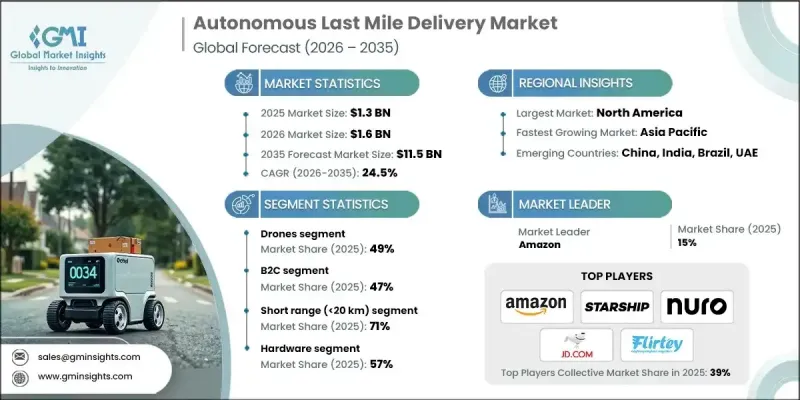
自主末端配送被广泛认为是一种创新的物流解决方案,它利用人工智慧、机器人和自动驾驶车辆,在无需人工干预的情况下将货物从配送中心运送至最终用户。这项技术涵盖了多种平台,旨在有效地运作各种不同的配送环境。市场成长的驱动力来自数位商务的快速发展、人事费用的上升以及自主系统能力的提升。日益增长的线上购物活动显着提升了对扩充性、柔软性配送模式的需求。同时,技术成本的下降和营运效率的提高也增强了自主配送解决方案的经济可行性,使其更具竞争力,足以与传统配送方式相提并论。监管政策的发展也为商业化进程提供了支持,清晰的政策框架降低了营运商的不确定性。这些趋势正在汇聚,重塑物流策略,影响消费者对配送的预期,并推动都市区和郊区基础设施规划的变革。
| 市场覆盖范围 | |
|---|---|
| 开始年份 | 2025 |
| 预测年份 | 2026-2035 |
| 起始值 | 13亿美元 |
| 预测金额 | 115亿美元 |
| 复合年增长率 | 24.5% |
预计到2025年,无人机配送市占率将达到49%,并在2026年至2035年间以22.8%的复合年增长率成长。无人机平台因其能够快速配送并避免地面拥塞(尤其是在管制较少的空域)而日益受到青睐。动力系统、导航软体和运行可靠性的不断改进,正在拓展无人机的实际应用场景并提高配送效率。
预计到2025年,B2C领域将占据47%的市场份额,并以24.2%的复合年增长率(CAGR)实现最快成长,直至2035年。该领域的成长主要受消费者对更快产品交付速度和更灵活交付时间的日益增长的需求所驱动。自主配送解决方案凭藉其持续营运和降低的配送成本,能够很好地满足这些需求。
预计到2024年,北美自动驾驶最后一公里配送市场将占据36%的市场份额,并在2035年之前以22.1%的复合年增长率成长。该地区的主导地位得益于先进的数位零售基础设施、有利的法规环境、不断提高的自动化应用率以及技术开发商的高度集中。美国凭藉其早期应用和大规模部署倡议,继续成为该地区成长的主要贡献者。
目录
第一章调查方法
第二章执行摘要
第三章业界考察
- 生态系分析
- 供应商情况
- 利润率分析
- 成本结构
- 每个阶段的附加价值
- 影响价值链的因素
- 中断
- 产业影响因素
- 司机
- 电子商务的成长推动了对最后一公里配送的需求。
- 人事费用上升推动自动化
- 人工智慧和机器人技术的进步提高了效率
- 都市化加快和交通拥堵加剧,推动了对自动配送的需求。
- 永续性倡议将推动电动车和自动驾驶汽车的普及。
- 产业潜在风险与挑战
- 监管和法律障碍减缓了普及率。
- 高昂的初始投资是广泛采用的障碍。
- 市场机会
- 智慧城市融入配送走廊
- 医疗和药品配送
- 车队即服务 (FaaS) 模式
- 跨产业伙伴关係
- 在新兴市场拓展业务
- 成长潜力分析
- 监管环境
- 北美洲
- 美国 - 联邦机动车辆安全标准 (FMVSS) 人行道机器人(400 磅以下)豁免模板,取代个人豁免申请流程。
- 加拿大-拟议修改超视距飞行(BVLOS)操作法规和新的无人机送货重量限制,将加强都市区作业的安全标准。
- 欧洲
- 德国联邦交通和数位基础设施部计划开发自动驾驶汽车测试基础设施(投资 32 亿欧元),并在汉堡和慕尼黑建立专门的自动驾驶汽车测试区(Emergen Research)。
- 英国—《2024年自动驾驶汽车法案》将建立一个全面的法律体制,预计2027年将推出配套法规。
- 在法国,为了明确事故责任并确保透明度,从 2025 年起,所有自动驾驶汽车都必须配备黑盒子记录设备。
- 亚太地区
- 中国—《北京自动驾驶汽车管理条例(2025年4月版)》是由工业和资讯化部颁布的条例,规定了自动驾驶汽车测试的申请程序并解决了安全问题。
- 印度 - 2025 年民用无人机(促进和监管)法案(草案)规定了无人机登记、分配唯一识别号码 (UIN)、无人机製造商的强制性型号认证,以及对商用无人驾驶飞行器 (UAV) 征收 5% 的商品和服务税 (GST)。
- 日本-经济产业省的蓝图(2025)旨在到 2023 年将功能更强大的自主最后一公里配送解决方案的应用范围扩大到合法低速模式之外。
- 拉丁美洲
- 巴西-与圣保罗州合作L3级自动驾驶计程车区域试点计画(2024年),国家框架尚未建立
- 中东和非洲
- 沙乌地阿拉伯—「2030愿景」计画旨在透过政府主导的投资和监管改革,消除普及障碍,使公共道路上的自动驾驶汽车数量增加50%。
- 北美洲
- 波特分析
- PESTEL 分析
- 科技与创新趋势
- 当前技术趋势
- 新兴技术
- 专利分析
- 用例和成功案例
- 永续性和环境方面
- 永续实践
- 减少废弃物策略
- 生产中的能源效率
- 环保倡议
- 碳足迹考量
- 未来前景与机会
第四章 竞争情势
- 介绍
- 公司市占率分析
- 北美洲
- 欧洲
- 亚太地区
- 拉丁美洲
- 中东和非洲
- 主要市场公司的竞争分析
- 竞争定位矩阵
- 战略展望矩阵
- 重大进展
- 併购
- 伙伴关係与合作
- 新产品发布
- 企业扩张计画和资金筹措
第五章 2022-2035年各平台市场估算与预测
- 无人机
- 多旋翼无人机
- 固定翼无人机
- 混合动力垂直起降无人机
- 机器人
- 人行道送货机器人
- 自主地面车辆(AGV)
- 室内配送机器人
- 卡车和货车
第六章 依交付方式分類的市场估算与预测,2022-2035年
- B2B
- B2C
- C2C
第七章 2022-2035年各地区市场估算与预测
- 短距离(小于20公里)
- 长途(超过20公里)
第八章 按解决方案分類的市场估算与预测,2022-2035年
- 硬体
- 汽车平臺
- 感测器(光达、摄影机、超音波、雷达)
- 电池/电源系统
- 软体
- 自主导航软体
- 车队管理平台
- 人工智慧/机器学习演算法
- 服务
- 维护和支援
- 系统整合和咨询
第九章 按应用领域分類的市场估算与预测,2022-2035年
- 电子商务
- 食品和杂货
- 小包裹和宅配服务
- 製药
- 家具和家电
- 其他的
第十章 2022-2035年各地区市场估计与预测
- 北美洲
- 我们
- 加拿大
- 欧洲
- 德国
- 英国
- 法国
- 义大利
- 西班牙
- 俄罗斯
- 北欧国家
- 比荷卢经济联盟
- 亚太地区
- 中国
- 印度
- 日本
- 澳洲
- 韩国
- 新加坡
- 泰国
- 印尼
- 越南
- 拉丁美洲
- 巴西
- 墨西哥
- 阿根廷
- 哥伦比亚
- 中东和非洲
- 南非
- 沙乌地阿拉伯
- 阿拉伯聯合大公国
第十一章:公司简介
- 世界公司
- Amazon
- DHL
- Flirtey
- JD.com
- Matternet
- Nuro
- Starship Technologies
- UPS
- Wing Aviation
- Zipline
- 当地公司
- JD Logistics
- Kiwibot
- Postmates
- RoboSense
- Segway Robotics
- SF Express
- Swiggy
- TeleRetail Robotics
- Yandex Delivery
- Zomato
- 新兴科技创新者
- Flytrex
- Manna Aero
- Ottonomy.IO
- Refraction AI
- Serve Robotics
The Global Autonomous Last Mile Delivery Market was valued at USD 1.3 billion in 2025 and is estimated to grow at a CAGR of 24.5% to reach USD 11.5 billion by 2035.
Autonomous last-mile delivery is widely recognized as a transformative logistics solution that relies on artificial intelligence, robotics, and self-operating vehicles to move goods from fulfillment points to end users without human intervention. The technology spans a range of platforms designed to operate efficiently across varied delivery environments. Market growth is being fueled by the rapid expansion of digital commerce, escalating workforce expenses, and continuous improvements in autonomous system capabilities. Rising online purchasing activity has significantly increased demand for scalable and flexible delivery models. At the same time, declining technology costs and improved operational efficiency are enhancing the economic viability of autonomous delivery solutions, allowing them to compete more effectively with conventional delivery methods. Regulatory progress is also supporting commercialization, as clearer policy frameworks are reducing uncertainty for operators. Together, these dynamics are reshaping logistics strategies, influencing consumer delivery expectations, and prompting changes in urban and suburban infrastructure planning.
| Market Scope | |
|---|---|
| Start Year | 2025 |
| Forecast Year | 2026-2035 |
| Start Value | $1.3 Billion |
| Forecast Value | $11.5 Billion |
| CAGR | 24.5% |
The drone-based delivery segment held a share of 49% in 2025 and is forecast to grow at a CAGR of 22.8% from 2026 to 2035. Drone platforms are gaining traction due to their ability to support rapid deliveries while avoiding ground-level congestion, particularly in less densely regulated airspace. Ongoing improvements in power systems, navigation software, and operational reliability are expanding their practical use cases and delivery efficiency.
The business-to-consumer segment accounted for 47% share in 2025 and is projected to grow at the fastest pace, with a CAGR of 24.2% through 2035. Growth in this segment is attributed to increasing consumer expectations for faster fulfillment and flexible delivery windows. Autonomous delivery solutions are well-suited to meet these requirements through continuous operation and reduced delivery costs.
North America Autonomous Last Mile Delivery Market captured 36% share in 2024 and is expected to grow at a CAGR of 22.1% during 2035. The region's leadership is supported by advanced digital retail infrastructure, favorable regulatory developments, increasing automation adoption, and a strong concentration of technology developers. The United States remains the primary contributor to regional growth due to early adoption and large-scale deployment initiatives.
Key companies operating in the Global Autonomous Last Mile Delivery Market include Starship Technologies, Amazon, Wing Aviation, Nuro, Zipline, UPS, JD.com, Kiwibot, and Flirtey. Companies active in the Autonomous Last Mile Delivery Market are strengthening their positions through technology development, pilot deployments, and strategic partnerships. Many players are investing heavily in artificial intelligence, navigation systems, and fleet management platforms to improve reliability and scalability. Collaborations with retailers, logistics providers, and local authorities are helping accelerate real-world deployment and regulatory alignment. Firms are also expanding geographic coverage through phased rollouts and focusing on cost optimization to improve commercial viability. Continuous testing, data-driven optimization, and modular platform design are enabling companies to adapt quickly to evolving delivery requirements and secure long-term market footholds.
Table of Contents
Chapter 1 Methodology
- 1.1 Research approach
- 1.2 Quality commitments
- 1.3 Research trail and confidence scoring
- 1.3.1 Research trail components
- 1.3.2 Scoring components
- 1.4 Data collection
- 1.4.1 Partial list of primary sources
- 1.5 Data mining sources
- 1.5.1 Paid sources
- 1.6 Best estimates and calculations
- 1.6.1 Base year calculation for any one approach
- 1.7 Forecast model
- 1.8 Research transparency addendum
Chapter 2 Executive Summary
- 2.1 Industry 3600 synopsis, 2022 - 2035
- 2.2 Key market trends
- 2.2.1 Regional
- 2.2.2 Platform
- 2.2.3 Delivery Mode
- 2.2.4 Range
- 2.2.5 Solutions
- 2.2.6 Application
- 2.3 TAM Analysis, 2026-2035
- 2.4 CXO perspectives: Strategic imperatives
- 2.4.1 Executive decision points
- 2.4.2 Critical success factors
- 2.5 Future outlook and strategic recommendations
Chapter 3 Industry Insights
- 3.1 Industry ecosystem analysis
- 3.1.1 Supplier landscape
- 3.1.2 Profit margin analysis
- 3.1.3 Cost structure
- 3.1.4 Value addition at each stage
- 3.1.5 Factor affecting the value chain
- 3.1.6 Disruptions
- 3.2 Industry impact forces
- 3.2.1.1 Growth drivers
- 3.2.1.2 E-commerce growth boosts last-mile delivery demand
- 3.2.1.3 Rising labor costs favor automation
- 3.2.1.4 AI and robotics advancements improve efficiency
- 3.2.1.5 Urbanization and traffic congestion increase need for autonomous delivery
- 3.2.1.6 Sustainability initiatives promote electric autonomous vehicles
- 3.2.2 Industry pitfalls and challenges
- 3.2.2.1 Regulatory and legal barriers slow deployment
- 3.2.2.2 High initial investment limits adoption
- 3.2.3 Market opportunities
- 3.2.3.1 Smart city integration for delivery corridors
- 3.2.3.2 Healthcare and pharmaceutical deliveries
- 3.2.3.3 Fleet-as-a-service models
- 3.2.3.4 Cross-industry partnerships
- 3.2.3.5 Expansion in emerging markets
- 3.3 Growth potential analysis
- 3.4 Regulatory landscape
- 3.4.1 North America
- 3.4.1.1 US - Federal Motor Vehicle Safety Standards (FMVSS) exemption templates for sidewalk robots under 400 pounds, replacing waiver-by-waiver process.
- 3.4.1.2 Canada - Anticipated updates to beyond-visual-line-of-sight (BVLOS) operations regulations and new weight regulations for drone delivery with enhanced safety rules for urban operations.
- 3.4.2 Europe
- 3.4.2.1 Germany - Federal Ministry of Transport and Digital Infrastructure autonomous vehicle testing infrastructure framework with €3.2 billion investment and dedicated autonomous vehicle zones in Hamburg and Munich Emergen Research
- 3.4.2.2 UK - Automated Vehicles Act 2024 establishing comprehensive legal framework with secondary regulations expected by 2027
- 3.4.2.3 France - Black-box recorder requirement for all self-driving cars starting 2025 to establish accident responsibility and transparency
- 3.4.3 Asia Pacific
- 3.4.3.1 China - Beijing Autonomous Vehicle Regulation (April 2025) outlining procedures for AV pilot applications and Ministry of Industry and Information Technology regulations addressing safety concerns
- 3.4.3.2 India - Draft Civil Drone (Promotion and Regulation) Bill 2025 mandating registration, Unique Identification Numbers (UIN), type certification for drone manufacturers, and 5% GST on commercial UAVs
- 3.4.3.3 Japan - National METI roadmap (2025) to scale higher-capability autonomous last-mile delivery solutions beyond low-speed models legalized in 2023
- 3.4.4 Latin America
- 3.4.4.1 Brazil - Regional autonomy with Sao Paulo Level 3 autonomous taxi pilots (2024), no national framework yet established
- 3.4.5 MEA
- 3.4.5.1 Saudi Arabia - Vision 2030 initiative targeting 50% increase in autonomous vehicle presence on public roads with government-driven investment and regulatory reforms to remove AV deployment barriers
- 3.4.1 North America
- 3.5 Porter';s analysis
- 3.6 PESTEL analysis
- 3.7 Technology and innovation landscape
- 3.7.1 Current technological trends
- 3.7.2 Emerging technologies
- 3.8 Patent analysis
- 3.9 Use cases & success stories
- 3.10 Sustainability and environmental aspects
- 3.10.1 Sustainable practices
- 3.10.2 Waste reduction strategies
- 3.10.3 Energy efficiency in production
- 3.10.4 Eco-friendly Initiatives
- 3.10.5 Carbon footprint considerations
- 3.11 Future outlook and opportunities
Chapter 4 Competitive Landscape, 2025
- 4.1 Introduction
- 4.2 Company market share analysis
- 4.2.1 North America
- 4.2.2 Europe
- 4.2.3 Asia Pacific
- 4.2.4 LATAM
- 4.2.5 MEA
- 4.3 Competitive analysis of major market players
- 4.4 Competitive positioning matrix
- 4.5 Strategic outlook matrix
- 4.6 Key developments
- 4.6.1 Mergers & acquisitions
- 4.6.2 Partnerships & collaborations
- 4.6.3 New product launches
- 4.6.4 Expansion plans and funding
Chapter 5 Market Estimates & Forecast, By Platform, 2022 - 2035 ($Bn, Units)
- 5.1 Key trends
- 5.2 Drones
- 5.2.1 Multi-rotor drones
- 5.2.2 Fixed-wing drones
- 5.2.3 Hybrid VTOL drones
- 5.3 Robots
- 5.3.1 Sidewalk delivery robots
- 5.3.2 Autonomous ground vehicles (AGVs)
- 5.3.3 Indoor delivery robots
- 5.4 Trucks & vans
Chapter 6 Market Estimates & Forecast, By Delivery Mode, 2022 - 2035 ($Bn, Units)
- 6.1 Key trends
- 6.2 B2B
- 6.3 B2C
- 6.4 C2C
Chapter 7 Market Estimates & Forecast, By Range, 2022 - 2035 ($Bn, Units)
- 7.1 Key trends
- 7.2 Short range (<20 km)
- 7.3 Long range (>20 km)
Chapter 8 Market Estimates & Forecast, By Solution, 2022 - 2035 ($Bn, Units)
- 8.1 Key trends
- 8.2 Hardware
- 8.2.1 Vehicle platforms
- 8.2.2 Sensors (LiDAR, cameras, ultrasonic, radar)
- 8.2.3 Batteries / Power systems
- 8.3 Software
- 8.3.1 Autonomous navigation software
- 8.3.2 Fleet management platforms
- 8.3.3 AI / Machine learning algorithms
- 8.4 Services
- 8.4.1 Maintenance & support
- 8.4.2 System integration & consultancy
Chapter 9 Market Estimates & Forecast, By Application, 2022 - 2035 ($Bn, Units)
- 9.1 Key trends
- 9.2 E-commerce
- 9.3 Food and grocery
- 9.4 Parcel & courier services
- 9.5 Pharmaceutical
- 9.6 Furniture & appliance
- 9.7 Others
Chapter 10 Market Estimates & Forecast, By Region, 2022 - 2035 ($Bn, Units)
- 10.1 Key trends
- 10.2 North America
- 10.2.1 US
- 10.2.2 Canada
- 10.3 Europe
- 10.3.1 Germany
- 10.3.2 UK
- 10.3.3 France
- 10.3.4 Italy
- 10.3.5 Spain
- 10.3.6 Russia
- 10.3.7 Nordics
- 10.3.8 Benelux
- 10.4 Asia Pacific
- 10.4.1 China
- 10.4.2 India
- 10.4.3 Japan
- 10.4.4 Australia
- 10.4.5 South Korea
- 10.4.6 Singapore
- 10.4.7 Thailand
- 10.4.8 Indonesia
- 10.4.9 Vietnam
- 10.5 Latin America
- 10.5.1 Brazil
- 10.5.2 Mexico
- 10.5.3 Argentina
- 10.5.4 Colombia
- 10.6 MEA
- 10.6.1 South Africa
- 10.6.2 Saudi Arabia
- 10.6.3 UAE
Chapter 11 Company Profiles
- 11.1 Global Players
- 11.1.1 Amazon
- 11.1.2 DHL
- 11.1.3 Flirtey
- 11.1.4 JD.com
- 11.1.5 Matternet
- 11.1.6 Nuro
- 11.1.7 Starship Technologies
- 11.1.8 UPS
- 11.1.9 Wing Aviation
- 11.1.10 Zipline
- 11.2 Regional Players
- 11.2.1 JD Logistics
- 11.2.2 Kiwibot
- 11.2.3 Postmates
- 11.2.4 RoboSense
- 11.2.5 Segway Robotics
- 11.2.6 SF Express
- 11.2.7 Swiggy
- 11.2.8 TeleRetail Robotics
- 11.2.9 Yandex Delivery
- 11.2.10 Zomato
- 11.3 Emerging Technology Innovators
- 11.3.1 Flytrex
- 11.3.2 Manna Aero
- 11.3.3 Ottonomy.IO
- 11.3.4 Refraction AI
- 11.3.5 Serve Robotics

 自动驾驶最后一公里配送市场规模、份额和成长分析(按车辆类型、配送方式、应用、组件、解决方案和地区划分)-2026-2033年产业预测
 2032 年自动驾驶最后一哩配送市场预测:按组件、范围、自主等级、最终用户和地区进行的全球分析
 自主式最后一哩发送的全球市场:各零件,各机器人类型,各车辆类型,负载容量,各用途,各产业,场所,各地区,市场规模,产业动态,机会分析,预测(2025年~2033年)
 自动驾驶最后一哩配送市场规模、份额、趋势分析报告:按平台、解决方案、范围、最终用途、地区和细分市场预测,2025 年至 2030 年
 2025 年至 2033 年自动驾驶最后一哩配送市场报告(按平台、解决方案、范围(短程、长程)、应用和地区)
 自动驾驶最后一哩配送全球市场规模、份额、趋势分析报告:2024 年至 2031 年按范围、解决方案、车辆类型、应用、地区分類的展望和预测
 到 2033 年自动最后一哩交付的全球市场、机会与策略