


 |
市场调查报告书
商品编码
1928927
韩国美妆产品市场机会、成长要素、产业趋势分析及2026年至2035年预测K-Beauty Products Market Opportunity, Growth Drivers, Industry Trend Analysis, and Forecast 2026 - 2035 |
||||||

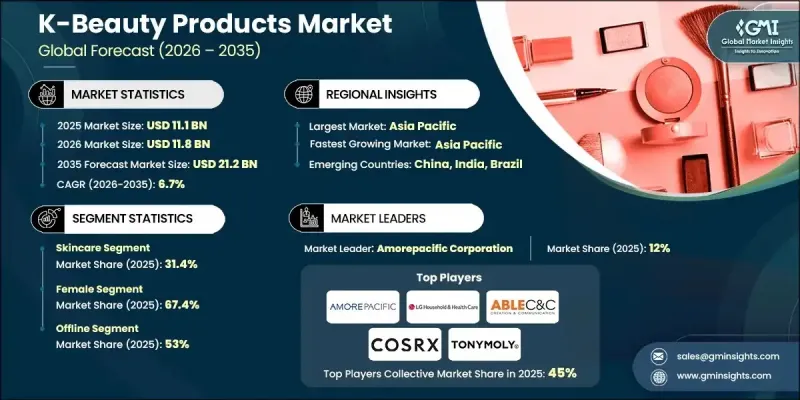
全球韩妆产品市场预计到 2025 年将达到 111 亿美元,到 2035 年将达到 212 亿美元,年复合成长率为 6.7%。
随着品牌日益重视创新、产品线拓展和全球布局,市场正经历一场意义深远的变革时期。策略整合活动正被广泛用于加速产品研发,并增强其在国际市场的竞争力。同时,消费者的偏好也转向了更注重环保和长期肌肤健康的配方。依赖刺激性化学成分的传统方法正逐渐被更干净、更永续的替代方案所取代。这种转变正在重塑产品研发策略,并推动对先进护肤解决方案的需求。全球消费者越来越倾向于以预防和维护为主的美容护肤方案,这些方案强调肌肤屏障的维护和整体健康。消费者对高效护肤和专业级解决方案日益增长的兴趣,进一步推动了其在成熟市场和新兴市场的普及。这些因素共同促成了韩妆(K-beauty)成为全球美容产业中一个充满活力、创新主导的细分市场。
| 市场覆盖范围 | |
|---|---|
| 开始年份 | 2025 |
| 预测期 | 2026-2035 |
| 起始值 | 111亿美元 |
| 预测金额 | 212亿美元 |
| 复合年增长率 | 6.7% |
到 2025 年,护肤类将成为全球最大的细分市场,占 31.4% 的市占率。其主导地位的驱动力在于消费者对先进的护肤流程、创新质地和以科学为依据的配方有着浓厚的兴趣,这些产品专注于长期改善肤质和外观。
2024年,女性消费者群体将占市场份额的67.4%,创造75亿美元的收入。这群人体现了对结构化美容程序的高度重视以及对高端、专业韩妆产品的持续需求。
预计到2025年,北美韩妆产品市场规模将达到31亿美元,到2035年将以7.2%的复合年增长率成长。美国约占该地区收入的85%,这得益于不断扩大的零售分销网络以及消费者对温和、预防性护肤方案日益增长的偏好。
目录
第一章调查方法和范围
第二章执行摘要
第三章业界考察
- 生态系分析
- 供应商情况
- 利润率
- 每个阶段的附加价值
- 影响价值链的因素
- 产业影响因素
- 司机
- 男性对仪容和自我护理的需求日益增长
- 智慧互联生态系统
- 永续性和生态设计
- 产业潜在风险与挑战
- 高端设备高成本
- 仿冒品的氾滥
- 机会
- 人工智慧驱动的个人化
- 方便携带且易于使用的「随时随地」设计
- 司机
- 成长潜力分析
- 未来市场趋势
- 科技与创新趋势
- 当前技术趋势
- 新兴技术
- 价格趋势
- 按地区
- 按类型
- 监管环境
- 标准和合规要求
- 区域法规结构
- 认证标准
- 波特分析
- PESTEL 分析
第四章 竞争情势
- 介绍
- 公司市占率分析
- 按地区
- 企业矩阵分析
- 主要市场公司的竞争分析
- 竞争定位矩阵
- 重大进展
- 併购
- 伙伴关係与合作
- 新产品发布
- 扩张计划
第五章 依产品类型分類的市场估算与预测,2022-2035年
- 护肤
- 洗面乳
- 爽肤水
- 美容精华液
- 保湿霜
- 面具
- 防晒油
- 化妆品
- 脸
- 唇
- 眼科
- 身体保养
- 身体乳液
- 沐浴露
- 去角质剂
- 护髮
- 其他的
6. 依最终用途分類的市场估计与预测,2022-2035 年
- 男性
- 女士
7. 2022-2035年按分销管道分類的市场估算与预测
- 线上管道
- 离线频道
第八章 2022-2035年各地区市场估算与预测
- 北美洲
- 我们
- 加拿大
- 欧洲
- 德国
- 英国
- 法国
- 义大利
- 西班牙
- 亚太地区
- 中国
- 日本
- 印度
- 澳洲
- 韩国
- 拉丁美洲
- 巴西
- 墨西哥
- 阿根廷
- 中东和非洲
- 南非
- 沙乌地阿拉伯
- 阿拉伯聯合大公国
第九章:公司简介
- Able C&C Co.Ltd.
- Amorepacific Corporation
- LG Household &Health Care
- APR Corp(Medicube)
- COSRX
- Dr. Jart+(Estee Lauder)
- Clio Cosmetics
- Beauty of Joseon
- Innisfree
- Tony Moly
- Nature Republic
- Neogen Corporation
- Banila Co
- Missha(Able C&C)
- Kolmar Korea(ODM/OEM)
The Global K-Beauty Products Market was valued at USD 11.1 billion in 2025 and is estimated to grow at a CAGR of 6.7% to reach USD 21.2 billion by 2035.
The market is undergoing a strong transformation as brands increasingly prioritize innovation, portfolio expansion, and global reach. Strategic consolidation activity is being used to accelerate product development and strengthen competitive positioning across international markets. At the same time, consumer preferences are shifting toward formulations that align with environmental responsibility and long-term skin health. Traditional approaches that rely heavily on harsh chemical inputs are gradually being replaced by cleaner and more sustainable alternatives. This shift is reshaping product development strategies and elevating demand for advanced skincare solutions. Global consumers are increasingly drawn to preventative and maintenance-focused beauty routines that emphasize skin barrier support and overall wellness. Rising interest in high-performance skincare and professional-grade solutions is further supporting adoption across mature and emerging markets. These factors collectively position K-beauty as a resilient and innovation-driven segment within the global beauty industry.
| Market Scope | |
|---|---|
| Start Year | 2025 |
| Forecast Year | 2026-2035 |
| Start Value | $11.1 Billion |
| Forecast Value | $21.2 Billion |
| CAGR | 6.7% |
The skincare category accounted for 31.4% share in 2025, making it the largest segment globally. Its leadership is supported by strong consumer interest in advanced routines, innovative textures, and science-backed formulations that focus on long-term skin quality and appearance.
The female consumer segment held a 67.4% share in 2024, generating USD 7.5 billion. This segment reflects higher engagement with structured beauty routines and consistent demand for premium and specialized K-beauty offerings.
North America K-Beauty Products Market reached USD 3.1 billion in 2025 and is expected to grow at a CAGR of 7.2% through 2035. The United States accounted for nearly 85% of regional revenue, supported by expanding retail availability and growing consumer preference for gentle, preventative skincare solutions.
Key companies active in the Global K-Beauty Products Market include Amorepacific Corporation, LG Household & Health Care, COSRX, Innisfree, Tony Moly, Dr. Jart+, Beauty of Joseon, Nature Republic, Clio Cosmetics, Banila Co, Neogen Corporation, APR Corp, Able C&C Co., Ltd., Missha, and Kolmar Korea. Companies in the Global K-Beauty Products Market are strengthening their market position through continuous formulation innovation and global brand expansion. Many players are investing in research focused on skin-friendly and sustainability-oriented ingredients to align with evolving consumer expectations. Strategic partnerships, acquisitions, and contract manufacturing support faster product launches and market entry. Brands are also leveraging digital marketing and social media to build global awareness and educate consumers on skincare routines.
Table of Contents
Chapter 1 Methodology and Scope
- 1.1 Market scope and definition
- 1.2 Research design
- 1.2.1 Research approach
- 1.2.2 Data collection methods
- 1.3 Data mining sources
- 1.3.1 Global
- 1.3.2 Regional/Country
- 1.4 Base estimates and calculations
- 1.4.1 Base year calculation
- 1.4.2 Key trends for market estimation
- 1.5 Primary research and validation
- 1.5.1 Primary sources
- 1.6 Forecast model
- 1.7 Research assumptions and limitations
Chapter 2 Executive Summary
- 2.1 Industry 360° synopsis
- 2.2 Key market trends
- 2.2.1 Regional
- 2.2.2 Product type
- 2.2.3 End Use
- 2.2.4 Distribution channel
- 2.3 CXO perspectives: Strategic imperatives
- 2.3.1 Key decision points for industry executives
- 2.3.2 Critical success factors for market players
- 2.4 Future outlook and strategic recommendations
Chapter 3 Industry Insights
- 3.1 Industry ecosystem analysis
- 3.1.1 Supplier landscape
- 3.1.2 Profit margin
- 3.1.3 Value addition at each stage
- 3.1.4 Factor affecting the value chain
- 3.2 Industry impact forces
- 3.2.1 Growth drivers
- 3.2.1.1 Rise in Male Grooming & Self-Care
- 3.2.1.2 Smart & Connected Ecosystems
- 3.2.1.3 Sustainability & Eco-Design
- 3.2.2 Industry pitfalls & challenges
- 3.2.2.1 High Cost of Premium Devices
- 3.2.2.2 Proliferation of Counterfeit Products
- 3.2.3 Opportunities
- 3.2.3.1 AI-Driven Personalization
- 3.2.3.2 Travel-friendly & "On-the-go" designs
- 3.2.1 Growth drivers
- 3.3 Growth potential analysis
- 3.4 Future market trends
- 3.5 Technology and innovation landscape
- 3.5.1 Current technological trends
- 3.5.2 Emerging technologies
- 3.6 Price trends
- 3.6.1 By region
- 3.6.2 By type
- 3.7 Regulatory landscape
- 3.7.1 Standards and compliance requirements
- 3.7.2 Regional regulatory frameworks
- 3.7.3 Certification standards
- 3.8 Porter';s analysis
- 3.9 PESTEL analysis
Chapter 4 Competitive Landscape, 2025
- 4.1 Introduction
- 4.2 Company market share analysis
- 4.2.1 By region
- 4.2.1.1 North America
- 4.2.1.2 Europe
- 4.2.1.3 Asia Pacific
- 4.2.1.4 Latin America
- 4.2.1.5 Middle East and Africa
- 4.2.1 By region
- 4.3 Company matrix analysis
- 4.4 Competitive analysis of major market players
- 4.5 Competitive positioning matrix
- 4.6 Key developments
- 4.6.1 Mergers & acquisitions
- 4.6.2 Partnerships & collaborations
- 4.6.3 New product launches
- 4.6.4 Expansion plans
Chapter 5 Market Estimates & Forecast, By Product Type, 2022 - 2035, (USD Billion) (Million Units)
- 5.1 Key trends
- 5.2 Skincare
- 5.2.1 Cleansers
- 5.2.2 Toners
- 5.2.3 Serums
- 5.2.4 Moisturizers
- 5.2.5 Masks
- 5.2.6 Sunscreens
- 5.3 Makeup
- 5.3.1 Face
- 5.3.2 Lip
- 5.3.3 Eye
- 5.4 Bodycare
- 5.4.1 Body lotions
- 5.4.2 Body wash
- 5.4.3 Exfoliants
- 5.5 Haircare
- 5.6 Others
Chapter 6 Market Estimates & Forecast, By End Use, 2022 - 2035, (USD Billion) (Million Units)
- 6.1 Key trends
- 6.2 Male
- 6.3 Female
Chapter 7 Market Estimates & Forecast, By Distribution Channel, 2022 - 2035, (USD Billion) (Million Units)
- 7.1 Key trends
- 7.2 Online channels
- 7.3 Offline channels
Chapter 8 Market Estimates and Forecast, By Region, 2022 - 2035 (USD Billion) (Million Units)
- 8.1 Key trends
- 8.2 North America
- 8.2.1 U.S.
- 8.2.2 Canada
- 8.3 Europe
- 8.3.1 Germany
- 8.3.2 UK
- 8.3.3 France
- 8.3.4 Italy
- 8.3.5 Spain
- 8.4 Asia Pacific
- 8.4.1 China
- 8.4.2 Japan
- 8.4.3 India
- 8.4.4 Australia
- 8.4.5 South Korea
- 8.5 Latin America
- 8.5.1 Brazil
- 8.5.2 Mexico
- 8.5.3 Argentina
- 8.6 Middle East and Africa
- 8.6.1 South Africa
- 8.6.2 Saudi Arabia
- 8.6.3 UAE
Chapter 9 Company Profiles
- 9.1 Able C&C Co.Ltd.
- 9.2 Amorepacific Corporation
- 9.3 LG Household & Health Care
- 9.4 APR Corp (Medicube)
- 9.5 COSRX
- 9.6 Dr. Jart+ (Estee Lauder)
- 9.7 Clio Cosmetics
- 9.8 Beauty of Joseon
- 9.9 Innisfree
- 9.10 Tony Moly
- 9.11 Nature Republic
- 9.12 Neogen Corporation
- 9.13 Banila Co
- 9.14 Missha (Able C&C)
- 9.15 Kolmar Korea (ODM/OEM)


