


 |
市场调查报告书
商品编码
1928935
电动汽车电池测试市场机会、成长要素、产业趋势分析及预测(2026年至2035年)Electric Vehicle Battery Testing Market Opportunity, Growth Drivers, Industry Trend Analysis, and Forecast 2026 - 2035 |
||||||

全球电动车电池测试市场预计到 2025 年将达到 13.5 亿美元,预计到 2035 年将达到 53.6 亿美元,年复合成长率为 15.2%。
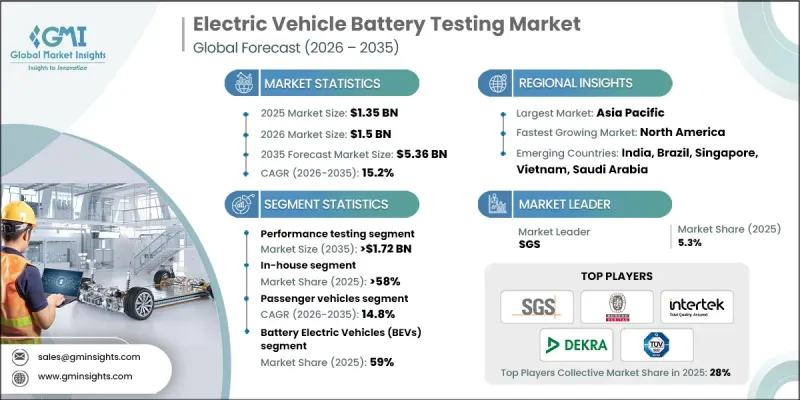
市场扩张与全球电动车产量加速成长密切相关,这迫使电池製造商和供应商采用先进的测试解决方案,以确保电池的安全性、可靠性和性能。随着电池设计朝着更高能量密度、更紧凑的几何形状和新的化学成分发展,与故障相关的经济和安全风险也不断增加。製造商优先考虑在多种运作条件下进行全面检验,以确保产品在大规模生产过程中的一致性。此外,对电芯、模组和电池包层面的长期耐久性、劣化行为、极端条件耐受性和热稳定性进行评估的需求也推动了测试需求的成长。由于电池更换成本居高不下,电池测试已成为风险管理策略的重要组成部分。曾经的合规性活动如今已成为整个电动车生态系统的策略性投资,旨在保护品牌声誉、降低保固风险并提高整体产品品质。
| 市场覆盖范围 | |
|---|---|
| 开始年份 | 2025 |
| 预测年份 | 2026-2035 |
| 起始值 | 13.5亿美元 |
| 预测金额 | 53.6亿美元 |
| 复合年增长率 | 15.2% |
预计到2025年,性能测试领域将占38%的市场份额,到2035年将达到17.2亿美元。该领域专注于评估电池在各种负载条件和运行环境下的高效供电能力。生命週期评估已不再局限于基本的充电循环,而是涵盖加速劣化测试、预测性劣化分析和先进的电池健康建模,以支援更长的车辆使用寿命预期。
预计到2034年,乘用车市场将以14.8%的复合年增长率成长。电动乘用车的日益普及持续推动着对满足续航里程、充电性能、耐用性和安全性等严格要求的电池的需求。製造商依靠广泛的测试通讯协定来确保效能稳定,并满足消费者对可靠性的期望。
美国电动车电池测试市场预计到2025年将达到2.322亿美元,并预计在2026年至2035年间保持强劲成长。对安全检验和法规遵循的日益重视正在推动对先进测试服务的需求。製造商正在扩大内部和外包测试能力,以加快产品上市速度,同时应对日益严峻的技术挑战和合规要求。
目录
第一章调查方法
第二章执行摘要
第三章业界考察
- 生态系分析
- 供应商情况
- 利润率分析
- 成本结构
- 每个阶段的附加价值
- 影响价值链的因素
- 中断
- 产业影响因素
- 司机
- 全球电动车产量成长
- 严格的电池安全和监管标准
- 提高电池能量密度和增加系统复杂性
- 专注于OEM厂商的品质保证和保固风险降低
- 扩大全球电池製造能力
- 产业潜在风险与挑战
- 先进测试基础设施的高昂资本成本
- 漫长的测试週期和上市时间压力
- 市场机会
- 第三方电池测试服务的成长
- 数位和自动化测试技术的进步
- 下一代电池化学的崛起
- 延长电池寿命週期和二次利用
- 成长潜力分析
- 监管环境
- 北美洲
- 美国:NHTSA汽车网路安全最佳实践
- 加拿大:加拿大机动车辆安全标准(CMVSS)
- 欧洲
- 英国:联合国欧洲经济委员会第13号法规 车辆煞车与稳定係统
- 德国:ISO 26262 道路车辆电气和电子系统的功能安全
- 法国:联合国欧洲经济委员会第79号法规《转向与车辆控制系统》
- 义大利:ISO 21434 道路车辆网路安全工程
- 西班牙:ISO 14001环境管理体系
- 亚太地区
- 中国:GB/T 38628 电动车电池测试和OTA更新安全要求
- 日本:ISO 26262 道路车辆电气和电子系统功能安全
- 印度:AIS 155 汽车软体网路安全和OTA要求
- 拉丁美洲
- 巴西:ABNT NBR ISO 26262 道路车辆功能安全
- 墨西哥:NOM-194-SCFI 车辆安全性能标准
- 阿根廷:ISO 9001品质管理体系
- 中东和非洲
- 阿联酋:联合国欧洲经济委员会第155号条例《网路安全与网路安全管理系统》
- 南非:ISO 26262 道路车辆电气和电子系统功能安全
- 沙乌地阿拉伯:SASO汽车技术法规、网路安全和软体
- 北美洲
- 波特分析
- PESTEL 分析
- 科技与创新趋势
- 当前技术趋势
- 新兴技术
- 成本細項分析
- 专利分析
- 永续性和环境方面
- 永续实践
- 减少废弃物策略
- 生产中的能源效率
- 环保倡议
- 碳足迹考量
- 测试标准和通讯协定
- 电池测试标准和通讯协定
- 认证测验、检验测验和型式核准测验的比较
- 强制性测试要求和OEM特定测试要求
- 电池化学类型测试
- 电池化学类型的测试要求
- 化学热失控和滥用测试的发展
- 基于生命週期阶段的测试
- 数位化、人工智慧和基于仿真的测试
第四章 竞争情势
- 介绍
- 公司市占率分析
- 北美洲
- 欧洲
- 亚太地区
- 拉丁美洲
- 中东和非洲
- 主要市场公司的竞争分析
- 竞争定位矩阵
- 战略展望矩阵
- 重大进展
- 併购
- 伙伴关係与合作
- 新产品发布
- 企业扩张计画和资金筹措
5. 2022-2035年按测试类型分類的市场估算与预测
- 性能测试
- 安全测试
- 生命週期测试
- 其他的
第六章 依采购方式分類的市场估计与预测,2022-2035年
- 内部采购
- 外包
第七章 依车辆类型分類的市场估计与预测,2022-2035年
- 搭乘用车
- 掀背车
- 轿车
- SUV
- 商用车辆
- 轻型商用车(LCV)
- 中型商用车(MCV)
- 重型商用车(HCV)
第八章 2022-2035年按推进方式分類的市场估算与预测
- 电池式电动车(BEV)
- 插电式混合动力电动车(PHEV)
- 混合动力电动车(HEV)
第九章 按组件分類的市场估算与预测,2022-2035年
- 电池单元
- 电池模组
- 电池组
- 电池管理系统(BMS)
第十章 依最终用途分類的市场估计与预测,2022-2035年
- 汽车製造商
- 电池製造商
- 研究与发展研究所
- 第三方测试服务提供者
第十一章 2022-2035年各地区市场估计与预测
- 北美洲
- 我们
- 加拿大
- 欧洲
- 德国
- 英国
- 法国
- 义大利
- 西班牙
- 俄罗斯
- 北欧国家
- 葡萄牙
- 克罗埃西亚
- 比荷卢经济联盟
- 亚太地区
- 中国
- 印度
- 日本
- 澳洲
- 韩国
- 新加坡
- 泰国
- 印尼
- 越南
- 拉丁美洲
- 巴西
- 墨西哥
- 阿根廷
- 哥伦比亚
- 中东和非洲
- 南非
- 沙乌地阿拉伯
- 阿拉伯聯合大公国
- 土耳其
第十二章:公司简介
- 世界玩家
- ALS
- Applus+
- Bureau Veritas
- DEKRA
- DNV
- Element Materials Technology
- Eurofins
- Intertek
- SGS
- TUV SUD
- UL Solutions
- 区域玩家
- AVL
- CSA
- FEV
- Instron
- KEMA Labs
- Nemko
- NTS(National Technical Systems)
- Tektronix
- VDE Testing and Certification
- Emerging/Disruptor Players
- Arbin Instruments
- AVILOO
- Bitrode
- Chroma ATE
- Digatron
- Espec
- Hioki
- Keysight Technologies
- Maccor
- Weiss Technik
The Global Electric Vehicle Battery Testing Market was valued at USD 1.35 billion in 2025 and is estimated to grow at a CAGR of 15.2% to reach USD 5.36 billion by 2035.
Market expansion is tied to the accelerating production of electric vehicles worldwide, which is pushing battery manufacturers and suppliers to adopt advanced testing solutions to confirm safety, reliability, and performance. As battery designs evolve toward higher energy density, compact form factors, and new chemical compositions, the financial and safety risks associated with failure continue to rise. Manufacturers are prioritizing comprehensive validation across multiple operating conditions to ensure product consistency during mass production. Testing demand is further strengthened by the need to evaluate long-term durability, degradation behavior, abuse tolerance, and thermal stability across cell, module, and pack levels. Battery testing has become an essential component of risk management strategies as the cost of battery replacement remains high. What was once a compliance-driven activity is now viewed as a strategic investment to protect brand reputation, reduce warranty exposure, and improve overall product quality across the electric mobility ecosystem.
| Market Scope | |
|---|---|
| Start Year | 2025 |
| Forecast Year | 2026-2035 |
| Start Value | $1.35 Billion |
| Forecast Value | $5.36 Billion |
| CAGR | 15.2% |
The performance testing segment held 38% share in 2025 and is projected to reach USD 1.72 billion by 2035. This segment focuses on assessing how efficiently batteries deliver power under varying load conditions and operating environments. Lifecycle evaluation has expanded beyond basic charge cycles to include accelerated aging, predictive degradation analysis, and advanced battery health modeling, supporting longer vehicle usage expectations.
The passenger vehicle segment is expected to grow at a CAGR of 14.8% throughout 2034. Rising adoption of electric passenger cars continues to increase demand for batteries that meet strict requirements related to driving range, charging performance, durability, and safety. Manufacturers depend on extensive testing protocols to ensure consistent performance and align with consumer expectations for reliability.
US Electric Vehicle Battery Testing Market was valued at USD 232.2 million in 2025 and is expected to record strong growth from 2026 to 2035. Increasing emphasis on safety validation and regulatory compliance is driving demand for advanced testing services. Manufacturers are expanding internal and outsourced testing capabilities to support faster commercialization while managing growing technical and compliance challenges.
Key companies active in the Global Electric Vehicle Battery Testing Market include SGS, UL Solutions, Intertek, TUV SUD, Bureau Veritas, DEKRA, Eurofins, DNV, Applus+, and Element. Companies operating in the Global Electric Vehicle Battery Testing Market are reinforcing their market position by expanding technical capabilities and service breadth. Investments in advanced testing infrastructure, automation, and simulation tools allow faster and more precise validation. Strategic partnerships with battery manufacturers and vehicle OEMs support long-term service agreements and recurring revenue. Many players are broadening global laboratory networks to serve customers across regions with consistent standards. A strong focus on safety, reliability, and time-to-market optimization helps testing providers differentiate their offerings while supporting the evolving requirements of next-generation electric vehicle batteries.
Table of Contents
Chapter 1 Methodology
- 1.1 Research approach
- 1.2 Quality commitments
- 1.2.1 GMI AI policy & data integrity commitment
- 1.3 Research trail & confidence scoring
- 1.3.1 Research trail components
- 1.3.2 Scoring components
- 1.4 Data collection
- 1.4.1 Partial list of primary sources
- 1.5 Data mining sources
- 1.5.1 Paid sources
- 1.6 Base estimates and calculations
- 1.6.1 Base year calculation
- 1.7 Forecast
- 1.8 Research transparency addendum
Chapter 2 Executive Summary
- 2.1 Industry 3600 synopsis, 2022 - 2035
- 2.2 Key market trends
- 2.2.1 Regional
- 2.2.2 Testing
- 2.2.3 Sourcing
- 2.2.4 Vehicle
- 2.2.5 Propulsion
- 2.2.6 Component
- 2.2.7 End use
- 2.3 TAM Analysis, 2026-2034
- 2.4 CXO perspectives: Strategic imperatives
- 2.4.1 Executive decision points
- 2.4.2 Critical success factors
- 2.5 Future outlook & strategic recommendations
Chapter 3 Industry Insights
- 3.1 Industry ecosystem analysis
- 3.1.1 Supplier landscape
- 3.1.2 Profit margin analysis
- 3.1.3 Cost structure
- 3.1.4 Value addition at each stage
- 3.1.5 Factor affecting the value chain
- 3.1.6 Disruptions
- 3.2 Industry impact forces
- 3.2.1.1 Growth drivers
- 3.2.1.2 Growth in global electric vehicle production
- 3.2.1.3 Stringent battery safety and regulatory standards
- 3.2.1.4 Increasing battery energy density and system complexity
- 3.2.1.5 OEM focus on quality assurance and warranty risk reduction
- 3.2.1.6 Expansion of global battery manufacturing capacity
- 3.2.2 Industry pitfalls and challenges
- 3.2.2.1 High capital cost of advanced testing infrastructure
- 3.2.2.2 Long testing cycles and time-to-market pressures
- 3.2.3 Market opportunities
- 3.2.3.1 Growth of third-party battery testing services
- 3.2.3.2 Advancements in digital and automated testing technologies
- 3.2.3.3 Emergence of next-generation battery chemistries
- 3.2.3.4 Expansion of battery lifecycle and second-life applications
- 3.3 Growth potential analysis
- 3.4 Regulatory landscape
- 3.4.1 North America
- 3.4.1.1 United States: NHTSA Automotive Cybersecurity Best Practices
- 3.4.1.2 Canada: Canadian Motor Vehicle Safety Standards CMVSS
- 3.4.2 Europe
- 3.4.2.1 UK: UNECE Regulation No. 13 Vehicle Braking and Stability Systems
- 3.4.2.2 Germany: ISO 26262 Functional Safety of Electrical and Electronic Systems in Road Vehicles
- 3.4.2.3 France: UNECE Regulation No. 79 Steering and Vehicle Control Systems
- 3.4.2.4 Italy: ISO 21434 Road Vehicles Cybersecurity Engineering
- 3.4.2.5 Spain: ISO 14001 Environmental Management Systems
- 3.4.3 Asia Pacific
- 3.4.3.1 China: GB/T 38628 Electric Vehicle Battery Testing and OTA Update Security Requirements
- 3.4.3.2 Japan: ISO 26262 Functional Safety of Electrical and Electronic Systems in Road Vehicles
- 3.4.3.3 India: AIS 155 Cybersecurity and OTA Requirements for Automotive Software
- 3.4.4 Latin America
- 3.4.4.1 Brazil: ABNT NBR ISO 26262 Functional Safety for Road Vehicles
- 3.4.4.2 Mexico: NOM-194-SCFI Vehicle Safety and Performance Standards
- 3.4.4.3 Argentina: ISO 9001 Quality Management Systems
- 3.4.5 Middle East & Africa
- 3.4.5.1 UAE: UNECE Regulation No. 155 Cybersecurity and Cybersecurity Management Systems
- 3.4.5.2 South Africa: ISO 26262 Functional Safety of Electrical and Electronic Systems in Road Vehicles
- 3.4.5.3 Saudi Arabia: SASO Automotive Technical Regulations Cybersecurity and Software
- 3.4.1 North America
- 3.5 Porter';s analysis
- 3.6 PESTEL analysis
- 3.7 Technology and innovation landscape
- 3.7.1 Current technological trends
- 3.7.2 Emerging technologies
- 3.8 Cost breakdown analysis
- 3.9 Patent analysis
- 3.10 Sustainability and environmental aspects
- 3.10.1 Sustainable practices
- 3.10.2 Waste reduction strategies
- 3.10.3 Energy efficiency in production
- 3.10.4 Eco-friendly initiatives
- 3.10.5 Carbon footprint considerations
- 3.11 Testing Standards & Protocols
- 3.11.1 Battery testing standards & protocols
- 3.11.2 Certification vs validation vs homologation testing
- 3.11.3 Mandatory vs OEM-specific test requirements
- 3.12 Battery Chemistry-Specific Testing
- 3.12.1 Testing requirements by battery chemistry
- 3.12.2 Thermal runaway & abuse testing evolution by chemistry
- 3.13 Lifecycle Phase-Based Testing
- 3.14 Digital, AI & Simulation-Based Testing
Chapter 4 Competitive Landscape, 2025
- 4.1 Introduction
- 4.2 Company market share analysis
- 4.2.1 North America
- 4.2.2 Europe
- 4.2.3 Asia Pacific
- 4.2.4 LATAM
- 4.2.5 MEA
- 4.3 Competitive analysis of major market players
- 4.4 Competitive positioning matrix
- 4.5 Strategic outlook matrix
- 4.6 Key developments
- 4.6.1 Mergers & acquisitions
- 4.6.2 Partnerships & collaborations
- 4.6.3 New Product Launches
- 4.6.4 Expansion Plans and funding
Chapter 5 Market Estimates & Forecast, By Testing, 2022 - 2035 ($Bn)
- 5.1 Key trends
- 5.2 Performance testing
- 5.3 Safety testing
- 5.4 Lifecycle testing
- 5.5 Others
Chapter 6 Market Estimates & Forecast, By Sourcing, 2022 - 2035 ($Bn)
- 6.1 Key trends
- 6.2 In-house
- 6.3 Outsourcing
Chapter 7 Market Estimates & Forecast, By Vehicle, 2022 - 2035 ($Bn)
- 7.1 Key trends
- 7.2 Passenger vehicles
- 7.2.1 Hatchback
- 7.2.2 Sedan
- 7.2.3 SUV
- 7.3 Commercial vehicles
- 7.3.1 Light Commercial Vehicles (LCV)
- 7.3.2 Medium Commercial Vehicles (MCV)
- 7.3.3 Heavy Commercial Vehicles (HCV)
Chapter 8 Market Estimates & Forecast, By Propulsion, 2022 - 2035 ($Bn)
- 8.1 Key trends
- 8.2 Battery Electric Vehicles (BEVs)
- 8.3 Plug-in Hybrid Electric Vehicles (PHEVs)
- 8.4 Hybrid Electric Vehicles (HEVs)
Chapter 9 Market Estimates & Forecast, By Component, 2022 - 2035 ($Bn)
- 9.1 Key trends
- 9.2 Battery Cells
- 9.3 Battery Modules
- 9.4 Battery Packs
- 9.5 Battery Management Systems (BMS)
Chapter 10 Market Estimates & Forecast, By End Use, 2022 - 2035 ($Bn)
- 10.1 Key trends
- 10.2 Automotive OEMs
- 10.3 Battery manufacturers
- 10.4 Research and development institutes
- 10.5 Third-party testing service providers
Chapter 11 Market Estimates & Forecast, By Region, 2022 - 2035 ($Bn)
- 11.1 Key trends
- 11.2 North America
- 11.2.1 US
- 11.2.2 Canada
- 11.3 Europe
- 11.3.1 Germany
- 11.3.2 UK
- 11.3.3 France
- 11.3.4 Italy
- 11.3.5 Spain
- 11.3.6 Russia
- 11.3.7 Nordics
- 11.3.8 Portugal
- 11.3.9 Croatia
- 11.3.10 Benelux
- 11.4 Asia Pacific
- 11.4.1 China
- 11.4.2 India
- 11.4.3 Japan
- 11.4.4 Australia
- 11.4.5 South Korea
- 11.4.6 Singapore
- 11.4.7 Thailand
- 11.4.8 Indonesia
- 11.4.9 Vietnam
- 11.5 Latin America
- 11.5.1 Brazil
- 11.5.2 Mexico
- 11.5.3 Argentina
- 11.5.4 Colombia
- 11.6 MEA
- 11.6.1 South Africa
- 11.6.2 Saudi Arabia
- 11.6.3 UAE
- 11.6.4 Turkey
Chapter 12 Company Profiles
- 12.1 Global Players
- 12.1.1 ALS
- 12.1.2 Applus+
- 12.1.3 Bureau Veritas
- 12.1.4 DEKRA
- 12.1.5 DNV
- 12.1.6 Element Materials Technology
- 12.1.7 Eurofins
- 12.1.8 Intertek
- 12.1.9 SGS
- 12.1.10 TUV SUD
- 12.1.11 UL Solutions
- 12.2 Regional Players
- 12.2.1 AVL
- 12.2.2 CSA
- 12.2.3 FEV
- 12.2.4 Instron
- 12.2.5 KEMA Labs
- 12.2.6 Nemko
- 12.2.7 NTS (National Technical Systems)
- 12.2.8 Tektronix
- 12.2.9 VDE Testing and Certification
- 12.3 Emerging / Disruptor Players
- 12.3.1 Arbin Instruments
- 12.3.2 AVILOO
- 12.3.3 Bitrode
- 12.3.4 Chroma ATE
- 12.3.5 Digatron
- 12.3.6 Espec
- 12.3.7 Hioki
- 12.3.8 Keysight Technologies
- 12.3.9 Maccor
- 12.3.10 Weiss Technik

 2026-2034年全球电动车工程塑胶市场规模、份额、趋势及成长分析
 全球自我调整交通底盘市场预测(至2034年):按底盘类型、材料、车辆类型、技术、最终用户和地区划分
 电动汽车电池组件市场机会、成长要素、产业趋势分析及2026年至2035年预测
 电动车零件市场-全球产业规模、份额、趋势、机会及预测(按车辆类型、动力类型、零件类型、地区和竞争格局划分,2021-2031年)
 新能源汽车保险丝市场按安装类型、电压等级、车辆类型、应用、额定电流、保险丝类型和分销管道划分,全球预测(2026-2032年)新能源汽车诊断设备市场按诊断技术、连接方式、车辆类型、应用、分销管道和最终用户划分-全球预测(2026-2032年)汽车电流感测器市场按感测器类型、车辆类型、输出类型、通道数、最终用户和电流范围划分 - 全球预测 2026-2032滑板底盘电池盒市场(按电池类型、分销管道、最终用户和产品类型划分)-2026-2032年全球预测电动汽车转子轴市场按车辆类型、额定功率、轴材质、转子类型、冷却方式、製造流程、最终用户和分销管道划分-2026-2032年全球预测车用级电流电压感测器市场(按产品类型、输出类型、车辆类型、应用和通路划分),全球预测,2026-2032年