


 |
市场调查报告书
商品编码
1928956
语言学习市场机会、成长要素、产业趋势分析及预测(2026-2035年)Language Learning Market Opportunity, Growth Drivers, Industry Trend Analysis, and Forecast 2026 - 2035 |
||||||

全球语言学习市场预计到 2025 年将达到 851 亿美元,到 2035 年将达到 6,490 亿美元,年复合成长率为 22.9%。
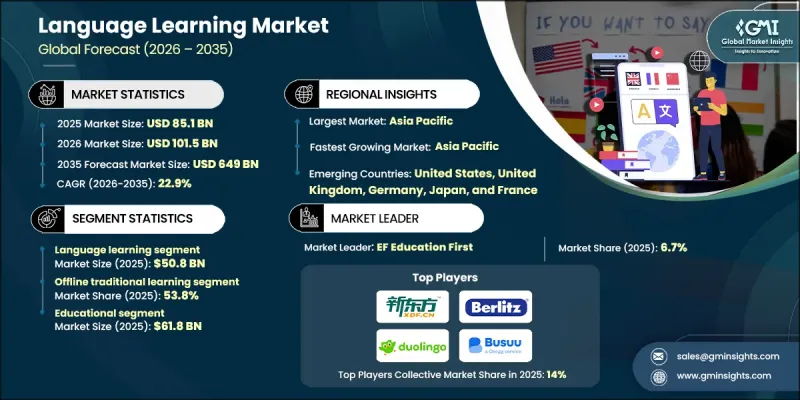
这一增长得益于全球一体化的加深、跨境交流的日益频繁以及数位化学习工具的广泛应用。随着国际旅行、移民和留学机会的不断增加,人们越来越重视语言能力,以支持自身的教育、职业发展和文化融入。随着越来越多的企业将多语言能力视为在全球化职场中高效运作的必要条件,企业对语言培训的需求也正在加速成长。企业语言培训已成为各行各业的策略性投资,旨在提高生产力和促进协作。远距办公和国际团队的扩张进一步凸显了跨语言有效沟通的重要性。科技正在改变各行各业,人工智慧驱动的平台能够提供客製化的学习路径和互动式学习体验。强调沉浸式、自适应和参与式学习的数位化工具正在重新定义学习者获取语言技能的方式,并推动全球市场的持续扩张。
| 市场覆盖范围 | |
|---|---|
| 开始年份 | 2025 |
| 预测年份 | 2026-2035 |
| 起始值 | 851亿美元 |
| 预测金额 | 6490亿美元 |
| 复合年增长率 | 22.9% |
预计到2025年,结构化语言学习市场规模将达到508亿美元,主要得益于人们对能够提升学业成绩、拓展职业发展机会和增强全球流动性的结构化课程的需求不断增长。学习者越来越倾向于选择结合课程教学、权威评估和可衡量成果的正规课程,这使得结构化学习成为学生和在职人士的首选。
到2025年,线下或传统课堂学习将占53.8%的市场份额,凸显了教师指导、同侪协作和身临其境型学习体验的重要性。许多学习者,尤其是在网路连线和数位基础设施有限的地区,非常重视实体教室提供的面对面互动、即时回馈和结构化学习环境。由于指导主导学习和与经验丰富的教师进行个人化互动带来的实际益处,这一学习领域依然保持强劲势头。
预计到2025年,北美语言学习市场规模将达到239亿美元,巩固其作为关键成长区域的地位。推动市场成长的因素包括教育科技的广泛应用、数位化学习工具的整合以及将线上学习的柔软性与传统课堂教学相结合的混合模式的推广。该地区对创新课程、技能型语言计画和企业培训倡议的重视,持续推动多元化学习群体的语言学习市场成长和普及。
目录
第一章调查方法和范围
第二章执行摘要
第三章业界考察
- 生态系分析
- 供应商情况
- 利润率
- 成本结构
- 每个阶段的附加价值
- 影响价值链的因素
- 中断
- 产业影响因素
- 司机
- 人工智慧驱动的个人化
- 数位转型与行动平台
- 企业培训需求
- 全球化与移民趋势
- 出国留学和国际旅行越来越受欢迎
- 陷阱与挑战
- 教师短缺
- 部分地区有网路连线环境限制
- 司机
- 成长潜力分析
- 监管环境
- 北美洲
- 欧洲
- 亚太地区
- 拉丁美洲
- 中东和非洲
- 波特分析
- PESTEL 分析
- 科技与创新趋势
- 当前技术趋势
- 新兴技术
- 新兴经营模式
- 合规要求
- 供应链韧性
- 地缘政治分析
- 数位转型
- 风险评估与管理
第四章 竞争情势
- 介绍
- 公司市占率分析
- 按地区
- 北美洲
- 欧洲
- 亚太地区
- 拉丁美洲
- 中东和非洲
- 市场集中度分析
- 按地区
- 主要企业的竞争标竿分析
- 产品系列比较
- 产品线的广度
- 科技
- 创新
- 区域比较
- 全球扩张分析
- 服务网路覆盖
- 按地区分類的市场渗透率
- 竞争定位矩阵
- 领导企业
- 受让人
- 追踪者
- 小众玩家
- 战略展望矩阵
- 产品系列比较
- 2022-2025 年主要发展动态
- 併购
- 合作伙伴关係和合资企业
- 技术进步
- 扩张与投资策略
- 永续发展倡议
- 数位转型计划
- 新兴/Start-Ups竞赛的趋势
第五章 按语言分類的市场估计与预测,2022-2035年
- 英语
- 西班牙语
- 德文
- 中国人
- 法语
- 俄文
- 葡萄牙语
- 义大利语
- 韩国人
- 日本人
- 其他的
第六章 按学习类型分類的市场估算与预测,2022-2035年
- 数位平台
- 线下传统学习
- 杂交种
第七章 按应用领域分類的市场估算与预测,2022-2035年
- 教育
- 面向专业
- 其他的
8. 按学习类型分類的市场估算与预测,2022-2035 年
- 语言学习
- 身临其境型学习
第九章 依最终用户分類的市场估算与预测,2022-2035年
- 小学、国中和高中学生
- 高等教育学生
- 企业/专业学习者
- 直接面向消费者 (DTC) 学习者
第十章 2022-2035年各地区市场估计与预测
- 北美洲
- 我们
- 加拿大
- 欧洲
- 德国
- 英国
- 法国
- 西班牙
- 义大利
- 荷兰
- 亚太地区
- 中国
- 印度
- 日本
- 澳洲
- 韩国
- 拉丁美洲
- 巴西
- 墨西哥
- 阿根廷
- 中东和非洲
- 沙乌地阿拉伯
- 南非
- 阿拉伯聯合大公国
第十一章 公司简介
- Babbel Gmbh
- Berlitz Corporation
- Busuu Ltd.(Chegg)
- Duolingo
- EF Education First
- eLanguage, LLC
- HHM Education Company
- Inlingua International Ltd.
- McGraw-Hill Education, Inc.
- Memrise
- New Oriental Education &Technology Group Inc.
- Rosetta Stone LLC
- Sanako Corporation
- Speexx
- Voxy
The Global Language Learning Market was valued at USD 85.1 billion in 2025 and is estimated to grow at a CAGR of 22.9% to reach USD 649 billion by 2035.
Growth is fueled by deeper global integration, rising cross-border interaction, and the widespread adoption of digital learning tools. Individuals increasingly pursue language skills to support education, career mobility, and cultural integration as international travel, migration, and study opportunities continue to rise. Demand from enterprises is also accelerating, as organizations prioritize multilingual capabilities to operate efficiently in globalized work environments. Corporate language training has become a strategic investment across sectors focused on productivity and collaboration. The expansion of remote work and international teams has further increased the need for effective communication across languages. Technology is reshaping the industry, with AI-driven platforms enabling customized learning paths and interactive experiences. Digital tools that emphasize engagement, adaptability, and immersion are redefining how learners acquire language skills and driving sustained market expansion worldwide.
| Market Scope | |
|---|---|
| Start Year | 2025 |
| Forecast Year | 2026-2035 |
| Start Value | $85.1 Billion |
| Forecast Value | $649 Billion |
| CAGR | 22.9% |
The organized language learning segment generated USD 50.8 billion in 2025, driven by the rising demand for structured programs that improve academic performance, professional growth, and global mobility opportunities. Learners increasingly seek formal courses that combine curriculum-based instruction, certified assessments, and measurable outcomes, which makes organized learning the preferred choice for both students and working professionals.
The offline or traditional classroom-based learning segment accounted for 53.8% share in 2025, highlighting the continued importance of instructor-led teaching, peer collaboration, and immersive learning experiences. Many learners value face-to-face interaction, immediate feedback, and the structured environment that physical classrooms provide, especially in regions where internet connectivity or digital infrastructure is limited. This segment remains strong due to the tangible benefits of guided learning and personal engagement with experienced instructors.
North America Language Learning Market generated USD 23.9 billion in 2025, cementing its position as a key growth region. The market is propelled by widespread adoption of educational technology, integration of digital learning tools, and the expansion of hybrid models that combine online flexibility with traditional classroom support. The region's focus on innovative curricula, skill-based language programs, and corporate training initiatives continues to drive growth and adoption across diverse learner segments.
Key companies active in the Global Language Learning Market include Duolingo, EF Education First, Babbel Gmbh, Berlitz Corporation, Busuu Ltd. (Chegg), Inlingua International Ltd., Memrise, McGraw-Hill Education, Inc., eLanguage, LLC, and HHM Education Company. Companies in the Global Language Learning Market are strengthening their market position by investing heavily in artificial intelligence and data-driven personalization to improve learner engagement and outcomes. Many players are expanding digital platforms to support scalable, mobile-first learning experiences that appeal to global audiences. Strategic partnerships with educational institutions and corporate clients help broaden customer reach and diversify revenue streams. Firms are also enhancing content libraries with culturally relevant and industry-specific language modules. Flexible pricing models, subscription plans, and freemium offerings are being used to attract and retain users.
Table of Contents
Chapter 1 Methodology and Scope
- 1.1 Market scope and definition
- 1.2 Research design
- 1.2.1 Research approach
- 1.2.2 Data collection methods
- 1.3 Data mining sources
- 1.3.1 Global
- 1.3.2 Regional/Country
- 1.4 Base estimates and calculations
- 1.4.1 Base year calculation
- 1.4.2 Key trends for market estimation
- 1.5 Primary research and validation
- 1.5.1 Primary sources
- 1.6 Forecast model
- 1.7 Research assumptions and limitations
Chapter 2 Executive Summary
- 2.1 Industry 3600 synopsis
- 2.2 Key market trends
- 2.2.1 Language trends
- 2.2.2 Learning mode trends
- 2.2.3 Application trends
- 2.2.4 End-user trends
- 2.2.5 Regional trends
- 2.3 TAM Analysis, 2026-2035 (USD Billion)
- 2.4 CXO perspectives: Strategic imperatives
- 2.4.1 Executive decision points
- 2.4.2 Critical success factors
- 2.5 Future outlook and strategic recommendations
Chapter 3 Industry Insights
- 3.1 Industry ecosystem analysis
- 3.1.1 Supplier landscape
- 3.1.2 Profit margin
- 3.1.3 Cost structure
- 3.1.4 Value addition at each stage
- 3.1.5 Factor affecting the value chain
- 3.1.6 Disruptions
- 3.2 Industry impact forces
- 3.2.1 Growth drivers
- 3.2.1.1 AI-Driven Personalization
- 3.2.1.2 Digital Transformation and Mobile Platforms
- 3.2.1.3 Corporate Training Demands
- 3.2.1.4 Globalization and Immigration Trends
- 3.2.1.5 Rising popularity of study abroad and international travel
- 3.2.2 Pitfalls and challenges
- 3.2.2.1 Teacher Shortages
- 3.2.2.2 Limited Internet Access in Some Regions
- 3.2.1 Growth drivers
- 3.3 Growth potential analysis
- 3.4 Regulatory landscape
- 3.4.1 North America
- 3.4.2 Europe
- 3.4.3 Asia Pacific
- 3.4.4 Latin America
- 3.4.5 Middle East & Africa
- 3.5 Porter';s analysis
- 3.6 PESTEL analysis
- 3.7 Technology and Innovation landscape
- 3.7.1 Current technological trends
- 3.7.2 Emerging technologies
- 3.8 Emerging Business Models
- 3.9 Compliance Requirements
- 3.10 Supply Chain Resilience
- 3.11 Geopolitical Analysis
- 3.12 Digital Transformation
- 3.13 Risk Assessment and Management
Chapter 4 Competitive Landscape, 2025
- 4.1 Introduction
- 4.2 Company market share analysis
- 4.2.1 By region
- 4.2.1.1 North America
- 4.2.1.2 Europe
- 4.2.1.3 Asia Pacific
- 4.2.1.4 Latin America
- 4.2.1.5 Middle East & Africa
- 4.2.2 Market concentration analysis
- 4.2.1 By region
- 4.3 Competitive benchmarking of key players
- 4.3.1 Product portfolio comparison
- 4.3.1.1 Product range breadth
- 4.3.1.2 Technology
- 4.3.1.3 Innovation
- 4.3.2 Geographic presence comparison
- 4.3.2.1 Global footprint analysis
- 4.3.2.2 Service network coverage
- 4.3.2.3 Market penetration by region
- 4.3.3 Competitive positioning matrix
- 4.3.3.1 Leaders
- 4.3.3.2 Challengers
- 4.3.3.3 Followers
- 4.3.3.4 Niche players
- 4.3.4 Strategic outlook matrix
- 4.3.1 Product portfolio comparison
- 4.4 Key developments, 2022-2025
- 4.4.1 Mergers and acquisitions
- 4.4.2 Partnerships and collaborations
- 4.4.3 Technological advancements
- 4.4.4 Expansion and investment strategies
- 4.4.5 Sustainability initiatives
- 4.4.6 Digital transformation initiatives
- 4.5 Emerging/ startup competitors landscape
Chapter 5 Market Estimates and Forecast, By Language, 2022 - 2035 (USD Billion)
- 5.1 English
- 5.2 Spanish
- 5.3 German
- 5.4 Chinese
- 5.5 French
- 5.6 Russian
- 5.7 Portuguese
- 5.8 Italian
- 5.9 Korean
- 5.10 Japanese
- 5.11 Others
Chapter 6 Market Estimates and Forecast, By Learning Mode, 2022 - 2035 (USD Billion)
- 6.1 Key trends
- 6.2 Digital platforms
- 6.3 Offline traditional learning
- 6.4 Hybrid
Chapter 7 Market Estimates and Forecast, By Application, 2022 - 2035 (USD Billion)
- 7.1 Key trends
- 7.2 Educational
- 7.3 Professional
- 7.4 Others
Chapter 8 Market Estimates and Forecast, By Learning Type, 2022 - 2035 (USD Billion)
- 8.1 Key trends
- 8.2 Language learning
- 8.3 Immersive learning
Chapter 9 Market Estimates and Forecast, By End User, 2022 - 2035 (USD Billion)
- 9.1 Key trends
- 9.2 K-12 Students
- 9.3 Higher Education Students
- 9.4 Corporate / Professional Learners
- 9.5 Direct-to-Consumer (DTC) Learners
Chapter 10 Market Estimates and Forecast, By Region, 2022 - 2035 (USD Billion)
- 10.1 Key trends
- 10.2 North America
- 10.2.1 U.S.
- 10.2.2 Canada
- 10.3 Europe
- 10.3.1 Germany
- 10.3.2 UK
- 10.3.3 France
- 10.3.4 Spain
- 10.3.5 Italy
- 10.3.6 Netherlands
- 10.4 Asia Pacific
- 10.4.1 China
- 10.4.2 India
- 10.4.3 Japan
- 10.4.4 Australia
- 10.4.5 South Korea
- 10.5 Latin America
- 10.5.1 Brazil
- 10.5.2 Mexico
- 10.5.3 Argentina
- 10.6 Middle East and Africa
- 10.6.1 Saudi Arabia
- 10.6.2 South Africa
- 10.6.3 UAE
Chapter 11 Company Profiles
- 11.1 Babbel Gmbh
- 11.2 Berlitz Corporation
- 11.3 Busuu Ltd. (Chegg)
- 11.4 Duolingo
- 11.5 EF Education First
- 11.6 eLanguage, LLC
- 11.7 HHM Education Company
- 11.8 Inlingua International Ltd.
- 11.9 McGraw-Hill Education, Inc.
- 11.10 Memrise
- 11.11 New Oriental Education & Technology Group Inc.
- 11.12 Rosetta Stone LLC
- 11.13 Sanako Corporation
- 11.14 Speexx
- 11.15 Voxy

 语言学习应用市场规模、份额和成长分析:按语言类型、部署模式、技术类型、收入模式、内容类型、使用者类型和地区划分 - 2026-2033 年产业预测
 手语应用市场 - 全球产业规模、份额、趋势、机会及预测(按产品类型、应用、订阅模式、部署模式、地区和竞争格局划分,2021-2031年)
 儿童数学学习应用市场:依学习形式、平台、定价模式、年龄层、学科重点、连结方式与使用者类型划分-2026-2032年全球预测
 语言学习市场规模、份额和成长分析(按语言、学习方法、最终用户、应用和地区划分)-2026-2033年产业预测
 语言学习应用市场预测至2032年:全球收入模式、学习模式、平台、语言类型、最终用户和区域分析
 语言培训市场规模、份额和成长分析(按培训类型、交付方式、学习者类型、语言类型、定价模式、应用和地区划分)-2026-2033年产业预测
 语言学习应用:全球市场份额和排名、总收入和需求预测(2025-2031 年)线上日语学习平台市场按产品类型、交付模式、定价模式、平台类型和最终用户划分-2025-2030 年全球预测
 全球语言学习应用程式市场全球商务英语培训市场