


 |
市场调查报告书
商品编码
1928995
拉伸膜及收缩膜市场机会、成长要素、产业趋势分析及预测(2026年至2035年)Stretch and Shrink Films Market Opportunity, Growth Drivers, Industry Trend Analysis, and Forecast 2026 - 2035 |
||||||

全球拉伸收缩膜市场预计到 2025 年将达到 200 亿美元,到 2035 年将达到 384 亿美元,年复合成长率为 6.9%。
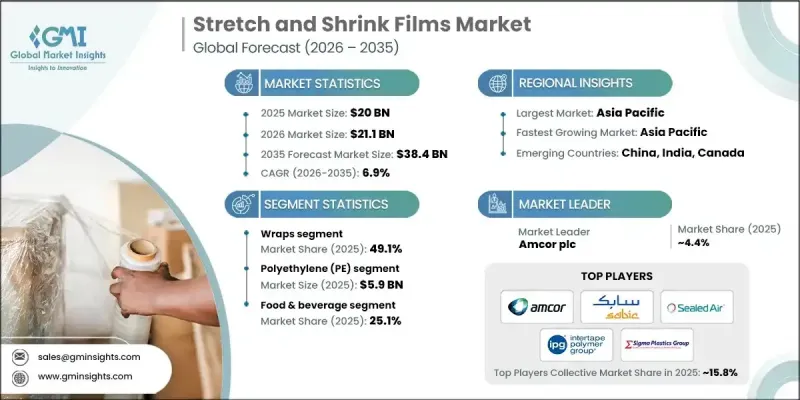
市场成长的驱动力来自循环经济实践的加速发展、回收活动的增加以及监管机构对永续包装解决方案日益增长的关注。电子商务和物流活动的快速扩张显着推动了对耐用、轻巧且经济高效的包装材料的需求,这些材料能够在运输和储存过程中保护货物。食品保鲜领域应用的不断拓展,以及智慧包装和薄膜製造技术的进步,进一步促进了市场扩张。日益增强的环保意识和更严格的塑胶废弃物法规促使製造商采用可再生、可生物降解和环保的薄膜解决方案。此外,对本地采购的日益青睐以及对区域永续性政策的遵守,正在推动供应链的重组。这些趋势在过去几年中不断增强,尤其是在欧洲和北美,监管压力和消费者偏好的转变正在加速环保包装的普及。
| 市场覆盖范围 | |
|---|---|
| 开始年份 | 2025 |
| 预测年份 | 2026-2035 |
| 起始值 | 200亿美元 |
| 预测金额 | 384亿美元 |
| 复合年增长率 | 6.9% |
预计到2025年,包装膜市占率将达到49.1%。此细分市场的需求主要源自于对价格合理、防护性强的包装解决方案的需求,以确保食品、零售和线上分销通路的产品完整性。製造商越来越重视开发高性能、永续的包装膜解决方案,力求在防护性、效率和环境影响之间取得平衡。
预计到2025年,聚乙烯产业的收入将达到59亿美元。聚乙烯薄膜因其用途广泛、经久耐用且成本优势显着,在多个终端应用产业中持续广泛应用。生产商致力于提升薄膜质量,同时也开发可回收、可堆肥和环保材料。
预计到2025年,北美拉伸膜和收缩膜市占率将达到30.2%。该地区的成长主要得益于蓬勃发展的电子商务、包装作业自动化程度的提高以及鼓励采用永续包装的法规结构。消费者对环保包装的需求也进一步推动了市场成长。
目录
第一章调查方法和范围
第二章执行摘要
第三章业界考察
- 生态系分析
- 供应商情况
- 利润率
- 成本结构
- 每个阶段的附加价值
- 影响价值链的因素
- 中断
- 产业影响因素
- 司机
- 重点关注循环经济和回收措施
- 不断发展的电子商务和物流行业
- 在食品保藏领域不断拓展的应用
- 智慧包装解决方案的兴起
- 薄膜製造技术的进步
- 产业潜在风险与挑战
- 来自替代包装材料的竞争
- 减少塑胶使用的监管压力
- 市场机会
- 永续包装解决方案
- 引入可生物降解薄膜
- 司机
- 成长潜力分析
- 监管环境
- 北美洲
- 欧洲
- 亚太地区
- 拉丁美洲
- 中东和非洲
- 波特分析
- PESTEL 分析
- 科技与创新趋势
- 当前技术趋势
- 新兴技术
- 新兴经营模式
- 合规要求
- 永续性措施
- 消费者心理分析
- 地缘政治和贸易趋势
第四章 竞争情势
- 介绍
- 公司市占率分析
- 按地区
- 市场集中度分析
- 主要企业的竞争标竿分析
- 财务绩效比较
- 收入
- 利润率
- 研究与开发
- 产品系列比较
- 产品线丰富
- 科技
- 创新
- 地理分布比较
- 全球扩张分析
- 服务网路覆盖范围
- 按地区分類的市场渗透率
- 竞争定位矩阵
- 领导企业
- 受让人
- 追踪者
- 小众玩家
- 战略展望矩阵
- 财务绩效比较
- 2022-2025 年主要发展动态
- 併购
- 合作伙伴关係和合资企业
- 技术进步
- 扩张与投资策略
- 永续性措施
- 数位转型计划
新兴企业/Start-Ups竞争趋势
第五章 按材料分類的市场估算与预测,2022-2035年
- 聚乙烯(PE)
- 聚氯乙烯(PVC)
- 聚丙烯(PP)
- 可生物降解和可堆肥
- 其他的
第六章 2022-2035年按产品分類的市场估算与预测
- 食物
- 封套和标籤
- 裹
第七章 依厚度类型分類的市场估计与预测,2022-2035年
- 超薄/膜(5-15μm)
- 标准商用胶片(15-25μm)
- 厚膜(25-50μm)
- 超厚/特殊规格薄膜(50微米或以上)
第八章 按应用领域分類的市场估算与预测,2022-2035年
- 消费品
- 食品/饮料
- 工业包装
- 物流/运输
- 製药
- 其他的
第九章 2022-2035年各地区市场估算与预测
- 北美洲
- 我们
- 加拿大
- 欧洲
- 德国
- 英国
- 法国
- 西班牙
- 义大利
- 荷兰
- 亚太地区
- 中国
- 印度
- 日本
- 澳洲
- 韩国
- 拉丁美洲
- 巴西
- 墨西哥
- 阿根廷
- 中东和非洲
- 南非
- 沙乌地阿拉伯
- 阿拉伯聯合大公国
第十章:公司简介
- 主要企业
- Amcor plc
- Dow
- Sealed Air
- SABIC
- 按地区分類的主要企业
- 北美洲
- Intertape Polymer Group Inc.
- Film Source Packaging
- Sigma Plastics Group
- 亚太地区
- Scientex Berhad
- Shaktiman Packaging Pvt. Ltd.
- 欧洲
- Klockner Pentaplast
- Bollore Inc.
- 北美洲
- 小众玩家/颠覆者
- Balcan Innovations Inc.
- HIPAC Spa
- Italdibipack SpA
- RKW Group
- LyondellBasell Industries NV
- AZ Packaging
- Paragon Films
- Coveris Holdings SA
- LUBAN PACK
The Global Stretch and Shrink Films Market was valued at USD 20 billion in 2025 and is estimated to grow at a CAGR of 6.9% to reach USD 38.4 billion by 2035.
Market growth is driven by the accelerating adoption of circular economy practices, rising recycling initiatives, and increasing regulatory focus on sustainable packaging solutions. Rapid expansion of e-commerce and logistics activities is significantly boosting demand for durable, lightweight, and cost-efficient packaging materials that protect goods during transportation and storage. Growing applications in food preservation, combined with advancements in smart packaging and film manufacturing technologies, are further supporting market expansion. Heightened environmental awareness and stricter plastic waste regulations are encouraging manufacturers to introduce recyclable, biodegradable, and environmentally responsible film solutions. In addition, a growing preference for local sourcing and compliance with regional sustainability policies is reshaping supply chains. These trends have gained momentum over the past few years, particularly across Europe and North America, where eco-conscious packaging adoption has accelerated due to regulatory pressure and shifting consumer preferences.
| Market Scope | |
|---|---|
| Start Year | 2025 |
| Forecast Year | 2026-2035 |
| Start Value | $20 Billion |
| Forecast Value | $38.4 Billion |
| CAGR | 6.9% |
The wraps segment accounted for 49.1% share in 2025. Demand within this segment is being supported by the need for affordable and protective packaging solutions that maintain product integrity across food, retail, and online distribution channels. Manufacturers are increasingly prioritizing the development of high-performance and sustainable wrap solutions that balance protection, efficiency, and reduced environmental impact.
The polyethylene segment generated USD 5.9 billion in 2025. Polyethylene films continue to be widely adopted due to their versatility, durability, and cost advantages across multiple end-use industries. Producers are focusing on enhancing film quality while advancing recyclable, compostable, and lower-impact material options.
North America Stretch and Shrink Films Market held a 30.2% share in 2025. Regional growth is being driven by strong e-commerce activity, increasing automation in packaging operations, and regulatory frameworks that promote sustainable packaging adoption. Consumer demand for environmentally responsible packaging is further reinforcing market momentum.
Key companies operating in the Global Stretch and Shrink Films Market include Berry Global Inc., Amcor plc, Dow, LyondellBasell Industries N.V., Sealed Air, SABIC, Sigma Plastics Group, Paragon Films, RKW Group, Klockner Pentaplast, Intertape Polymer Group Inc., Coveris Holdings S.A., Bollore Inc, Balcan Innovations Inc, Scientex Berhad, HIPAC Spa, Italdibipack SpA, Film Source Packaging, A-Z Packaging, LUBAN PACK, and Shaktiman Packaging Pvt. Ltd. Companies in the Global Stretch and Shrink Films Market are strengthening their competitive position through sustainability-focused innovation, capacity expansion, and material optimization. Many players are investing in research to develop recyclable and bio-based films that comply with evolving environmental regulations. Enhancing production efficiency through automation and advanced manufacturing techniques is helping reduce costs and improve consistency. Strategic partnerships with e-commerce, food, and logistics companies are enabling long-term supply agreements.
Table of Contents
Chapter 1 Methodology and Scope
- 1.1 Market scope and definition
- 1.2 Research design
- 1.2.1 Research approach
- 1.2.2 Data collection methods
- 1.3 Data mining sources
- 1.3.1 Global
- 1.3.2 Regional/Country
- 1.4 Base estimates and calculations
- 1.4.1 Base year calculation
- 1.4.2 Key trends for market estimation
- 1.5 Primary research and validation
- 1.5.1 Primary sources
- 1.6 Forecast model
- 1.7 Research assumptions and limitations
Chapter 2 Executive Summary
- 2.1 Industry snapshot, 2022-2035
- 2.2 Key market trends
- 2.2.1 Material trends
- 2.2.2 Product trends
- 2.2.3 Thickness type trends
- 2.2.4 Application trends
- 2.2.5 Regional trends
- 2.3 TAM analysis, 2026-2035 (USD Million)
- 2.4 CXO perspectives: Strategic imperatives
- 2.4.1 Executive decision points
- 2.4.2 Critical success factors
- 2.5 Future outlook and strategic recommendations
Chapter 3 Industry Insights
- 3.1 Industry ecosystem analysis
- 3.1.1 Supplier landscape
- 3.1.2 Profit margin
- 3.1.3 Cost structure
- 3.1.4 Value addition at each stage
- 3.1.5 Factor affecting the value chain
- 3.1.6 Disruptions
- 3.2 Industry impact forces
- 3.2.1 Growth drivers
- 3.2.1.1 Focus on circular economy and recycling initiatives
- 3.2.1.2 Expansion of E-commerce and logistics sector
- 3.2.1.3 Increasing applications in food preservation
- 3.2.1.4 Emergence of smart packaging solutions
- 3.2.1.5 Advancements in film manufacturing technologies
- 3.2.2 Industry pitfalls & challenges
- 3.2.2.1 Competition of alternative packaging materials
- 3.2.2.2 Regulatory pressures for plastic use reduction
- 3.2.3 Market Opportunities
- 3.2.3.1 Sustainable packaging solutions
- 3.2.3.2 Adoption of biodegradable films
- 3.2.1 Growth drivers
- 3.3 Growth potential analysis
- 3.4 Regulatory landscape
- 3.4.1 North America
- 3.4.2 Europe
- 3.4.3 Asia Pacific
- 3.4.4 Latin America
- 3.4.5 Middle East & Africa
- 3.5 Porter';s analysis
- 3.6 PESTEL analysis
- 3.7 Technology and innovation landscape
- 3.7.1 Current technological trends
- 3.7.2 Emerging technologies
- 3.8 Emerging business models
- 3.9 Compliance requirements
- 3.10 Sustainability measures
- 3.11 Consumer sentiment analysis
- 3.12 Geopolitical and trade dynamics
Chapter 4 Competitive Landscape, 2025
- 4.1 Introduction
- 4.2 Company market share analysis
- 4.2.1 By region
- 4.2.1.1 North America
- 4.2.1.2 Europe
- 4.2.1.3 Asia Pacific
- 4.2.1.4 Latin America
- 4.2.1.5 MEA
- 4.2.2 Market Concentration Analysis
- 4.2.1 By region
- 4.3 Competitive Benchmarking of key Players
- 4.3.1 Financial Performance Comparison
- 4.3.1.1 Revenue
- 4.3.1.2 Profit Margin
- 4.3.1.3 R&D
- 4.3.2 Product Portfolio Comparison
- 4.3.2.1 Product Range Breadth
- 4.3.2.2 Technology
- 4.3.2.3 Innovation
- 4.3.3 Geographic Presence Comparison
- 4.3.3.1 Global Footprint Analysis
- 4.3.3.2 Service Network Coverage
- 4.3.3.3 Market Penetration by Region
- 4.3.4 Competitive Positioning Matrix
- 4.3.4.1 Leaders
- 4.3.4.2 Challengers
- 4.3.4.3 Followers
- 4.3.4.4 Niche Players
- 4.3.5 Strategic outlook matrix
- 4.3.1 Financial Performance Comparison
- 4.4 Key developments, 2022-2025
- 4.4.1 Mergers and Acquisitions
- 4.4.2 Partnerships and Collaborations
- 4.4.3 Technological Advancements
- 4.4.4 Expansion and Investment Strategies
- 4.4.5 Sustainability Initiatives
- 4.4.6 Digital Transformation Initiatives
Emerging/ Startup Competitors Landscape
Chapter 5 Market Estimates and Forecast, By Material, 2022 - 2035 (USD Million)
- 5.1 Key trends
- 5.2 Polyethylene (PE)
- 5.3 Polyvinyl chloride (PVC)
- 5.4 Polypropylene (PP)
- 5.5 Biodegradable and compostable
- 5.6 Others
Chapter 6 Market Estimates and Forecast, By Product, 2022 - 2035 (USD Million)
- 6.1 Key trends
- 6.2 Hoods
- 6.3 Sleeves and labels
- 6.4 Wraps
Chapter 7 Market Estimates and Forecast, By Thickness Type, 2022 - 2035 (USD Million)
- 7.1 Key trends
- 7.2 Very thin / downgauged films (5-15 μm)
- 7.3 Standard commercial films (15- 25 μm)
- 7.4 Heavy-duty films (25-50 μm)
- 7.5 Ultra-heavy / specialty gauges (50 μm and above)
Chapter 8 Market Estimates and Forecast, By Application, 2022 - 2035 (USD Million)
- 8.1 Key trends
- 8.2 Consumer goods
- 8.3 Food & beverage
- 8.4 Industrial packaging
- 8.5 Logistics & transportation
- 8.6 Pharmaceuticals
- 8.7 Others
Chapter 9 Market Estimates and Forecast, By Region, 2022 - 2035 (USD Million)
- 9.1 Key trends
- 9.2 North America
- 9.2.1 U.S.
- 9.2.2 Canada
- 9.3 Europe
- 9.3.1 Germany
- 9.3.2 UK
- 9.3.3 France
- 9.3.4 Spain
- 9.3.5 Italy
- 9.3.6 Netherlands
- 9.4 Asia Pacific
- 9.4.1 China
- 9.4.2 India
- 9.4.3 Japan
- 9.4.4 Australia
- 9.4.5 South Korea
- 9.5 Latin America
- 9.5.1 Brazil
- 9.5.2 Mexico
- 9.5.3 Argentina
- 9.6 Middle East and Africa
- 9.6.1 South Africa
- 9.6.2 Saudi Arabia
- 9.6.3 UAE
Chapter 10 Company Profiles
- 10.1 Global Key Players
- 10.1.1 Amcor plc
- 10.1.2 Dow
- 10.1.3 Sealed Air
- 10.1.4 SABIC
- 10.2 Regional key players
- 10.2.1 North America
- 10.2.1.1 Intertape Polymer Group Inc.
- 10.2.1.2 Film Source Packaging
- 10.2.1.3 Sigma Plastics Group
- 10.2.2 Asia Pacific
- 10.2.2.1 Scientex Berhad
- 10.2.2.2 Shaktiman Packaging Pvt. Ltd.
- 10.2.3 Europe
- 10.2.3.1 Klockner Pentaplast
- 10.2.3.2 Bollore Inc.
- 10.2.1 North America
- 10.3 Niche Players/Disruptors
- 10.3.1 Balcan Innovations Inc.
- 10.3.2 HIPAC Spa
- 10.3.3 Italdibipack SpA
- 10.3.4 RKW Group
- 10.3.5 LyondellBasell Industries N.V.
- 10.3.6 A-Z Packaging
- 10.3.7 Paragon Films
- 10.3.8 Coveris Holdings S.A.
- 10.3.9 LUBAN PACK

 全球拉伸膜和收缩膜市场:市场规模、份额和趋势分析(按材料、产品、应用和地区划分),细分市场预测(2026-2033 年)
 拉伸膜包装市场-2026-2031年预测流延拉伸膜市场-2026-2031年预测
 拉伸膜包装市场:全球预测(2026-2032 年),按薄膜类型、材料、厚度、应用和最终用途产业划分
 全球流延拉伸膜市场
 吹塑拉伸包装膜市场机会、成长动力、产业趋势分析及2025-2034年预测
 2032 年拉伸膜市场预测:按产品类型、品种、材料、厚度、应用和地区进行的全球分析拉伸和收缩套标市场机会、成长动力、产业趋势分析及 2025 - 2034 年预测
 北美收缩和拉伸膜:市场占有率分析、行业趋势和统计、成长预测(2025-2030 年)全球透气拉伸膜市场规模依材料类型、最终用途产业、厚度、地区、范围和预测划分