


 |
市场调查报告书
商品编码
1936652
露营装备市场机会、成长要素、产业趋势分析及2026年至2035年预测Camping Equipment Market Opportunity, Growth Drivers, Industry Trend Analysis, and Forecast 2026 - 2035 |
||||||

全球露营装备市场预计到 2025 年将达到 211 亿美元,到 2035 年将达到 394 亿美元,年复合成长率为 6.5%。
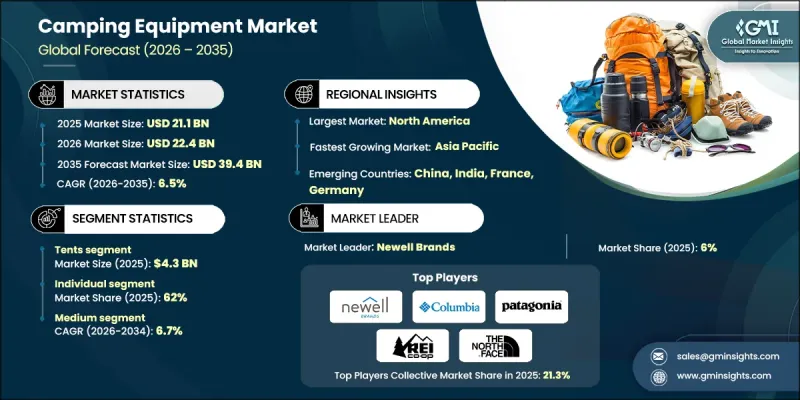
户外休閒的日益普及以及人们对露营有益身心健康的认识不断提高,是推动市场扩张的主要因素。消费者越来越追求能够缓解压力、促进健康生活方式的自然体验,从而刺激了对露营相关产品的需求。此外,以探险为导向和注重环保的旅行方式的兴起也推动了市场成长。公共和私营机构持续进行教育活动,鼓励人们更亲近自然,从而推广户外活动。同时,产品设计和材料的创新正在重塑消费者的期望,更加重视产品的便利性、便携性和舒适性。这些发展与不断变化的生活方式偏好密切相关,尤其是在年轻消费者群体中。可支配收入的增加,尤其是在开发中国家,也使得人们更容易获得高品质的露营装备。生活方式的改变、创新、收入的成长以及有效的推广活动,共同为全球露营装备市场的持续成长创造了有利条件。
| 市场覆盖范围 | |
|---|---|
| 开始年份 | 2025 |
| 预测年份 | 2026-2035 |
| 起始值 | 211亿美元 |
| 预测金额 | 394亿美元 |
| 复合年增长率 | 6.5% |
预计到2025年,个人用户市场将占据62%的市场份额,并在2026年至2035年间以6.8%的复合年增长率成长。人们对户外休閒活动的兴趣日益浓厚、购买力不断提升以及环保旅游意识的增强,持续推动个人消费者的需求成长。因此,注重易用性和便携性的设备尤其受到该细分市场的青睐。
预计到2035年,中价位市场将以6.7%的复合年增长率成长。该价位段的消费者註重性价比,希望获得性能可靠且价格合理的产品。製造商正透过改进产品功能并保持成本竞争力来满足这一需求。
2025年,美国露营装备市场价值54亿美元,占全球市场份额的80%。露营活动的高参与度、对经济实惠的旅行方式日益增长的兴趣以及材料的不断创新,都在支撑着该国露营装备市场的整体成长。
目录
第一章调查方法和范围
第二章执行摘要
第三章业界考察
- 生态系分析
- 供应商情况
- 利润率
- 每个阶段的附加价值
- 影响价值链的因素
- 中断
- 产业影响因素
- 司机
- 产业潜在风险与挑战
- 机会
- 成长潜力分析
- 未来市场趋势
- 科技与创新趋势
- 当前技术趋势
- 新兴技术
- 价格趋势
- 按地区
- 依产品类型
- 法律规范
- 标准与认证
- 环境法规
- 进出口限制
- 波特五力分析
- PESTEL 分析
- 消费行为分析
- 购买模式
- 偏好分析
- 消费行为的区域差异
- 电子商务如何影响购买决策
第四章 竞争情势
- 介绍
- 公司市占率分析
- 按地区
- 企业矩阵分析
- 主要市场公司的竞争分析
- 竞争定位矩阵
- 重大进展
- 併购
- 伙伴关係与合作
- 新产品发布
- 扩张计划
第五章 依产品类型分類的市场估算与预测,2022-2035年
- 帐篷
- 家具
- 背包
- 睡袋
- 烹饪系统
- 炉灶和燃烧器
- 炊具
- 其他(空调等)
- 其他(装备、求生工具包等)
第六章 2022-2035年按价格分類的市场估计与预测
- 低价位
- 中号
- 高价位范围
7. 按最终用户分類的市场估计和预测,2022-2035 年
- 个人
- 面向专业人士
第八章 按分销管道分類的市场估算与预测,2022-2035年
- 在线的
- 电子商务
- 公司网站
- 离线
- 超级市场/大卖场
- 专卖店
- 其他(例如,独立零售商)
第九章 2022-2035年各地区市场估算与预测
- 北美洲
- 我们
- 加拿大
- 欧洲
- 德国
- 英国
- 法国
- 西班牙
- 义大利
- 荷兰
- 亚太地区
- 中国
- 日本
- 印度
- 澳洲
- 韩国
- 拉丁美洲
- 巴西
- 墨西哥
- 阿根廷
- 中东和非洲
- 南非
- 沙乌地阿拉伯
- 阿拉伯聯合大公国
第十章:公司简介
- Big Agnes
- Clarus
- Columbia
- Garmin
- Johnson Outdoors
- Marmot
- MSR
- Nemo
- Newell(Coleman)
- Patagonia
- REI Co-op
- RSP
- Sea to Summit
- The North Face
- YETI Holdings
The Global Camping Equipment Market was valued at USD 21.1 billion in 2025 and is estimated to grow at a CAGR of 6.5% to reach USD 39.4 billion by 2035.
Market expansion is driven by the rising participation in outdoor recreation and the growing perception of camping as a positive activity for physical and mental wellness. Consumers are increasingly seeking nature-based experiences that support stress reduction and healthy lifestyles, which is accelerating demand for camping-related products. The growth of adventure-oriented and environmentally focused travel is further reinforcing market momentum. Public institutions and private organizations continue to promote outdoor engagement through awareness initiatives that encourage people to spend more time in natural environments. At the same time, innovation in product design and materials is reshaping consumer expectations, with a strong focus on convenience, portability, and comfort. These developments align closely with evolving lifestyle preferences, particularly among younger consumer groups. Rising disposable income levels, especially across developing economies, are also enabling broader access to higher-quality camping equipment. Together, lifestyle shifts, innovation, income growth, and supportive promotional efforts are creating favorable conditions for sustained growth in the global camping equipment market.
| Market Scope | |
|---|---|
| Start Year | 2025 |
| Forecast Year | 2026-2035 |
| Start Value | $21.1 Billion |
| Forecast Value | $39.4 Billion |
| CAGR | 6.5% |
The individual user segment accounted for 62% share in 2025 and is expected to grow at a CAGR of 6.8% from 2026 to 2035. Increasing personal interest in outdoor leisure activities, combined with higher spending power and greater awareness of eco-focused travel, continues to support demand from individual consumers. Equipment designed for ease of use and transport is particularly appealing to this segment.
The medium-priced segment is forecast to grow at a CAGR of 6.7% through 2035. Consumers in this category prioritize value, seeking reliable performance without premium pricing. Manufacturers are responding by advancing product features while maintaining competitive cost structures.
United States Camping Equipment Market held 80% share generating USD 5.4 billion in 2025. Strong participation in camping activities, increasing interest in cost-effective travel options, and ongoing material innovation are supporting market growth across the country.
Key companies active in the Global Camping Equipment Market include Decathlon, The North Face, YETI Holdings, Patagonia, REI Co-op, Columbia, Big Agnes, Marmot, Nemo, MSR, Sea to Summit, Garmin, Johnson Outdoors, Newell (Coleman), and Clarus. Companies in the camping equipment market are strengthening their market position through product innovation, brand building, and expanded distribution strategies. Many players are investing in advanced materials and design improvements to enhance durability, comfort, and portability. Expanding direct-to-consumer and omnichannel sales models helps brands reach a wider audience while improving customer engagement. Sustainability-focused product development and responsible sourcing are increasingly used to align with consumer values. Strategic partnerships, targeted marketing campaigns, and strong brand storytelling are helping companies connect with younger and experience-driven consumers.
Table of Contents
Chapter 1 Methodology and scope
- 1.1 Market scope and definition
- 1.2 Research design
- 1.2.1 Research approach
- 1.2.2 Data collection methods
- 1.3 Data mining sources
- 1.3.1 Global
- 1.3.2 Regional/country
- 1.4 Base estimates and calculations
- 1.4.1 Base year calculation
- 1.4.2 Key trends for market estimation
- 1.5 Primary research and validation
- 1.5.1 Primary sources
- 1.6 Forecast model
- 1.7 Research assumptions and limitations
Chapter 2 Executive summary
- 2.1 Industry 360° synopsis
- 2.2 Key market trends
- 2.2.1 Regional
- 2.2.2 Product Type
- 2.2.3 Price
- 2.2.4 End Users
- 2.2.5 Distribution Channel
- 2.3 CXO perspectives: strategic imperatives
- 2.3.1 Key decision points for industry executives
- 2.3.2 Critical success factors for market players
- 2.4 Future outlook and strategic recommendations
Chapter 3 Industry insights
- 3.1 Industry ecosystem analysis
- 3.1.1 Supplier landscape
- 3.1.2 Profit margin
- 3.1.3 Value addition at each stage
- 3.1.4 Factor affecting the value chain
- 3.1.5 Disruptions
- 3.2 Industry impact forces
- 3.2.1 Growth drivers
- 3.2.2 Industry pitfalls & challenges
- 3.2.3 Opportunities
- 3.3 Growth potential analysis
- 3.4 Future market trends
- 3.5 Technology and innovation landscape
- 3.5.1 Current technological trends
- 3.5.2 Emerging technologies
- 3.6 Price trends
- 3.6.1 By region
- 3.6.2 By product type
- 3.7 Regulatory framework
- 3.7.1 Standards and certifications
- 3.7.2 Environmental regulations
- 3.7.3 Import export regulations
- 3.8 Porter's five forces analysis
- 3.9 PESTEL analysis
- 3.10 Consumer behavior analysis
- 3.10.1 Purchasing patterns
- 3.10.2 Preference analysis
- 3.10.3 Regional variations in consumer behavior
- 3.10.4 Impact of e-commerce on buying decisions
Chapter 4 Competitive landscape, 2025
- 4.1 Introduction
- 4.2 Company market share analysis
- 4.2.1 By region
- 4.2.1.1 North America
- 4.2.1.2 Europe
- 4.2.1.3 Asia Pacific
- 4.2.1.4 Latin America
- 4.2.1.5 MEA
- 4.2.1 By region
- 4.3 Company matrix analysis
- 4.4 Competitive analysis of major market players
- 4.5 Competitive positioning matrix
- 4.6 Key developments
- 4.6.1 Mergers & acquisitions
- 4.6.2 Partnerships & collaborations
- 4.6.3 New product launches
- 4.6.4 Expansion plans
Chapter 5 Market Estimates & Forecast, By Product Type, 2022 - 2035 ($Billion, Thousand Units)
- 5.1 Key trends
- 5.2 Tents
- 5.3 Furniture
- 5.4 Backpack
- 5.5 Sleeping bags
- 5.6 Cooking systems
- 5.6.1 Stoves and burners
- 5.6.2 Utensils
- 5.6.3 Others (coolers, etc.)
- 5.7 Others (gears, survival kit, etc.)
Chapter 6 Market Estimates & Forecast, By Price, 2022 - 2035 ($Billion, Thousand Units)
- 6.1 Key trends
- 6.2 Low
- 6.3 Medium
- 6.4 High
Chapter 7 Market Estimates & Forecast, By End User, 2022 - 2035 ($Billion, Thousand Units)
- 7.1 Key trends
- 7.2 Individual
- 7.3 Professional
Chapter 8 Market Estimates & Forecast, By Distribution Channel, 2022 - 2035 ($Billion, Thousand Units)
- 8.1 Key trends
- 8.2 Online
- 8.2.1 E-commerce
- 8.2.2 Company websites
- 8.3 Offline
- 8.3.1 Supermarkets/hypermarket
- 8.3.2 Specialty retail stores
- 8.3.3 Others (independent retailer etc.)
Chapter 9 Market Estimates & Forecast, By Region, 2022 - 2035 ($Billion, Thousand Units)
- 9.1 Key trends
- 9.2 North America
- 9.2.1 U.S.
- 9.2.2 Canada
- 9.3 Europe
- 9.3.1 Germany
- 9.3.2 UK
- 9.3.3 France
- 9.3.4 Spain
- 9.3.5 Italy
- 9.3.6 Netherlands
- 9.4 Asia Pacific
- 9.4.1 China
- 9.4.2 Japan
- 9.4.3 India
- 9.4.4 Australia
- 9.4.5 South Korea
- 9.5 Latin America
- 9.5.1 Brazil
- 9.5.2 Mexico
- 9.5.3 Argentina
- 9.6 MEA
- 9.6.1 South Africa
- 9.6.2 Saudi Arabia
- 9.6.3 UAE
Chapter 10 Company Profiles
- 10.1 Big Agnes
- 10.2 Clarus
- 10.3 Columbia
- 10.4 Garmin
- 10.5 Johnson Outdoors
- 10.6 Marmot
- 10.7 MSR
- 10.8 Nemo
- 10.9 Newell (Coleman)
- 10.10 Patagonia
- 10.11 REI Co-op
- 10.12 RSP
- 10.13 Sea to Summit
- 10.14 The North Face
- 10.15 YETI Holdings

 房车市场:2026-2032年全球市场预测(按房车类型、销售管道和应用划分)露营厨房市场:2026-2032年全球市场预测(按产品类型、燃料类型、价格范围、活动类型、材料类型、分销管道和最终用户划分)露营椅市场:2026-2032年全球市场预测(依产品类型、材料、价格范围、承重能力、销售管道及最终用户划分)露营冷藏箱市场:全球市场按产品类型、容量、材料、应用和销售管道分類的预测 - 2026-2032 年露营和房车市场:2026-2032年全球市场预测(按露营方式、产品类型、活动、最终用户和分销管道划分)
 露营装备市场规模、份额、趋势和预测:按产品类型、分销管道和地区划分,2026-2034年
 露营家具市场机会、成长要素、产业趋势分析及2026年至2035年预测
 露营冷藏箱市场 - 全球产业规模、份额、趋势、机会、预测:按类型、材料、产能、应用、地区和竞争格局划分,2021-2031年露营房车市场 - 全球产业规模、份额、趋势、机会、预测:按类型、房车类型、年龄层、地区和竞争格局划分,2021-2031年露营装备市场-全球产业规模、份额、趋势、机会及预测(依产品类型、应用、通路、地区及竞争格局划分,2021-2031年)