


 |
市场调查报告书
商品编码
1982354
汽车行人保护系统市场:市场机会、成长要素、产业趋势分析及2026-2035年预测Automotive Pedestrian Protection System Market Opportunity, Growth Drivers, Industry Trend Analysis, and Forecast 2026 - 2035 |
||||||

全球汽车行人保护系统市场预计到 2025 年将价值 63 亿美元,预计到 2035 年将以 10.4% 的复合年增长率增长至 168 亿美元。
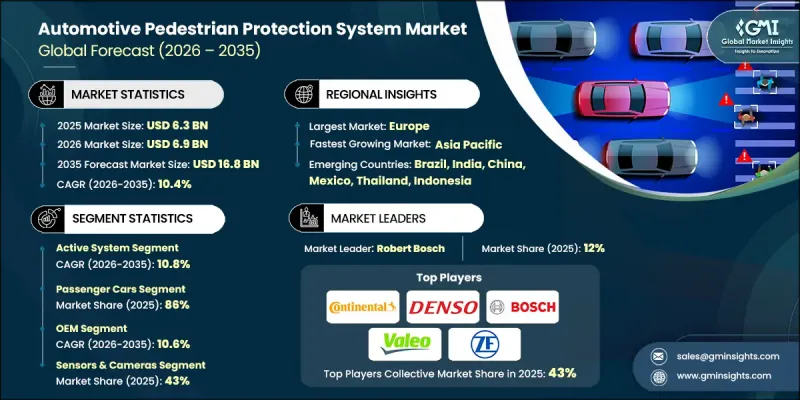
随着汽车製造商优先采用旨在减少行人伤亡的车辆安全技术,尤其是在拥挤的都市区,市场呈现强劲的成长动能。行人保护系统 (PPS) 结合了先进的紧急煞车和行人侦测技术、可部署的安全组件、基于感测器的监控以及智慧碰撞缓解技术,旨在预防碰撞或减轻伤亡程度。该市场涵盖整合安全软体、感测器硬体、致动器系统、结构能量吸收设计以及为原始设备製造商 (OEM) 和一级供应商提供的工程支援服务。随着时间的推移,行人保护解决方案已从被动结构设计发展到能够即时识别物体和预测碰撞避免的人工智慧智慧系统。由于全球严格的安全法规和车辆评估计划,以及监管机构强制要求新车配备具备行人和骑乘者侦测功能的高级煞车系统,提前部署正在加速进行。对基于云端的模拟工具和数位检验平台的日益依赖,进一步提高了系统精度,并加速了整个汽车行人保护系统市场的创新。
| 市场范围 | |
|---|---|
| 开始年份 | 2025 |
| 预测期 | 2026-2035 |
| 上市时的市场规模 | 63亿美元 |
| 预测金额 | 168亿美元 |
| 复合年增长率 | 10.4% |
预计到2025年,主动式行人保护系统市占率将达到59%,并在2026年至2035年间以10.8%的复合年增长率成长。主动式行人保护技术整合了前置摄影机、雷达感测器以及日益普及的光达系统,并搭配先进的处理软体。这些系统透过侦测行人移动、评估轨迹风险、计算碰撞机率,并在达到预设安全阈值时自动启动煞车功能,显着提升了即时反应能力。
预计到2025年,乘用车市占率将达到86%,复合年增长率(CAGR)为10.2%。此细分市场的需求主要受欧洲新车安全评估协会(Euro NCAP)和美国国家公路交通安全管理局(NHTSA)等机构制定的严格行人安全评估标准的驱动,这些标准尤其重视主动行人安全性能。所有车型类别的监管压力正促使製造商采用先进的模拟和检验平台,以确保合规性并优化系统效率。
德国汽车行人保护系统市场预计将在2026年至2035年间以10.9%的复合年增长率成长。 BMW、宾士、奥迪和保时捷等主要汽车製造商对安全技术创新的大力投资,巩固了德国在该领域的主导地位。日益复杂的都市区交通环境和混合交通格局,推动了可靠行人保护系统的应用,这些系统旨在有效应对动态的实际交通状况。
目录
第一章:调查方法
第二章执行摘要
第三章业界考察
- 生态系分析
- 供应商情况
- 利润率分析
- 成本结构
- 每个阶段增加的价值
- 影响价值链的因素
- 中断
- 影响产业的因素
- 促进因素
- 全球有关行人安全的严格法规和义务
- 都市区行人死亡率上升
- 消费者对先进安全功能的需求日益增长
- ADAS和自动驾驶技术的广泛应用。
- 保险业会推广安全评级的车辆
- 产业潜在风险与挑战
- 高昂的实施和整合成本
- 恶劣天气条件下系统效率下降
- 由于技术复杂,售后市场接受度有限。
- 被动式系统(外部安全气囊)的一次性特性
- 市场机会
- 现有商用车辆车队的改装解决方案
- 与V2X和智慧城市基础设施的集成
- 正在建立安全标准的新兴市场
- 人工智慧驱动的夜间侦测系统
- 用于被动防护系统的轻质材料
- 促进因素
- 成长潜力分析
- 监理情势
- 北美洲
- 美国联邦安全法规与ADAS实施指南
- 加拿大 - 连网和自动驾驶汽车安全框架 (CASF)
- 欧洲
- 德国 - 欧洲新车安全评估协会 (Euro NCAP) 行人安全评估
- 英国:脱欧后ADAS的柔软性
- 法国-国内ADAS测试与智慧交通系统战略
- 义大利——智慧交通系统示范计画与智慧基础设施
- 亚太地区
- 中国——工业和资讯化部强制实施和规范C-V2X
- 印度:新兴ADAS和汽车互联技术的监管
- 日本——智慧交通系统连结性与频率政策
- 澳洲—技术中立的智慧交通系统政策
- 拉丁美洲
- 墨西哥 - NOM 汽车安全标准
- 阿根廷 - 交通法第 24.449 号
- 中东和非洲
- 南非 - 道路交通法(1996 年)
- 沙乌地阿拉伯—交通运输法律与「2030愿景」交通运输倡议
- 北美洲
- 波特五力分析
- PESTEL 分析
- 科技与创新趋势
- 当前技术趋势
- 感测器技术的发展(摄影机、光达、雷达、超音波)
- 整合感测器融合
- 人工智慧和机器学习在行人侦测的应用
- 新兴技术
- V2X 通讯可提高侦测能力
- 适用于夜间和低光源环境的侦测技术
- 当前技术趋势
- 专利分析
- 主要专利趋势
- 技术创新热点
- 主要企业提交的专利申请
- 新兴智慧财产权策略
- 价格分析
- 对过去价格趋势的分析
- 按业务类型分類的定价策略(溢价/价值/成本加成)
- 总拥有成本 (TCO) 分析
- 使用案例和成功案例
- 案例研究
- OEM整合PPS技术
- 商用车辆车队简介
- 行人保护计画改装
- 智慧城市都市区示范计划
- 永续性和环境方面
- 永续倡议
- 减少废弃物策略
- 生产中的能源效率
- 具有环保意识的倡议
- 关于碳足迹的考量
- 人工智慧和生成式人工智慧对市场的影响
- 利用人工智慧改造现有经营模式
- 针对特定领域的生成式人工智慧应用案例和实施蓝图
- 风险、限制和监管考量
- 未来趋势和市场展望
- 下一代感测器技术
- 与自动驾驶生态系统的集成
- 人工智慧驱动的行人安全预测系统
- 新兴市场的扩张
- 市场风险及风险缓解策略
- 监理合规风险
- 技术采用的障碍
- 供应链中断
- 网路安全和资料隐私问题
第四章 竞争情势
- 介绍
- 企业市占率分析
- 北美洲
- 欧洲
- 亚太地区
- 拉丁美洲
- 中东和非洲(MEA)
- 主要市场公司的竞争分析
- 竞争定位矩阵
- 战略展望矩阵
- 主要进展
- 併购
- 伙伴关係与合作
- 新产品发布
- 业务拓展计划及资金筹措
第五章 市场估计与预测:依组件划分,2022-2035年
- 感应器和摄影机
- 控制单元
- 致动器
- 其他的
第六章 市场估算与预测:依产品划分,2022-2035年
- 主动系统
- 被动系统
第七章 市场估价与预测:依车辆类型划分,2022-2035年
- 搭乘用车
- 掀背车
- 轿车
- SUV
- 商用车辆
- 轻型商用车(LCV)
- 中型商用车(MCV)
- 重型商用车(HCV)
第八章 市场估算与预测:依通路划分,2022-2035年
- OEM
- 售后市场
第九章 市场估计与预测:依地区划分,2022-2035年
- 北美洲
- 我们
- 加拿大
- 欧洲
- 德国
- 英国
- 法国
- 义大利
- 西班牙
- 俄罗斯
- 荷兰
- 瑞典
- 丹麦
- 波兰
- 亚太地区
- 中国
- 印度
- 日本
- 澳洲
- 韩国
- 新加坡
- 泰国
- 印尼
- 越南
- 拉丁美洲
- 巴西
- 墨西哥
- 阿根廷
- 哥伦比亚
- 中东和非洲(MEA)
- 南非
- 沙乌地阿拉伯
- 阿拉伯聯合大公国
- 以色列
第十章:公司简介
- 世界公司
- Autoliv
- Continental
- Denso
- Ford Motor
- Magna International
- Mobileye
- Nissan Motor
- Robert Bosch
- Toyota Motor
- ZF Friedrichshafen
- 本地球员
- Aptiv
- HELLA
- Hitachi Astemo
- Hyundai Mobis
- Knorr-Bremse
- Magneti Marelli
- Subaru
- Valeo
- 新兴企业和技术基础设施公司
- Gentex
- Luminar Technologies
The Global Automotive Pedestrian Protection System Market was valued at USD 6.3 billion in 2025 and is estimated to grow at a CAGR of 10.4% to reach USD 16.8 billion by 2035.
The market is gaining strong momentum as automakers prioritize vehicle safety technologies designed to reduce pedestrian injuries and fatalities, particularly in high-traffic urban environments. Pedestrian protection systems (PPS) combine advanced emergency braking with pedestrian detection, deployable safety components, sensor-based monitoring, and intelligent impact mitigation technologies to either prevent collisions or reduce injury severity. The market encompasses integrated safety software, sensor hardware, actuator systems, structural energy-absorbing designs, and engineering support services supplied to OEMs and Tier 1 manufacturers. Over time, pedestrian protection solutions have evolved from passive structural designs to intelligent, AI-enabled systems capable of real-time object recognition and predictive collision avoidance. Strict safety mandates and vehicle rating programs worldwide are accelerating adoption, as regulators require advanced braking systems with pedestrian and cyclist detection capabilities in new vehicles. Growing reliance on cloud-based simulation tools and digital validation platforms is further enhancing system accuracy and accelerating innovation across the automotive pedestrian protection system market.
| Market Scope | |
|---|---|
| Start Year | 2025 |
| Forecast Year | 2026-2035 |
| Start Value | $6.3 Billion |
| Forecast Value | $16.8 Billion |
| CAGR | 10.4% |
The active system segment accounted for 59% share in 2025 and is anticipated to grow at a CAGR of 10.8% from 2026 to 2035. Active pedestrian protection technologies integrate forward-facing cameras, radar sensors, and increasingly LiDAR systems with advanced processing software. These systems detect pedestrian movement, assess trajectory risks, calculate collision probability, and automatically activate braking functions when predefined safety thresholds are reached, significantly improving real-time response capabilities.
The passenger cars segment held 86% share in 2025 and is projected to grow at a CAGR of 10.2%. Demand within this segment is supported by stringent pedestrian safety assessment standards established by organizations such as the European New Car Assessment Programme and the National Highway Traffic Safety Administration, which place significant emphasis on active pedestrian safety performance. Regulatory pressure across vehicle categories is encouraging manufacturers to adopt advanced simulation and validation platforms to ensure compliance and optimize system efficiency.
Germany Automotive Pedestrian Protection System Market is forecast to grow at a CAGR of 10.9% between 2026 and 2035. The country's leadership is supported by strong investments in safety innovation from major automotive manufacturers such as BMW, Mercedes-Benz, Audi, and Porsche. Increasing urban mobility complexity and mixed-traffic environments are driving the integration of highly reliable pedestrian protection systems designed to operate effectively in dynamic real-world conditions.
Key companies operating in the Global Automotive Pedestrian Protection System Market include ZF Friedrichshafen, Aptiv, Denso, Valeo, Robert Bosch, Autoliv, Continental, Marelli, Hitachi Astemo, and Hella. Companies in the Automotive Pedestrian Protection System Market strengthen their competitive position through continuous investment in research and development focused on AI-driven sensing, advanced braking algorithms, and sensor fusion technologies. Strategic collaborations with OEMs and Tier 1 suppliers enable co-development of integrated safety platforms tailored to specific vehicle architectures. Firms are expanding simulation capabilities using cloud-based validation tools to accelerate product certification and regulatory compliance. Geographic expansion, portfolio diversification, and modular system designs allow suppliers to serve both premium and mass-market vehicle segments. In addition, companies emphasize cost optimization, scalable production, and software updates to enhance long-term system performance, ensuring sustainable growth and stronger market penetration in the evolving global automotive safety landscape.
Table of Contents
Chapter 1 Methodology
- 1.1 Research approach
- 1.2 Quality commitments
- 1.3 Research trail and confidence scoring
- 1.3.1 Research trail components
- 1.3.2 Scoring components
- 1.4 Data collection
- 1.4.1 Partial list of primary sources
- 1.5 Data mining sources
- 1.5.1 Paid sources
- 1.6 Best estimates and calculations
- 1.6.1 Base year calculation for any one approach
- 1.7 Forecast model
- 1.8 Research transparency addendum
Chapter 2 Executive Summary
- 2.1 Industry 360° synopsis, 2022 - 2035
- 2.2 Key market trends
- 2.2.1 Regional
- 2.2.2 Components
- 2.2.3 Product
- 2.2.4 Vehicles
- 2.2.5 Distribution Channel
- 2.3 TAM Analysis, 2026-2035
- 2.4 CXO perspectives: Strategic imperatives
Chapter 3 Industry Insights
- 3.1 Industry ecosystem analysis
- 3.1.1 Supplier landscape
- 3.1.2 Profit margin analysis
- 3.1.3 Cost structure
- 3.1.4 Value addition at each stage
- 3.1.5 Factor affecting the value chain
- 3.1.6 Disruptions
- 3.2 Industry impact forces
- 3.2.1 Growth drivers
- 3.2.1.1 Stringent global pedestrian safety regulations & mandates
- 3.2.1.2 Rising pedestrian fatality rates in urban areas
- 3.2.1.3 Increasing consumer demand for advanced safety features
- 3.2.1.4 Growing adoption of ADAS & autonomous driving technologies
- 3.2.1.5 Insurance industry push for safety-rated vehicles
- 3.2.2 Industry pitfalls and challenges
- 3.2.2.1 High installation & integration costs
- 3.2.2.2 Low system efficiency in adverse weather conditions
- 3.2.2.3 Limited aftermarket adoption due to technical complexity
- 3.2.2.4 One-time use nature of passive systems (external airbags)
- 3.2.3 Market opportunities
- 3.2.3.1 Retrofit solutions for existing commercial vehicle fleets
- 3.2.3.2 Integration with V2X & smart city infrastructure
- 3.2.3.3 Emerging markets with developing safety standards
- 3.2.3.4 AI-enhanced nighttime detection systems
- 3.2.3.5 Lightweight materials for passive protection systems
- 3.2.1 Growth drivers
- 3.3 Growth potential analysis
- 3.4 Regulatory landscape
- 3.4.1 North America
- 3.4.1.1 US- Federal safety rules & ADAS deployment guidance
- 3.4.1.2 Canada - Safety framework for connected & automated vehicles (CASF)
- 3.4.2 Europe
- 3.4.2.1 Germany- Euro NCAP pedestrian safety ratings
- 3.4.2.2 UK- Post-Brexit ADAS flexibility
- 3.4.2.3 France- National ADAS testing & ITS strategy
- 3.4.2.4 Italy- ITS pilots & smart infrastructure
- 3.4.3 Asia Pacific
- 3.4.3.1 China- MIIT C-V2X mandates & standards
- 3.4.3.2 India- Emerging ADAS & automotive connectivity regulations
- 3.4.3.3 Japan- ITS connect & spectrum policy
- 3.4.3.4 Australia- Technology neutral ITS policies
- 3.4.4 LATAM
- 3.4.4.1 Mexico- NOM vehicle safety standards
- 3.4.4.2 Argentina- National traffic law 24.449
- 3.4.5 MEA
- 3.4.5.1 South Africa- National road traffic act (1996)
- 3.4.5.2 Saudi Arabia- Traffic law & vision 2030 transport initiatives
- 3.4.1 North America
- 3.5 Porter's analysis
- 3.6 PESTEL analysis
- 3.7 Technology and innovation landscape
- 3.7.1 Current technological trends
- 3.7.1.1 Sensor technology evolution (camera, LiDAR, RADAR, ultrasonic)
- 3.7.1.2 Sensor fusion & integration
- 3.7.1.3 AI & machine learning in pedestrian detection
- 3.7.2 Emerging technologies
- 3.7.2.1 V2X communication for enhanced detection
- 3.7.2.2 Nighttime & low-light detection technologies
- 3.7.1 Current technological trends
- 3.8 Patent analysis
- 3.8.1 Key patent trends
- 3.8.2 Technology innovation hotspots
- 3.8.3 Patent filing by key players
- 3.8.4 Emerging IP strategies
- 3.9 Pricing analysis
- 3.9.1 Historical price trend analysis
- 3.9.2 Pricing strategy by player type (premium / value / cost-plus)
- 3.9.3 Total cost of ownership (TCO) analysis
- 3.10 Use cases & success stories
- 3.11 Case studies
- 3.11.1 OEM integration of PPS technologies
- 3.11.2 Commercial vehicle fleet deployments
- 3.11.3 Retrofit pedestrian protection programs
- 3.11.4 Urban pilot projects in smart cities
- 3.12 Sustainability and environmental aspects
- 3.12.1 Sustainable practices
- 3.12.2 Waste reduction strategies
- 3.12.3 Energy efficiency in production
- 3.12.4 Eco-friendly Initiatives
- 3.12.5 Carbon footprint considerations
- 3.13 Impact of AI & generative AI on the market
- 3.13.1 AI-driven disruption of existing business models
- 3.13.2 GenAI use cases & adoption roadmap by segment
- 3.13.3 Risks, limitations & regulatory considerations
- 3.14 Future trends and market outlook
- 3.14.1 Next-generation sensor technologies
- 3.14.2 Integration with autonomous driving ecosystems
- 3.14.3 AI-driven predictive pedestrian safety systems
- 3.14.4 Expansion in emerging markets
- 3.15 Market risks and mitigation strategies
- 3.15.1 Regulatory compliance risks
- 3.15.2 Technology adoption barriers
- 3.15.3 Supply chain disruptions
- 3.15.4 Cybersecurity and data privacy concerns
Chapter 4 Competitive Landscape, 2025
- 4.1 Introduction
- 4.2 Company market share analysis
- 4.2.1 North America
- 4.2.2 Europe
- 4.2.3 Asia Pacific
- 4.2.4 LATAM
- 4.2.5 MEA
- 4.3 Competitive analysis of major market players
- 4.4 Competitive positioning matrix
- 4.5 Strategic outlook matrix
- 4.6 Key developments
- 4.6.1 Mergers & acquisitions
- 4.6.2 Partnerships & collaborations
- 4.6.3 New product launches
- 4.6.4 Expansion plans and funding
Chapter 5 Market Estimates & Forecast, By Component, 2022 - 2035 ($Bn, Units)
- 5.1 Key trends
- 5.2 Sensors & cameras
- 5.3 Control unit
- 5.4 Actuators
- 5.5 Others
Chapter 6 Market Estimates & Forecast, By Product, 2022 - 2035 ($Bn, Units)
- 6.1 Key trends
- 6.2 Active system
- 6.3 Passive system
Chapter 7 Market Estimates & Forecast, By Vehicle, 2022 - 2035 ($Bn, Units)
- 7.1 Key trends
- 7.2 Passenger cars
- 7.2.1 Hatchback
- 7.2.2 Sedan
- 7.2.3 SUV
- 7.3 Commercial vehicles
- 7.3.1 Light commercial vehicles (LCVs)
- 7.3.2 Medium commercial vehicles (MCVs)
- 7.3.3 Heavy commercial vehicles (HCVs)
Chapter 8 Market Estimates & Forecast, By Distribution Channel, 2022 - 2035 ($Bn, Units)
- 8.1 Key trends
- 8.2 OEM
- 8.3 Aftermarket
Chapter 9 Market Estimates & Forecast, By Region, 2022 - 2035 ($Bn, Units)
- 9.1 Key trends
- 9.2 North America
- 9.2.1 US
- 9.2.2 Canada
- 9.3 Europe
- 9.3.1 Germany
- 9.3.2 UK
- 9.3.3 France
- 9.3.4 Italy
- 9.3.5 Spain
- 9.3.6 Russia
- 9.3.7 Netherlands
- 9.3.8 Sweden
- 9.3.9 Denmark
- 9.3.10 Poland
- 9.4 Asia Pacific
- 9.4.1 China
- 9.4.2 India
- 9.4.3 Japan
- 9.4.4 Australia
- 9.4.5 South Korea
- 9.4.6 Singapore
- 9.4.7 Thailand
- 9.4.8 Indonesia
- 9.4.9 Vietnam
- 9.5 Latin America
- 9.5.1 Brazil
- 9.5.2 Mexico
- 9.5.3 Argentina
- 9.5.4 Colombia
- 9.6 MEA
- 9.6.1 South Africa
- 9.6.2 Saudi Arabia
- 9.6.3 UAE
- 9.6.4 Israel
Chapter 10 Company Profiles
- 10.1 Global Players
- 10.1.1 Autoliv
- 10.1.2 Continental
- 10.1.3 Denso
- 10.1.4 Ford Motor
- 10.1.5 Magna International
- 10.1.6 Mobileye
- 10.1.7 Nissan Motor
- 10.1.8 Robert Bosch
- 10.1.9 Toyota Motor
- 10.1.10 ZF Friedrichshafen
- 10.2 Regional Players
- 10.2.1 Aptiv
- 10.2.2 HELLA
- 10.2.3 Hitachi Astemo
- 10.2.4 Hyundai Mobis
- 10.2.5 Knorr-Bremse
- 10.2.6 Magneti Marelli
- 10.2.7 Subaru
- 10.2.8 Valeo
- 10.3 Emerging Players & Technology Enablers
- 10.3.1 Gentex
- 10.3.2 Luminar Technologies

 车辆和行人通讯市场:2026年至2032年全球市场预测(按通讯技术、组件类型、部署模式、网路类型、行人用设备类型、应用和最终用户划分)
 2026年全球行人侦测系统市场报告2026年全球行人保护气囊市场报告
 行人侦测系统市场:商业机会、成长要素、产业趋势分析及 2026-2035 年预测。汽车行人保护系统市场:依行人侦测技术、系统类型、ADAS等级、车辆类型和通路划分-2026-2032年全球预测
 汽车行人保护系统市场规模、份额及成长分析(依技术、组件类型、类型及地区划分)-2026-2033年产业预测
 行人侦测系统市场-全球产业规模、份额、趋势、机会和预测,按类型(视讯、红外线、混合、其他类型)、按组件(感测器、摄影机、雷达、其他)、按地区和竞争情况细分,2020 年至 2030 年
 行人侦测系统市场,按技术、按组件、按车辆类型、按系统类型、按国家和地区 - 2025 年至 2032 年全球行业分析、市场规模、市场份额和预测
 商用车行人保护系统 (PPS) 的全球市场行人保护安全气囊市场机会、成长动力、产业趋势分析与 2025 - 2034 年预测