


 |
市场调查报告书
商品编码
1998765
汽车并联式混合动力系统市场机会、成长要素、产业趋势分析及2026-2035年预测Automotive Parallel Hybrid Power System Market Opportunity, Growth Drivers, Industry Trend Analysis, and Forecast 2026 - 2035 |
||||||

全球汽车并联混合动力系统市场预计到 2025 年将达到 784 亿美元,年复合成长率为 8.4%,到 2035 年将达到 1,914 亿美元。
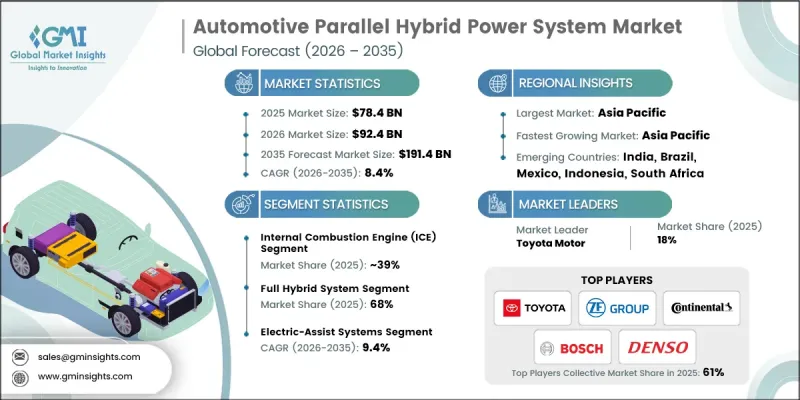
车辆平均温室气体排放和燃油经济性的监管压力日益增大,迫使汽车製造商采用并联式混合动力系统作为一种经济有效的减排策略,而无需转型为纯电动车。并联式混合动力系统为提高排放效率提供了一种切实可行的解决方案,特别适用于乘用车、计程车和末端配送车辆,尤其是在都市区和走走停停的驾驶条件下。这些系统结合了能量回收煞车、电动马达辅助和优化的内燃机,以降低油耗和长期营运成本。都市化加快、油价波动以及对永续出行日益增长的需求,进一步推动了并联式混合动力汽车的普及。汽车製造商(OEM)和车队营运商正在投资于能够兼顾环保法规、性能、耐用性和成本效益的混合动力解决方案。
| 市场范围 | |
|---|---|
| 开始年份 | 2025 |
| 预测期 | 2026-2035 |
| 上市时的市场规模 | 784亿美元 |
| 预测金额 | 1914亿美元 |
| 复合年增长率 | 8.4% |
预计到2025年,内燃机市占率将达到39%,并在2035年之前以7.1%的复合年增长率成长。并联式混合动力汽车中使用的内燃机正朝着更小、更有效率的方向发展,并整合了涡轮增压器、轻量化材料和先进的温度控管技术。再生煞车和先进的控制软体提高了扭力辅助、燃油效率和排放气体,同时实现了电动模式和内燃机模式之间的平顺切换。这些技术进步确保了车辆在各种驾驶条件下的稳定性能,并提高了动力传动系统的整体效率。
预计到2025年,全混合动力系统市占率将达到68%,并在2035年之前以8%的复合年增长率成长。全混合动力解决方案正受到消费者的青睐,他们追求的是燃油效率高的SUV和乘用车,尤其是在政府持续提供财政奖励鼓励推广混合动力汽车的背景下。汽车製造商正加大投入,致力于提升电池系统与内燃机(ICE)零件的整合度,优化能量回收,并改善电动辅助性能。这些发展正在提高燃油效率,并有助于实现排放气体目标,使全混合动力系统成为成长最快的市场区隔领域之一。
预计2025年,美国汽车并联式混合动力系统市场规模将达到178亿美元。轻度混合动力和全混合动力轿车及SUV日益普及,主要受都市区通勤者的需求、联邦政府的奖励以及消费者日益增强的环保意识所驱动。车队营运商正在采用混合动力汽车以降低营运成本并满足排放气体法规的要求。製造商致力于提高再生煞车、电动辅助系统和混合动力传动系统的效率,同时提升驾驶体验,这推动了混合动力解决方案在个人和商业车队中的广泛应用。
目录
第一章:调查方法
第二章执行摘要
第三章业界考察
- 生态系分析
- 供应商情况
- 利润率
- 成本结构
- 每个阶段增加的价值
- 影响价值链的因素
- 中断
- 影响产业的因素
- 促进因素
- 严格的排放法规
- 燃油价格飙升
- 都市化和交通拥堵
- 对节能型车辆的需求日益增长
- 产业潜在风险与挑战
- 高昂的系统成本
- 消费者意识低下
- 市场机会
- 新兴市场的扩张
- 商用车混合动力
- 电动机的技术进步
- 与车辆电气化相关的倡议
- 促进因素
- 成长潜力分析
- 监理情势
- 北美洲
- 美国能源局
- SAE国际/美国国家标准协会(ANSI)
- 欧洲
- 欧盟委员会
- CharIN/Eurovent Certita Certification
- 亚太地区
- 新加坡建设局 (BCA)
- JIS-日本工业标准
- 拉丁美洲
- 巴西技术标准协会
- 国家能源委员会
- 中东和非洲
- 阿拉伯联合大公国(阿联酋)能源与基础设施部
- 沙乌地阿拉伯标准、计量和品质组织
- 北美洲
- 波特五力分析
- PESTEL 分析
- 科技与创新趋势
- 当前技术趋势
- 新兴技术
- 价格分析(基于初步调查)
- 对过去价格趋势的分析
- 按球员类型分類的定价策略(高端/超值/成本加成)
- 成本細項分析
- 专利分析(基于初步研究)
- 生产能力和生产趋势(基于初步调查)
- 按地区和主要生产商分類的已安装产能
- 运转率和扩张计划
- 永续性和环境方面
- 永续倡议
- 减少废弃物策略
- 生产中的能源效率
- 具有环保意识的倡议
- 关于碳足迹的考量
- 交易数据分析(基于付费资料库)
- 进出口量及进口额趋势
- 主要贸易走廊及关税的影响
- 人工智慧和生成式人工智慧对市场的影响
- 利用人工智慧改造现有经营模式
- 针对特定领域的生成式人工智慧应用案例和实施蓝图
- 风险、限制和监管考量
- 预测假设和情境分析(基于初步研究)
- 基本案例-驱动复合年增长率的关键宏观经济与产业变量
- 乐观情境-宏观经济与产业的顺风
- 悲观情景-宏观经济放缓或产业逆风
第四章 竞争情势
- 介绍
- 企业市占率分析
- 北美洲
- 欧洲
- 亚太地区
- 拉丁美洲
- 中东和非洲(MEA)
- 主要市场公司的竞争分析
- 竞争定位矩阵
- 主要进展
- 併购
- 伙伴关係与合作
- 新产品发布
- 业务拓展计划及资金筹措
第五章 市场估计与预测:依组件划分,2022-2035年
- 电动机
- DC/DC转换器
- 直流/交流转换器(逆变器)
- 内燃机(ICE)
- 汽油引擎
- 柴油引擎
- 电池和能源储存系统
- 锂离子电池
- 全固态电池
- 锂硫电池
- 电力电子
- 逆变器
- 控制器
- 电池管理系统(BMS)
- 传动系统
- 混合动力专用传输
- 双离合器变速箱(DCT)
- 无段变速箱(CVT)
第六章 市场估计与预测:依实施法划分,2022-2035年
- 全混合动力系统
- 高压系统(200V至400V)
- 800V高性能係统
- 轻度混合动力系统
- 48V 轻混
- 12V微型混合动力
第七章 市场估价与预测:依车辆类型划分,2022-2035年
- 搭乘用车
- SUV
- 轿车
- 掀背车
- 商用车辆
- LCV
- MCV
- 大型商用车辆
第八章 市场估计与预测:依技术划分,2022-2035年
- 再生煞车系统
- 启动停止系统
- 电动辅助系统
第九章 市场估计与预测:依应用领域划分,2022-2035年
- 城市交通
- 城际旅行
- 非公路用途
第十章 市场估价与预测:依地区划分,2022-2035年
- 北美洲
- 我们
- 加拿大
- 欧洲
- 德国
- 英国
- 法国
- 义大利
- 西班牙
- 北欧国家
- 俄罗斯
- 波兰
- 罗马尼亚
- 亚太地区
- 中国
- 印度
- 日本
- 韩国
- ANZ
- 越南
- 印尼
- 拉丁美洲
- 巴西
- 墨西哥
- 阿根廷
- 中东和非洲(MEA)
- 南非
- 沙乌地阿拉伯
- 阿拉伯聯合大公国
第十一章:公司简介
- 世界公司
- Aisin
- BorgWarner
- Continental
- Denso
- Hyundai Mobis
- Magna International
- Robert Bosch
- Toyota Motor
- Valeo
- ZF Friedrichshafen
- 当地公司
- Hitachi Astemo
- Infineon
- LG Chem
- Mitsubishi Electric
- Panasonic
- Schaeffler
- Siemens
- 新兴企业
- Mahle
- Nidec
- YASA
The Global Automotive Parallel Hybrid Power System Market was valued at USD 78.4 billion in 2025 and is estimated to grow at a CAGR of 8.4% to reach USD 191.4 billion by 2035.
Rising regulatory pressure on fleet average greenhouse gas emissions and vehicle fuel economy is compelling automakers to adopt parallel hybrid systems as a cost-effective strategy to reduce emissions without fully transitioning to battery electric vehicles. Parallel hybrids offer a practical solution to improve fuel efficiency in urban and stop-and-go driving conditions, particularly for passenger cars, taxis, and last-mile delivery vehicles. These systems combine regenerative braking, electric motor assistance, and optimized internal combustion engines (ICE) to reduce fuel consumption and provide long-term operational cost savings. Growing urbanization, fluctuating oil prices, and increasing demand for sustainable mobility further strengthen the adoption of parallel hybrid vehicles. OEMs and fleet operators are investing in hybrid solutions that balance environmental compliance with performance, durability, and cost efficiency.
| Market Scope | |
|---|---|
| Start Year | 2025 |
| Forecast Year | 2026-2035 |
| Start Value | $78.4 Billion |
| Forecast Value | $191.4 Billion |
| CAGR | 8.4% |
The internal combustion engines segment held 39% share in 2025 and is projected to grow at a CAGR of 7.1% through 2035. ICE units in parallel hybrid vehicles are becoming smaller, more efficient, and integrated with turbochargers, lightweight materials, and advanced thermal management. Regenerative braking and sophisticated control software are enhancing torque assistance, fuel efficiency, and emission reductions, while providing smooth transitions between electric and combustion modes. These technological improvements ensure consistent performance under varied driving conditions and improve overall powertrain efficiency.
The full hybrid systems segment held a 68% share in 2025 and is expected to grow at a CAGR of 8% through 2035. Full hybrid solutions are favored by consumers seeking fuel-efficient SUVs and passenger cars, particularly as governments continue to offer financial incentives for hybrid adoption. OEMs are investing in better integration of battery systems with ICE components, optimizing energy recovery, and enhancing electric assist performance. These developments increase fuel economy, support emission reduction targets, and make full hybrid systems one of the fastest-growing market segments.
U.S. Automotive Parallel Hybrid Power System Market reached USD 17.8 billion in 2025. Increased adoption of mild and full hybrid sedans and SUVs is driven by urban commuters, federal incentives, and rising consumer awareness of environmental impacts. Fleet operators are incorporating hybrid vehicles to reduce operational costs and meet emission regulations. Manufacturers are enhancing regenerative braking, electric assist systems, and hybrid powertrain efficiency while improving the driving experience, which is driving widespread acceptance of hybrid solutions across private and commercial fleets.
Major players operating in the Global Automotive Parallel Hybrid Power System Market include Aisin, BorgWarner, Continental, Denso, Hyundai Mobis, Magna International, Robert Bosch, Toyota Motor, Valeo, and ZF Friedrichshafen. Companies in the Global Automotive Parallel Hybrid Power System Market are pursuing strategies such as expanding R&D for high-efficiency hybrid components, integrating lightweight materials and advanced electronics, and developing modular full and mild hybrid platforms. They are forming strategic partnerships with OEMs to accelerate vehicle adoption and comply with emission standards. Firms are also investing in software solutions for optimized energy management, regenerative braking, and torque assistance. Targeted regional expansion, local manufacturing, and aftermarket support enhance market penetration. Additionally, offering cost-effective, fuel-efficient hybrid solutions tailored for urban fleets and passenger vehicles strengthens brand presence, drives consumer preference, and ensures long-term competitive advantage in a rapidly evolving automotive landscape.
Table of Contents
Chapter 1 Methodology
- 1.1 Research approach
- 1.2 Quality commitments
- 1.3 GMI AI policy & data integrity commitment
- 1.4 Research trail & confidence scoring
- 1.4.1 Research trail components
- 1.4.2 Scoring components
- 1.5 Data collection
- 1.5.1 Partial list of primary sources
- 1.6 Data mining sources
- 1.6.1 Paid sources
- 1.7 Base estimates and calculations
- 1.7.1 Base year calculation
- 1.8 Forecast model
- 1.9 Research transparency addendum
Chapter 2 Executive Summary
- 2.1 Industry 360° synopsis
- 2.2 Key market trends
- 2.2.1 Regional
- 2.2.2 Component
- 2.2.3 Propulsion
- 2.2.4 Vehicle
- 2.2.5 Technology
- 2.2.6 Application
- 2.3 TAM analysis, 2026-2035
- 2.4 CXO perspectives: Strategic imperatives
Chapter 3 Industry Insights
- 3.1 Industry ecosystem analysis
- 3.1.1 Supplier landscape
- 3.1.2 Profit margin
- 3.1.3 Cost structure
- 3.1.4 Value addition at each stage
- 3.1.5 Factor affecting the value chain
- 3.1.6 Disruptions
- 3.2 Industry impact forces
- 3.2.1 Growth drivers
- 3.2.1.1 Stringent emission regulations
- 3.2.1.2 Rising fuel prices
- 3.2.1.3 Growing urbanization and traffic congestion
- 3.2.1.4 Increasing demand for fuel-efficient vehicles
- 3.2.2 Industry pitfalls and challenges
- 3.2.2.1 High system cost
- 3.2.2.2 Limited consumer awareness
- 3.2.3 Market opportunities
- 3.2.3.1 Expansion in emerging markets
- 3.2.3.2 Commercial vehicle hybridization
- 3.2.3.3 Technological advancements in electric motors
- 3.2.3.4 Fleet electrification initiatives
- 3.2.1 Growth drivers
- 3.3 Growth potential analysis
- 3.4 Regulatory landscape
- 3.4.1 North America
- 3.4.1.1 U.S. Department of Energy
- 3.4.1.2 SAE International / American National Standards Institute (ANSI)
- 3.4.2 Europe
- 3.4.2.1 European Commission
- 3.4.2.2 CharIN / Eurovent Certita Certification
- 3.4.3 Asia Pacific
- 3.4.3.1 BCA - Building and Construction Authority (Singapore)
- 3.4.3.2 JIS - Japanese Industrial Standards
- 3.4.4 Latin America
- 3.4.4.1 Associacao Brasileira de Normas Tecnicas
- 3.4.4.2 Comision Nacional de Energia
- 3.4.5 Middle East & Africa
- 3.4.5.1 UAE Ministry of Energy and Infrastructure
- 3.4.5.2 Saudi Standards, Metrology and Quality Organization
- 3.4.1 North America
- 3.5 Porter's analysis
- 3.6 PESTEL analysis
- 3.7 Technology and innovation landscape
- 3.7.1 Current technological trends
- 3.7.2 Emerging technologies
- 3.8 Pricing Analysis (Driven by Primary Research)
- 3.8.1 Historical Price Trend Analysis
- 3.8.2 Pricing Strategy by Player Type (Premium / Value / Cost-plus)
- 3.9 Cost breakdown analysis
- 3.10 Patent analysis (Driven by Primary Research)
- 3.11 Capacity & Production Landscape (Driven by Primary Research)
- 3.11.1 Installed Capacity by Region & Key Producer
- 3.11.2 Capacity Utilization Rates & Expansion Pipelines
- 3.12 Sustainability and environmental aspects
- 3.12.1 Sustainable practices
- 3.12.2 Waste reduction strategies
- 3.12.3 Energy efficiency in production
- 3.12.4 Eco-friendly initiatives
- 3.12.5 Carbon footprint considerations
- 3.13 Trade Data Analysis (Driven by Paid Database)
- 3.13.1 Import/Export Volume & Value Trends
- 3.13.2 Key Trade Corridors & Tariff Impact
- 3.14 Impact of AI & Generative AI on the Market
- 3.14.1 AI-Driven Disruption of Existing Business Models
- 3.14.2 GenAI Use Cases & Adoption Roadmap by Segment
- 3.14.3 Risks, limitations & regulatory considerations
- 3.15 Forecast assumptions & scenario analysis (Driven by Primary Research)
- 3.15.1 Base Case - key macro & industry variables driving CAGR
- 3.15.2 Optimistic Scenarios - Favorable macro and industry tailwinds
- 3.15.3 Pessimistic Scenario - Macroeconomic slowdown or industry headwinds
Chapter 4 Competitive Landscape, 2025
- 4.1 Introduction
- 4.2 Company market share analysis
- 4.2.1 North America
- 4.2.2 Europe
- 4.2.3 Asia Pacific
- 4.2.4 LATAM
- 4.2.5 MEA
- 4.3 Competitive analysis of major market players
- 4.4 Competitive positioning matrix
- 4.5 Key developments
- 4.5.1 Mergers & acquisitions
- 4.5.2 Partnerships & collaborations
- 4.5.3 New product launches
- 4.5.4 Expansion plans and funding
Chapter 5 Market Estimates & Forecast, By Component, 2022 - 2035 ($Mn, Mn Units)
- 5.1 Key trends
- 5.2 Electric Motor
- 5.2.1 DC/DC Converter
- 5.2.2 DC/AC Converter (Inverter)
- 5.3 Internal combustion engine (ICE)
- 5.3.1 Gasoline Engine
- 5.3.2 Diesel Engine
- 5.4 Battery & energy storage systems
- 5.4.1 Lithium-ion Batteries
- 5.4.2 Solid-State Batteries
- 5.4.3 Lithium-Sulphur Batteries
- 5.5 Power electronics
- 5.5.1 Inverters
- 5.5.2 Controllers
- 5.5.3 Battery Management Systems (BMS)
- 5.6 Transmission system
- 5.6.1 Dedicated Hybrid Transmissions
- 5.6.2 Dual-Clutch Transmissions (DCT)
- 5.6.3 Continuously Variable Transmissions (CVT)
Chapter 6 Market Estimates & Forecast, By Propulsion, 2022 - 2035 ($Mn, Mn Units)
- 6.1 Key trends
- 6.2 Full Hybrid System
- 6.2.1 High-Voltage Systems (200V-400V)
- 6.2.2 800V High-Performance Systems
- 6.3 Mild Hybrid System
- 6.3.1 48V Mild Hybrid
- 6.3.2 12V Micro Hybrid
Chapter 7 Market Estimates & Forecast, By Vehicle, 2022 - 2035 ($Mn, Mn Units)
- 7.1 Key trends
- 7.2 Passenger cars
- 7.2.1 SUV
- 7.2.2 Sedan
- 7.2.3 Hatchback
- 7.3 Commercial vehicle
- 7.3.1 LCV
- 7.3.2 MCV
- 7.3.3 HCV
Chapter 8 Market Estimates & Forecast, By Technology, 2022 - 2035 ($Mn, Mn Units)
- 8.1 Key trends
- 8.2 Regenerative braking systems
- 8.3 Start-stop system
- 8.4 Electric-assist systems
Chapter 9 Market Estimates & Forecast, By Application, 2022 - 2035 ($Mn, Mn Units)
- 9.1 Key trends
- 9.2 Urban transportation
- 9.3 Intercity travel
- 9.4 Off-highway applications
Chapter 10 Market Estimates & Forecast, By Region, 2022 - 2035 ($Mn, Mn Units)
- 10.1 Key trends
- 10.2 North America
- 10.2.1 US
- 10.2.2 Canada
- 10.3 Europe
- 10.3.1 Germany
- 10.3.2 UK
- 10.3.3 France
- 10.3.4 Italy
- 10.3.5 Spain
- 10.3.6 Nordics
- 10.3.7 Russia
- 10.3.8 Poland
- 10.3.9 Romania
- 10.4 Asia Pacific
- 10.4.1 China
- 10.4.2 India
- 10.4.3 Japan
- 10.4.4 South Korea
- 10.4.5 ANZ
- 10.4.6 Vietnam
- 10.4.7 Indonesia
- 10.5 Latin America
- 10.5.1 Brazil
- 10.5.2 Mexico
- 10.5.3 Argentina
- 10.6 MEA
- 10.6.1 South Africa
- 10.6.2 Saudi Arabia
- 10.6.3 UAE
Chapter 11 Company Profiles
- 11.1 Global companies
- 11.1.1 Aisin
- 11.1.2 BorgWarner
- 11.1.3 Continental
- 11.1.4 Denso
- 11.1.5 Hyundai Mobis
- 11.1.6 Magna International
- 11.1.7 Robert Bosch
- 11.1.8 Toyota Motor
- 11.1.9 Valeo
- 11.1.10 ZF Friedrichshafen
- 11.2 Regional players
- 11.2.1 Hitachi Astemo
- 11.2.2 Infineon
- 11.2.3 LG Chem
- 11.2.4 Mitsubishi Electric
- 11.2.5 Panasonic
- 11.2.6 Schaeffler
- 11.2.7 Siemens
- 11.3 Emerging players
- 11.3.1 Mahle
- 11.3.2 Nidec
- 11.3.3 YASA

 混合动力小型汽车市场:按驱动系统、车辆类型和最终用户划分-2026-2032年全球市场预测
 全球混合动力传动系统市场规模、份额、趋势和成长分析报告(2026-2034)
 混合动力传动系统市场-全球产业规模、份额、趋势、机会与预测:按动力传动系统类型、车辆类型、地区和竞争格局划分,2021-2031年
 轻度混合动力车市场规模、份额和成长分析(按容量、车辆类型、电池类型和地区划分)—2026-2033年产业预测混合动力自行车市场按类型、零件、齿轮类型、悬吊类型、车架材料、最终用户和分销管道划分 - 2025-2030 年全球预测
 全球混合动力传动系统市场
 全球轻度混合动力车市场评估:依车型、容量类型、电池类型、地区、机会及预测,2018-2032
 非公路电动车零件市场机会、成长动力、产业趋势分析及 2025 - 2034 年预测全球混合动力自行车市场-按产品、地区和预测的市场规模
 轻度混合动力车:市场占有率分析、产业趋势与统计、成长预测(2025-2030 年)