


 |
市场调查报告书
商品编码
1998808
2026 年至 2035 年饲料益生菌市场的商业机会、成长要素、产业趋势分析与预测。Animal Feed Probiotics Market Opportunity, Growth Drivers, Industry Trend Analysis, and Forecast 2026 - 2035 |
||||||

预计到 2025 年,全球动物饲料益生菌市场价值将达到 2.673 亿美元,年复合成长率为 7.7%,到 2035 年将达到 5.512 亿美元。
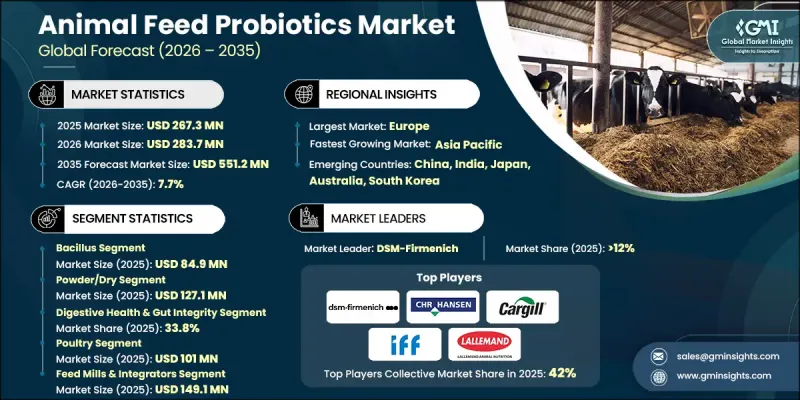
饲料益生菌市场的成长与鼓励无抗生素畜牧养殖系统的监管政策的推进密切相关。随着对饲料和饮用水中常规使用动物抗生素的监管日益严格,生产者越来越多地采用以营养改善和生物解决方案为重点的替代性健康管理策略。因此,益生菌作为维持牲畜肠道菌丛平衡的重要添加剂,正获得广泛认可。鑑于全球饲料生产规模庞大,即使益生菌添加剂的采用率不高,也可能带来显着的市场成长。除了监管影响外,业界也意识到补充益生菌带来的持续性能提升。针对不同畜种的大量饲餵试验表明,益生菌能够显着改善动物健康、生长性能和成本效益。这些结果有助于提高生长速度、降低疾病发生率和改善产品质量,使益生菌成为畜牧预防性健康管理的关键要素。此外,对永续性的关注也在推动市场需求,因为益生菌有助于提高营养利用效率并减少对环境的影响。随着精准饲餵技术的不断发展和更有效的功效数据的出现,随着生产商响应不断增长的全球食品需求和不断变化的监管标准,动物饲料益生菌市场预计将保持长期增长。
| 市场范围 | |
|---|---|
| 开始年份 | 2025 |
| 预测期 | 2026-2035 |
| 上市时的市场规模 | 2.673亿美元 |
| 预测金额 | 5.512亿美元 |
| 复合年增长率 | 7.7% |
预计到2025年,芽孢桿菌市场规模将达到8,490万美元,成为饲料配方中最广泛应用的益生菌类别之一。芽孢桿菌益生菌因其耐高温和形成持久孢子的能力而备受推崇,即使在高温胁迫的饲料加工和储存条件下也能保持稳定。其生物活性有助于维持消化平衡,并帮助牲畜在生理压力时期保持稳定的肠道环境。此外,这些益生菌还能产生有益酶,改善营养物质的消化吸收,这也是它们在各种畜牧养殖计画中广泛应用的重要因素。
到2025年,专注于消化健康和肠道健康的细分市场将占据33.8%的市场。维持肠道菌丛平衡仍是将益生菌纳入动物营养方案的主要原因之一。健康的消化器官系统能够帮助牲畜更有效地吸收营养,同时稳定消化道内的微生物平衡。这些益处在早期生长阶段和饲料转换期尤其重要,因为此时动物更容易出现消化器官系统问题,对整体生产力产生负面影响。因此,专注于消化健康的益生菌解决方案仍然是市场上的主要应用领域。
预计2035年,北美动物饲料益生菌市场规模将达到1.047亿美元。北美正崛起为关键成长区域,这得益于其高度发达的畜牧系统、清晰的法规结构以及业界对无抗生素饲养方式日益增长的兴趣。该地区对精准营养策略和永续畜牧业的高度重视,为先进益生菌技术的应用创造了有利条件。益生菌配方和输送系统的持续创新,进一步推动了全部区域市场的扩张。
目录
第一章:调查方法和范围
第二章执行摘要
第三章业界考察
- 生态系分析
- 供应商情况
- 利润率
- 每个阶段增加的价值
- 影响价值链的因素
- 中断
- 影响产业的因素
- 促进因素
- 科学证据支持的性能提升
- 管理职责和贸易要求
- 精密农业与稳定技术
- 产业潜在风险与挑战
- 菌株多样性和剂量
- 法规的复杂性
- 市场机会
- 甲烷与营养管理
- 水产养殖与宠物营养
- 促进因素
- 成长潜力分析
- 监理情势
- 北美洲
- 欧洲
- 亚太地区
- 拉丁美洲
- 中东和非洲
- 波特五力分析
- PESTEL 分析
- 价格趋势
- 按地区
- 依产品类型
- 未来市场趋势
- 科技与创新趋势
- 当前技术趋势
- 新兴技术
- 专利趋势
- 贸易统计(HS编码)
- 主要进口国
- 主要出口国
- 永续性和环境方面
- 永续倡议
- 减少废弃物策略
- 生产中的能源效率
- 环保意识的倡议
- 考虑碳足迹
第四章 竞争情势
- 介绍
- 企业市占率分析
- 按地区
- 北美洲
- 欧洲
- 亚太地区
- 拉丁美洲
- 中东和非洲
- 按地区
- 企业矩阵分析
- 主要市场公司的竞争分析
- 竞争定位矩阵
- 主要进展
- 併购
- 伙伴关係与合作
- 新产品发布
- 业务拓展计划
第五章 市场估算与预测:依产品类型划分,2022-2035年
- 芽孢桿菌
- 乳酸桿菌
- 酿酒酵母(源自酵母)
- 双歧桿菌
- 肠球菌
- 后生元
- 链球菌
- 其他的
第六章 市场估计与预测:依类型划分,2022-2035年
- 粉末/干粉
- 微胶囊化
- 液体/水溶性
- 颗粒
- 其他的
第七章 市场估计与预测:依功能划分,2022-2035年
- 消化系统健康和肠道健康
- 免疫支持与调节
- 促进生长和饲料效率
- 病原体控制和竞争性消除
- 压力管理
- 其他的
第八章 市场估算与预测:依畜牧业划分,2022-2035年
- 家禽
- 肉鸡
- 产蛋母鸡
- 种苗
- 其他的
- 猪
- 仔猪(断奶前和断奶后)
- 发展期
- 肥育猪
- 其他的
- 牛(反刍动物)
- 牛
- 牛
- 水产养殖
- 鲑鱼
- 鳟鱼
- 虾
- 鲤鱼
- 其他的
- 宠物食品
- 狗
- 猫
- 马
- 其他的
第九章 市场估价与预测:依通路划分,2022-2035年
- 饲料厂及综合企业
- 兽药批发商
- 直接销售(从生产商到农场)
- 线上/电子商务
- 其他的
第十章 市场估价与预测:依最终用户划分,2022-2035年
- 商业和工业农场
- 小规模家庭花园
- 其他的
第十一章 市场估价与预测:按地区划分,2022-2035年
- 北美洲
- 我们
- 加拿大
- 欧洲
- 德国
- 英国
- 法国
- 西班牙
- 义大利
- 其他欧洲地区
- 亚太地区
- 中国
- 印度
- 日本
- 澳洲
- 韩国
- 亚太其他地区
- 拉丁美洲
- 巴西
- 墨西哥
- 阿根廷
- 其他拉丁美洲地区
- 中东和非洲
- 沙乌地阿拉伯
- 南非
- 阿拉伯聯合大公国
- 其他中东和非洲地区
第十二章:公司简介
- DSM-Firmenich
- Chr. Hansen(Novonesis)
- Cargill Animal Nutrition
- IFF
- Lallemand Animal Nutrition
- Alltech
- Kemin Industries
- Evonik Industries
- Novus International
- Lesaffre Group
- Angel Yeast
- Biomin
- Nutreco
- MicroSynbiotiX
The Global Animal Feed Probiotics Market was valued at USD 267.3 million in 2025 and is estimated to grow at a CAGR of 7.7% to reach USD 551.2 million by 2035.
Growth in the animal feed probiotics market is linked to evolving regulatory policies that encourage antibiotic-free livestock production systems. Increasing restrictions on the routine use of veterinary antibiotics in feed and water have encouraged producers to adopt alternative health management strategies that focus on improved nutrition and biological solutions. As a result, probiotics are gaining widespread recognition as valuable additives that support a balanced gut microbiome in livestock. The massive scale of global feed production means that even modest adoption rates of probiotic additives can translate into substantial market growth. In addition to regulatory influences, the industry is also recognizing the consistent performance advantages associated with probiotic supplementation. Numerous feeding trials across different livestock categories have demonstrated measurable improvements in animal health, growth performance, and cost efficiency. These outcomes contribute to stronger growth rates, lower disease incidence, and improved product quality, positioning probiotics as a key element in preventive livestock health management. Sustainability considerations are also reinforcing market demand, as probiotics support improved nutrient utilization and reduced environmental impact. With the continued development of precision feeding technologies and the availability of stronger efficacy data, the animal feed probiotics market is expected to maintain long-term growth as producers respond to rising global food demand and evolving regulatory standards.
| Market Scope | |
|---|---|
| Start Year | 2025 |
| Forecast Year | 2026-2035 |
| Start Value | $267.3 Million |
| Forecast Value | $551.2 Million |
| CAGR | 7.7% |
The bacillus segment generated USD 84.9 million in 2025 and represents one of the most widely adopted probiotic categories used in feed formulations. Bacillus-based probiotics are particularly valued for their ability to withstand high temperatures and form durable spores, allowing them to remain stable during feed processing and storage conditions that involve thermal stress. Their biological activity supports digestive balance and helps maintain gut stability during periods of physiological stress in livestock. Additionally, these probiotics are known to produce beneficial enzymes that improve nutrient digestion, which has contributed to their strong presence across several animal production programs.
The digestive health and gut integrity segment accounted for 33.8% share in 2025. Maintaining a balanced intestinal environment remains one of the primary reasons for incorporating probiotics into animal nutrition programs. Healthy digestive systems allow livestock to absorb nutrients more efficiently while maintaining a stable microbial balance in the gastrointestinal tract. These benefits are particularly valuable during early growth stages and during dietary transitions, when animals are more vulnerable to digestive disturbances that can negatively affect overall performance. As a result, probiotic solutions focused on digestive health continue to represent a major application area within the market.
North America Animal Feed Probiotics Market is projected to reach USD 104.7 million by 2035. North America has emerged as an important growth region due to its highly developed livestock production systems, well-defined regulatory frameworks, and increasing industry emphasis on antibiotic-free feeding practices. The region's strong focus on precision nutrition strategies and sustainable livestock production has created favorable conditions for the adoption of advanced probiotic technologies. Continued innovation in probiotic formulations and delivery systems is further supporting the market's expansion across the region.
Major companies operating in the Global Animal Feed Probiotics Market include Cargill Animal Nutrition, DSM-Firmenich, Chr. Hansen (Novonesis), IFF, Lallemand Animal Nutrition, Alltech, Kemin Industries, Evonik Industries, Novus International, Lesaffre Group, Angel Yeast, Nutreco, Biomin, and MicroSynbiotiX. Companies operating in the Global Animal Feed Probiotics Market are strengthening their market position through innovation, strategic partnerships, and expansion of research capabilities. Many firms are investing heavily in microbiome research to develop advanced probiotic strains that deliver improved performance and stability in animal feed applications. Strategic collaborations with feed manufacturers and livestock producers help companies integrate probiotic solutions into large-scale nutrition programs. Businesses are also focusing on expanding production capacity and improving formulation technologies to enhance product stability during feed processing. Additionally, organizations are increasing their presence in emerging livestock markets while strengthening distribution networks worldwide. Continuous investment in scientific validation, field trials, and regulatory approvals further supports product credibility and helps companies build stronger relationships with producers seeking reliable alternatives to antibiotic-based growth promoters.
Table of Contents
Chapter 1 Methodology & Scope
- 1.1 Market scope and definition
- 1.2 Research design
- 1.2.1 Research approach
- 1.2.2 Data collection methods
- 1.3 Data mining sources
- 1.3.1 Global
- 1.3.2 Regional/Country
- 1.4 Base estimates and calculations
- 1.4.1 Base year calculation
- 1.4.2 Key trends for market estimation
- 1.5 Primary research and validation
- 1.5.1 Primary sources
- 1.6 Forecast model
- 1.7 Research assumptions and limitations
Chapter 2 Executive Summary
- 2.1 Industry 360° synopsis
- 2.2 Key market trends
- 2.2.1 Regional
- 2.2.2 Product Type
- 2.2.3 Form
- 2.2.4 Function
- 2.2.5 Livestock
- 2.2.6 Distribution Channel
- 2.2.7 End-User
- 2.3 TAM Analysis, 2026-2035
- 2.4 CXO perspectives: Strategic imperatives
- 2.4.1 Executive decision points
- 2.4.2 Critical success factors
- 2.5 Future Outlook and Strategic Recommendations
Chapter 3 Industry Insights
- 3.1 Industry ecosystem analysis
- 3.1.1 Supplier landscape
- 3.1.2 Profit margin
- 3.1.3 Value addition at each stage
- 3.1.4 Factor affecting the value chain
- 3.1.5 Disruptions
- 3.2 Industry impact forces
- 3.2.1 Growth drivers
- 3.2.1.1 Science-backed performance gains
- 3.2.1.2 Stewardship and trade requirements
- 3.2.1.3 Precision farming & stability tech
- 3.2.2 Industry pitfalls and challenges
- 3.2.2.1 Strain variability & dosing
- 3.2.2.2 Regulatory complexity
- 3.2.3 Market opportunities
- 3.2.3.1 Methane and nutrient management
- 3.2.3.2 Aquaculture and pet nutrition.
- 3.2.1 Growth drivers
- 3.3 Growth potential analysis
- 3.4 Regulatory landscape
- 3.4.1 North America
- 3.4.2 Europe
- 3.4.3 Asia Pacific
- 3.4.4 Latin America
- 3.4.5 Middle East & Africa
- 3.5 Porter's analysis
- 3.6 PESTEL analysis
- 3.7 Price trends
- 3.7.1 By region
- 3.7.2 By product type
- 3.8 Future market trends
- 3.9 Technology and Innovation landscape
- 3.9.1 Current technological trends
- 3.9.2 Emerging technologies
- 3.10 Patent Landscape
- 3.11 Trade statistics (HS code)
- 3.11.1 Major importing countries
- 3.11.2 Major exporting countries
- 3.12 Sustainability and environmental aspects
- 3.12.1 Sustainable practices
- 3.12.2 Waste reduction strategies
- 3.12.3 Energy efficiency in production
- 3.12.4 Eco-friendly initiatives
- 3.13 Carbon footprint consideration
Chapter 4 Competitive Landscape, 2025
- 4.1 Introduction
- 4.2 Company market share analysis
- 4.2.1 By region
- 4.2.1.1 North America
- 4.2.1.2 Europe
- 4.2.1.3 Asia Pacific
- 4.2.1.4 LATAM
- 4.2.1.5 MEA
- 4.2.1 By region
- 4.3 Company matrix analysis
- 4.4 Competitive analysis of major market players
- 4.5 Competitive positioning matrix
- 4.6 Key developments
- 4.6.1 Mergers & acquisitions
- 4.6.2 Partnerships & collaborations
- 4.6.3 New Product Launches
- 4.6.4 Expansion Plans
Chapter 5 Market Estimates and Forecast, By Product Type, 2022-2035 (USD Million) (Kilo Tons)
- 5.1 Key trends
- 5.2 Bacillus
- 5.3 Lactobacilli
- 5.4 Saccharomyces (Yeast-Based)
- 5.5 Bifidobacterium
- 5.6 Enterococcus
- 5.7 Postbiotics
- 5.8 Streptococcus
- 5.9 Others
Chapter 6 Market Estimates and Forecast, By Form, 2022-2035 (USD Million) (Kilo Tons)
- 6.1 Key trends
- 6.2 Powder/Dry
- 6.3 Microencapsulated
- 6.4 Liquid/Soluble
- 6.5 Granules
- 6.6 Others
Chapter 7 Market Estimates and Forecast, By Function, 2022-2035 (USD Million) (Kilo Tons)
- 7.1 Key trends
- 7.2 Digestive health & gut integrity
- 7.3 Immune support & modulation
- 7.4 Growth promotion & feed efficiency
- 7.5 Pathogen control & competitive exclusion
- 7.6 Stress management
- 7.7 Others
Chapter 8 Market Estimates and Forecast, By Livestock, 2022-2035 (USD Million) (Kilo Tons)
- 8.1 Key trends
- 8.2 Poultry
- 8.2.1 Broilers
- 8.2.2 Layers
- 8.2.3 Breeders
- 8.2.4 Others
- 8.3 Swine
- 8.3.1 Piglets (pre-weaning & post-weaning)
- 8.3.2 Growers
- 8.3.3 Finishers
- 8.3.4 Others
- 8.4 Cattle (ruminants)
- 8.4.1 Dairy cattle
- 8.4.2 Beef cattle
- 8.5 Aquaculture
- 8.5.1 Salmon
- 8.5.2 Trout
- 8.5.3 Shrimp
- 8.5.4 Carp
- 8.5.5 Others
- 8.6 Pet food
- 8.6.1 Dogs
- 8.6.2 Cats
- 8.7 Equine
- 8.8 Others
Chapter 9 Market Estimates and Forecast, By Distribution Channel, 2022-2035 (USD Million) (Kilo Tons)
- 9.1 Key trends
- 9.2 Feed mills & integrators
- 9.3 Veterinary distributors
- 9.4 Direct sales (manufacturer to farm)
- 9.5 Online/e-commerce
- 9.6 Others
Chapter 10 Market Estimates and Forecast, By End-User, 2022-2035 (USD Million) (Kilo Tons)
- 10.1 Key trends
- 10.2 Commercial/industrial farms
- 10.3 Small-scale/backyard operations
- 10.4 Others
Chapter 11 Market Estimates and Forecast, By Region, 2022-2035 (USD Million) (Kilo Tons)
- 11.1 Key trends
- 11.2 North America
- 11.2.1 U.S.
- 11.2.2 Canada
- 11.3 Europe
- 11.3.1 Germany
- 11.3.2 UK
- 11.3.3 France
- 11.3.4 Spain
- 11.3.5 Italy
- 11.3.6 Rest of Europe
- 11.4 Asia Pacific
- 11.4.1 China
- 11.4.2 India
- 11.4.3 Japan
- 11.4.4 Australia
- 11.4.5 South Korea
- 11.4.6 Rest of Asia Pacific
- 11.5 Latin America
- 11.5.1 Brazil
- 11.5.2 Mexico
- 11.5.3 Argentina
- 11.5.4 Rest of Latin America
- 11.6 Middle East and Africa
- 11.6.1 Saudi Arabia
- 11.6.2 South Africa
- 11.6.3 UAE
- 11.6.4 Rest of Middle East and Africa
Chapter 12 Company Profiles
- 12.1 DSM-Firmenich
- 12.2 Chr. Hansen (Novonesis)
- 12.3 Cargill Animal Nutrition
- 12.4 IFF
- 12.5 Lallemand Animal Nutrition
- 12.6 Alltech
- 12.7 Kemin Industries
- 12.8 Evonik Industries
- 12.9 Novus International
- 12.10 Lesaffre Group
- 12.11 Angel Yeast
- 12.12 Biomin
- 12.13 Nutreco
- 12.14 MicroSynbiotiX

 2026-2034年全球动物饲料益生菌市场规模、份额、趋势和成长分析报告
 动物饲料益生菌市场-全球产业规模、份额、趋势、机会和预测:按动物种类、原料、剂型、分销管道、地区和竞争格局划分,2021-2031年
 动物饲料益生菌市场规模、份额和成长分析(按动物种类、市场来源、剂型、通路、功能和地区划分)-2026-2033年产业预测
 动物饲料益生菌市场规模、份额和成长分析(按形态、来源、动物种类和地区划分)—产业预测(2026-2033 年)
 全球精准益生菌市场:预测至2032年-按产品类型、剂型、通路、应用、最终用户和地区分類的分析
 动物饲料益生菌市场:全球按产地、牲畜、形态、菌株、功能、分销管道和地区划分 - 预测至 2030 年
 食品、饮料、营养补充品和饲料中的益生菌至 2030 年动物饲料中益生菌市场预测:按成分、形式、功能、牲畜、销售管道和地区进行的全球分析