


 |
市场调查报告书
商品编码
1906904
北美塑胶瓶盖及封盖市场:市占率分析、产业趋势、统计及成长预测(2026-2031)North America Plastic Caps And Closures - Market Share Analysis, Industry Trends & Statistics, Growth Forecasts (2026 - 2031) |
||||||

※ 本网页内容可能与最新版本有所差异。详细情况请与我们联繫。
预计北美塑胶瓶盖和封盖市场将从 2025 年的 3,993.9 亿个成长到 2026 年的 4,130.1 亿个,到 2031 年将达到 4,884 亿个,2026 年至 2031 年的复合年增长率为 3.41%。
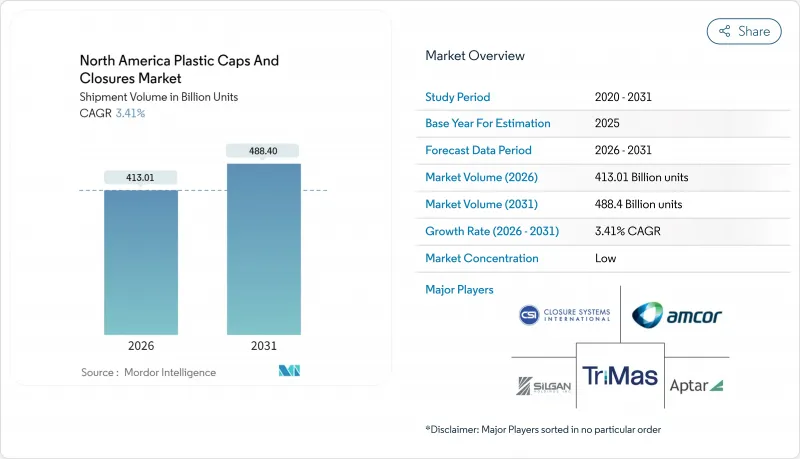
这一增长反映了市场在保护产品品质以及满足饮料、食品、药品和个人保健产品领域严格的安全性和永续性要求方面所发挥的作用。新型机能饮料的产品推出、不断增长的电商药品销售额以及各州层面的再生材料含量强制令持续推动着对专用高性能盖子与封口装置的需求。同时,品牌拥有者倾向于选择符合循环经济目标的互锁式、单一材料和儿童安全型解决方案。原生树脂价格上涨和气候变迁导致的供应中断带来的成本压力,促使製造商实现生产自动化并整合再生材料,以保持竞争力。产业相关人员也积极寻求併购,并采用基于人工智慧的缺陷检测系统,以提高效率并实现规模经济。
北美塑胶瓶盖及封盖市场趋势及洞察
瓶装饮料和机能饮料的需求激增
强化水、清爽型无酒精调饮和含咖啡因的运动饮料持续渗透零售管道,推动了对瓶盖的需求,而不仅限于传统的补水饮品类别。高阶定位促使厂商投资研发耐压防窜改瓶盖,这些瓶盖能够维持高达四倍体积的二氧化碳,同时也能帮助品牌在货架上脱颖而出。饮料开发商还需要能够保护敏感膳食补充剂成分并符合美国食品药物管理局(FDA) 补充剂标籤标准的瓶盖。此外,墨西哥消费者支出的成长也带动了当地饮料生产的发展,从而推动了对轻便耐用瓶盖的需求。由于製造商需要与填充商合作,以确保在高速填充过程中扭矩和密封性能的一致性,因此供应链的可靠性仍然至关重要。
品牌所有者推广可连接/相容电子商务的瓶盖
随着直接面向消费者的配送模式兴起,亚马逊的ISTA-6合规性已成为个人保健产品和饮料新品上市的必备条件。因此,品牌商优先考虑使用可牢固固定在瓶颈上的繫绳式瓶盖,以减少洩漏并防止瓶盖在运输纸箱中遗失。 Aptar的Future Desktop就是一个很好的例子,它将安全的锁定机制与100%聚乙烯材质结合,以便于家庭回收。食品零售商同样青睐繫绳式瓶盖设计,这种设计简化了自动化封盖生产线,并减少了因瓶盖和瓶子不匹配而造成的停机时间。取得专利的铰链设计允许多次开合循环,而不会影响防篡改性能或消费者使用便利性。
原生树脂的生产者延伸责任制(EPR)成本
包括加州在内的四个州,根据原生树脂的使用量向生产商收取回收费,这直接增加了瓶盖的成本。儘管生产商正在转向使用再生和生物基材料以降低这些费用,但PCR聚丙烯的市场供应仍然有限。不同司法管辖区的收费系统各异,使得在多个州运营的灌装商难以合规,而报告要求也增加了额外的行政负担。缺乏必要监管资源的小型加工商面临的负担最大,这可能会加速产业整合,导致资产出售给大型公司。
细分市场分析
截至2025年,聚乙烯仍将占据塑胶瓶盖和封盖市场41.98%的最大份额,主要得益于其成本效益和加工灵活性。然而,聚对苯二甲酸乙二醇酯(PET)将以6.45%的复合年增长率实现最快增长,因为品牌所有者将永续性承诺与单一聚合物包装相结合。 PET瓶盖凭藉其固有的可回收性和成熟的回收网络,正在帮助饮料和个人护理行业实现材料循环利用。结晶控制和添加剂包装的创新提高了耐热性,使得热填充果汁成为可能,不会影响密封性能。 Origin Materials公司最近成功展示了一种与标准填充线相容的聚酯树脂瓶盖,表明加工商现在拥有了一种可大规模生产的替代方案。
製造商们也寻求将消费后PET含量目标设定为25%,以避免因生产者延伸责任制(EPR)而受到附加税,这推动了对食品级再生颗粒的需求。同时,聚丙烯凭藉其卓越的抗应力开裂性能,在严苛的化学和製药应用领域仍占有一席之地。生物基聚合物虽然仍属于小众市场,但在需要强制堆肥的地区,它们正引起监管机构的注意。这些变化共同造就了由整体拥有成本和可回收性指标所驱动的多元化材料选择格局。
由于瓶口通用,螺旋盖容器长期以来一直是标准配置,并保持着46.85%的市场份额(截至2025年)。然而,随着线上药局直接向消费者配送处方药的兴起,儿童安全盖(CRC)预计将超越所有其他类别,到2031年复合年增长率将达到5.55%。美国食品药物管理局(FDA)更严格的法规强制要求某些非处方膳食补充剂粉末必须使用儿童安全盖,这进一步扩大了潜在市场。 Berry World的选择性开启设计体现了其持续研发的成果,将双重安全机制与成人易用性完美结合。
对于个人护理乳液和家用清洁剂剂而言,由于其流量控制功能可减少浪费,按压式瓶盖正日益受到青睐;而在乳製品等需要快速使用和经济成型的行业,卡扣式和推入式瓶盖解决方案仍然可行。在各种瓶盖上嵌入QR码,用于支援真伪验证和回收流程,已成为直销通路的一项增值差异化优势。
其他福利:
- Excel格式的市场预测(ME)表
- 分析师支持(3个月)
目录
第一章 引言
- 研究假设和市场定义
- 调查范围
第二章调查方法
第三章执行摘要
第四章 市场情势
- 市场概览
- 市场驱动因素
- 瓶装饮料和机能饮料的需求激增
- 品牌所有者推广合作/欧盟相容瓶盖
- 过渡到使用单一材料PP瓶盖,以便于回收。
- 线上药品和营养补充品市场的快速成长推动了对CRC的需求。
- 人工智慧驱动的在线连续视觉系统可降低缺陷率和成本。
- 市场限制
- 原生树脂的生产者延伸责任制(EPR)成本
- 立式袋的兴起,以及用接头取代螺旋盖的趋势
- 美国和加拿大强制规定再生聚酯(rPET)含量,正在挤压原生聚丙烯(PP)的需求。
- 饮料品牌测试可重复密封的铝盖
- 供应链分析
- 监管环境
- 技术展望
- 地缘政治情势的影响
- 波特五力分析
- 供应商的议价能力
- 买方的议价能力
- 新进入者的威胁
- 替代品的威胁
- 竞争对手之间的竞争
第五章 市场规模与成长预测
- 材料
- 聚乙烯(PE)
- 聚对苯二甲酸乙二醇酯(PET)
- 聚丙烯(PP)
- 其他成分
- 按类型
- 螺纹式
- 自动贩卖机
- 没有螺丝
- 儿童安全
- 按最终用户行业划分
- 饮料
- 瓶装水
- 软性饮料
- 烈酒
- 其他饮料
- 食物
- 製药和医疗保健
- 化妆品和盥洗用品
- 家用化学品
- 其他行业
- 饮料
- 透过製造工艺
- 射出成型
- 压缩成型
- 3D列印/快速原型製作
- 其他製造工艺
- 按国家/地区
- 美国
- 加拿大
- 墨西哥
第六章 竞争情势
- 市场集中度
- 策略趋势
- 市占率分析
- 公司简介
- Silgan Holdings Inc.
- Amcor plc
- AptarGroup Inc.
- Closure Systems International Inc.
- TriMas Corporation
- Guala Closures SpA
- Tetra Pak Group
- O.Berk Company LLC
- BERICAP Holding GmbH
- Pano Cap Canada Ltd
- Erie Molded Plastics Inc.
- Crown Holdings Inc.
- Phoenix Closures Inc.
- Mold-Rite Plastics LLC
- Comar LLC
- Husky Technologies
- SACMI Imola SC
- Sonoco Products Company
- Plastipak Holdings Inc.
- Albea Group
第七章 市场机会与未来展望
The North America plastic caps and closures market is expected to grow from 399.39 billion units in 2025 to 413.01 billion units in 2026 and is forecast to reach 488.4 billion units by 2031 at 3.41% CAGR over 2026-2031.
This growth reflects the market's role in safeguarding product quality across beverages, food, pharmaceuticals, and personal-care items while meeting rigorous safety and sustainability expectations. Functional beverage launches, e-commerce-driven pharmaceutical sales, and state-level recycled-content mandates continue to steer demand for specialized, high-performance closures. At the same time, brand owners favor tethered, mono-material, and child-resistant solutions that align with circular-economy goals. Cost pressures from virgin-resin fees and climate-related supply disruptions push manufacturers to automate production and integrate recycled feedstocks, ensuring competitive resilience. Industry participants also pursue mergers and AI-enabled defect-inspection systems to enhance efficiency and secure scale advantages.
North America Plastic Caps And Closures Market Trends and Insights
Demand Surge for Bottled and Functional Beverages
Enhanced waters, relaxation mocktails, and caffeinated sports drinks continue to penetrate retail channels, lifting closure volumes beyond traditional hydration categories. Premium positioning drives investments in pressure-resistant, tamper-evident designs that preserve carbonation up to 4 volumes of CO2 while supporting brand shelf differentiation. Beverage formulators also require closures that protect sensitive nutraceutical ingredients and comply with U.S. Food and Drug Administration supplement labeling. In addition, Mexican consumer spending growth bolsters regional beverage production, amplifying unit demand for lightweight yet robust caps. Supply-chain reliability remains essential as manufacturers coordinate with fillers to deliver consistent torque and seal performance during high-speed bottling.
Brand-Owner Push for Tethered / E-commerce-Ready Closures
Direct-to-consumer shipping has made Amazon ISTA-6 compliance a gating requirement for personal-care and beverage launches. Brand owners therefore prioritize tethered formats that stay attached to the neck finish, mitigate leakage, and avoid cap loss inside shipping cartons. Aptar's Future Disc Top exemplifies this, pairing a secure lock with 100% polyethylene construction that simplifies curbside recycling. Grocery retailers likewise favor tethered designs because they streamline automated capping lines and cut downtime tied to cap-to-bottle mismatches. Patented hinge geometries now support multiple open-close cycles without compromising tamper evidence or consumer convenience.
Extended Producer Responsibility (EPR) Fees on Virgin Resin
California and three other states now levy producer-funded recycling fees that climb with virgin resin intensity, directly raising closure unit costs. Producers have begun shifting portfolios toward recycled or bio-based feedstocks to blunt fee exposure, yet the market supply of PCR polypropylene remains limited. Fee schedules differ by jurisdiction, complicating compliance for multi-state fillers, while reporting obligations create new administrative tasks. Smaller converters lacking regulatory staff face the greatest burden, potentially accelerating consolidation as they sell assets to scale players.
Other drivers and restraints analyzed in the detailed report include:
- Shift Toward PP Mono-Material Caps for Easier Recycling
- On-Line Pharma and Nutraceutical Boom Fuels CRC Demand
- Rise of Stand-Up Pouches with Fitments Replacing Screw Caps
For complete list of drivers and restraints, kindly check the Table Of Contents.
Segment Analysis
Polyethylene retained the largest 41.98% slice of the plastic caps and closures market in 2025 on the back of cost efficiency and versatile processing. Nevertheless, polyethylene terephthalate marked the quickest advance at a 6.45% CAGR as brand owners linked sustainability pledges with single-polymer packaging streams. PET closures now leverage intrinsic recyclability and mature reclaim networks to close material loops in beverage and personal-care segments. Innovations in crystallinity control and additive packages lift heat-resistance, enabling hot-fill juices without sacrificing seal integrity. Origin Materials recently demonstrated polyester resin closures compatible with standard filling lines, signaling scale-ready alternatives for converters.
Manufacturers also explore post-consumer PET content targets of 25% to sidestep EPR levies, pushing demand for food-grade recycled pellets. Meanwhile, polypropylene holds ground in aggressive chemical and pharma uses because of superior stress-crack resistance. Bio-based polymers, though niche, gain regulatory attention where compostability mandates apply. Together, these shifts create a mosaic of material choices that hinge on total-cost-of-ownership and recyclability metrics.
Threaded formats, long the default due to universal neck compatibility, secured 46.85% share in 2025. Yet child-resistant closures outpaced all categories at 5.55% CAGR through 2031 as e-commerce pharmacies shipped increasing prescription volumes directly to consumers. Tightening FDA guidance now requires CRCs on certain over-the-counter nutraceutical powders, further broadening addressable volumes. Berry Global's selectively openable design illustrates ongoing R&D, merging dual-input safety with adult-friendly ergonomics.
Dispensing variants hold appeal in personal-care lotions and household cleaners where controlled flow minimizes waste. Snap-fit and press-on solutions remain useful in dairy products needing quick application and economical tooling. Across closure types, embedded QR codes supporting authenticity verification and recycling instructions emerge as value-added differentiators in direct-to-consumer channels.
The North America Plastic Caps and Closures Market Report is Segmented by Material (Polyethylene, PET, Polypropylene, and More), Type (Threaded, Dispensing, and More), End-User Industry (Beverage, Food, Pharmaceutical and Healthcare, Cosmetics and Toiletries, and More), Manufacturing Process (Injection Molding, Compression Molding, 3-D Printing, and More), and Geography. The Market Forecasts are Provided in Terms of Volume (Units).
List of Companies Covered in this Report:
- Silgan Holdings Inc.
- Amcor plc
- AptarGroup Inc.
- Closure Systems International Inc.
- TriMas Corporation
- Guala Closures SpA
- Tetra Pak Group
- O.Berk Company LLC
- BERICAP Holding GmbH
- Pano Cap Canada Ltd
- Erie Molded Plastics Inc.
- Crown Holdings Inc.
- Phoenix Closures Inc.
- Mold-Rite Plastics LLC
- Comar LLC
- Husky Technologies
- SACMI Imola S.C.
- Sonoco Products Company
- Plastipak Holdings Inc.
- Albea Group
Additional Benefits:
- The market estimate (ME) sheet in Excel format
- 3 months of analyst support
TABLE OF CONTENTS
1 INTRODUCTION
- 1.1 Study Assumptions and Market Definition
- 1.2 Scope of the Study
2 RESEARCH METHODOLOGY
3 EXECUTIVE SUMMARY
4 MARKET LANDSCAPE
- 4.1 Market Overview
- 4.2 Market Drivers
- 4.2.1 Demand surge for bottled and functional beverages
- 4.2.2 Brand-owner push for tethered / e-commerce-ready closures
- 4.2.3 Shift toward PP mono-material caps for easier recycling
- 4.2.4 On-line pharma and nutraceutical boom fuels CRC demand
- 4.2.5 AI-enabled in-line vision lowers defect rates and costs
- 4.3 Market Restraints
- 4.3.1 Extended Producer Responsibility (EPR) fees on virgin resin
- 4.3.2 Rise of stand-up pouches with fitments replacing screw caps
- 4.3.3 U.S./Canada rPET content mandates squeeze virgin PP demand
- 4.3.4 Beverage brand trials of aluminium crown re-seals
- 4.4 Supply-Chain Analysis
- 4.5 Regulatory Landscape
- 4.6 Technological Outlook
- 4.7 Impact of Geopolitical Scenarios
- 4.8 Porter's Five Forces Analysis
- 4.8.1 Bargaining Power of Suppliers
- 4.8.2 Bargaining Power of Buyers
- 4.8.3 Threat of New Entrants
- 4.8.4 Threat of Substitutes
- 4.8.5 Intensity of Competitive Rivalry
5 MARKET SIZE AND GROWTH FORECASTS (VOLUME)
- 5.1 By Material
- 5.1.1 Polyethylene (PE)
- 5.1.2 Polyethylene Terephthalate (PET)
- 5.1.3 Polypropylene (PP)
- 5.1.4 Other Materials
- 5.2 By Type
- 5.2.1 Threaded
- 5.2.2 Dispensing
- 5.2.3 Unthreaded
- 5.2.4 Child-Resistant
- 5.3 By End-user Industry
- 5.3.1 Beverage
- 5.3.1.1 Bottled Water
- 5.3.1.2 Soft Drinks
- 5.3.1.3 Spirits
- 5.3.1.4 Other Beverages
- 5.3.2 Food
- 5.3.3 Pharmaceutical and Healthcare
- 5.3.4 Cosmetics and Toiletries
- 5.3.5 Household Chemicals
- 5.3.6 Other Industries
- 5.3.1 Beverage
- 5.4 By Manufacturing Process
- 5.4.1 Injection Molding
- 5.4.2 Compression Molding
- 5.4.3 3-D Printing / Rapid Prototyping
- 5.4.4 Other Manufacturing Process
- 5.5 By Country
- 5.5.1 United States
- 5.5.2 Canada
- 5.5.3 Mexico
6 COMPETITIVE LANDSCAPE
- 6.1 Market Concentration
- 6.2 Strategic Moves
- 6.3 Market Share Analysis
- 6.4 Company Profiles (includes Global level Overview, Market level overview, Core Segments, Financials as available, Strategic Information, Market Rank/Share, Products and Services, Recent Developments)
- 6.4.1 Silgan Holdings Inc.
- 6.4.2 Amcor plc
- 6.4.3 AptarGroup Inc.
- 6.4.4 Closure Systems International Inc.
- 6.4.5 TriMas Corporation
- 6.4.6 Guala Closures SpA
- 6.4.7 Tetra Pak Group
- 6.4.8 O.Berk Company LLC
- 6.4.9 BERICAP Holding GmbH
- 6.4.10 Pano Cap Canada Ltd
- 6.4.11 Erie Molded Plastics Inc.
- 6.4.12 Crown Holdings Inc.
- 6.4.13 Phoenix Closures Inc.
- 6.4.14 Mold-Rite Plastics LLC
- 6.4.15 Comar LLC
- 6.4.16 Husky Technologies
- 6.4.17 SACMI Imola S.C.
- 6.4.18 Sonoco Products Company
- 6.4.19 Plastipak Holdings Inc.
- 6.4.20 Albea Group
7 MARKET OPPORTUNITIES AND FUTURE OUTLOOK
- 7.1 White-space and Unmet-Need Assessment

 塑胶盖子与封口装置市场:2026-2032年全球市场预测(按产品类型、材料、最终用途和分销管道划分)
 美国塑胶瓶盖和封盖:市场份额分析、行业趋势和统计数据、成长预测(2026-2031 年)
 全球塑胶瓶盖和封盖市场规模、份额、趋势和成长分析报告(2026-2034年)
 2026年全球塑胶瓶盖和封盖市场报告
 塑胶瓶盖和封盖市场 - 全球产业规模、份额、趋势、机会和预测(按产品类型、容器类型、原材料、技术、最终用途行业、地区和竞争格局划分,2021-2031年)
 70mm塑胶瓶盖市场规模、份额和趋势分析报告:按材料、应用、地区和细分市场预测,2026-2033年欧洲塑胶瓶盖和封盖:市场份额分析、行业趋势、统计数据和成长预测(2026-2031 年)
 塑胶瓶盖和封盖:全球市场份额和排名、总销售额和需求预测(2025-2031 年)
 2032年塑胶瓶盖和封口市场预测:依产品类型、原料、製造流程、应用和地区分析塑胶瓶盖和封盖:市场份额分析、行业趋势、统计数据和成长预测(2025-2030 年)