


 |
市场调查报告书
商品编码
1940629
美国塑胶瓶盖和封盖:市场份额分析、行业趋势和统计数据、成长预测(2026-2031 年)United States (US) Plastic Caps And Closures - Market Share Analysis, Industry Trends & Statistics, Growth Forecasts (2026 - 2031) |
||||||

※ 本网页内容可能与最新版本有所差异。详细情况请与我们联繫。
预计到 2025 年,美国塑胶瓶盖和封盖市场价值将达到 121.2 亿美元,从 2026 年的 124.2 亿美元成长到 2031 年的 140.5 亿美元。
预计在预测期(2026-2031 年)内,复合年增长率将达到 2.48%。
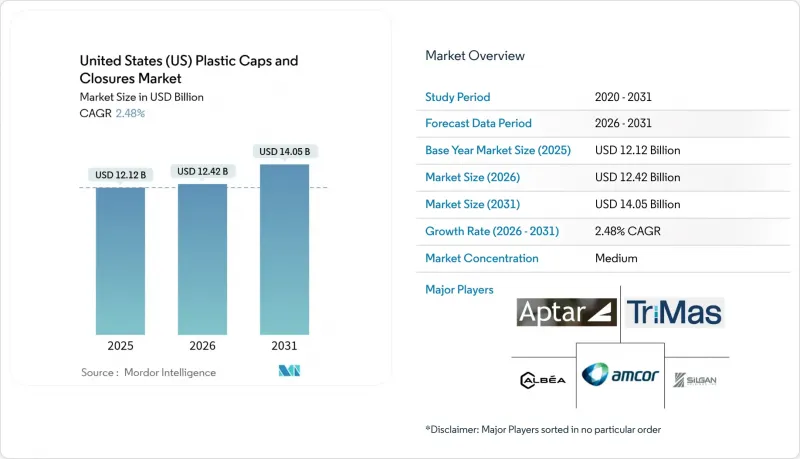
这种缓慢的成长速度是多种因素共同作用的结果,包括监管合规成本、树脂价格波动以及饮料、医药和电商包装行业需求的激增。有关扎带盖的法规、更严格的儿童安全标准以及品牌对NFC认证技术日益增长的兴趣,都在推动对材料选择和製造方法的重新评估。儘管聚丙烯(PP)凭藉其低成本和优异的阻隔性能保持着主导地位,但随着品牌追求轻量化和循环利用的目标,聚对苯二甲酸乙二醇酯(PET)的市场份额正在不断增长。能够将经济高效的射出成型与优质智慧封盖技术相结合的製造商,最有可能在美国塑胶瓶盖和封盖市场抓住新的机会。
美国塑胶瓶盖及封盖市场趋势及洞察
对便利包装饮料的需求激增
受便利消费习惯和功能性补水产品推出的推动,市场对配备易开可重复密封瓶盖的单份宝特瓶的需求持续增长。饮料填充商越来越多地指定使用与运动瓶盖和翻盖式瓶盖相容的瓶盖,以便单手操作,同时符合21 CFR S211.132防篡改法规。品牌拥有者正在瓶盖上整合NFC标籤和QR码,以促进售后互动和忠诚度计画,并将瓶盖作为数位媒体的载体。随着高端水、能量饮料和即饮咖啡占据货架主导地位,瓶盖製造商看到了销售增值产品的商机,例如吸氧内衬、整合式吸嘴和颜色匹配的表面处理,这些都能强化品牌形象。美国塑胶瓶盖市场正受益于这些需求,因为增值设计弥补了碳酸饮料销售成长缓慢的影响。
不断扩大的药品包装要求
随着人口老化和处方药治疗的普及,对符合美国消费品安全委员会 (CPSC) 扭力和推拉测试标准的儿童安全型、老年人友善瓶盖的需求日益增长。医院和药房在部署自动配药柜时,需要高度一致的扭矩范围和内衬完整性,以防止剂量错误。合法的大麻产品(目前在24个州被列为管制药品)必须符合防中毒包装标准,这为经认证的可重复密封系统创造了一个高价值的细分市场。整合微型感测器和时间戳功能的智慧瓶盖有助于追踪治疗依从性并提醒潜在的误用情况,这为专业加工商在医疗保健技术领域的合作创造了机会。
树脂价格波动
集中在墨西哥湾沿岸的聚烯原料易受飓风和裂解装置意外停产的影响,这可能导致聚丙烯 (PP) 和聚乙烯 (PE) 现货价格在几週内上涨 30% 至 50%。瓶盖製造商不愿将附加费转嫁给消费者,这在价格飙升期间挤压了利润空间,并抑制了对新模具的投资。虽然一些加工商使用期货合约对冲树脂采购风险,但价格波动仍然使依赖固定价格指数的长期饮料供应协议变得复杂。儘管计划于 2026 年至 2027 年运作的新页岩气裂解装置有望提高产能,但短期风险状况促使企业采取更薄型化和多元化的筹资策略。
细分市场分析
聚丙烯(PP)因其化学稳定性好且与高速射出成型线相容,在美国塑胶瓶盖和封盖市场占据41.12%的份额。随着饮料灌装商普遍采用轻质螺旋盖,预计该细分市场将维持个位数低成长;而家用化学品产业则因其耐溶剂性而继续青睐PP翻盖。聚对苯二甲酸乙二醇酯(PET)虽然仍处于个位数中增长水平,但由于其低密度且与瓶盖回收工艺兼容,预计到2031年将以3.45%的复合年增长率快速增长。 Origin Materials公司推出的新型热成型製程进一步强化了这一优势,该工艺可缩短生产週期并减少废弃物。
除了前两大材料之外,高密度聚苯乙烯(HDPE) 是需要抗穿刺性和儿童安全扭矩范围的药品管瓶的首选材料,永续性。这些趋势共同推动了加工商和压力树脂供应商可选择的材料范围,使他们不仅能够在价格上脱颖而出,还能在对循环经济的承诺上展现差异化优势。
到2025年,饮料业将占美国塑胶瓶盖和封盖市场的30.05%,这主要得益于瓶装水和碳酸饮料补充装的强劲需求。然而,随着碳酸饮料市场日趋成熟,预计成长速度将放缓,而机能饮料饮料和运动饮料正在向利润更高的运动型瓶盖转型。同时,受处方药销售成长以及各州大麻市场新增需要符合儿童安全/老年人安全认证标准的SKU的推动,药品瓶盖将以4.79%的复合年增长率成长。儘管医院越来越多地采用单剂量泡壳包装,但静脉输液瓶和口服悬浮液的瓶盖仍然占据主导地位,即使一些治疗方法正在转向使用药袋和注射笔,其潜在需求依然存在。
食品业在电子商务市场的推动下,持续保持稳定成长,而电子商务市场对防篡改和防漏性能的要求也日益提高。化妆品和盥洗用品产业则凭藉其高端瓶盖、金属饰面和品牌配色等特性,开闢了一个虽小但盈利的细分市场。家用化学品产业对安全密封和剂量精准度的重视,再次凸显了坚固的内衬系统和扭力控制的重要性。这些因素共同表明,成功的供应商并非过度依赖饮料市场的需求,而是会根据多个成长领域的需求,客製化其瓶盖产品组合。
其他福利:
- Excel格式的市场预测(ME)表
- 3个月的分析师支持
目录
第一章 引言
- 研究假设和市场定义
- 调查范围
第二章调查方法
第三章执行摘要
第四章 市场情势
- 市场概览
- 市场驱动因素
- 包装便利饮料的需求激增
- 不断扩大的药品包装要求
- 从金属帽换成轻质塑胶帽
- 电子商务的发展需要防篡改设计。
- 采用与约束条件挂钩的上限规定
- 利用高速压缩成型能力实现回流
- 市场限制
- 树脂价格波动
- 来自永续替代品的竞争
- 预计联邦政府将对一次性塑胶製品进行监管
- 人们对微塑胶问题的关注正在推动无内衬瓶盖的普及。
- 产业价值链分析
- 监管环境
- 技术展望
- 波特五力分析
- 供应商的议价能力
- 买方的议价能力
- 新进入者的威胁
- 替代品的威胁
- 竞争程度
- 宏观经济因素如何影响市场
第五章 市场规模与成长预测
- 材料
- 聚对苯二甲酸乙二醇酯(PET)
- 聚丙烯(PP)
- 低密度聚乙烯(LDPE)
- 高密度聚苯乙烯(HDPE)
- 其他材料
- 按最终用户行业划分
- 饮料
- 食物
- 製药和医疗保健
- 化妆品和盥洗用品
- 家用化学品
- 其他终端用户产业
- 按帽型
- 螺帽
- 繫绳帽
- 翻盖式和按扣式瓶盖
- 儿童安全帽
- 豪华/高级装饰帽
- 分配盖
- 透过製造技术
- 射出成型
- 压缩成型
- 三件式在线连续组装
- 数位印刷智慧帽
第六章 竞争情势
- 市场集中度
- 策略趋势
- 市占率分析
- 公司简介
- Silgan Holdings Inc.
- AptarGroup, Inc.
- Amcor plc
- Albea SA
- TriMas Corporation
- Tetra Pak International SA
- Guala Closures SpA
- MJS Packaging, Inc.
- O. Berk Company, LLC
- Closure Systems International, Inc.
- BERICAP GmbH & Co. KG
- Crown Holdings, Inc.
- Evergreen Packaging LLC
- Phoenix Closures, Inc.
- Portola Packaging, Inc.
- Plastipak Packaging, Inc.
- Mold-Rite Plastics, LLC
- Smurfit WestRock
- SIG Combibloc Group AG
第七章 市场机会与未来展望
The United States plastic caps and closures market was valued at USD 12.12 billion in 2025 and estimated to grow from USD 12.42 billion in 2026 to reach USD 14.05 billion by 2031, at a CAGR of 2.48% during the forecast period (2026-2031).
This measured pace reflects a mix of regulatory compliance costs, resin price swings, and surging demand from beverages, pharmaceuticals, and e-commerce packaging. Legislation on tethered caps, stricter child-resistant rules, and brand interest in NFC-enabled authentication are reshaping material choices and production methods. Polypropylene (PP) retains a dominant footprint due to its low cost and strong barrier performance, while polyethylene terephthalate (PET) is gaining share as brands pursue lightweighting and circularity objectives. Manufacturers that combine cost-efficient injection molding with premium smart-closure features are best positioned to capture emerging opportunities in the United States plastic caps and closures market.
United States (US) Plastic Caps And Closures Market Trends and Insights
Surge in Demand for Convenient Packaged Beverages
On-the-go consumption habits and functional hydration launches continue to pull volume through single-serve PET bottles fitted with easy-open, resealable tops. Beverage fillers increasingly specify closures compatible with sports caps and flip-top formats that support one-handed operation while complying with 21 CFR S211.132 tamper-evident rules. Brand owners are pairing NFC tags and QR codes on caps to drive post-purchase engagement and loyalty programs, turning closures into a digital media surface. As premium water, energy drinks, and ready-to-drink coffee command shelf space, closure makers gain opportunities to upsell oxygen-scavenging liners, integrated spouts, and color-matched finishes that reinforce brand identity. The United States plastic caps and closures market benefits from these requirements because value-added designs offset modest volume growth in carbonated soft drinks.
Expanding Pharmaceutical Packaging Requirements
An aging population and wider access to prescription therapies elevate demand for child-resistant, senior-friendly caps that pass Consumer Product Safety Commission torque and push-turn protocols. Hospitals and pharmacies rolling out automated dispensing cabinets also require highly consistent torque ranges and liner integrity to prevent dosage errors. Legal cannabis products-now regulated as controlled substances in 24 states-must meet poison-prevention packaging standards, spawning a premium niche for certified reclosable systems. Smart closures embedding micro-sensors or time-stamp features help track therapy adherence and flag potential misuse, giving specialty converters an entry point into health-tech partnerships.
Volatility in Resin Prices
Polyolefin feedstocks clustered along the Gulf Coast remain vulnerable to hurricanes and unplanned cracker outages that can lift spot PP and PE prices by 30-50% within weeks. Closure makers pass through surcharges with a lag, compressing margins and curbing investment in new tooling during spikes. Some converters hedge resin purchases via futures contracts, yet volatility still complicates long-term beverage supply agreements that favor fixed-price indexation. While new shale-gas crackers slated for 2026-2027 promise incremental capacity, the near-term risk profile encourages leaner inventories and multiple-sourcing strategies.
Other drivers and restraints analyzed in the detailed report include:
- Shift Toward Lightweight Plastic Over Metal Closures
- Growth of E-commerce Requiring Tamper-Evident Designs
- Competition from Sustainable Alternative Materials
For complete list of drivers and restraints, kindly check the Table Of Contents.
Segment Analysis
Polypropylene commands 41.12% share of the United States plastic caps and closures market, anchored by its chemical stability and suitability for high-speed injection molding lines. The segment is expected to post low-single-digit growth as beverage fillers standardize lightweight screw tops and household chemicals continue to favor PP flip caps for solvent resistance. PET, while only a mid-single-digit share contributor, is forecast as the fastest-growing at a 3.45% CAGR through 2031 thanks to its low density and compatibility with bottle-to-cap recycling streams, an advantage amplified by Origin Materials' novel thermoforming route that lowers cycle time and waste.
Moving beyond the top two, high-density polyethylene remains the material of choice for pharmaceutical vials that demand puncture resistance and child-safe torque ranges, whereas low-density polyethylene is preferred in dispensing nozzles for condiments and personal-care creams. Specialty bio-polymers, though under 2% share, gain traction where brand sustainability mandates override cost. Collectively, these dynamics widen the material toolbox available to converters and force resin suppliers to differentiate on circularity credentials, not just price.
Beverages accounted for 30.05% of the United States plastic caps and closures market size in 2025 due to vast bottled-water volumes and carbonated soft drink refills. Growth, however, moderates as carbonated segments mature, while functional beverages and sports drinks shift toward higher-margin sports caps. Pharmaceutical closures, in contrast, will grow 4.79% annually as prescription drug volumes climb and state cannabis markets add SKUs that mandate certified child-resistant or senior-friendly designs. Hospitals converting to unit-dose blister packs still rely on closure-sealed infusion bottles and oral suspensions, sustaining baseline demand even as some therapies migrate to pouches or pens.
Food products maintain a stable trajectory, helped by e-commerce adoption, which places a premium on tamper-evident and leak-proof attributes. Cosmetics and toiletries reach for premium overcaps, metallized finishes, and color harmony with brand palettes, making them a lucrative niche despite modest volumes. Household chemicals emphasize safety seals and dosing accuracy, reinforcing the importance of robust liner systems and torque control. Together, the mix underscores why successful suppliers tailor closure portfolios to multiple growth vectors instead of over-relying on beverage volumes.
The United States Plastic Caps and Closures Market Report is Segmented by Material (PET, PP, LDPE, and More), End-User Industry (Beverage, Food, Pharmaceutical and Healthcare, and More), Cap Type (Screw Closures, Tethered Caps, and More), and Manufacturing Technology (Injection Molding, Compression Molding, and More). The Market Forecasts are Provided in Terms of Value (USD).
List of Companies Covered in this Report:
- Silgan Holdings Inc.
- AptarGroup, Inc.
- Amcor plc
- Albea S.A.
- TriMas Corporation
- Tetra Pak International S.A.
- Guala Closures S.p.A.
- MJS Packaging, Inc.
- O. Berk Company, LLC
- Closure Systems International, Inc.
- BERICAP GmbH & Co. KG
- Crown Holdings, Inc.
- Evergreen Packaging LLC
- Phoenix Closures, Inc.
- Portola Packaging, Inc.
- Plastipak Packaging, Inc.
- Mold-Rite Plastics, LLC
- Smurfit WestRock
- SIG Combibloc Group AG
Additional Benefits:
- The market estimate (ME) sheet in Excel format
- 3 months of analyst support
TABLE OF CONTENTS
1 INTRODUCTION
- 1.1 Study Assumptions and Market Definition
- 1.2 Scope of the Study
2 RESEARCH METHODOLOGY
3 EXECUTIVE SUMMARY
4 MARKET LANDSCAPE
- 4.1 Market Overview
- 4.2 Market Drivers
- 4.2.1 Surge in demand for convenient packaged beverages
- 4.2.2 Expanding pharmaceutical packaging requirements
- 4.2.3 Shift toward lightweight plastic over metal closures
- 4.2.4 Growth of e-commerce requiring tamper-evident designs
- 4.2.5 Adoption of tethered cap legislation
- 4.2.6 Reshoring via high-speed compression-molding capacity
- 4.3 Market Restraints
- 4.3.1 Volatility in resin prices
- 4.3.2 Competition from sustainable alternative materials
- 4.3.3 Prospective federal single-use-plastic restrictions
- 4.3.4 Micro-plastic scrutiny driving liner-less closures
- 4.4 Industry Value Chain Analysis
- 4.5 Regulatory Landscape
- 4.6 Technological Outlook
- 4.7 Porter's Five Forces Analysis
- 4.7.1 Bargaining Power of Suppliers
- 4.7.2 Bargaining Power of Buyers
- 4.7.3 Threat of New Entrants
- 4.7.4 Threat of Substitute Products
- 4.7.5 Degree of Competition
- 4.8 Impact of Macroeconomic Factors on the Market
5 MARKET SIZE AND GROWTH FORECASTS (VALUE)
- 5.1 By Material
- 5.1.1 Polyethylene Terephthalate (PET)
- 5.1.2 Polypropylene (PP)
- 5.1.3 Low Density Polyethylene (LDPE)
- 5.1.4 High-Density Polyethylene (HDPE)
- 5.1.5 Other Materials
- 5.2 By End-user Industry
- 5.2.1 Beverage
- 5.2.2 Food
- 5.2.3 Pharmaceutical and Healthcare
- 5.2.4 Cosmetics and Toiletries
- 5.2.5 Household Chemicals
- 5.2.6 Other End-user industries
- 5.3 By Cap Type
- 5.3.1 Screw Closures
- 5.3.2 Tethered Caps
- 5.3.3 Flip-top and Snap-on Caps
- 5.3.4 Child-resistant Closures
- 5.3.5 Luxury/Premium Decorative Closures
- 5.3.6 Dispensing Caps
- 5.4 By Manufacturing Technology
- 5.4.1 Injection Molding
- 5.4.2 Compression Molding
- 5.4.3 3-Piece and In-line Assembly
- 5.4.4 Digitally Printed Smart Closures
6 COMPETITIVE LANDSCAPE
- 6.1 Market Concentration
- 6.2 Strategic Moves
- 6.3 Market Share Analysis
- 6.4 Company Profiles (includes Global level Overview, Market level overview, Core Segments, Financials as available, Strategic Information, Market Rank/Share for key companies, Products and Services, and Recent Developments)
- 6.4.1 Silgan Holdings Inc.
- 6.4.2 AptarGroup, Inc.
- 6.4.3 Amcor plc
- 6.4.4 Albea S.A.
- 6.4.5 TriMas Corporation
- 6.4.6 Tetra Pak International S.A.
- 6.4.7 Guala Closures S.p.A.
- 6.4.8 MJS Packaging, Inc.
- 6.4.9 O. Berk Company, LLC
- 6.4.10 Closure Systems International, Inc.
- 6.4.11 BERICAP GmbH & Co. KG
- 6.4.12 Crown Holdings, Inc.
- 6.4.13 Evergreen Packaging LLC
- 6.4.14 Phoenix Closures, Inc.
- 6.4.15 Portola Packaging, Inc.
- 6.4.16 Plastipak Packaging, Inc.
- 6.4.17 Mold-Rite Plastics, LLC
- 6.4.18 Smurfit WestRock
- 6.4.19 SIG Combibloc Group AG
7 MARKET OPPORTUNITIES AND FUTURE OUTLOOK
- 7.1 White-Space and Unmet-Need Assessment

 塑胶盖子与封口装置市场:2026-2032年全球市场预测(按产品类型、材料、最终用途和分销管道划分)
 全球塑胶瓶盖和封盖市场规模、份额、趋势和成长分析报告(2026-2034年)
 2026年全球塑胶瓶盖和封盖市场报告
 塑胶瓶盖和封盖市场 - 全球产业规模、份额、趋势、机会和预测(按产品类型、容器类型、原材料、技术、最终用途行业、地区和竞争格局划分,2021-2031年)
 70mm塑胶瓶盖市场规模、份额和趋势分析报告:按材料、应用、地区和细分市场预测,2026-2033年
 北美塑胶瓶盖及封盖市场:市占率分析、产业趋势、统计及成长预测(2026-2031)欧洲塑胶瓶盖和封盖:市场份额分析、行业趋势、统计数据和成长预测(2026-2031 年)
 塑胶瓶盖和封盖:全球市场份额和排名、总销售额和需求预测(2025-2031 年)
 2032年塑胶瓶盖和封口市场预测:依产品类型、原料、製造流程、应用和地区分析塑胶瓶盖和封盖:市场份额分析、行业趋势、统计数据和成长预测(2025-2030 年)