


 |
市场调查报告书
商品编码
1906969
北美软包装市场:市场占有率分析、产业趋势与统计、成长预测(2026-2031)North America Flexible Packaging - Market Share Analysis, Industry Trends & Statistics, Growth Forecasts (2026 - 2031) |
||||||

※ 本网页内容可能与最新版本有所差异。详细情况请与我们联繫。
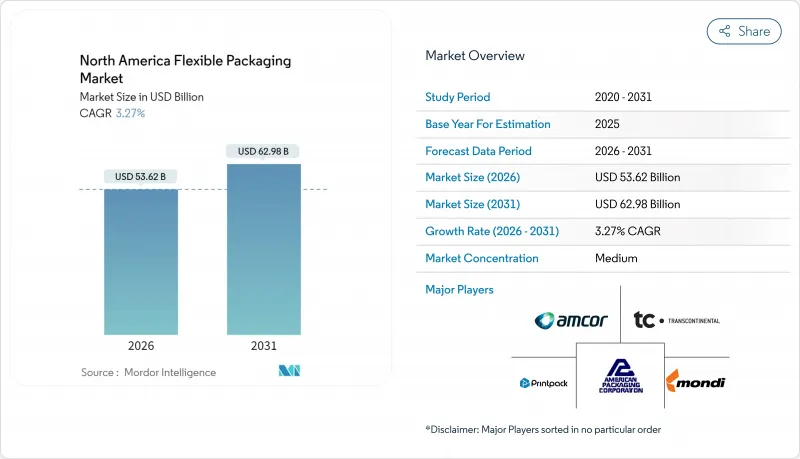
预计到 2026 年,北美软包装市场规模将达到 536.2 亿美元,高于 2025 年的 519.2 亿美元。预计到 2031 年,该市场规模将达到 629.8 亿美元,2026 年至 2031 年的复合年增长率为 3.27%。
终端用户需求的成熟、日益严格的永续性法规以及技术的逐步升级支撑着这一稳步增长的趋势。可回收的单一材料设计、电商履约的自动化以及医疗包装需求的激增是推动成长的主要因素。然而,聚合物价格的波动以及多层薄膜回收的不足限制了短期内的成长空间。品牌所有者目前已将消费后回收树脂的目标直接纳入长期采购合同,而加工商则正在扩展其纤维基产品线,以满足零售商的塑胶减量承诺。儘管竞争格局仍然分散,但大型企业正在透过整合来获取循环经济方面的专业知识并确保成本优势。
北美软包装市场趋势与洞察
便携式零食包装需求激增
随着行动消费习惯的日益普及,对单件包装的投资持续成长。玛氏和百事可乐2024年的产品线扩张计画包括兼顾保质期和份量控制的柔性包装,这促使加工商扩大其高速填充封口设备的规模。预计2023年包装器材出货收益将达到109亿美元,主要得益于每分钟可处理70-100个包装袋的包装袋生产线。食品接触应用中再生聚乙烯使用需求的明确,使得在维持产品完整性的前提下,可以预先混合消费后回收材料(PCR)。这项监管政策的明确推动了采用符合How2Recycle「退货至商店」标准的单一材料聚乙烯立式袋包装的休閒食品的上市,进一步增强了销售量势头。
品牌所有者正转向可回收的单一材料结构
多层薄膜历来有助于解决阻隔难题,但北美地区的回收率仍低于10%。品牌商目前正围绕单一聚合物结构重新设计产品系列。 Mondi为Skanemeierri开发了一种聚丙烯酸奶包装袋,该包装袋在保持60天保质期的同时,还能整合到现有的回收系统中。据报导,与层压结构相比,Amco的AmPrima Plus平台可将其生产过程的碳足迹降低高达68%。功能性阻隔树脂是此转变的关键,其基于取向聚丙烯和原子层涂层的EVOH替代化学技术,无需共挤出黏合层即可实现0.1 cc/m²/天或更低的氧气透过率。持续改善通讯协定会根据APR的关键指导原则评估设计,以确保其符合可回收性声明和零售商清单的要求。
家庭收藏的多层薄膜数量有限
多层复合材料占软包装总重量的26%,但由于混合聚合物阻碍了机械分离,路边回收率仍低于10%。BASF和Tomra的化学剥离先导工厂可提取高达69%的纯净组分,但商业化仍处于早期阶段。市政项目优先回收高价值的宝特瓶,导致薄膜回收资金不足,这将阻碍北美软包装市场的发展,直到可扩展的分类解决方案出现。
细分市场分析
到2025年,塑胶基材将维持北美软包装市场86.72%的份额,这主要得益于LDPE、HDPE和BOPP薄膜的强劲表现,这些薄膜在密封性、刚性和成本效益方面实现了良好的平衡。然而,随着零售商从不可可再生复合材料转向纤维基包装袋和邮寄袋,纸板的市占率正以4.41%的复合年增长率成长。 Sappi北美公司斥资5亿美元升级其2号造纸厂,将使其固态硫酸盐浆的年产能提升至47万吨,这表明该公司对阻隔性涂布纸充满信心。铝箔仍用于保护对湿度敏感的药品,但其高消费量限制了其市场份额,使其仅占小规模部分。
循环经济的迫切需求正在加速消费后回收材料(PCR)的普及应用。美国 )2022年发布的食品药物管理局明确了食品级再生聚乙烯(PE)的化学成分要求,允许PCR含量高达30%,且不会影响其阻隔性能。预计到2031年,北美纸基软包装市场规模将成长21.8亿美元。同时,多层薄膜製造商正转向无溶剂复合製程和相容剂添加剂,以保持产品的可回收性。品牌商正在评估纤维-聚合物混合材料,以功能性水性涂层取代金属化层,从而建立一条过渡路径,降低对现有塑胶供应商造成衝击的风险。
其他福利:
- Excel格式的市场预测(ME)表
- 分析师支持(3个月)
目录
第一章 引言
- 研究假设和市场定义
- 调查范围
第二章调查方法
第三章执行摘要
第四章 市场情势
- 市场概览
- 市场驱动因素
- 方便携带的零食需求激增
- 品牌所有者正转向可回收的单一材料结构
- 宠物食品软包装的优质化
- 州级PCR强制令推动了长期树脂回收合约的签订。
- 微型仓配中心的自动化推动了超薄邮寄薄膜的发展
- 零售商向自动化微型仓配中心的转变正在推动对超薄膜的需求。
- 市场限制
- 多层薄膜的有限路边回收
- 地缘政治衝击引发聚合物价格波动
- 符合FDA标准的再生聚乙烯原料短缺
- 生产者延伸责任制(EPR)立法带来了新的成本和报告义务。
- 产业价值链分析
- 监管环境
- 技术展望
- 波特五力分析
- 新进入者的威胁
- 买方的议价能力
- 供应商的议价能力
- 替代品的威胁
- 竞争对手之间的竞争
第五章 市场规模与成长预测
- 依材料类型
- 塑胶
- 聚乙烯(PE)
- 双轴延伸聚丙烯(BOPP)
- 流延聚丙烯(CPP)
- 聚氯乙烯(PVC)
- 乙烯-乙烯醇共聚物(EVOH)
- 纸
- 铝箔
- 塑胶
- 依产品类型
- 小袋
- 袋装/小袋装
- 薄膜和包装
- 收缩套标和标籤
- 其他产品类型
- 按最终用户行业划分
- 食物
- 冷冻食品
- 乳製品
- 水果和蔬菜
- 肉类、家禽、鱼贝类
- 烘焙点心和零食
- 糖果甜点
- 其他食物
- 饮料
- 药品和医疗用品
- 居家及个人护理
- 工业和化学产品
- 食物
- 按国家/地区
- 美国
- 加拿大
- 墨西哥
第六章 竞争情势
- 市场集中度
- 策略趋势
- 市占率分析
- 公司简介
- Amcor plc
- Sealed Air Corp.
- Mondi plc
- ProAmpac LLC
- Transcontinental Inc.
- American Packaging Corp.
- Sonoco Products Co.
- Printpack Inc.
- Sigma Plastics Group
- Novolex Holdings Inc.
- Constantia Flexibles
- PPC Flexible Packaging
- Charter Next Generation
- Glenroy Inc.
- CCL Industries
- Smurfit Westrock plc
- Coveris Holdings SA
- Emmerson Packaging
第七章 市场机会与未来展望
North America flexible packaging market size in 2026 is estimated at USD 53.62 billion, growing from 2025 value of USD 51.92 billion with 2031 projections showing USD 62.98 billion, growing at 3.27% CAGR over 2026-2031.
Mature end-user demand, tightening sustainability regulations and incremental technology upgrades underpin this steady trajectory. Growth centers on recyclable mono-material designs, automation in e-commerce fulfillment, and surging health-care packaging volumes, even as polymer-price volatility and multilayer film recycling gaps temper near-term upside. Brand owners now embed post-consumer resin targets directly into long-term procurement contracts, while converters expand fiber-based offerings to serve retailers' plastic-reduction pledges. The competitive field remains fragmented; scale players consolidate to access circular-economy know-how and lock in cost advantages.
North America Flexible Packaging Market Trends and Insights
Surge in Demand for Convenient On-the-Go Snacking Formats
Portable consumption habits continue to expand single-serve packaging investments. Mars and PepsiCo's 2024 portfolio additions relied on flexibles that balance shelf life with portion control, prompting converters to scale high-speed form-fill-seal capacity. packaging-machinery shipments reached USD 10.9 billion in 2023, led by pouching lanes optimized for 70-100 units per minute guidance now clarifies conditions under which recycled polyethylene can enter food-contact applications, enabling brands to pre-blend PCR while protecting product integrity. The regulatory clarity supports snack launches in mono-material PE stand-up pouches that meet How2Recycle "store-drop-off" criteria, reinforcing volume momentum.
Brand-Owner Shift Toward Recyclable Mono-Material Structures
Multilayer films historically solved barrier challenges but suffer from <10% collection rates in North America. Brand owners now redesign portfolios around single-polymer formats; Mondi's polypropylene yogurt pouch for Skanemejerier maintained 60-day shelf life while entering existing recycle streams . Amcor's AmPrima Plus platform reports up to 68% lower cradle-to-gate carbon footprint versus laminated structures. The transition depends on functional barrier resins, including EVOH replacement chemistries that rely on oriented PP plus atomic-layer coatings, enabling oxygen-transmission rates under 0.1 cc/m2/day without co-extruded tie layers. Continuous-improvement protocols now benchmark designs against APR Critical Guidance to secure recyclability claims and retailer listings.
Limited Curb-Side Collection for Multilayer Films
Multilayer laminates make up 26% of flexible-packaging tonnage yet achieve <10% curbside recovery because mixed polymers hinder mechanical separation.Chemical-delamination pilots from BASF and Tomra extract up to 69% clean fractions, but commercialization is at early stages. Municipal programs prioritize higher-value PET bottles, leaving film streams underfunded, thereby restraining the North America flexible packaging market until scalable sortation solutions emerge.
Other drivers and restraints analyzed in the detailed report include:
- Premiumisation in Pet-Food Flexibles
- State-Level PCR Mandates Triggering Long-Term Resin Off-Take Contracts
- Polymer-Price Volatility After Geopolitical Shocks
For complete list of drivers and restraints, kindly check the Table Of Contents.
Segment Analysis
Plastic substrates retained 86.72% share of the North America flexible packaging market in 2025, led by LDPE, HDPE and BOPP films that balance sealability, stiffness and cost efficiency. Yet paperboard grades grow at a 4.41% CAGR as retailers substitute non-recyclable laminates with fiber-based sachets and mailers. Sappi North America's USD 500 million upgrade of Paper Machine 2 boosts solid-bleached-sulfate capacity to 470,000 t/y, signaling confidence in high-barrier coated papers. Aluminum foil continues to protect moisture-sensitive pharmaceuticals but remains a small-volume niche owing to high energy intensity.
Circular-economy imperatives accelerate PCR incorporation, and FDA's 2022 guidance clarifies chemistry requirements for food-grade recycled PE, facilitating PCR rates up to 30% without barrier compromises. The North America flexible packaging market size tied to paper substrates is forecast to add USD 2.18 billion incremental revenue by 2031, while multilayer film producers pivot toward solvent-less lamination and compatibilizer additives to maintain recyclability. Brand owners evaluate fiber-poly hybrid formats where functional waterborne coatings replace metallized layers, creating a transition path that tempers disruptive risk for incumbent plastic suppliers.
The North America Flexible Packaging Market Report is Segmented by Material Type (Plastics, Paper, and Aluminum Foil), Product Type (Pouches, Bags and Sachets, Films and Wraps, Shrink Sleeves and Labels, and More), End-User Industry (Food, Beverage, Pharmaceutical and Medical, Household and Personal Care, and Industrial and Chemical), and Country. The Market Forecasts are Provided in Terms of Value (USD).
List of Companies Covered in this Report:
- Amcor plc
- Sealed Air Corp.
- Mondi plc
- ProAmpac LLC
- Transcontinental Inc.
- American Packaging Corp.
- Sonoco Products Co.
- Printpack Inc.
- Sigma Plastics Group
- Novolex Holdings Inc.
- Constantia Flexibles
- PPC Flexible Packaging
- Charter Next Generation
- Glenroy Inc.
- CCL Industries
- Smurfit Westrock plc
- Coveris Holdings SA
- Emmerson Packaging
Additional Benefits:
- The market estimate (ME) sheet in Excel format
- 3 months of analyst support
TABLE OF CONTENTS
1 INTRODUCTION
- 1.1 Study Assumptions and Market Definition
- 1.2 Scope of the Study
2 RESEARCH METHODOLOGY
3 EXECUTIVE SUMMARY
4 MARKET LANDSCAPE
- 4.1 Market Overview
- 4.2 Market Drivers
- 4.2.1 Surge in demand for convenient on-the-go snacking formats
- 4.2.2 Brand-owner shift toward recyclable mono-material structures
- 4.2.3 Premiumisation in pet-food flexibles
- 4.2.4 State-level PCR mandates triggering long-term resin off-take contracts
- 4.2.5 Automation in micro-fulfilment hubs favouring ultra-thin mailer films
- 4.2.6 Retailers' shift to automated micro-fulfilment hubs is spurring demand for ultra-thin
- 4.3 Market Restraints
- 4.3.1 Limited curb-side collection for multilayer films
- 4.3.2 Polymer-price volatility after geopolitical shocks
- 4.3.3 Scarcity of FDA-grade rPE feedstock
- 4.3.4 Extended Producer Responsibility (EPR) laws impose new fees and reporting burdens
- 4.4 Industry Value Chain Analysis
- 4.5 Regulatory Landscape
- 4.6 Technological Outlook
- 4.7 Porter's Five Forces Analysis
- 4.7.1 Threat of New Entrants
- 4.7.2 Bargaining Power of Buyers
- 4.7.3 Bargaining Power of Suppliers
- 4.7.4 Threat of Substitutes
- 4.7.5 Intensity of Competitive Rivalry
5 MARKET SIZE AND GROWTH FORECASTS (VALUE)
- 5.1 By Material Type
- 5.1.1 Plastics
- 5.1.1.1 Polyethylene (PE)
- 5.1.1.2 Biaxially-Oriented Polypropylene (BOPP)
- 5.1.1.3 Cast Polypropylene (CPP)
- 5.1.1.4 Polyvinyl Chloride (PVC)
- 5.1.1.5 Ethylene-Vinyl Alcohol (EVOH)
- 5.1.2 Paper
- 5.1.3 Aluminum Foil
- 5.1.1 Plastics
- 5.2 By Product Type
- 5.2.1 Pouches
- 5.2.2 Bags and Sachets
- 5.2.3 Films and Wraps
- 5.2.4 Shrink Sleeves and Labels
- 5.2.5 Other Product Type
- 5.3 By End-user Industry
- 5.3.1 Food
- 5.3.1.1 Frozen Food
- 5.3.1.2 Dairy Products
- 5.3.1.3 Fruits and Vegetables
- 5.3.1.4 Meat, Poultry and Seafood
- 5.3.1.5 Baked Goods and Snacks
- 5.3.1.6 Confectionery
- 5.3.1.7 Other Food
- 5.3.2 Beverage
- 5.3.3 Pharmaceutical and Medical
- 5.3.4 Household and Personal Care
- 5.3.5 Industrial and Chemical
- 5.3.1 Food
- 5.4 By Country
- 5.4.1 United States
- 5.4.2 Canada
- 5.4.3 Mexico
6 COMPETITIVE LANDSCAPE
- 6.1 Market Concentration
- 6.2 Strategic Moves
- 6.3 Market Share Analysis
- 6.4 Company Profiles (includes Global level Overview, Market level overview, Core Segments, Financials as available, Strategic Information, Market Rank/Share for key companies, Products and Services, and Recent Developments)
- 6.4.1 Amcor plc
- 6.4.2 Sealed Air Corp.
- 6.4.3 Mondi plc
- 6.4.4 ProAmpac LLC
- 6.4.5 Transcontinental Inc.
- 6.4.6 American Packaging Corp.
- 6.4.7 Sonoco Products Co.
- 6.4.8 Printpack Inc.
- 6.4.9 Sigma Plastics Group
- 6.4.10 Novolex Holdings Inc.
- 6.4.11 Constantia Flexibles
- 6.4.12 PPC Flexible Packaging
- 6.4.13 Charter Next Generation
- 6.4.14 Glenroy Inc.
- 6.4.15 CCL Industries
- 6.4.16 Smurfit Westrock plc
- 6.4.17 Coveris Holdings SA
- 6.4.18 Emmerson Packaging
7 MARKET OPPORTUNITIES and FUTURE OUTLOOK
- 7.1 White-space and Unmet-need Assessment

 永续柔性包装市场预测至2034年—按材料、包装类型、应用、最终用户和地区分類的全球分析纸本保护包装市场预测至2034年-全球产品类型、材料类型、包装形式、功能、分销管道、最终用户和区域分析
 柔性包装市场:按材料、包装形式、技术、结构、最终用户和分销管道划分-2026-2032年全球市场预测柔性工业包装市场:按材料、产品类型、包装形式、最终用途和分销管道划分-2026-2032年全球市场预测
 软包装市场规模、份额、趋势和预测:按产品类型、原材料、印刷技术、应用和地区划分,2026-2034年非食品麦芽酚市场依用途、等级和形态划分,全球预测(2026-2032年)
 柔性胶合板市场规模、份额和成长分析:按胶合板类型、产品厚度、等级、最终用户产业和地区划分-2026-2033年产业预测
 柔性包装市场分析及预测(至2035年):依类型、产品类型、材料类型、应用、技术、组件、最终用户、功能及製程划分
 亚太地区软质包装:市占率分析、产业趋势与统计、成长预测(2026-2031)
 全球软包装市场规模、份额、趋势和成长分析报告(2026-2034年)