


 |
市场调查报告书
商品编码
1907217
电气外壳:市场份额分析、行业趋势和统计数据、成长预测(2026-2031)Electrical Enclosures - Market Share Analysis, Industry Trends & Statistics, Growth Forecasts (2026 - 2031) |
||||||

※ 本网页内容可能与最新版本有所差异。详细情况请与我们联繫。
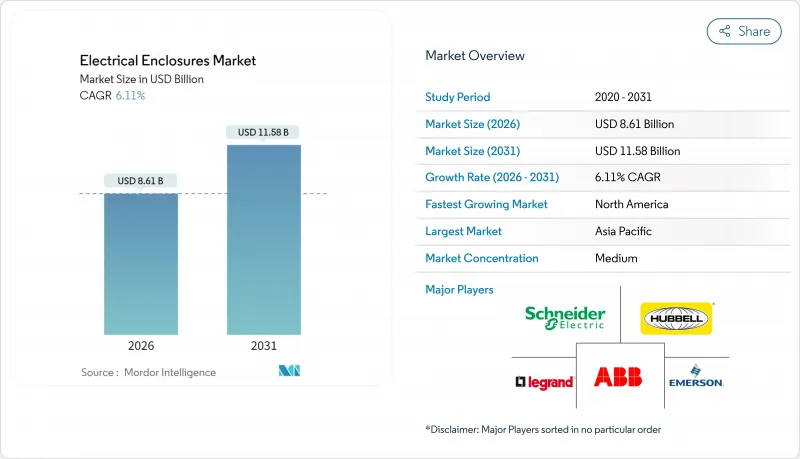
预计到 2025 年,电气外壳市场价值将达到 81.1 亿美元,从 2026 年的 86.1 亿美元成长到 2031 年的 115.8 亿美元,在预测期(2026-2031 年)内,复合年增长率将达到 6.11%。
随着公用事业公司、工厂和通讯业者配备感测器、边缘处理器和无线模组的智慧机柜取代传统机壳,市场需求正在加速成长。电力产业的快速扩张、5G 的兴起以及交通运输的电气化,都保持了强劲的订单週期;同时,紫外线稳定聚碳酸酯和玻璃纤维等材料的创新,有效解决了腐蚀、散热和重量等难题。供应商正透过模组化、温度控管和工业物联网 (IIoT) 连接来打造差异化优势,并积极寻求策略併购,专注于资料中心、可再生能源和电网现代化等细分领域。
全球电气外壳市场趋势与洞察
加速可再生能源设施的扩张
公用事业规模的太阳能和离岸风力发电指定使用防护等级为 IP67/IP68 的机柜,这些机柜能够承受盐雾、超过 1000 W/m² 的紫外线辐射以及超过 70°C 的内部温度。主动冷却、突波保护和整合通讯模组是太阳能汇流箱、逆变器外壳和电池储能配电盘的基本要求。符合 IEC 61215 和 UL 1741 标准指导机柜设计,并增强电弧故障侦测和绝缘追踪功能,以确保安全并网。
工业自动化和工业4.0的扩展
数位化化工厂将振动、湿度和温度感测器直接整合到开关设备中,从而将非计划性停机时间减少高达 82%。随着边缘伺服器从控制室转移到现场,机柜必须能够散发更高的热负荷。面板内部温度每升高 10°C,故障风险就会增加一倍。模组化框架和快速安装导轨系统可以实现快速调整,帮助汽车、电子和食品製造商适应订单策略。
原物料价格波动
能源成本飙升和出口限制导致铝材溢价在2024年上涨10%,挤压机壳毛利率,并促使厂商签订双重采购协议。不銹钢附加费与镍价波动挂钩,迫使原始设备製造商(OEM)在300毫米以上的机柜中转向使用玻璃纤维增强塑料和聚碳酸酯。外汇波动进一步加剧了成本计算的复杂性,导致厂商采用准时制库存管理和在多年合约中加入价格调整条款。
细分市场分析
到2025年,金属外壳在机壳。碳钢是工厂自动化领域的主流材料,而316L不銹钢则是食品、製药和海洋环境领域的主流材料。非金属外壳市场规模预计将以7.98%的复合年增长率成长,超过整体市场成长速度,因为聚碳酸酯具有IK10抗衝击等级和25年抗紫外线性能,而成本约为不銹钢的三分之一。玻璃纤维增强聚酯材料因其良好的可塑性和耐化学性,将在300mm x 300mm以上的机柜市场占据主导地位,而铝材将满足铁路和航太产业对轻量化的需求。
聚碳酸酯箱体整合透明盖,方便目视检查,并采用正在申请专利的铰链链卡扣,可将组装时间缩短 40%。玻璃纤维的介电强度使其可在带电作业,且无需接地装置。不銹钢在卫生应用领域仍占据主导地位,其无焊接接缝和光滑的 4 号表面可抑制细菌滋生。供应商正竞相研发新一代阻燃树脂和生物基复合复合材料,以便在不影响性能的前提下减少生命週期排放。
预计到2025年,壁挂式机柜将在分散式控制迴路和建筑自动化终端市场占据46.20%的收入份额。然而,随着设施扩建和资料中心需求的成长,电气外壳市场正转向落地式机架,其复合年增长率(CAGR)高达7.51%,这主要得益于超大规模业者采用承重能力达3500磅的通道封闭式机架。模组化底座允许电缆从各个方向接入,抗震套件符合加州和日本4区抗震标准。
电线杆和地面安装设备支援电錶、电动车充电器和 5G 节点,并采用粉末涂层铝製机壳和防破坏锁。地下安装式设备专为郊区电网设计,透过将开关设备隐藏在地面盖板下,保持街道景观的美观。製造商正在推广快速摇摆门和 180 度铰链,即使在狭窄的通道中,也能让技术人员畅通无阻地维护设备。
区域分析
北美地区将占2025年总收入的38.10%,这主要得益于美国老旧开关设备的更换以及为加强电网网路安全防护所做的努力。联邦政府资助的智慧电网部署计画强制要求采用符合IEEE 1613标准的机壳级入侵侦测和突波保护装置。在加拿大,面临-40°C严寒冬季的采矿、液化天然气和风电发电工程,由于玻璃纤维和双层钢具有优异的隔热性能,因此更倾向于使用这两种材料。
亚太地区将以7.22%的复合年增长率实现最快增速,各国政府在输电走廊、半导体製造厂和高速铁路领域的投资超过3兆美元。中国正逐步淘汰焊接钢箱,转而采用智慧化的、配备丰富感测器的配电柜,并将其接入变电站的数位双胞胎。印度的智慧城市规划将33千伏环路开关与可抵御季风洪水的垫片安装式组合控制亭结合。东南亚正积极推动电子製造业的转移,因此对能够承受90%相对湿度的不銹钢控制设备的订单大幅成长。
在欧洲,离岸风电、氢能和工厂自动化计画正稳步推进。德国在工业4.0应用方面主导,已将状态监测功能整合到Rittal VX系列机架中。北欧公用事业公司要求使用配备硅胶加热器和透气亲水通风口的耐寒外壳。欧盟网路安全法规要求原始设备製造商(OEM)在控制面板门中整合安全启动和防篡改记录功能,这增加了认证的复杂性。
其他福利:
- Excel格式的市场预测(ME)表
- 3个月的分析师支持
目录
第一章 引言
- 研究假设和市场定义
- 调查范围
第二章调查方法
第三章执行摘要
第四章 市场情势
- 市场概览
- 市场驱动因素
- 可再生能源的快速发展
- 工业自动化和工业4.0的扩展
- 电网现代化与变电站维修
- 更严格的全球安全和防尘/防水标准
- 户外5G小型基地台部署需要IP防护等级的外壳。
- 用于预测性维护的智慧物联网机壳
- 市场限制
- 原物料价格(钢铁、铝)波动
- 密封完整性和温度控管故障
- 网路机壳中的网路攻击风险
- 客製化製造业技术纯熟劳工短缺
- 产业价值链分析
- 监管环境
- 技术展望
- 波特五力分析
- 新进入者的威胁
- 买方的议价能力
- 供应商的议价能力
- 替代品的威胁
- 竞争对手之间的竞争
第五章 市场规模与成长预测
- 材料
- 金属(碳钢、不锈钢、铝)
- 非金属材质(聚碳酸酯、玻璃纤维增强塑胶、聚酯、ABS树脂)
- 按安装类型
- 壁挂式
- 落地式/独立式
- 地下安装类型/地上安装类型
- 桿式安装型
- 按外形规格
- 小型(小于10公升)
- 紧凑型(10-50公升)
- 均码/大尺寸(50公升或以上)
- 模组化/可配置系统
- 按最终用户行业划分
- 能源与电力
- 石油和天然气
- 工业製造与机器人
- 金属和采矿
- 交通运输(铁路、公路、航空、电动车充电)
- 资料中心和电信
- 食品、饮料和药品
- 按地区
- 北美洲
- 美国
- 加拿大
- 南美洲
- 巴西
- 阿根廷
- 其他南美洲
- 欧洲
- 德国
- 英国
- 法国
- 义大利
- 西班牙
- 其他欧洲地区
- 亚太地区
- 中国
- 日本
- 印度
- 韩国
- 亚太其他地区
- 中东
- 阿拉伯聯合大公国
- 沙乌地阿拉伯
- 其他中东地区
- 非洲
- 南非
- 其他非洲地区
- 北美洲
第六章 竞争情势
- 市场集中度
- 策略趋势
- 市占率分析
- 公司简介
- Schneider Electric SE
- ABB Ltd.
- Eaton Corporation plc
- nVent Electric plc(Hoffman and Schroff)
- Rittal GmbH and Co. KG
- Emerson Electric Company
- Hubbell Incorporated
- Pentair plc
- Legrand SA
- Hammond Manufacturing Ltd.
- AZZ Inc.
- Adalet(Scott Fetzer Company)
- Allied Moulded Products, Inc.
- Fibox Oy Ab
- Eldon Holding AB
- Siemens AG
- General Electric Company
- Saginaw Control and Engineering
- BOXCO Co., Ltd.
- Nitto Kogyo Corp.
- Socomec Group SA
- Bison ProFab Inc.
- Integra Enclosures Inc.
- Austin Electrical Enclosures
- ITS Enclosures(Builder's Service Company)
第七章 市场机会与未来展望
The electrical enclosures market was valued at USD 8.11 billion in 2025 and estimated to grow from USD 8.61 billion in 2026 to reach USD 11.58 billion by 2031, at a CAGR of 6.11% during the forecast period (2026-2031).
Demand accelerates as utilities, factories and telecom providers replace legacy cabinets with intelligent housings that host sensors, edge processors and wireless modules. Rapid power-sector build-outs, 5G densification and the electrification of transportation keep ordering cycles robust, while material innovations such as UV-stabilized polycarbonate and fiberglass address corrosion, thermal and weight challenges. Vendors differentiate through modularity, thermal management and IIoT connectivity, driving strategic mergers focused on data-center, renewable-energy and grid-modernization niches.
Global Electrical Enclosures Market Trends and Insights
Accelerating Renewable-Energy Build-Out
Utility-scale solar and offshore-wind farms specify IP67/IP68 cabinets that tolerate salt spray, UV irradiance above 1,000 W/m2 and internal temperatures surpassing 70 °C. Active cooling, surge protection and integrated communication modules are now baseline requirements for photovoltaic combiner boxes, inverter housings and battery-energy-storage switchboards. Compliance with IEC 61215 and UL 1741 standards guides enclosure designs toward enhanced arc-fault detection and insulation tracking, supporting safe grid interconnection.
Industrial Automation and Industry 4.0 Expansion
Digitized plants embed vibration, humidity and temperature sensors directly in switchgear to cut unplanned downtime by up to 82%. As edge servers migrate from control rooms to the shop floor, cabinets must dissipate higher heat loads; every 10 °C rise inside a panel doubles outage risk. Modular frames and quick-mount rail systems enable rapid re-tooling, helping automotive, electronics and food producers align with make-to-order strategies.
Raw-Material Price Volatility
Aluminum premiums rose 10% in 2024 amid energy-cost spikes and export curbs, squeezing enclosure gross margins and prompting dual-sourcing pacts. Stainless-steel surcharges track nickel swings, pushing OEMs toward fiberglass and polycarbonate for cabinets exceeding 300 mm dimensions. Currency gyrations further complicate costing, prompting just-in-time inventories and price-adjustment clauses in multiyear framework deals.
Other drivers and restraints analyzed in the detailed report include:
- Grid-Modernization and Substation Retrofits
- Stricter Global Safety and Ingress-Protection Codes
- Seal-Integrity and Thermal-Management Failures
For complete list of drivers and restraints, kindly check the Table Of Contents.
Segment Analysis
Metallic housings retained 74.15% of electrical enclosures market share in 2025, anchored by carbon steel in factory automation and 316L stainless in food, pharma and marine environments. The electrical enclosures market size for non-metallic alternatives is projected to grow at an 7.98% CAGR, outpacing the overall curve as polycarbonate delivers IK10 impact ratings and 25-year UV endurance at roughly one-third the cost of stainless. Fiberglass-reinforced polyester dominates cabinets larger than 300 mm X 300 mm thanks to moldability and chemical resistance, while aluminum addresses rail and aerospace weight targets.
Polycarbonate boxes integrate transparent lids for visual inspection and patent-pending hingeless snaps that cut assembly time by 40%. Fiberglass' dielectric strength supports live-line work, eliminating grounding hardware. Stainless continues to command hygienic applications where weld-less seams and smooth #4 finishes deter bacterial growth. Vendors compete on next-generation flame-retardant resins and bio-based composites that reduce lifecycle emissions without sacrificing performance.
Wall-mounted cabinets captured 46.20% revenue in 2025 for distributed control loops and building automation endpoints. Facility expansions and data centers, however, are driving the electrical enclosures market toward floor-standing racks, forecast to post a 7.51% CAGR as hyperscale operators adopt aisle-containment frames with 3,500-lb load ratings. Modular base plinths enable cable entry from any side, while seismic kits satisfy Zone 4 requirements in California and Japan.
Pole- and pad-mounted variants support utility metering, EV chargers and 5G nodes, combining powder-coated aluminum shells with vandal-proof locks. Underground housings serve suburban distribution networks, hiding switchgear beneath grade-level lids to preserve streetscape aesthetics. Manufacturers push quick-swing doors and 180-degree hinges that let technicians service gear without obstruction in cramped corridors.
The Electrical Enclosures Market Report is Segmented by Material (Metallic, and Non-Metallic), Mounting Type (Wall-Mounted, Floor-mounted/Free-standing, and More), Form Factor (Small [Less Than or Equal To 10L], Compact [10-50L], and More), End-User Industry (Energy and Power, Oil and Gas, Industrial Manufacturing and Robotics, Metals and Mining, and More), and Geography. The Market Forecasts are Provided in Terms of Value (USD).
Geography Analysis
North America accounted for 38.10% of 2025 revenue, led by United States initiatives to replace aging switchgear and harden grids against cyber threats. Federal funding drives smart-grid rollouts that specify enclosure-level intrusion detection and IEEE 1613-rated surge protection. Canada adds demand from mining, LNG and wind projects that face -40 °C winters, favoring fiberglass and double-wall steel for thermal buffering.
Asia-Pacific will register the quickest 7.22% CAGR as governments channel more than USD 3 trillion into transmission corridors, semiconductor fabs and high-speed rail. China transitions from welded sheet-metal boxes to intelligent, sensor-rich cabinets that feed substation digital twins. India's smart-city plans couple 33-kV ring-main units with pad-mounted composite kiosks capable of resisting monsoon floods. Southeast Asia absorbs relocated electronics manufacturing, lifting orders for stainless controls that endure 90% relative humidity.
Europe advances steadily on offshore-wind, hydrogen and factory-automation programs. Germany leads Industry 4.0 adoption, embedding condition monitoring in Rittal VX series racks. Nordic utilities request cold-climate enclosures that deploy silicon heaters and breathable hydrophilic vents. The EU Cyber-Resilience Act pushes OEMs to embed secure boot and tamper logging at the panel door, elevating certification complexity.
- Schneider Electric SE
- ABB Ltd.
- Eaton Corporation plc
- nVent Electric plc (Hoffman and Schroff)
- Rittal GmbH and Co. KG
- Emerson Electric Company
- Hubbell Incorporated
- Pentair plc
- Legrand SA
- Hammond Manufacturing Ltd.
- AZZ Inc.
- Adalet (Scott Fetzer Company)
- Allied Moulded Products, Inc.
- Fibox Oy Ab
- Eldon Holding AB
- Siemens AG
- General Electric Company
- Saginaw Control and Engineering
- BOXCO Co., Ltd.
- Nitto Kogyo Corp.
- Socomec Group SA
- Bison ProFab Inc.
- Integra Enclosures Inc.
- Austin Electrical Enclosures
- ITS Enclosures (Builder's Service Company)
Additional Benefits:
- The market estimate (ME) sheet in Excel format
- 3 months of analyst support
TABLE OF CONTENTS
1 INTRODUCTION
- 1.1 Study Assumptions and Market Definition
- 1.2 Scope of the Study
2 RESEARCH METHODOLOGY
3 EXECUTIVE SUMMARY
4 MARKET LANDSCAPE
- 4.1 Market Overview
- 4.2 Market Drivers
- 4.2.1 Accelerating renewable-energy build-out
- 4.2.2 Industrial automation and Industry 4.0 expansion
- 4.2.3 Grid-modernization and substation retrofits
- 4.2.4 Stricter global safety and ingress-protection codes
- 4.2.5 Outdoor 5G small-cell rollout needing IP-rated housings
- 4.2.6 Smart, IoT-enabled enclosures for predictive maintenance
- 4.3 Market Restraints
- 4.3.1 Raw-material price volatility (steel, aluminium)
- 4.3.2 Seal-integrity and thermal-management failures
- 4.3.3 Cyber-attack risk in connected enclosures
- 4.3.4 Skilled-labour shortage for custom fabrication
- 4.4 Industry Value Chain Analysis
- 4.5 Regulatory Landscape
- 4.6 Technological Outlook
- 4.7 Porter's Five Forces Analysis
- 4.7.1 Threat of New Entrants
- 4.7.2 Bargaining Power of Buyers
- 4.7.3 Bargaining Power of Suppliers
- 4.7.4 Threat of Substitute Products
- 4.7.5 Intensity of Competitive Rivalry
5 MARKET SIZE AND GROWTH FORECASTS (VALUE)
- 5.1 By Material
- 5.1.1 Metallic (Carbon Steel, Stainless Steel, Aluminum)
- 5.1.2 Non-metallic (Polycarbonate, Fiberglass, Polyester, ABS)
- 5.2 By Mounting Type
- 5.2.1 Wall-mounted
- 5.2.2 Floor-mounted / Free-standing
- 5.2.3 Underground / Pad-mounted
- 5.2.4 Pole-mounted
- 5.3 By Form Factor
- 5.3.1 Small (Less than or Equal to 10 L)
- 5.3.2 Compact (10-50 L)
- 5.3.3 Free-size / Full-size (Above 50 L)
- 5.3.4 Modular / Configurable systems
- 5.4 By End-user Industry
- 5.4.1 Energy and Power
- 5.4.2 Oil and Gas
- 5.4.3 Industrial Manufacturing and Robotics
- 5.4.4 Metals and Mining
- 5.4.5 Transportation (Rail, Road, Air, EV-charging)
- 5.4.6 Data Centres and Telecom
- 5.4.7 Food and Beverage and Pharmaceuticals
- 5.5 By Geography
- 5.5.1 North America
- 5.5.1.1 United States
- 5.5.1.2 Canada
- 5.5.2 South America
- 5.5.2.1 Brazil
- 5.5.2.2 Argentina
- 5.5.2.3 Rest of South America
- 5.5.3 Europe
- 5.5.3.1 Germany
- 5.5.3.2 United Kingdom
- 5.5.3.3 France
- 5.5.3.4 Italy
- 5.5.3.5 Spain
- 5.5.3.6 Rest of Europe
- 5.5.4 Asia-Pacific
- 5.5.4.1 China
- 5.5.4.2 Japan
- 5.5.4.3 India
- 5.5.4.4 South Korea
- 5.5.4.5 Rest of Asia-Pacific
- 5.5.5 Middle East
- 5.5.5.1 United Arab Emirates
- 5.5.5.2 Saudi Arabia
- 5.5.5.3 Rest of Middle East
- 5.5.6 Africa
- 5.5.6.1 South Africa
- 5.5.6.2 Rest of Africa
- 5.5.1 North America
6 COMPETITIVE LANDSCAPE
- 6.1 Market Concentration
- 6.2 Strategic Moves
- 6.3 Market Share Analysis
- 6.4 Company Profiles (includes Global level Overview, Market level overview, Core Segments, Financials as available, Strategic Information, Market Rank/Share, Products and Services, Recent Developments)
- 6.4.1 Schneider Electric SE
- 6.4.2 ABB Ltd.
- 6.4.3 Eaton Corporation plc
- 6.4.4 nVent Electric plc (Hoffman and Schroff)
- 6.4.5 Rittal GmbH and Co. KG
- 6.4.6 Emerson Electric Company
- 6.4.7 Hubbell Incorporated
- 6.4.8 Pentair plc
- 6.4.9 Legrand SA
- 6.4.10 Hammond Manufacturing Ltd.
- 6.4.11 AZZ Inc.
- 6.4.12 Adalet (Scott Fetzer Company)
- 6.4.13 Allied Moulded Products, Inc.
- 6.4.14 Fibox Oy Ab
- 6.4.15 Eldon Holding AB
- 6.4.16 Siemens AG
- 6.4.17 General Electric Company
- 6.4.18 Saginaw Control and Engineering
- 6.4.19 BOXCO Co., Ltd.
- 6.4.20 Nitto Kogyo Corp.
- 6.4.21 Socomec Group SA
- 6.4.22 Bison ProFab Inc.
- 6.4.23 Integra Enclosures Inc.
- 6.4.24 Austin Electrical Enclosures
- 6.4.25 ITS Enclosures (Builder's Service Company)
7 MARKET OPPORTUNITIES AND FUTURE OUTLOOK
- 7.1 White-space and Unmet-need Assessment

 电气外壳市场:按类型、安装配置、材质、最终用途产业和应用划分-2026-2032年全球市场预测电气柜及外壳市场:依材质、防护等级、额定电压、产品类型及最终用户产业划分-2026-2032年全球市场预测全球机柜冷却器市场按类型、冷却能力、机柜类型、安装方式、最终用途产业和分销管道划分,2026-2032年预测
 印度电气外壳市场:市场占有率分析、产业趋势与统计、成长预测(2026-2031)美国电气机壳:市场份额分析、产业趋势与统计、成长预测(2026-2031)
 电气外壳市场规模、份额、成长及全球产业分析:按类型、应用和地区划分,并提供 2026-2034 年的洞察和预测
 2026年全球电气外壳市场报告不銹钢烘干柜市场按产品类型、材质等级、容量、价格范围、应用、终端用户产业和分销管道划分-2026-2032年全球预测电池外壳及机柜市场(依产品类型、安装类型、材料、电池类型、最终用户和应用划分)-全球预测,2026-2032年
 塑胶外壳市场规模、份额和成长分析(按应用、最终用途产业、材质、配置类型、产业标准和地区划分)-2026-2033年产业预测